
Micheline Lee, Lifeboat: Disability, Humanity and the NDIS (Quarterly Essay 91, 2023) – plus correspondence in Quarterly Essay 92
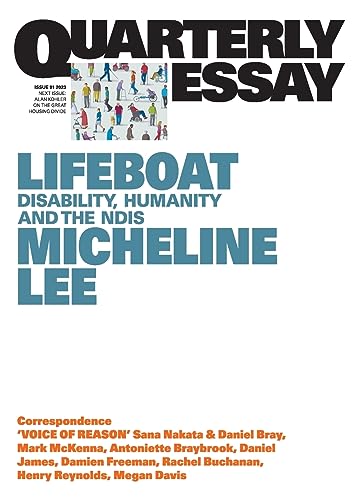
Micheline Lee is a novelist. In this Quarterly Essay and in her reply to correspondents in the following one, she demonstrates that she is a master of the killer last line. The essay ends with a personal story. When she was eighteen, anxious at the prospect of becoming increasingly disabled, she went travelling in Europe and Africa alone, without any support:
I remember Kamanja, a man I met in Kenya. He was one of many people who came my way and helped me through, who pushed me in my wheelchair and carried me when I was at a low ebb and battered. I started to thank him. He held out his hand for me to stop. ‘I help you because you need help,’ he said.
(Page 59)
Her reply to correspondents ends with a reference to Ann Marie Smith, who died in Adelaide in 2020 after years of extreme neglect while on a full time care plan with the NDIS:
If Ann Marie Smith had had one friend in the world, the abuse she suffered over three years that finally took her life would not have happened.
(Quarterly Essay 92: The Great Divide by Alan Kohler, page 122)
The essay lays out the origins of the National Disability Insurance Scheme, its underlying principles and goals, and the massive faults in its implementation, but it also offers sharp insights into lived experiences of disability – and the overwhelming importance of meaningful human connection.
The medical, or individual, model of disability defines disability as individual deficit or tragedy. The social model ‘demonstrates that the problems people with disabilities face are the result of exclusion and social and environmental barriers’. The activists whose lobbying led to the creation of the NDIS were proponents of the social model. The NDIS was intended to serve the needs of people who otherwise could not participate in society, and was to be one part of a whole ecosystem of support for people with disabilities.
The scheme was legislated in the last days of the Gillard Labor government, but it’s implementation took place under successive Coalition governments. Micheline Lee refrains from pointing the finger of blame, but she describes the way the rest of the ecosystem failed to materialise, much of the support that previously existed dried up as the NDIS was seen to be the only game in town, a narrowly market-based system was established that meant the ‘participants’ in the scheme have to negotiate complex application processes and regular reassessments of their disabilities. The individual model of disability reasserted itself in an economic rationalist environment.
My blog practice is to have a closer look at a single page. Usually it’s page 76 (my age). As there is no page 76 in this essay, I’ll talk about page 47 (I was born in 1947). As it happens, it’s a brilliant example of the feature of the essay that makes it not just informative but engrossing. Along with the trenchant analysis of the system, its potential transformative value and its actual flaws, the essay contains many startling glimpses of the realities of life with a disability, always in the service of the argument.
Page 47 is part of the longest of these glimpses. Micheline is travelling by plane to a writers’ festival. She decides to travel without a support worker because it would cost the NDIS 14 hours of the worker’s time, and she would have to pay their return air fare. Her preferred airline refuses to take her without a carer. The more expensive airline that will take her does so on a much longer flight, but she calculates that even with an hour’s delay she can hold off going to the toilet, which would raise impossible logistic difficulties. She arrives at security at Melbourne airport, and asks the officer if he could help lift her bag off the back of her wheelchair onto the screening table:
‘Where’s your carer?’ he asked. I told him I was travelling alone.
‘You should have a carer to help you with that,’ he said. I was taken aback; in the past, airport staff had always helped. The woman behind me in the queue muttered, ‘Unbelievable,’ and lifted my bag onto the belt. I could have kissed her.
Next, I met the wheelchair assistance officer at the boarding gate, and he asked me where my carer was. And similarly, on the plane, the fight attendant asked, ‘Who’s assisting you?’
The story continues:
I arrive at Sydney airport only to find that the connecting flight has been cancelled and the next one is four hours later. My heart starts pumping faster. I ask the airline assistant who is pushing me in an aircraft wheelchair if he can bring my electric wheelchair to me. He makes a call, then tells me that all the luggage needs to stay on the plane.
‘My wheelchair is not luggage,’ I cry out. ‘I can’t move without my wheelchair.’ The chair I am strapped into is what the airline uses to fit between the aisles in the aeroplane. It’s a thin wedge of a chair that is hard for me to balance on and you can’t push it yourself. He parks me on a square of carpet with a wheelchair symbol on it some distance from the service desk and the customer seating area. He tells me he’ll let them know at the service desk that I want my wheelchair. ‘Can you take me over so I can speak with them myself?’ I ask, but he has already walked off.
An hour later:
It’s a new person at the service desk now and I call out to get her attention. She is busy with customers and doesn’t hear. I call out to passengers passing by but they don’t look my way.
Reflecting on the episode o the next page, Micheline acknowledges that it wasn’t just the expense that made her decide to travel solo:
It has more to do with protest. I don’t want the NDIS to take the focus off the need for society to be more inclusive.
It’s not a tragic story, like that of Ann Marie Smith who was confined to the same woven chair for over a year, but in this one the readers are implicated. Would I be one of those passengers passing by, or would I be the woman who mutters, ‘Unbelievable’?
The essay, in the end, isn’t an account of another bureaucratic stuff-up like Robodebt that we can shake our outraged heads over. It’s a passionate, articulate appeal to our common humanity.
The correspondents in QE 92 include the current Minister for the NDIS, a commissioner of the recently concluded Royal Commission into Violence, Abuse, Neglect and Exploitation of People with Disabilities, and a number of disability activists. Often the Quarterly Essay correspondence includes argumentation, or correction, or defensiveness. Not here. These writers reinforce the essay’s account of things, coming from a range of perspectives and a range of lived experience. Taken together with the essay and Micheline Lee’s ‘Response to Correspondence’ they make a compelling case for change.


 Me fail? I fly!