Monthly Archives: Feb 2024

Katzuko Yamamoto’s Litto

Katzuko Yamamoto, Litto (©2020, translation by Junko Ishii Blades & Peter Cummins, Monomori Books 2023)

This is a sweet Japanese children’s story about the power of innocence.

Litto is a little dog (I believe ‘litto’ is a Japanese rendition of the English ‘little’), whose naive kindness wins through in a series of dangerous encounters – not only enabling him to escape but giving rise to transformations in his would-be attackers and captors. The book is illustrated by the author with line drawings that perfectly match the charming simplicity of the tale.

The story is accompanied by two essays explaining that it was inspired by the late Kazuo Murakami, an eminent geneticist who came to believe that the enormous complexity of human genes and DNA implies the existence of what he calls ‘Something Great’ guiding the course of events. In the book, this Something Great is called Gashuda. In an essay here, ‘Living in gratitude to Something Great’, he discusses the Covid pandemic, and to my mind comes dangerously close to saying that a positive mental attitude will protect from it. Certainly he argued, with evidence, that human genes can be ‘awakened’ to dramatic effect by mental and emotional factors.

Though I’m happy to be alerted to Professor Murakami’s work, and now have his book The Divine Code of Life on my radar, I can’t help feeling that Litto would have worked better as a book without the earnest weight of its supporting material.

Page 76 provides a taste of the writing. Litto has found a loving home with a girl named Ollie and her mother, a baker whose secret is that she always bakes with love:

One day, a lot of orders for bread came to Ollie’s mum.
The director of a large hospital in the city had heard of the bread, and he wanted all the patients to eat the Mother’s delicious bread.
Normally Ollie’s mum wouldn’t accept such large orders because she couldn’t bake so many loaves at one time. But she felt very grateful when she heard the director’s plan to give the patients her bread. She was passionately motivated by his thinking and really wanted all the hospital patients to eat her bread.
The Mother started making bread from the day before the bread was to be delivered. Putting her prayers into each of them, she kneaded the loaves carefully one by one.
She put her heart into the work while imagining the smiles of the people who would eat it. By the time the last loaf was baked, the sun had begun to rise. She delivered the bread to the hospital without delay.

The patients report that the bread is delicious and immediately begin to feel better. And soon Litto is reaching out to all the humans and animals he has influenced, enlisting them in a communal project to relieve the suffering of people in lockdown by distributing loaves of Ollie’s mum’s bread.

Sadly I didn’t manage to try out the book with its intended readership. My three-year-old grandson lost interest after half a page (there are no trucks!), and the six-year-old is currently far too busy exercising her newly developed reading skills (mainly on the Billy B Brown books) to tolerate being read to, unless it’s Harry Potter.

Two very slim volumes by Annie Ernaux

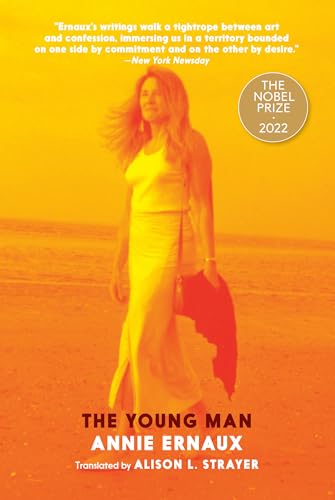
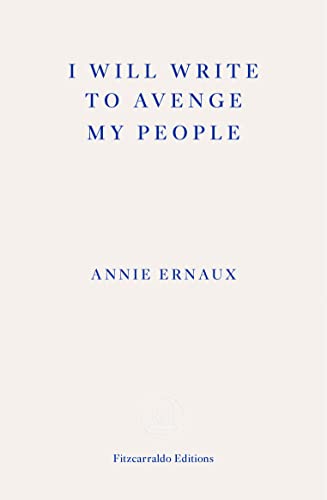
My family still give each other far too many presents at Christmas, but I’m not complaining. Among the many thoughtful gifts I received recently were these two tiny books by Annie Ernaux. The first is the story of a sexual relationship the writer had with a much younger man when she was in her mid 50s; the second is the text of her Nobel Lecture, delivered in Stockholm in December 2022. Each of them includes about 20 pages of supplementary material, with a lot of overlap between the books: photographs, a ten-page self-written biography, praise for Ernaux’s other books. They’re clearly designed to catch impulse buyers at the till, but they are written by the incomparable Annie Ernaux and I love them.

Neither book has a page 76, or even a page 47, so my usual arbitrary blogging practice is stymied.


The Young Man (Le jeune homme © 2022, translated by Alison L Strayer, Seven Stories Press 2023)

Page 7 of The Young Man is its epigraph:

If I don’t write things down, they
haven’t been carried through to completion,
they have only been lived.

Which captures perfectly the nature of this book. It serves to complete a strangely inconclusive episode in the writer’s life.

Dates at the end of the text indicate that it was written over a span of time, from 1998 to 2000, perhaps immediately after the relationship ended, and then prepared for publication – rewritten? – in 2022. It shows the signs of both dates. There’s the freshness of description of, say, sleeping together in his cold student flat, or of feeling the gaze of other people when they lie on the beach together, a gaze that neither of them would have attracted solo. And then there are reflections that have had time to mature:

In more than one domain – literature, theatre, bourgeois customs – I was his initiator, but the things I experienced because of him were also initiatory. My main reason for wanting our story to continue was that, in a sense, it was already over and I was a fictional character within it.

(page 28)

After that last comment, she continues: ‘I was aware that this entailed a kind of cruelty towards this younger man who was doing things for the first time.’

There are at least two high-profile fictional works around at the moment in which an older woman has a sexual ‘affair’ with a boy, Ian McEwan’s novel The Lessons and Todd Haynes’s movie May December. This is not that. This unnamed young man was in his twenties, and Annie Ernaux was not his teacher. There is no question of criminality, but some of the same ethical issues arise. She was an admired cultural figure to whom he could barely speak when they first met in person. She does not spare herself in the writing, but nor does she rush to judgement. As that tiny excerpt illustrates, class is always an issue, and there is a constant sense of the feedback loop between her life and her art.

The copious photos that the publishers have included to make up a decent number of pages attest to the fact that she was, and is, gorgeous. The young man didn’t love her just to learn bourgeois customs.


I will write to avenge my people (©2023, translated by Alison L Strayer, Fitzcarraldo Press 2023)

The title of Ernaux’s Nobel lecture comes from something she wrote in her diary in her early 20s: ‘J’écrirai pour venger ma race.‘ She expands on this sentence in the lecture:

I proudly and naively believed that writing books, becoming a writer, as the last in a line of landless labourers, factory workers and shopkeepers, people despised for their manners, their accent, their lack of education, would be enough to redress the social injustice linked to social class at birth.

(page 12)

The lecture traces the way she moved away from this goal, until she was brought back to it ‘through byroads that were unseen and proximate’. And it explains beautifully her central preoccupation with telling intimate stories from her own life (The Young Man among them):

This is how I conceived my commitment to writing, which does not consist of writing ‘for’ a category of readers, but in writing ‘from’ my experience as a woman and an immigrant of the interior; and from my longer and longer memory of the years I have lived, and from the present, an endless provider of the images and words of others. This commitment through which I pledge myself in writing is supported by the belief, which has become a certainty, that a book can contribute to change in private life, help to shatter the loneliness of experiences endured and repressed, and enable beings to reimagine themselves.
When the unspeakable is brought to light, it is political.

(pages 19-20)

(Alison L Strayer has rendered both this lecture and The Young Man into impeccable English. I do wonder, though, whether ‘internal migrant’ might have been better than ‘immigrant of the interior’. I haven’t read the original, but I believe Ernaux is referring to her ‘migration’ from rural working class to the lettered bourgeoisie as opposed to migration between countries.)

There’s a lot more. If you see this little book on the front counter as you’re leaving a bookshop, let yourself be tempted.

Jennifer Maiden’s China Shelf, page 47

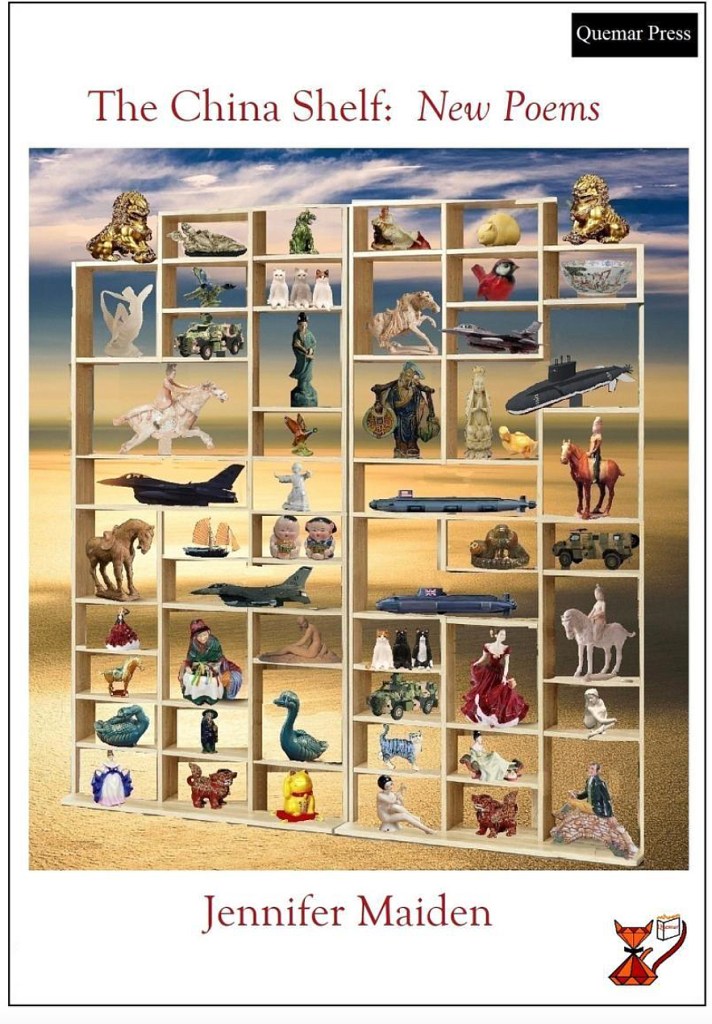
Jennifer Maiden, The China Shelf: New Poems (Quemar Press 2024)

Jennifer Maiden and her daughter Katharine Margot Toohey, publisher of Quemar Press, have been doing a literary highwire act for years: a cover image of a future book and its general theme are announced early in the year, sample poems uploaded as they are written, and then the book appears at the beginning of January the next year. They did it again in 2023.

Beginning early last year, Quemar Press uploaded an image of the cover of The China Shelf and 11 ‘sample poems’. Each of the poems was freshly written when uploaded, and very much of its moment: July’s poem referred to talk of Julian Assange at an Ausmin Conference (press report here, poem here); August’s to the US’s alleged demand that Imran Khan be removed as PM of Pakistan (press report here, poem here); and so on. We were seeing the project being created in real time – its contents determined by world events, and the collection as a whole relating thematically to Jennifer Maiden’s china shelf with its figurines that range from cute ceramic cats to model nuclear submarines. Now we have the book itself.

The poems in The China Shelf continue in the mode Jennifer Maiden has made her own: conversational, with unobtrusively musical half-rhymes; featuring fictional or historical characters freshly woken up (most of them familiar from earlier Maiden collections); taking issue with political leaders, mostly from the Labor or Democratic Party side of politics; taking controversial stands on many issues, including sympathy for Putin in his invasion of Ukraine (though there’s not so much that in this collection); making surprising connections between people and events; reflecting on her creative process and arguing with critics and publishers; sometimes gossipy, with flashes of glorious lyricism. You can read the samples at this link.

There’s no page 76 (the page I usually blog about, because it’s my age). My fallback position is page 47 (my birth year). Because the poem that begins there is three pages long, I’m bending my rule to talk about pages 47–49. I apologise in advance if the discussion is a bit laboured – the poem is not.

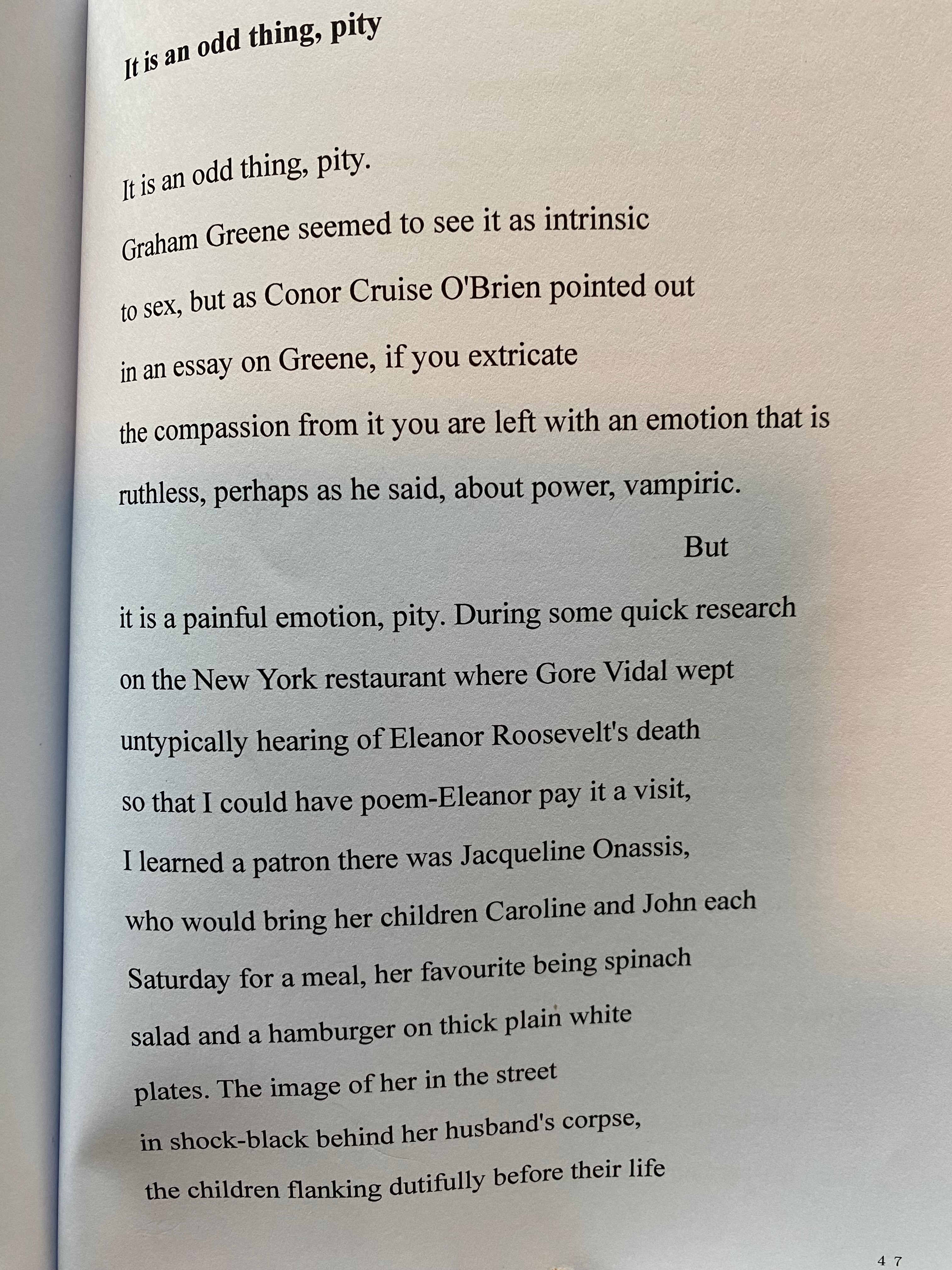
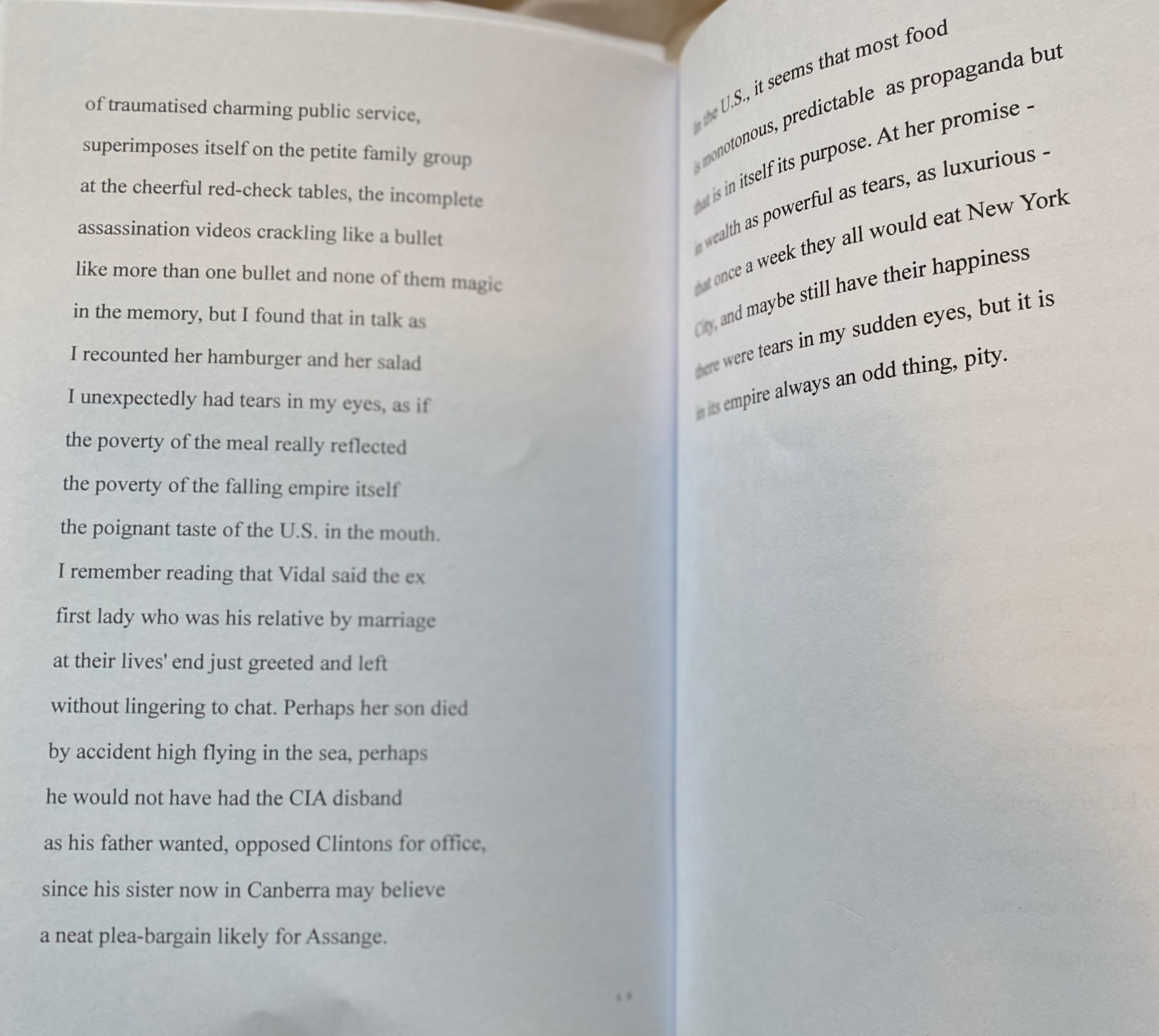
First, here are phone photos, which with any luck will look OK on your device. Click to enlarge.

I probably wouldn’t have chosen ‘It is an odd thing, pity’ to discuss – it doesn’t feature the china shelf, or begin with a character waking up, or reflect on the Australian poetry scene – but it turns out that serendipity is a wonderful thing, and the poem rewards a closer look.

A Study Notes synopsis might go something like this: The poet, while researching a restaurant that is the setting for another poem, discovers that Jackie Onassis took her two children there regularly for hamburgers and salad. She surprises herself by shedding a tear when telling someone about these modest family meals. The poem probes the meaning of those tears.

If you wanted a straightforward enactment of the Study Notes synopsis, you’d be annoyed by the amount of extra clutter in the poem. But (of course) that clutter is what makes the poem interesting.

It starts with a move characteristic of Maiden, an invocation of another writer, in this case Graham Greene, and Conor Cruise O’Brien commenting on him:

It is an odd thing, pity

It is an odd thing, pity.
Graham Greene seemed to see it as intrinsic
to sex, but as Conor Cruise O'Brien pointed out
in an essay on Greene, if you extricate
the compassion from it you are left with an emotion that is
ruthless, perhaps as he said, about power, vampiric.

It’s a long time since I’ve read any Graham Greene, and I have only a vague idea who Conor Cruise O’Brien is. (Change the names, and I could write that sentence about many Maiden poems – not a criticism of her, but an acknowledgement of my own ignorance.) I did a quick internet search, mainly hoping to read a less cryptic version of what Greene and O’Brien said. The search was fruitless, so I’m left where I might have been content to be anyway, finding my own way with the poem.

it turns out that the poem doesn’t need a reader to grasp the paradox of pity as a ruthless emotion, understand the distinction between compassion and pity, or know anything specific about Graham Greene and sex. Greene and O’Brien now depart and are heard no more. The poem has invoked them as a way of announcing that pity is seen as problematic more widely than in this poem. The lines are a kind of paradoxical preface that one expects the rest of the poem to elucidate, or perhaps bounce off.

And bounce it does, with the word ‘But’ on the extreme right on the next line:

______________ __________________________But
it is a painful emotion, pity.

Echoing the opening line, this takes control back from Greene and O’Brien, not so much disagreeing with their thesis as adding another dimension. Pity is not just an objective ‘thing’ to be discussed, but an ’emotion’ to be felt. It might be odd from a philosophical distance, but as lived experience, it’s painful.

Now the narrative proper begins:

it is a painful emotion, pity. During some quick research
on the New York restaurant where Gore Vidal wept
untypically hearing of Eleanor Roosevelt's death
so that I could have poem-Eleanor pay it a visit,
I learned a patron there was Jacqueline Onassis,
who would bring her children Caroline and John each
Saturday for a meal, her favourite being spinach
salad and a hamburger on thick plain white
plates.

That’s all one sentence. There’s no rhyme scheme in this poem, but it’s interesting to notice the music in these lines, helped among other things by the recurring ch sound at the end of lines: ‘research’, ‘each’, ‘spinach’.

The poem has arrived at its central image: Jacqueline Onassis and her children eating a modest meal. As I imagine you know, Jacqueline Onassis, wife of business magnate Aristotle Onassis, was formerly Jackie Kennedy, wife of President John F. Kennedy, who was assassinated in 1963.

The restaurant, as you probably don’t know, is Mortimer’s, a fashionable burger joint (the subject of a memoir, Mortimer’s: Moments in Time by Robin Baker Leacock (2022)). The poem referred to, ‘Eleanor Roosevelt Woke Up in a New York Burger Bar’, appears earlier in the book and is included in the Quemar Press sampler. Gore Vidal makes regular appearances in Maiden’s poems, mainly because Julian Assange was carrying a book by him when forcibly removed from the Ecuadorian embassy in 2019. Maiden’s poems often refer to each other in this way, and the detail of Gore Vidal weeping ‘untypically’ may be a product of another feature of her poetry: the recurring characters (poem-Eleanor is one, poem-Gore is another) tend to take on a life of their own, and here Gore Vidal insists on being more than a passing name-drop. His tears are the first of three lots in the poem.

Picturing Jacqueline Onassis with her children, Maiden’s mind goes to the assassination and the famous footage of Kennedy’s funeral:

plates. The image of her in the street 
in shock-black behind her husband's corpse,
the children flanking dutifully before their life
of traumatised charming public service,
superimposes itself on the petite family group
at the cheerful red-check tables, the incomplete
assassination videos crackling like a bullet
like more than one bullet and none of them magic
in the memory,

‘Shock-black’ demonstrates just how much work a single adjective can do, conjuring up the mood of that famous footage. But it’s now 60 years after the event, and the passage of time adds further superimpositions. The children’s futures are summed up elegantly as lives ‘of traumatised charming public service’. The controversy and conspiracy theories surrounding the assassination (was there more than one shooter? was it a CIA plot?) are thriftily evoked: the videos are incomplete and there may be more than one bullet. (There’s no magic bullet to cure the ills of that moment.)

Now comes another ‘but’, which pulls attention back to the immediate emotional impact, not of the funeral scene, but of the image of the meal:

in the memory, but I found that in talk as 
I recounted her hamburger and her salad
I unexpectedly had tears in my eyes,

Earlier, Gore Vidal wept ‘untypically’. Now the poet’s speaker does so ‘unexpectedly’. Gore, waspish observer of the social scene and sharp political commentator, has a moment of straightforward grief. Maiden, intent on creating complex poem-versions of public figures alive, dead and fictional, has a simple emotional response. You or I might have left it at that – it may be unexpected, but surely it’s not weird to be moved by the image of a recent widow and her orphaned children having a quiet meal: ‘It is a painful emotion, pity.’ But things are rarely simple in a Jennifer Maiden poem, and this one twists off in an unexpected direction:

I unexpectedly had tears in my eyes, as if 
the poverty of the meal really reflected
the poverty of the falling empire itself
the poignant taste of the U.S. in the mouth.

Rather than reflecting, as a lesser poet might have done, that even in the midst of international political events the suffering of a small family can evoke our empathy, Maiden takes a different tack: even a simple empathetic response can be understood in terms of major political movements. The humble meal, it suggests, reflects something about the humbling of US imperialism.

Not everyone will grasp how US imperialism can be seen as ‘falling’. If anything some would say it’s on the verge of exploding and bringing the rest of us down with it, terrifying rather than poignant. But for the poem ‘the poverty of the falling empire’ is a given, not a point of view to be argued for or needing the reader’s agreement.

We now move on to what lay in the future for that ‘petite family’. Gore Vidal is back, this time as a witness:

I remember reading that Vidal said the ex 
first lady who was his relative by marriage
at their lives' end just greeted and left
without lingering to chat. Perhaps her son died
by accident high flying in the sea, perhaps
he would not have had the CIA disband
as his father wanted, opposed Clintons for office,
since his sister now in Canberra may believe
a neat plea-bargain likely for Assange.

The mother became unsociable. The son died in an air crash – with two perhapses reminding us that conspiracy theories also hovered around his death. The daughter is now the US ambassador to Australia. Julian Assange has appeared in many Jennifer Maiden poems, and Caroline’s probable support for ‘a neat plea-bargain’ makes her one of the good guys in Maiden-land.

I don’t understand the ‘since’ in the second-last line there. Again, it feels as if a more detailed argument is being gestured at, but not something to be gone into here – this poem has other fish to fry.

The final lines return to the burger joint:

In the U.S., it seems that most food
is monotonous, predictable as propaganda but
that is in itself its purpose.

In real life, food is probably no more monotonous in the U.S. than anywhere else, but we’re talking about a burger joint – specifically, comfort food in a high-profile burger joint. A crude paraphrase of these lines might be: Propaganda is the McDonalds of the soul. The purpose of monotonous, predictable food is the same as that of comforting, reassuring propaganda: to dull the senses, lower expectations, create a compliant population.

that is in itself its purpose. At her promise – 
in wealth as powerful as tears, as luxurious –
that once a week they all would eat New York
City, and maybe still have their happiness
there were tears in my sudden eyes, but it is
in its empire always an odd thing, pity

Without the ‘clutter’ (that is, without the things that make the poem interesting), this could be paraphrased: ‘It was her promise of this weekly routine meal together, which might enable the three of them to be happy in spite of Kennedy’s death, that brought tears to my eyes.’ That is, the poem’s speaker, aware of the terrible ordeal that this family has gone through and of so much that is yet to come, sees this attempt at reassurance as pitiable.

The line that gives me pause is ‘in wealth as powerful as tears, as luxurious’. The line’s music works beautifully, ‘luxurious’ rhyming with ‘purpose’ and promise’ in the previous line, ‘powerful’ also resonating with ‘promise’, and ‘tears’ and luxurious’ resounding with a kind of end alliteration. Its meaning is not immediately clear. On the one hand, perhaps Onassis’ wealth, power and luxury are enough to outweigh her pain. On the other hand, her promise is made from a position of privilege that makes any tears she sheds a luxury. (I don’t want to make too much of ‘eat New York / City’ as suggesting that the Kennedy’s, specifically these three, were great devourers, as it is may be a typo – though even as a typo it would be a kind of Freudian slip.) In the poem, however, the person who sheds tears isn’t Onassis, but the poem’s speaker, demonstrating that whatever you/she might think about people of power, wealth and privilege, you can surprise yourself by the feeling a straightforward sympathy for them.

The final line brings us back to the start. Yes, pity is complex, but unless I’ve completely missed the point, this particular example is not sexy, ruthless of vampiric. We may even surprise ourselves by weeping tears of pity for those whom we might see as possessing those qualities. I love the phrase ‘in its empire’: pity, which I take to be the way we as humans spontaneous care about each other, has its own empire, which does not bow to any ideology.

Bookblog #65: The Book Group

I originally posted the following to the original version of this blog on 22 April 2004. I’m resurrecting it nearly 20 years later because my book group is currently reading another Sebastian Barry novel.

Sebastian Barry, A Long Long Way (Viking 2005)

Pasted Graphic

I missed the last meeting of my book group, where they discussed, among other things, Barack Obama’s Audacity of Hope and Stephen Carroll’s The Time We Have Taken. I was saved from the embarrassment of admitting that I hadn’t read either of them by an invitation I couldn’t refuse: to see Zack Snyder’s Watchmen with my sons on the giant iMax screen. But I arrived at last night’s meeting with a clear conscience. I had struggled with the first third or so of A Long Long Way.

There’s a huge field out there of First World War novels, and I know some people can’t get enough of them, but the déjà vu was a bit much for me: from Robert Graves’s Goodbye to All That, which I read an awfully long time ago, to Pat Barker’s Regeneration trilogy, they all tell the same monstrous story. The fact that the cover design of my library copy of A Long Long Way uses the same photograph as one of Pat Barker’s books only added to the turn-off. And then there was Sebastian Barry’s prose: not at all a transparent vehicle for the story, but calling attention to itself by its Irish musicality, asking to be read slowly, even aloud. Here’s a random paragraph from the early pages:

Willie Dunne’s father, in the privacy of his policeman’s quarters in Dublin Castle, was of the opinion that Redmond’s speech was the speech of a scoundrel. Willie’s father was in the Masons though he was a Catholic, and on top of that he was a member of the South Wicklow Lodge. It was King and Country he said a man should go and fight for, never thinking that his son Willie would go as soon as he did.

All that repetition and inversion and balance and general quirkiness is beautiful, but when you start reading a novel that’s written in such prose, on a subject you feel may have been done to death, you’re not necessarily enthusiastic.

Resistance proved futile. The subject, I confess, is huge enough to generate a potentially infinite number of novels, each with its own urgency and richness, its own take on things, its own ability to compel. The First World War may yet turn out to be the war to end wars if we can only learn its lessons. There’s a powerful story, well told here, in the situation of the Irish who fought for the King of England in Flanders while their compatriots were battling the forces of the same king in the streets of Dublin. Worse – and I trust completely that Sebastian Barry didn’t make this up – there were Irish recruits among the army units that fired on the Easter Uprising rebels in 1916. The novel tells the story of Willie Dunne, one of those recruits.

There was no controversy at the group. The book had touched us all. Someone said that books such as this were very important to counter the nationalistic garbage that comes at us in Australia as Anzac day approaches, obscuring the reality of modern wars. One guy arrived late, having read the wrong book, Birdsong by the wrong Sebastian, surname Faulks. Apart from giving rise to much merriment, this threw a different light on my déjà vu response: we would mention some detail from ‘our’ book, and he would exclaim, ‘That’s in this one too!’

As an added extra, someone had recently rediscovered a cache of his childhood reading, and gave each of us a comic from the early 1960s. Here’s mine:

war006

Different war, different propaganda.

Posted: Wed – April 22, 2009 at 08:01 AM

Sigrid Nunez’ Vulnerables, page 76

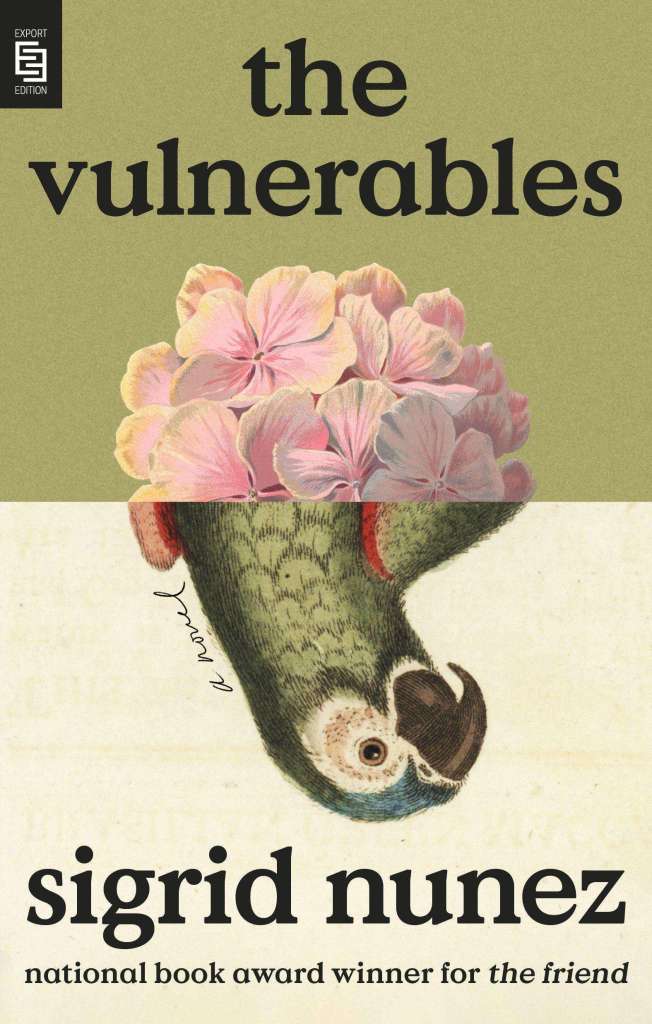
Sigrid Nunez, The Vulnerables (Riverhead Books 2023)

I first heard the notion that there are two Americas articulated at a Sydney Ideas lecture in 2008. Canadian writer Ronald Wright expanded on the idea in his book What Is America? (link is to my blog post), but the simplified version I took away from his lecture is this: there are two competing versions of America, each insisting that it is the true one.

The idea seems to have come into its own in the era of MAGA.

The Vulnerables inhabits one side of the divide. It’s literate, self-aware, alert to issues of class, race and gender – and it’s kind, while just outside the pages of the book the Covid pandemic and forces of violent unreason rage.

The narrator, a woman writer of a certain age who may well be Sigrid Nunez, stays in Manhattan during the worst of the Covid epidemic. Iris, a writer whose publisher is the narrator’s friend, has been stranded in California by travel restrictions, and the narrator agrees to look after Eureka, Iris’s macaw, eventually moving into Iris’s luxurious apartment to do so, lending her own apartment to a respiratory physician friend who has come to New York to help with the pandemic.

Circumstances lead to her sharing Iris’s apartment with a troubled young man, whom she calls Vetch. The pair don’t exactly hit it off at first, but (of course) that changes.

The tragedies of Covid and Trump are always there in the background, manifesting in the immediate narrative mainly in the narrator’s inability to apply her mind to any substantial writing project.

That’s the story. Add in some terrific scenes with a group of long-term woman friends, a plethora of quotes about writers and writing, a couple of detailed synopses of other works, including Craig Foster’s My Octopus Teacher, and you’ve just about got it. Back to my point about the two Americas: it’s interesting that the narrator dwells on My Octopus Teacher rather than the TV show that got a lot of attention at that time, the odious Tiger King.

I couldn’t put it down. (I lost patience only once, when the narrator tells us about a writing exercise that non-writers can perform well, and then proceeds to do the exercise.)

The writing is clear, unhurried, compassionate, and though the narrator ruminates on literary issues (as on page 277 – ‘Growing consensus: The traditional novel has lost its place as the major genre of our time’), it doesn’t go anywhere near disappearing into its own navel.

At page 76 (that’s still my age) the narrator has agreed to look out for Eureka, but hasn’t yet moved into Iris’s apartment. Pausing on this page, it turns out, highlights some interesting qualities of the book.

First it sets up the situation: the apartment block is empty, and the narrator is to visit for several hours a day. (I recently spent a week looking after a friend’s cat in her apartment with a spectacular view of the Pacific Ocean. Though Jennifer the cat didn’t raise any of the social/ethical issue that Eureka the macaw does, I identified strongly with the narrator.) Up to now, there have been stories of the writing life, childhood would-be boyfriends, a recently deceased friend’s love life, and a sense that Covid is narrowing the narrator’s world. Here we have a substantial, tangible narrowing: she must spend several hours a day in this one place. It’s a turning point in the narrative.

Then the page’s main work is to introduce Eureka as a character – first in Iris’s account of his needs and personality:

He does need daily physical and mental exercise – and a whole lot of admiration. He really likes to strut his stuff. He’s seen himself in the mirror, and he knows how gorgeous he is.

Then in the narrator’s physical description:

His name was Eureka, and he was a miniature breed, only about half the length of most full-sized macaws. All green except for a dab of scarlet on each shoulder and white patches around his eyes. A shade of green so bright and lush it was refreshing to look at, like a clump of tropical flora. One of those breeds famous for being able to mimic speech …

That’s Eureka, made graphically present.

We also learn something about Iris’s character. She remains offstage throughout, and although she feels real enough, in her absence she comes to represent a certain way of life: she writes books about design, and her apartment is beautifully designed, including a whole room painted like a tropical rainforest to make Eureka feel at home. There’s no doubt about where she sits in terms of the two Americas. There’s this, immediately after the last bit quoted above:

… but, according to Iris, not much of a talker.

We were never really into that, she said, the way so many other parrot owners are. All those people who get such a kick out of teaching their birds to swear. We love looking at him and playing with him and of course we talk to him, but we never tried to train him to repeat after us.

Paraphrase: we are not part of the vulgar crowd.

Later, Vetch is scathing about this: Iris and her husband think they are being enlightened in their treatment of the bird, but it’s still an imprisoned wild thing that they see as a possession. The narrator doesn’t endorse his high moral tone (he comes from a privileged background), but here she makes a similar point – as urbane, elliptical mockery, but still making it. (As I write this I’m reminded of the Renoir movie, La règle du jeu, whose aristocrats are so charming and loveable that you almost don’t notice that the film despises them.)

There are two more things on this page that weave it into the fabric of the novel. First, the little comment in brackets after Iris says Eureka knows how gorgeous he is:

(That parrot is a peacock.)

This loops back to a playful moment much earlier. The narrator has been trying to identify the colour of certain breeds of hydrangea – lavender, perhaps, or lilac:

But, because lilac and lavender are also kinds of flowers, you can’t say, The hydrangea is lilac, or The hydrangea is lavender. It would be like saying, That cat is sick as a dog, or His eyes are his Achilles’ heel. (I did not make those up, I read them somewhere.) … That hog farm is a pigsty. He uses his wheelchair as a crutch.

(Pages 22 and 25)

This running joke is a deft way of keeping front and centre the narrator’s identity as a writer.

Second, the first para on the page is a wry social observation:

Though the residents were gone for now, the building staff had been designated essential workers and were showing up every day. Just one of countless bizarreries of lockdown life: an entire luxury boutique building and a full staff, all for one little old bird and me.

This is a reminder that the official response to Covid has a class dimension. Elsewhere the narrator quotes a social media meme: ‘What lockdown? It’s just the middle class going into hiding while the working class wait on them.’ She doesn’t endorse the stridency of that, but nor does she disagree with it. She reminds us every now and then that she is a woman of colour and comes from a relatively disadvantaged background. She doesn’t make big deal of it, but it’s an undercurrent, a constant unease that occasionally surfaces, most clearly when she digs out statistics of the elementary school she attended and sees that, among other things, 93% of students were ‘Eligible for free lunch’.

As I notice these elements of the book, I’m reminded of Edward Said’s brilliant essay on Jane Austen’s Mansfield Park in Culture and Imperialism (1995). He points out that when Sir Thomas is absent, leaving a space for the young adults to indulge in scandalous theatrical activities, he is in fact visiting his plantation in the West Indies: his authoritarian behaviour on his return is a shadowy reflection of what we can assume he has been doing as a slaver. Patricia Rozema’s 1999 movie makes the connection explicit by having the heroine Fanny Price discover a portfolio of horrific charcoal drawings of African heritage people in distress. Perhaps a movie of The Vulnerables would have the camera linger on tent hospitals and ‘essential workers’ living dangerously.

One last question: who are the vulnerables? The short answer is, Everyone:

  • The narrator and her friends, as women of a certain age
  • Iris, who has a baby in California
  • Vetch, a young man whose wealthy parents are a case study in how to eff up a child
  • Eureka, of course, emblematic of all those pets abandoned during and after Covid
  • the essential workers
  • the narrator’s doctor friend, who (not a spoiler really) does get Covid
  • the boys who took the risk of declaring their love of the narrator when she was a ruthless child

The list could go on.


This book was lent to me by a kind friend as part of a care package when I had a positive RAT. My symptoms were mild, and back then my lockdowns were mild as well, but reading the book in these circumstances made me particularly receptive to it.

Claudia Rankine’s Plot, page 76

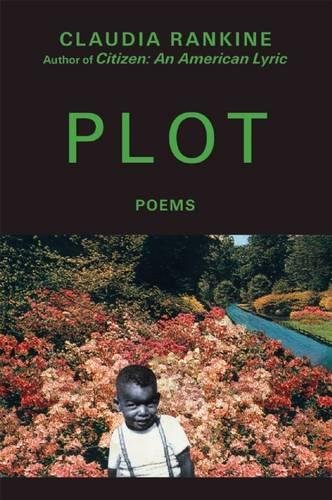
Claudia Rankine, Plot (Grove Press 2001)

Claudia Rankine’s two most recent books, Citizen: An American Lyric (2014) and Just Us: An American Conversation (2021) – links are to my reviews – issued brilliant, multi-faceted, take-no-prisoners challenges to anti-Black racism in the USA, shedding light and warmth on the issue well beyond American borders, and enthusing readers, me included, well beyond the borders of Contemporary Poetry land.

When a friend lent me Plot as part of a Covid care package (the Covid turned out to be a non-event, thanks for asking – vaccines and antivirals work wonders), I looked forward to more of the same. That is to say, I came to this slim volume of poetry, published more than a decade before Citizen, with completely inappropriate expectations.

The first page of verse gives fair warning. It consists of just four lines:

Submerged deeper than appetite

she bit into a freakish anatomy. the hard plastic of filiation.
a fetus dream. once severed. reattached. the baby femur
not fork-tender though flesh. the baby face now anchored.

OK, this book is going to expect the reader to work. A string of phrases separated by full stops without any opening capitals and only one conventional sentence. There seems to be something about biting onto the flesh of a foetus. It’s a dream, and maybe the dislocated syntax represents the fragmentary nature of the dream. But why ‘freakish’? What is ‘deeper than appetite’? What has been severed and reattached, and how? My phone dictionary wasn’t a lot of help with ‘filiation’ – the most relevant implied definition is ‘the process of attachment’ – but why plastic? And so on.

These four lines announce the book’s central theme of pregnancy, and they foreshadow that for much of it a good part of the reader’s pleasure is in being lost in a cloud of probabilities, not quite knowing what the endlessly suggestive words mean.

There is a story. Liv, an artist, is pregnant and ambivalent about it. The foetus has a name, Ersatz. The father’s name is Erland. The book’s most accessible moments are in occasional snatches of dialogue between the adults – in which Erland usually fails to grasp Liv’s emotional tumult. Most of the rest enacts that tumult: ‘dreams, memories, and meditations expanding and exploding the emotive capabilities of language and form’ (that’s from the back cover).

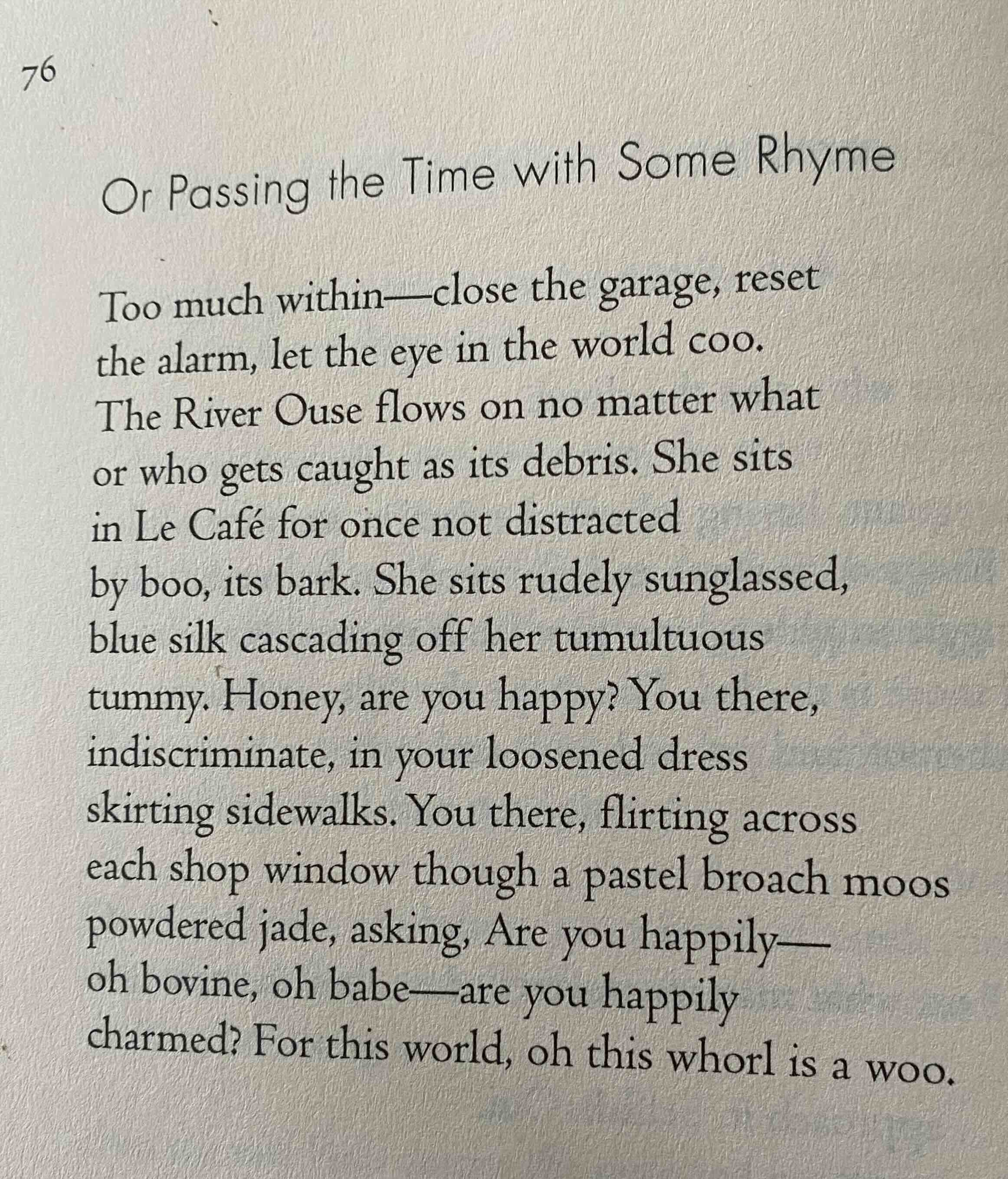
My blog practice is to write about page 76. In the kind of coincidence that I’ve almost come to expect, the only poem from this book that I could find online was the one on that page, ‘Or Passing the Time with Some Rhyme’, quoted in a review by Kate Kellaway in the Guardian. Kellaway doesn’t say a lot about this poem, but her review sheds excellent light on the book as a whole: for example, she describes many of the poems as ‘painterly’, and reminds us that Liv and Erland are the first names of the actors in Igmar Bergman’s monumental movie Scenes from a Marriage.

Page 76 (right click to enlarge):

There are lots of possibilities, but here goes with my reading.

This poem is something of a turning point in the book, as signalled by the ‘Or’ in its title (not ‘On’ as a careless reading might see). We can keep going as we have been, the title says, or we can take a different route. Let’s loosen up and just pass the time. Instead of more of the serious, introspective prose poems, let’s have some fun with rhyme.

Or Passing the Time with Some Rhyme

The body of the poem fills that promise, though perhaps not obviously.

To understand the first four lines, you need to know that in an earlier sequence, Liv has worked on a painting entitled Beached Debris referring to Virginia Woolf’s death in the River Ouse. Her brooding on Woolf’s suicide reflects her dark emotions about her pregnancy.

Too much within – close the garage, reset
the alarm, let the eye in the world coo.
The River Ouse flows on no matter what
or who gets caught in its debris.

The voice here is not, as mostly so far, giving us Liv’s inner workings. It’s more like a bossy friend: ‘Too much introspection, snap out of it.’ Maybe Liv has been painting in the garage. It’s time to close it, reset the burglar alarm and leave the house. Undo the fixation with Virginia Woolf’s death and notice the wider world, the river that still flows on no matter what tragedies it has seen.

The next lines are no longer addressed to Liv, but show her from the outside for the first time in the book. She’s looking cool, even arrogant, and splendidly, exuberantly pregnant:

or who gets caught in its debris. She sits
in Le Café for once not distracted
by boo, its bark. She sits rudely sunglassed,
blue silk cascading off her tumultuous
tummy.

This is a good time to notice that the poem is a sonnet, the only one in the book, and as far as I can tell the only poem in a traditional form. (Back to the ‘Or’ in the title: we could keep on with prose poems or we could have a crack at a sonnet.) It doesn’t have an obvious rhyme scheme (I’ll come back to that), but it does have the classic sonnet turn, right here in line eight where it’s supposed to be. The poem now addresses Liv again:

tummy. Honey, are you happy? 

You can read this a number of ways. It could be a straightforwardly sympathetic request for information. It could be a niggle: you look OK, ‘for once not distracted’, but are you actually happy? Or, and this is the reading that carries most weight for me, it could be registering unexpected good news: ‘Honey, after all this misery, are you actually happy?’

The remaining six lines (the sestet of the sonnet) have a cinematic feel. Liv is on the move, and the questioner repeats the question (this is very Boomer of me, but I think of Lynn Redgrave in the opening scenes of Georgy Girl, with Judith Durham on the soundtrack asking her questions in song). The tone still arguably ambiguous, but now with the possibility of enchantment much stronger:

tummy. Honey, are you happy? You there,
indiscriminate, in your loosened dress
skirting sidewalks. You there, flirting across
each shop window though a pastel broach moos
powdered jade, asking, Are you happily –
oh bovine, oh babe – are you happily
charmed? For this world, oh this whorl is a woo.

In ‘oh bovine, oh babe’, one of the words commonly used to disparage pregnant women is being reclaimed – someone might see her as cow like, but she is indiscriminately flirty, window shopping, and to all appearance happily charmed. It’s still a question, but surely now leaning towards a positive answer.

But what about rhyme? And also, what about those words that don’t make obvious sense that I’ve blithely glossed over until now?

After spending some time with this poem I realise that I have to let go of my habitual prosaic way of reading, and almost sing this, accentuating the vowels, starting with the title:

Or Passing the TIME with Some RHYME

When I do that, something wonderful happens. The sound patterning, especially the internal rhyming, is at the heart of how the poem works. Just look at all those oo words: Too, coo, Ouse, who, boo, rudely, blue, you (several times), loosened, moos, woo. There’s more to the soundscape than this (‘tumultuous tummy’, for example, and heaps of alliteration in the sestet), but once you’re alert to how the poem sounds, those odd words – coo, boo, moo and woo – make sense. It’s easy enough to find a paraphrasable meaning for them: ‘let the eye in the world coo’ equals ‘let the world look on you with the indulgence of a lover who bills and coos’; ‘not distracted / by boo, its bark’ equals ‘not having one’s attention dominated by this thing that is scary like a ghost or a savage dog’; ‘this world is a woo’ equals ‘this world is waiting to be loved by you, is wooing you’. It almost feels as if the notion of bovineness is introduced so the brooch (I think ‘broach’ must be a typo) in the shop window could moo. The literal meaning matters, but maybe what matters even mnore is the way the words just sing on the page. The final phrase, ‘oh this world is a woo’, becomes a fabulous, semi-nonsensical affirmation of life as joyful.

PS: Now have another look at the four lines I quoted at the start of this blog post. Read it emphasising the sounds, especially all those Fs. Quibbling at it for clear meaning seems much less valid all of a sudden. The pleasure is real.

Kim Stanley Robinson’s Blue Mars, page 76

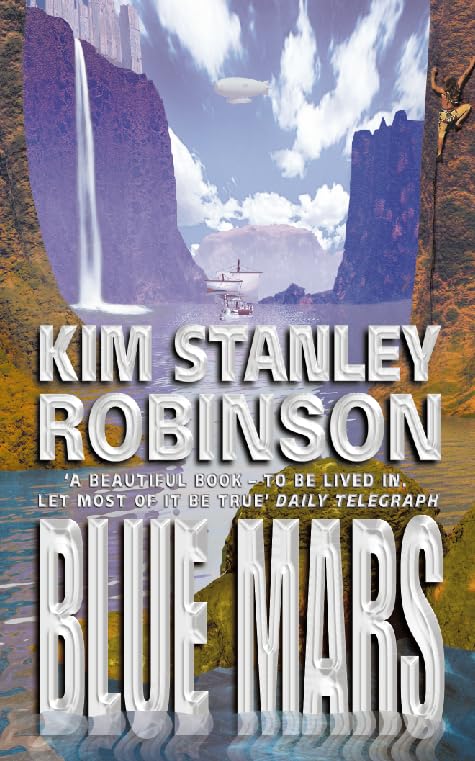
Kim Stanley Robinson, Blue Mars (1996)

This wonderful book is the third in Kim Stanley Robinson’s Mars trilogy.

I read the first two books – Red Mars (1992) and Green Mars (1993) – in pre-blogging days, that is, before 2003. I was swept away by them, but I kept deferring Blue Mars. In fact, last summer I read Kim Stanley Robinson’s more recent novel 2312 (my blog post here), thinking I would never return to Mars.

Yet here I am.

The trilogy begins in what was the future year of 2020 with the first human landing on Mars. In Red Mars, a hundred selected individuals and one stowaway, to be known and revered as the First Hundred, make the journey to the red planet, and the narrative follows the engineering, cultural and political processes of colonisation. The book ends, in about the year 2060, on a hopeful note in the middle of violent conflict against the forces of Earth capitalism, the ‘metanats’, and their political arm, the UN. Though the politics and the many individual stories are fascinating, what I remember most vividly of this book is the practicalities of interplanetary travel and survival on the arid, low-gravity planet.

Green Mars deals with the terraforming project (the greening of Mars), and the continuing struggle against the Terran forces. It ends in 2127, when Earth is devastated by a huge flood and Mars attains independence. Mars is largely habitable now, with tented cities, large bodies of water, a thickening atmosphere, and a huge reflecting mirror in space that augments the effect of the sun. A longevity treatment has been developed and is almost universally available.

Blue Mars starts in 2127 and finishes in 2212, so covers nearly a hundred years. The key characters are again from either the First Hundred, well over 200 years old by the book’s end, or the next two generations. As well as sorting out Mars’s relationship to Earth and the other colonies now being established elsewhere in the solar system (including those that feature in 2312), the main global story concerns the political struggles among the different Martian groupings. The Reds, including extremist ecoteurs, want Mars kept as close to its original state as possible. The Greens want it to become ever more Earthlike. Civil war is avoided and a new constitution is thrashed out in early chapters. We follow the teething problems of the new government structure and economy, and witness the development of distinctively Martian cultures. The younger generations grow very tall by Earth standards, tend to disregard gender binaries and can be spectacularly hedonistic.

The book is full of delights. Kim Stanley Robinson is interested in everything – politics, sociology, art, music, theatre, philosophy, religion, history, engineering, geology, climatology, rocket science, brain science, psychology, linguistics, myths, fairy tales, sports, the Basque cooperatives of Mondragon and the katabatic winds of Antarctica. All this and more finds its way into the story.

There are lovingly detailed descriptions of Martian landscapes and seascapes. In one meta moment a character observes, ‘This small-planet curvature is producing effects no one ever imagined.’ Yep, and Kim Stanley Robinson describes these effects, and those of the lower gravity, in such detail that you feel he has actually been there and seen what no one ever imagined.

None of that would work without a set of characters that we care about. Each of the book’s 14 parts is narrated from a different character’s the point of view, and Robinson has an almost Shakespearean ability to disappear into his characters.

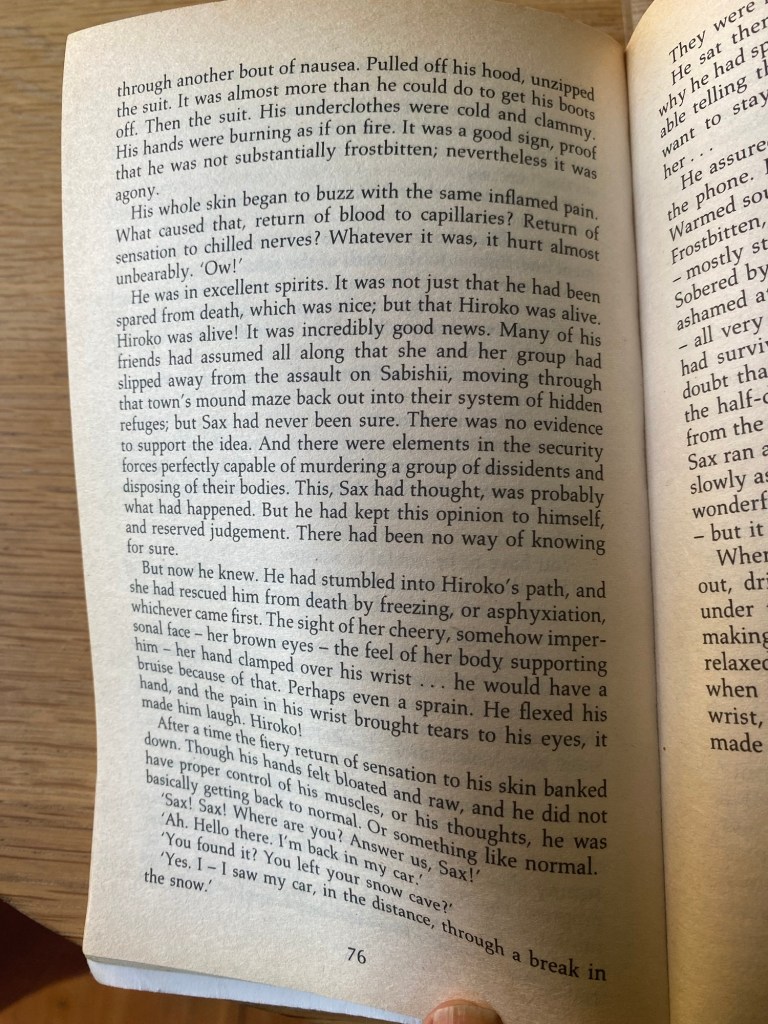
I could go on, but I want to give an example of the writing. Here’s page 76 (control click / right click to enlarge if you want to read it in full):

This is in Part Two, ‘Areophany’, told from the viewpoint of Sax Russell, one of the First Hundred who had his brain reconstituted after a stroke in the second book and has been oddly dissociated ever since. He is a brilliant scientist, committed to rational thinking and out of his depth when it comes to articulating emotional matters.

On the preceding 10 or so pages, Sax has been on a solo excursion, enjoying a Mars that is newly free from earth domination. Civil war has been averted, but only by appeasing of the Reds by removing the soletta, the mirror in space that created Earth-like warmth and light. Now, he has been caught out of his vehicle in a violent snow storm, one of the extreme weather events brought on by this removal – and the protection of his suit is almost useless against it. APS (as in Areological Positioning System) and a call on his wristpad have not helped him get back to his rover. He is facing certain death when a helmeted figure comes out of the storm, takes him firmly by the wrist and leads him to safety. He recognises his rescuer as Hiroko Ai, one of the First Hundred who is believed to have been killed. As soon as he is safe, she vanishes into the blizzard.

The high drama is over, but a lot happens on page 76.

First, there’s some deft character development. Sax manages to strip off his frozen clothes in the warmth of the car, and it hurts. But he’s Sax, always alive with scientific curiosity:

His whole skin began to buzz with the same inflamed pain. What caused that, return of blood to capillaries? Return of sensation to chilled nerves? Whatever it was, it hurt almost unbearably. ‘Ow!’

The next couple of paragraphs do a lot of work. They recap incidents from the earlier book, and they introduce a recurrent motif of this one. Since I’ve forgotten almost all the details of Green Mars‘ guerrilla struggles, I’m grateful for the recap, which is not so much a memory prompt as a general outline of what happened. (Incidentally, you could probably read Blue Mars as a stand-alone novel, but you’d have to fill in a lot of gaps from your own imagination.)

He was in excellent spirits. It was not just that he had been spared from death, which was nice; but that Hiroko was alive. Hiroko was alive! It was incredibly good news. Many of his friends had assumed all along that she and her group had slipped away from the assault on Sabishii, moving through that town’s mound maze back out into their system of hidden refuges; but Sax had never been sure. There was no evidence to support the idea. And there were elements in the security forces perfectly capable of murdering a group of dissidents and disposing of their bodies. This, Sax had thought, was probably what had happened. But he had kept this opinion to himself, and reserved judgement. There had been no way of knowing for sure.

But now he knew. He had stumbled into Hiroko’s path, and she had rescued him from death by freezing, or asphyxiation, whichever came first. The sight of her cheery, somehow impersonal face – her brown eyes – the feel of her body supporting him – her hand clamped over his wrist … he would have a bruise because of that. Perhaps even a sprain. He flexed his hand, and the pain in his wrist brought tears to his eyes, it made him laugh. Hiroko!

Stan, as he’s called in his bio, can spend pages describing a landscape (some readers might skip – I didn’t!), but he knows when to hold back. People with fresh memories of the earlier books will understand the reason for Sax’s joy. But the rest of us don’t need to be told, the joy itself is enough for us to know that Hiroko has been a key and much loved figure in the history of Mars.

Beginning with his lie when people at base finally contact him on his wrist on this page, Sax never tells anyone of this encounter, but its vivid physicality keeps Hiroko alive for the reader. In the remaining 700 pages, people report sightings, even some on Earth, none of them ever verified. In her absence she becomes a kind of genius loci, a spirit of the place – not part of the ordinary world of laboratories and constitutional assemblies, but elusive, concealed, anywhere. In the final act, when the surviving members of the First Hundred meet to remedy a glitch in the longevity treatments, I was on the edge of my seat hoping she would appear. I’m not saying if she does.

I went to Wikipedia to fill the gaps in my memory: it was Hiroko who created the spiritual underpinning of the new Martian culture – ‘a new belief system (the “Areophany”) devoted to the appreciation and furthering of life (“viriditas”)’. My understanding of viriditas is a little different from Wikipedia’s. I think of it as the universe’s impulse towards life, what Dylan Thomas called ‘the force that through the green leaf drives the flower’. It’s probably true to say that what makes the book more than a dry, overlong piece of speculation is the way on every page it bears witness to an imagination shot through with the thing that Hiroko comes to symbolise: Viriditas.


Added later: I meant to include this wonderful, terrible description of a future Earth, from page 511

Steaming, clotted, infectious, a human anthill stuck with a stick; the panic pullulation ongoing in the dreadful mash of history; the hypermalthusian nightmare at its worst; hot, humid, and heavy; and yet still, or perhaps because of all that, a great place to visit.

Ah, Earth, you’ve gotta love it!