
Richard Flanagan, Question 7 (Knopf 2023)

Before the meeting: Richard Flanagan is a giant of Australian literature. His non-fiction work has been transformative. He has won the Booker Prize and many other awards.
Before this year, I had read one and a half of his novels and had no desire to read any more. My blog posts on The Unknown Terrorist and Wanting speak for themselves.
So, bidden by the Book Group, I came to Question 7 bristling with prejudice.
I was not encouraged by this passage on the second page:
Sometimes I wonder why we keep returning to beginnings – why we seek the single thread we might pull to unravel the tapestry we call our life in the hope that behind it we will find the truth of why.
But there is no truth. There is only why. And when we look closer we see that behind that why is just another tapestry.
And behind it another, and another, until we arrive at oblivion.
Oh really? Other opinions are available, but this struck me as the kind of thing Les Murray meant when he described another of Richard Flanagan’s books as ‘superficial, showy and pretentious’ (link here)?
But what the Book Group wants, the Book Group gets … I read on.
I found a lot to dislike. The whole Question 7 schtick struck me as ‘superficial, showy and pretentious’ (more about that later). There are a couple of pages that could have been written by a self-righteous teenager, denouncing Oxford holus bolus as misogynist, racist and imperialist; a sneer often hovers at the edge of Flanagan’s descriptions of other writers; there’s a muddled insistence that all time is now – a kind of mix-up of Kurt Vonnegut in The Sirens of Titan and co-opted Indigenous notions. Regularly, out of the blue, there will be a bit of ‘philosophising’ about the uselessness of words, or a portentous one-line paragraph: Chekhov’s non-sequitur, ‘Who loves longest?’ or the sub-Vonnegut refrain, ‘That’s life.’
It could have been an engrossing book. There are powerful portraits of his grandmother, his mother and his father, and a gruelling, operatic account of near-death as a young adult. Above all, there’s the way Flanagan sets out to explore his own origins in the context of world history.
His father was a prisoner of the Japanese in 1945 and would have died in the camp if not for the nuclear bombs dropped on Hiroshima and Nagasaki – Flanagan owes his existence to that massively destructive act.
The book comes at that painful paradox from a number of angles: his father’s reminiscences of the camp; his own visit to its site, including an encounter with a former guard; stories about H. G. Wells, who coined the phrase ‘atom bomb’; the life of Leo Szilard, the scientist who first conceived of a chain reaction and after 1945 became a tireless campaigner for nuclear disarmament. It’s a fascinating tapestry of interlacing lives, thoughts and actions.
Flanagan is a Tasmanian, so he also owes his existence to the genocidal dispossession of the First Nations of luwitja. (In one of the recurrences that the book delights in, H. G. Wells’s novel The War of the Worlds was inspired that history.) There are powerful passages about colonisation, which (to my mind) he undermines by describing the term settler colonial society as lazy thinking because it hides the inequalities on which what he calls ‘the new Martian world’ was built. His point is that many of the first non-Indigenous arrivals were convicts, suffering terribly under the British system – and among them he counts his forebears. IMHO, settler colonial society is a fine term: patriarchy doesn’t hide inequalities among men; capitalist society doesn’t hide inequalities in our current world. The fact that you suffer doesn’t change the fact that you play an oppressive role. Not that Flanagan denies that, but he want to make it clear that his people were primarily victims rather than perpetrators.
But I’m getting irritated again.
Page 77* does not show the book in its best light. It falls in the midst of an excursion into historical fiction involving H. G. Wells.
The much younger Rebecca West has come into Wells’s life, and they are mutually entranced. After a first passionate kiss, he withdraws – not so much because he already has a wife and a mistress as because, according to Flanagan, she is too much his equal.
All that is evidently true to the known facts. West and Wells’s relationship was to endure. She had a son with him and they remained friends until his death. But at page 77 that’s all in the future, and she is struggling with his rejection of her:
Rebecca West, though, was not for defeat. For her, love and victory were synonyms. And she was not one for losing. She coupled audacity and ambition with an idea of stability she would forever after mistake older men as offering. She held herself to a high standard. She had written only a few months earlier how unrequited love was pathetic and undignified, adding as proof her contention that Christianity lacked dignity – and by implication was pathetic – not because Christ was crucified, but because his love for the world was unrequited. ‘A passion that fails to inspire passion,’ she wrote, ‘is defeated in the main object of its being.’
Having dispensed with God, she wrote to Wells that she was going to kill herself after being rejected by him, that all she could do was love. She had tried to hack the overwhelming love she felt for him back to the little thing he seemed to want. But even that, she realised, was too much for him.
Does that feel to you like a real person? Is it respectful of the historical Rebecca West? Does it use its sources fairly or even accurately? On the latter point, I looked up the essay it quotes (in The Freewoman, July 2012). It’s a brilliantly witty takedown of a book of literary history, in which the reference to Christ is cheeky, but not dismissive and not meant to prove anything. Flanagan is being snide, and not pretending otherwise. His Rebecca West is basically a comic character.
But what is she doing in this book at all? Maybe she’s there to establish that Wells was a truly complex, flawed human being (‘flawed’, to be specific, means physically ugly and using high-sounding ideals of free love to justify his promiscuity). It also serves the purpose of having a strong female presence in the historical part of the novel, which is otherwise full of men. This particular passage may owe something to her reference to Jesus echoing a repeated line in Flanagan’s The Unknown Terrorist: ‘the innocent heart of Jesus could never have enough of human love.’
The West–Wells story also, confusingly I think, seems to relate to the book’s title. That title is a riff on an early Chekhov short story, ‘Questions Posed by a Mad Mathematician’, an absurd parody of a mathematics quiz. The seventh quiz item starts with trains leaving stations at various times and ends with the non-sequitur question, ‘Who loves longer, a man or a woman?’ Because it’s posed as a question about gender, the Wells–West story (the only romance in the book) seems to hark back to it, but I think now probably not, as the version of the question that pops like a refrain, is simply, ‘Who loves longer?’ (Incidentally, the only version of Chekhov’s story I could find online, at this link, translates the question as, ‘Who is capable of loving?’ I’d be interested to know if the gendered version of the question is more a product of the gendered nature of the Russian language than of Chekhov’s intention.)
In the rest of the page, we follow the West-resistant Wells to Switzerland:
Wells arrived at his mistress’s magnificent Swiss retreat with his two sons and half a suitcase of scientific reprints concerning the recent discoveries about radium – discoveries that, he told Little e, as he called the diminutive Elizabeth, pleasantly took his mind as far away as laudanum once had Samuel Taylor Coleridge’s and which would form the basis of the novel he would write – the story of man summoning a power equivalent to the sun.
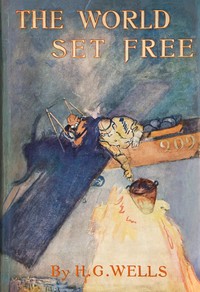
Wells runs from West to write the novel that is his reason for being in this book. It’s The World Set Free, in which he will coin the term ‘atom bomb’ and imagine with amazing accuracy the devastation such a bomb was to create. (I’m depending on Flanagan’s description. The novel is available at Project Gutenberg for the truly dedicated.)
Presumably the real-life Wells is being cited here, but what sense does it make to say that his lifelong interest in science was like a drug? In the immediate context, the implication seems to be that his interest in radioactivity is a distraction from the emotional turmoil associated with with Rebecca West. Am I wrong to read this as a sneer?
So, I look forward to having the virtues of the book made clear to me by people who have not been blinded by their own grumpiness.
After the meeting: After a wonderfully eclectic dinner over which we had exchanged important information about dumplings and life in general, we had one of the most interesting and spirited Book Group discussions ever.
Evidently it’s a love-it-or-hate-it book, and we were fairly evenly divided.
One man had hated the Wells-West thread so much that he re-read the book leaving it out, only to discover that he still hated the book, and spent days trying to figure out why. As I understand it, he realised that he regularly came up against a closing off of possibilities – just as Flanagan proclaimed he was opening up to complexity he would shut things down with a piece of certainty.
Another, on the contrary, read the book as an anti-narrative. Those shutting-down moments were a way of frustrating our quest for simple answers in an impossibly complex world. It’s important that Question 7 is about love, because all through the book there’s a dreadful intertwining of love and brutality.
Where some felt Flanagan was arrogant and withheld, others read him as exposing his own vulnerability. One loved the Rebecca West story; another loathed it. One read out a passage he particularly loved eliciting sympathetic nods from some and groans from others. Some felt that the book spoke directly to their own experience as colonial settlers, others not so much. I had to admit that I had got fixated on the things that annoyed me, and disregarded things that otherwise would have fed my soul.
None of us had previously heard of Leo Szilard. One of us said he now has Family Matters, by Flanagan’s brother Martin, on his to-be-read list, as a supplement to Richard’s account of his parents.
It was amazing! I don’t think anyone left feeling bruised. For myself, I intend to reread the book. But not for a while.
* My blogging practice for some time has been to focus arbitrarily on the page of a book that coincides with my age. Surprisingly, this page often reveals interesting things about the book as a whole.


 Me fail? I fly!