
[This is a post from 22 July 2008, which I’ve retrieved from the ‘Private’ category because Julius Lester’s name has cropped up in relation to my current reading. I’ve just learned on Wikipedia that he died in 2018, and discovered a lot more about his life. He was committed to telling the truth as he saw it, whatever the personal cost. Judging from my brief contacts with him, he was also a really nice guy.]
Julius Lester, Falling Pieces of the Broken Sky (Arcade Publishing 1990)
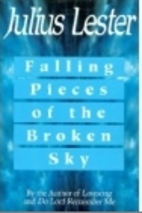
Since I’ve started making notes here about every book I read, I’ve been tempted to feel ashamed of the chaotic omnivorousness of my reading habits. I read books because they are on offer at the Book Club, because they happen to catch my eye at an airport, because I’ve received them as gifts, because they’re part of the canon and I should read them, because I need to get an insistent friend off my back, because I’ve run out of cereal packets to read at breakfast …
At first blush, it would seem that I’ve read Julius Lester’s collection of essays for a purely random reason – because I won it in a little competition he ran. But I wouldn’t have won it if I wasn’t a regular reader of Julius’s blog, and I wouldn’t read his blog regularly if— And it struck me, perhaps because I started reading this book just after spending two days reading a friend’s novel-in-typsecript, that one whole category of my reading is Books Written By Friends. I’m probably using ‘friend’ in a slightly idiosyncratic way here since I know Julius only through his writing – a handful of his books (Sam and the Tigers: A new telling of Little Black Sambo, John Henry, When Dad Killed Mom), his contributions to an E-List I once belonged to, his blog and a very few emails.
I’m expect that very few people in Australia have read this book of essays, published in 1990 and now out of print. And that’s a shame because each of its three sections is full of good stuff. The first, ‘Writers and Writing’, makes unlikely bedfellows of Henry Miller, Thomas Merton, Aldous Huxley and James Baldwin, and among other bracing delights includes an essay that begins, ‘I am grateful that among the indignities inflicted on me in childhood I escaped The Adventures of Huckleberry Finn.’ There are also a couple of pieces about his own writing, one of which begins:
I have always loved books. Medical science has learned that infants suck their thumbs in the womb. I read. I love books as much for their sheer physicality as for what I may learn and experience through the words on their pages. I love to touch books, to hold them. They are my security blanket, and whether I am happy or depressed, I go to bookstores to orient myself to the world, to feel myself enclosed, almost womblike, by books on all sides. I need books, almost as an alcoholic needs liquor. When I was in college, I always carried a book with me on dates, not sure that any girl could be as interesting or involving as a book. My wife wonders if I’ve changed.
The second section is titled ‘Race’. If there’s a binding thread to the book, it’s the responsibility of the writer to be truthful – to write the truth as he or she sees it, regardless of the demands of collectives of whatever kind. In this section Julius argues again and again for a deeply human perspective, rather than one determined by identity politics. He was part of the Civil Rights Movement, and laments the separatism and advocacy of violence that followed the assassination of Martin Luther King Jr, as well as the coming to dominance of victimhood and the shucking of responsibility. As a convert to Judaism, he has pungent things to say about anti-semitism among US Black leaders, and the tolerance of it among Black and other intellectuals.
The third section, ‘Falling Pieces of the Broken Sky’, draws its title from Seneca, ‘Of all the generations, it is we who have been designated to merit this fate, to be crushed by the falling pieces of the broken sky.’ The section consists mostly of short pieces that read as blog-entries before the existence of blogs – they were written to be read on the radio. I don’t think the title means to suggest that the reader will be crushed by them. On the contrary, I found myself thinking of the Judaic concept of Tikkun Olam, repair of the world, as if these small pieces are helping to piece the sky back together. Many of them are serio-whimsical – objecting to the term ‘Safe Sex’, for instance, because sex always has an edge of emotional or spiritual risk, so to ‘lead the young to believe that sex is safe may one day deprive them of love itself’. There’s a brilliant essay in defence of ‘the canon’ against those who urge educational institutions to introduce students primarily to writing that reflects their own experience, including this:
It is reprehensible that those who have suffered because they are different should now be the ones using difference as a weapon against others. Doing so denies that we are bound to each other by the simple fact that we all laugh and cry and suffer and rejoice about the same experiences or in the same ways. What matters is that we find the humanity within ourselves to delight in the laughter of others, even if we are not amused; that we feel a twinge of pain upon noticing someone weeping, though our own eyes remain dry; that our hearts pause in the presence of another person’s suffering; and that we exult when someone else rejoices, even when we do not understand the occasion for the joy.
The final essay is a mediation on the Holocaust and a brief account of his conversion to Judaism, which makes me want to read his memoir on the subject, Lovesong.


 Me fail? I fly!
I think I’d like this too.
But I’m curious, why didn’t he want to read Huck Finn?
LikeLiked by 1 person
Not so much didn’t want to read it as far as I remember, Lisa, as glad he wasn’t exposed to it as a child. It’s the unexamined racism he objects to. In fact, it’s that essay that made me go searching for this post – the book itself must be somewhere, but that’s a whole other issue. I’ve just read Percival Everett’s James, which writes back to Huckleberry Finn in ways that make Julius Lester’s case for him
LikeLike
Well, fair enough, but if he wasn’t taught it, how does he know it was unexamined? Teachers, as I’m sure you know, deal with all kinds of texts that get re-examined in the light of today’s values. No Prep child I ever taught escaped a feminist discussion about Cinderella and the concept of rescue by a Prince Charming!
LikeLiked by 1 person
I meant unexamined in the text itself. My memory is pretty minimal, but I think he’s talking about actually reading the story as a child, before the discussion of racism could happen, or maybe even with it already having happened. Child readers do bring a terrifying openness to the stories they read/hear/see. I’d rather have an episode of Bluey than one of Peppa Pig followed by a discussion of why fathers aren’t really stupid
LikeLike
But surely if you applied that logic across most of the literature that we know (the Bible, the canon, folk and fairy tales, the development of the novel through the 19th and 20th centuries, to say nothing of poetry) you’d be left only with recent literature that ‘ticked the boxes’ for the isms that we disapprove of now (racism, sexism, ableism, antisemitism, Islamophobia, homophobia etc etc.) Nearly everything is problematic depending on what lens you view it through and how alert you are to these issues. Sometimes it’s problematic because of something that’s not even there e.g. the absence of a diverse range of characters.
It’s decades since I read Huck Finn but what I remember most about that book was my profound sense of horror about people being owned and Jim’s terror of being caught. Not even in apartheid S. Africa, as dreadful as it was, were people *owned* so that they were bought and sold and separated even from their own children. I knew, of course, from school, about slavery and its violence and cruelty in ancient civilisations, but it had never been humanised in the way that Twain presented it. I didn’t know what a crime against humanity was then, but I knew that the system that Jim was living under was morally repugnant.
LikeLiked by 1 person
I think it’s fair to say that my initial response to Julius’ essay was pretty much as you’ve written here, both the argument against censorship and the horror of slavery. I’ve just managed to find the essay online, at https://www.enotes.com/topics/adventures-of-huckleberry-finn/critical-essays/adventures-huckleberry-finn-mark-twain. It’s worth reading – paywalled, but you can subscribe for free and then cancel once you’ve read the article. It’s much more nuanced than I’ve represented it, and much more vehement. He wrote it in 1984. Maybe he’d see things differently now. In case you don’t have time for the whole article, here’s a quote: ‘Jim does not exist with an integrity of his own. He is a childlike person who, in attitude and character, is more like one of the boys in Tom Sawyer’s gang than a grown man with a wife and children, an important fact we do not learn until much later. But to Twain, slavery was not an emotional reality to be explored extensively or with love.’
LikeLike
You know, you could say much the same about the representation of women for much of the novel’s history…
LikeLiked by 1 person
Yep!
LikeLiked by 1 person
My father was severely reprimanded by a daughter-in-law for telling her little children a version of the Three Little Pigs in which the wolf came down the chimney and was boiled alive. He was honestly bewildered by her outrage at the cruelty: ‘but that’s the story!’ It’s a many tendrilled issue
LikeLike
Oh, don’t get me started…
I used to do a whole term of traditional lit with my students: Aesop’s Fables for the Preps, Fairy Tales & Folklore with the 1s&2s, First Nations stories with the 3s&4s alternating with Hans Christian Anderson every other year, and with the 5s&6s, Sir Gawain and the Green Knight and Beowulf in alternate years. With the 1s&2s, I’d do the fairy tales that everyone knows in odd years, and stories from around the world (i.e. not Anglo ones) in even years. The kids always knew the Disneyfied versions of Cinderella et al, and had simply absorbed the plot. But when I read them the bloodthirsty versions, even the littlest ones would come up with very good reasons for ‘why the story is told this way’. They understand that the seven dwarfs are living by themselves in the forest because they’re not welcome in town, because ‘people were mean to disabled people in the olden days’ and that their names are mean too. They understand the impulse to violence, revenge, and meanness in general. They understand that adults tell stories as a warning. Literature, the real thing, that is, is (these days) almost the only acknowledgement that children have these troubling feelings…
LikeLiked by 1 person
I forgot to say, that it’s not hard to say ‘this couldn’t happen here’ because this is a made-up story from long ago in another country and we don’t have #insert scary thing e.g. wolves. But it’s much harder to reassure kids about the things that they are actually scared of: their parents getting a divorce and/or domestic violence at home and/or getting burgled, and more worryingly — because even the children of helicopter parents see the news — about school shootings, the murder of women, and floods and bushfire.
LikeLiked by 1 person
I’m glad I got you started, Lisa! That’s very interesting. We’re currently negotiating the porous boundary between literary and ‘real’ life with my 3 year old grandson on the subject of Burglar Bill. We’ve established that BB lives in a different world, but we’re careful not to leave precious things out the front where someone else might come along and say, ‘That’s a nice ––, I’ll have that!’
LikeLike
I will go out and buy this for a re-read some thirty years later.
I do wonder if you have a reference for the Seneca Quote though, I can’t seem to find it. I will have to plow though him again. But he will have to wait until I finish Epictetus.
Thanks for this (belatedly)
LikeLiked by 1 person
Thanks for commenting. Good luck it’s finding a copy. I’m sorry but I can’t help with the Seneca quote – I’ve never read him but I’ve just finished reading Montaigne’s Essays and have learned a lot about Seneca there
LikeLike