
Daniel Mason, North Woods (John Murray 2023)
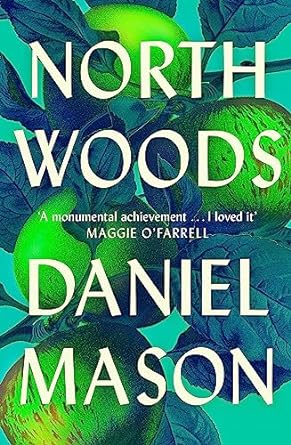
Before the meeting: If my experience is anything to go by, your heart may sink as you read the first pages of North Woods. It looks as if it’s going to be one of those historical novels written in a strained imitation of late 17th century semi-literate English. But be of good cheer – the passionate young couple who have fled into the forest from a Puritan settlement in Western Massachusetts don’t last long: the book is about the place they flee to. Each chapter moves to a new set of characters, descended from or otherwise related to the previous set, and we move through the decades and centuries up to the indefinite future of the final chapter.
It’s almost, but not quite, a collection of short stories in different modes, set in different time periods. There are ghost stories, stories of unrequited love, a tragic gay story, family sagas, a psychological horror story. There’s a persistent attention to what happens to the woods in question as an area is cleared for an apple orchard, which is turn is partly destroyed then overgrown, as various blights and diseases wipe out some of the splendid native species. Between the chapters there are sections that are presented as found documents: a story written in the margins of a family Bible, a True Crime article from the 1950s, a speech written for a local amateur historical society meeting. There are ballads written by one set of characters (which I found mostly unreadable), and photographs of the woods in its many stages.
Yes, it’s a terrifically inventive work, with US history of the last three hundred years as its backdrop.
But, well, meh!
I’m mostly left cold. It mostly feels like a writerly exercise with no deeper necessity. That would be fine if it was fun, but it’s not fun. What may be meant as magic realism just feels contrived and arbitrary. Lyrical descriptions of natural processes are laboured – more than anything, they made me want to reread Richard Powers’ Overstory (link to my blog post). Because nothing outweighed it, what might have been a niggle at the back of my mind became a constant unease: First Nations people are only glancingly present and mostly consigned to the unknowable past; tribal names are mentioned a number of times with due respect, and a wise Elder makes an appearance in an early chapter, but that’s it. I don’t know that a similar book could be written in Australia, possibly because colonisation is so much more recent here. For this Australian reader, this virtual absence meant the book felt hollow at its heart.
After the meeting: We discussed this book along with Andrew O’Hagan’s Caledonian Road. That book took up most of the discussion time, though it’s probably true that the excellent Indian meal and catch-up conversation took up more than both combined.
I think there was a consensus that the book worked as a collection of short stories. The over-all concept was impressive but didn’t quite come off, and the ghost stories worked least well of all. Someone else mentioned the Richard Powers novel as a comparison that didn’t reflect well on this book. The stories / chapters that received most honourable mentions were a long interstitial piece, the Johnny-Appleseed-like memoir of the man who planted the orchard, and Chapter Three, in which his daughters Alice and Mary are inseparable, until they’re not, with a creepy Gothic twist at the end.
I wrote this blog post on the unceded land of the Gadigal and Wangal clans of the Eora Nation, which has seen many changes in the last 236 years, but has never ceased being cared for by these First Nations people. I am very happy to acknowledge their elders past and present.


 Me fail? I fly!