
Anastasia Radievska, City of the Sun / Місто Сонця (Flying Island Books 2024)
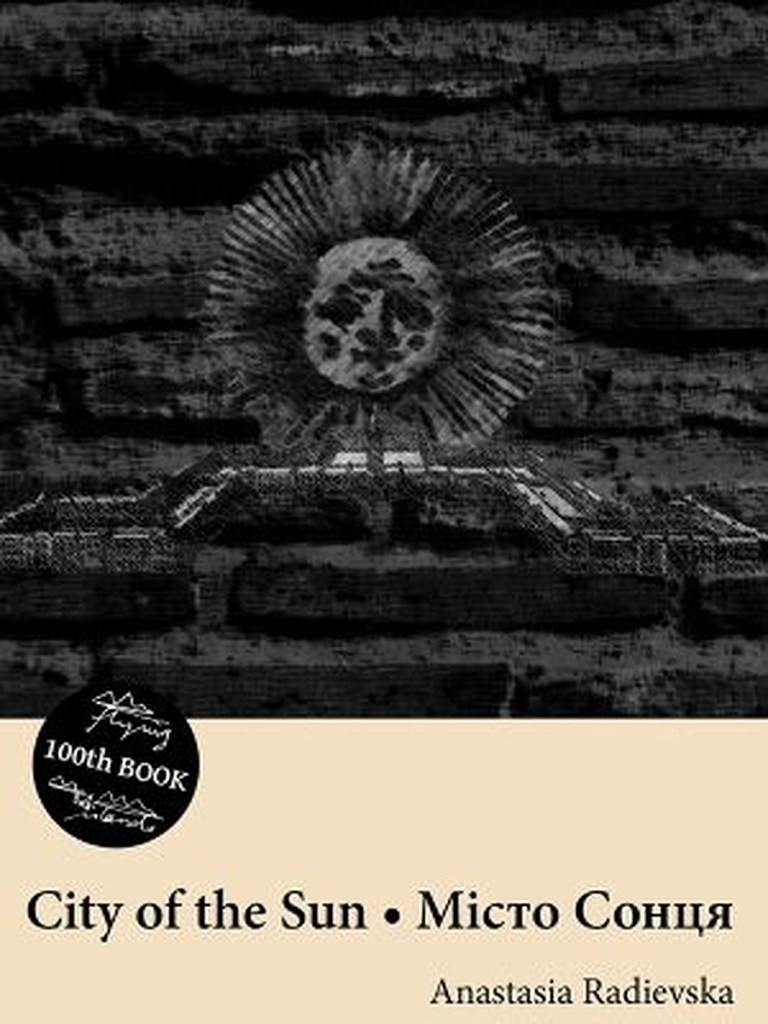
This is Ukrainian-Australian poet and artist Anastasia Radievska’s first book of poems. It’s a rich, complex creation.
There are poems in English and Ukrainian, which means that almost half the book’s contents remain enigmatic and even unpronounceable to readers like me who can’t read Ukrainian script – but beautiful to look at.
The book takes its title from The City of the Sun, an early 17th century philosophical work by Tommaso Campanella, which according to Wikipedia is an important early Utopian work. Campanella’s city is protected by a series of walls, and this book’s sections are named for six of those walls. Each section is introduced with what I assume to be a quote from Campanella describing the images painted on its wall – followed by a double-spread illustration, a semi-abstract painting that mostly relates to that description.
For example, ‘The Fifth Wall’ is introduced by this paragraph:
On the fifth interior they have all the larger animals of the earth, as many in number as would astonish you. We indeed know not the thousandth part of them, for on the exterior wall also a great many of immense size are also portrayed.
For a casual reader like me, this framing has a pleasingly decorative effect, but as with the beautiful characters of the Ukrainian alphabet I expect that a more serious approach would make the reading experience much richer. More serious readers, please speak to us in the comments.
Page 77* includes neither Ukrainian text, quotation from Campanella, nor illustration. It’s ‘instructions for lunchtime’, one of six English poems in the ‘The Fifth Wall’ (which also includes six Ukrainian poems). As you would expect from the section’s introduction above, the poem features some of ‘the larger animals of the earth’.
instructions for lunchtime

always remember
dogs are beautiful for having been engineered
and well-loved
to engineer us back

the gaze turned inward
towards something worthy –
finally – of looking back at

and an entire piece of ginger in the mouth
doesn't say otherwise

but thinks of course
of racing horses
with ginger in the sacrum
a culinary cruelty
somebody's paying to have
done to them

and on a Monday
I would too if hadn't thrown away
a fortune on tom kha soup
in little brown bowls
and a seat by the window

watching the dog wag its tail at the Lime bike
like it might be relevant to it
as a conspirator or fellow thing
to answer our doubts with –
throw in the river
– price – chase
at fleece rabbits –
does it not breed, breed, breed?
As with Radievska’s poems generally, part of the pleasure here lies in the poem’s difficulty. It’s not that there’s a puzzle to be deciphered; what the poem asks for is a little patience – understanding will come.
The poem starts with an abstract consideration about dogs, goes to the sensation of ginger in the mouth, then to a memory of cruelty to horses. Only at about the fifteenth line, you get to see some coherence. As advised in the title, it’s a lunch poem: the speaker is having her customary tom kha soup in a Thai eatery. Just as she sees a dog in the street outside the window wagging its tail at a hire bike, she finds she has put a whole piece of ginger into her mouth and her mind wanders to something she has heard about a use of ginger in horse-racing. Her attention returns from the ginger and horses to what she is seeing in the street, and she indulges some fanciful imaginings about the dog and the bike.
That’s the narrative.
There’s a lot else happening. The opening injunction, ‘Always remember…’, is a nice reminder of something we all know: we find dogs beautiful because we have bred (‘engineered’) them to be that way, but they have their own subjectivity and have changed us in turn. It’s not the standard joke about how dogs have made us their servants – bringing them food, throwing balls for them, cleaning up their messes, etc. It something about the dogs’ gaze: meeting a dog’s eyes can make you feel (‘finally’) that you are worth looking at (unlike the often indifferent or critical gaze of other human beings).
The piece of ginger in the mouth introduces a different human–animal relationship – a piece of ‘culinary cruelty’ in the racing industry. I don’t know what ‘ginger in the sacrum’ is and couldn’t find anything in a quick online search, but I’ll trust the poem that it’s a thing.
someone is paying
to have done to them
The cruelty to horses is a comparatively malevolent, profit-driven parallel to the engineering of dogs.
But this isn’t a poem of indignation or protest:
and on a Monday
I would too
At first glance this seems to be condoning cruelty to racehorses, but it’s worth spending time on the convoluted syntax to realise that it’s actually a little joke, playing perhaps on the ambiguity of ‘them’ in the previous line – callous about the horses, perhaps, but only because not keeping them in mind. A paraphrase might be: ‘When I have to drag myself to work on a Monday, I’d happily pay someone to do something similar to me …’
I would too if hadn’t thrown away
a fortune on tom kha soup
And with this mock-lament at having spent money on soup rather than self-torture, we’re back by the restaurant window, or in the reader’s case, realising for the first time that that’s where we are, watching with idle amusement as a dog confronts a hire bike (Lime bikes are everywhere in my part of town).
The thoughts projected onto the dog pick up on the poem’s opening lines: dogs are bred to please us but they look back and have an effect on us. Can a bike do the same? The answer isn’t as obvious as we’d like. Sure, a bike can be thrown in the river, the cash transaction is front and centre, and (we know, even if the dog doesn’t) that a bike won’t play with a soft toy. But the final line introduces some doubt:
does it not breed, breed, breed?
On the surface, this is a version of the joke about the discarded hire bikes that litter some parts of our cities – they’re breeding like rabbits. The dog asks if that’s literally so. But there are further possibilities: there may be something about capitalism as a creature that has got out of hand, but what strikes me is a suggestion that as artificial intelligence develops, perhaps objects like this bike will, like dogs, develop agency of their own, and if they haven’t already changed the way we see ourselves (with ‘the gaze turned inward’), that may be just a few generations of breeding/engineering away. Dogs and horses are among the ‘larger animals’; the poem asks if bicycles also belong in that category, or will some day.
Not bad for a poem that presents as capturing the idle play of mind during a lunch break.
I finished writing this blog post on Gadigal Wangal country, where the days are growing longer, and some wattle trees are in exuberant flower. I acknowledge Elders past, present and emerging for their continuing custodianship of this land.
* My blogging practice, especially with books of poetry, is to focus on the page that coincides with my age, currently 77.


 Me fail? I fly!