
Michel de Montaigne, The Complete Essays (Penguin Classics 1991, translated by M. A. Screech)
– part of Book 2 Essay 12, “An apology for Raymond Sebond’
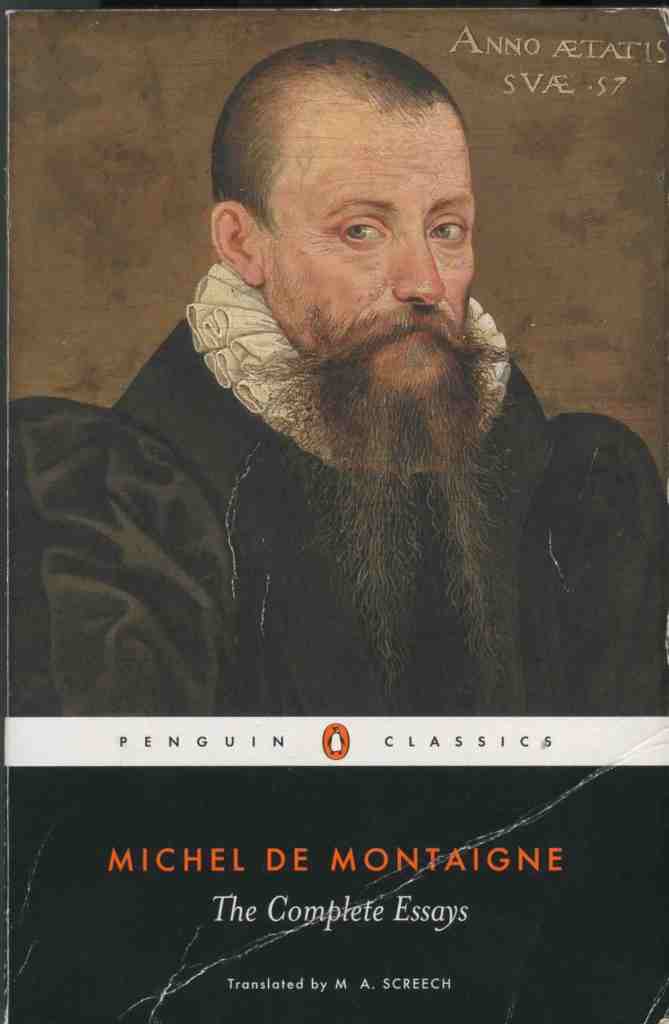
Since my last Montaigne report, I’ve been faithful to my four pages of Montaigne each morning except for two breaks – one for a fortnight and the other just a weekend. The book is too heavy to take on a plane, and travel tends to disrupt routines like this one.
Five weeks ago, I had just started reading the longest essay in the collection, ‘An apology for Raymond Sebond’. Today I still have 60 odd pages of that essay to go. As I have only the vaguest idea of who Raymond Sebond was, or in what way Montaigne is attempting an apology, I’ll spare you any attempt at a summary, and just give a couple of snapshots.
Having declared himself to be a sceptic (as opposed to a dogmatist), Montaigne sets out to establish the limits of human reason. He piles on example after example of ancient philosophical versions of God, products of the ‘fierce desire to scan the divine through human eyes’. Arguing that if reason were able to determine the nature of God, then these versions would tend to some kind of agreement. Having established that this isn’t what happened, he (at least in M. A. Screech’s translation) drops his dignified mode of discourse altogether and exclaims:
So much din from so many philosophical brainboxes! Trust in your philosophy now! Boast that you are the one who has found the lucky bean in your festive pudding!
That’s on page 577. I’ve now reached page 625. In those 48 pages he has explored (and deplored) the limitations of reason in understanding even the world of nature or the human mind itself, and has been cheerfully insulting of many ancient writers whom he clearly admires enormously (including describing Plato as sometimes ‘silly’). Now he is going on about how philosophers can’t reach any agreement about the immortality or otherwise of the soul. He has reached the transmigration of souls:
the received opinion … that our souls, when they depart from us, go the rounds from one body to another, from a lion, say, to a horse; from a horse, to a king, ceaselessly driven from one abode to another.
And he’s having quite a lot of fun with it, citing the Epicureans’ objection:
What order could be maintained if the crowds of the dying proved greater than the number being born? The souls turned out of house and home would all be jostling each other, trying to be first to get into their new containers! They also ask how souls would spend their time while waiting for their new lodgings to be got ready.
Having added some lines of Latin poetry, he then goes on:
Others make our souls remain in the body after death, so as to animate the snakes, worms and other creatures which are said to be produced by spontaneous generation in our rotting flesh or even from our ashes.
In short, I’m enjoying this essay as a kind of romp in the history of philosophy. As a settled atheist who thinks my mind is a function of my body, I have a kind of museum-piece interest in a lot of the arguments. I was taught at school that until a certain point in European history people relied on the authority of, I think it was Aristotle, for their knowledge of the world. We knew from Aristotle how many teeth a human had, and only at a certain stage did it occur to people to look in each other’s mouths and count for themselves. As I read this essay, it feels as if I’m seeing that change happen before my very eyes, and it’s riveting. (Mind you, I think the essay itself is going to end with a declaration that Christian revelation is the ultimate source of Truth, but both things can be happening at once.)
To be continued.
This blog post was written on Gadigal-Wangal land, where understandings of the universe beyond Montaigne’s imaginings were developed millennia before the Ancients he discusses. It’s raining again, and my compost bin is alive with worms. I acknowledge the Elders past, present and emerging of the Gadigal and Wangal Nations,.


 Me fail? I fly!