Category Archives: slow read

Starting How to End a Story

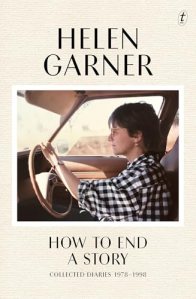
Helen Garner, How to End a Story: Collected Diaries 1978–1998 (Text Publishing 2025)

A generous friend gave me this whopping tome for my birthday this year.

Someone said, ‘It’s a book you dip into rather than read from start to finish.’ But I’m not much of a dipper, so I’ve decided to take it on as a slow read – five pages a day for six months or so. I loved doing that with Seamus Heaney’s letters. Why not with Helen Garner’s diaries?

The diaries were originally published in three volumes: Yellow Notebook (2019), One Day I’ll Remember This (2020), and How to End a Story (2021), covering the years 1978 to 1986, 1987 to 1995 and 1995 to 1988 respectively.

From what I’ve read elsewhere, I understand that Garner kept diaries for decades before the entries that begin Yellow Notebook, but she burned them all, and decided in 1978 to write readable diary, not necessarily for publication, but with attention to the crafting of sentences. Four decades after starting the first proper diary in a yellow notebook acquired for the purpose, she decided to publish, with minimal alterations, and none to spare her own feelings.

I’ve just read the first five pages. My initial response is to feel a little deprived that the entries aren’t dated, and people are identified only by a single initial. Any information about what relationship people have to Garner is to be deduced from the text – which is an odd bit of false reticence when of the two character mentioned so far one is clearly Garner’s daughter and the other seems to be a lover whose identity I imagine would be easy to discover. Similarly, there is no scaffolding to say where an entry was written: on the first pages Garner is feeling alone in a city, and only gradually does it merge that she’s in France, probably in Paris.

I’m probably just missing Christopher Reid’s helpful annotations in the Seamus Heaney book, and I’ll get used to this bare approach.

I hope to write a first monthly report towards the end of May.


I am a man of settler heritage who has been alive for almost a third of the time elapsed since Arthur Phillip claimed this continent for the British crown. I wrote this blog post on the land of Gadigal and Wangal of the Eora Nation. I acknowledge their Elders past and present and welcome any First Nations readers.

The Letters of Seamus Heaney, third and final progress report

Christopher Reid (editor), The Letters of Seamus Heaney (Faber & Faber 2023)
– pages 599–800

I’m sad to have finished my daily reading of Seamus Heaney. Though very few if any of the letters in this 800 pages were written with publication in mind, Christopher Reid has gathered them into a wonderful book.

In his last years, Heaney is still apologising for the lateness of his replies to other people’s letters or gifts of books. His excuses are generally wonderful – lists of lectures and readings given, honours received, holidays taken with his wife Marie. Sometimes he encloses a poem. In his final years he complains that he hasn’t been able to write any poetry. He seems cheerfully resigned to having to ‘stand on his hind legs’ and be a famous poet. More than once he explains that he won’t attend an event where a friend is being honoured because he has found that – because of ‘the N word’ – his presence tends to steal the limelight. (Do I need to explain that in this case N is for Nobel?)

He replies generously to graduate students asking him if they’re on the right track. His letters to translators are fascinating. He does a spectacular job of refusing requests without giving offence. He is a wonderful model of how to respond to other people’s writing. He struggles to protect his privacy and that of his family, to avoid the commodification of his personal life that must seem inevitable to many people who become famous. He is reluctant to give interviews about his book Human Chain, because some of its poems are more intensely personal than previous ones: he knows the interview will ask about these personal things, and he won’t go there.

As the decades pass, he increasingly types his letter on a laptop, sometimes offering the excuse that his handwriting has gone all wobbly as a result of a stroke. But he doesn’t use email. I think I’m right that there is only one electronic communication in the book, which is the text he sent to Marie when he was being wheeled into the operating theatre, just before he died:

Noli timere

Reid gives the translation, ‘Don’t be afraid,’ and tells us that the text went viral. But he leaves the reader to savour the way this final message epitomises so much of the book. It feels like a biblical quote – the first thing Jesus said after his resurrection was ‘Noli me tangere’. And though Heaney was no longer a practising Catholic, the language, imagery and stories of his Catholic childhood were still at the heart of his creativity, and often turn up in his correspondence. Latin was part of that, and important in its own right: he would often write ‘Gaudens gaudeo’ in a letter when there was reason to celebrate, and he translated Book 6 of the Aeneid in his last years.

Most movingly, this final text is addressed to Marie. She has been a constant presence, through marriage, parenthood, illness striking both of them, her occasionally mentioned creative endeavours. When the letters mention holidays, ceremonial occasions, social events, it’s often ‘Marie and I’. He quotes her opinions. She is intimately part of who is is. And this is the only time in the book that he speaks to her.

I’m going to miss my daily contact with this lovely mind.


I have written this blog post, punctuated by a walk by the beach in a windy darkness, face pricked by flying sand particles, on Awabakal country. I acknowledge Elders past and present, and welcome any First Nations readers.
The Letters of Seamus Heaney, progress report 2

Christopher Reid (editor), The Letters of Seamus Heaney (Faber & Faber 2023)
– pages 390-598

Over the month since my first progress report on reading Seamus Heaney’s collected letters, he has aged from 53 in 1992 to 64 in 2003. Among other things, he has translated Beowulf, written a couple of translations/versions of ancient Greek plays, won the Nobel Prize, had a number of friends die, become much in demand as a public person, travelled a lot including to Tasmania in 1994, and still managed to produce a number of books of poetry. Increasingly his personal letters (as opposed to ‘correspondence’) have been written in planes and airports. He uses a laptop and a fax machine but has stayed away from email for fear that he’d ‘be inundated entirely with queries from grad students and indeed grade schoolers doing their essays’. And always there’s a yearning for moments of solitude and recollection.

I’m enjoying hugely my morning read of seven or eight pages. Apart from anything else it’s a joy to pay attention to someone other than the Attention-Seeker-in-Chief at Mar-a-Lago. I can’t add much in general to what I said in my first progress report (at this link). Here are some snippets.

Heaney writes to his translators, clarifying meanings for them – and giving us fascinating insights into the poetry and the art of translation. Most recently in my reading is an explanation handwritten at the bottom of a fax from Jerzy Illg. Illg’s fax asks for an explanation of the phrase ‘the Bushmills killed’ in the poem ‘The Bookcase’. Heaney writes (page 593, probably 23 May 2003):

‘To kill the bottle’ means to finish off all the drink. So it’s late in the evening and the Bushmills bottle is empty … You know how it is –
Best – Seamus

I’m sure I didn’t know what the phrase meant when I read the poem. So thank you, Jerzy Illg.

There’s a lot of verbal playfulness in many of Heaney’s letters. He’ll slip in a phrase from Wordsworth or Hopkins or a contemporary poet, and Christopher Reid the editor will usually add a helpful explanation of the reference. One that that I loved, that Reid didn’t explain: Heaney and his wife Marie are heading off for a brief holiday, and he describes it as a period of ‘silence, exile and sunning’ – a reference to a much quoted phrase from James Joyce, Portrait of the Artist as a Young Man, ‘silence, exile, and cunning’. I laughed out loud at Reid’s note at the end of a letter to fellow poet Derek Mahon in October 1997. Congratulating Mahon on a recently published book. The letter reads, in part:

I couldn’t place one [of your poems] above the other in my mind just now, just have this Baudelairean dusk-mood of gratitude. I see Milosz calls poetry a dividend from ourselves: high-yields, mon vieux.

After explaining the references, Reid writes: ‘Below the signature, in Mahon’s hand, on the actual letter in the Emory archive: “Pompous ass.”‘ Oh, I think, not everyone enjoys Heaney’s playfulness.

My pleasure in the third moment I’ll mention is less mean-spirited.

In January 2000 (page 519), in a letter to musician Liam O’Flynn, Heaney writes:

I’ve been fiddling with this Japanese form called the tanka – two lines longer than the haiku, and a development of it – consisting of five lines of five-seven-five-seven-seven syllables. It’s like a wee pastry cutter I nick into the ould dough inside the head, just to give it shape.

That is such a wonderful descritption of why I love the tight form of the Onegin stanza: it too is a ‘wee pastry cutter’ that can ‘nick into the ould dough inside the head, just to give it shape’.

I’m now reading letters Heaney wrote while working on books that I read soon after they were published, and evidently before I blogged about every book I read: Beowulf, Electric Light, District and Circle and Human Chain. I’m already sad that there are just 100 pages of the book, 10 years of letter-writing, and one month of reading to go.


I have written this blog post on the land of Gadigal and Wangal of the Eora nation, as the sun rises later and tiny lizards bask while they can. I acknowledge Elders past and present of those clans, and welcome any First Nations readers.
The Letters of Seamus Heaney, progress report 1

Christopher Reid (editor), The Letters of Seamus Heaney (Faber & Faber 2023)
– pages 1– 389

In early December when I announced that I was embarking on a slow read of this book, I promised a progress report ‘in a month or so’. Given that so many of Heaney’s letters begin with some version of ‘Forgive me for not writing before now,’ maybe it’s appropriate that I’m more than a month late with this blog post.

In these two months, seven or eight pages a day, Heaney has aged from 25 in 1964 to 53 in 1992. He has married (to Marie, constantly referred to in the letters) and his two children have grown to adulthood. He has progressed from earning a living as a school teacher to being Poetry Professor at Oxford, and being in demand for lectures, readings and appearances in Ireland, the UK, the USA and occasionally in Europe. He has a number of books of poetry published, distinguished critics have engaged with his work, and he has won prizes. He has collaborated with Ted Hughes in editing two anthologies for children. He is part of Field Day, a Dublin organisation that presents plays and publishes pamphlets and books. He has become Famous Seamus – I phrase I got from the late Les Murray. He has been deeply embarrassed by being included in an anthology of contemporary British poets. He has fought off well-meaning attempts to, as he sees it, ‘commodify’ his early life. He has been been criticised by feminists and Irish nationalists.

Editor Christopher Reid has a brief head note at the beginning of each year, and follows most letters with brief explanatory notes (for example, on page 236, ‘”Frank” was the Faber editor Frank Pike (b. 1936)’). These minimal interventions allow the letters to tell their own story. What results is an intimate self-portrait and a partial, impressionistic autobiography. I’m enjoying it immensely, and I imagine that readers who are familiar with Heaney’s poetry – and that of his contemporaries and near-contemporaries – would enjoy it even more.

Today I have reached the half-way point, where eight pages of photographs bisect a 1992 letter to Ted Hughes – one of the photos being Heaney with Carol Hughes at Ted’s funeral in 1999.

The letter is one of the longer ones in the collection, and is a good illustration of why the letters make such good reading.

First he invites Hughes to visit him and Marie in their cottage in County Wicklow, which he describes as a refuge::

All you commended to me a year ago about gathering towards the focal point of self and surety and fate comes through as a breathing truth when I’m down here on my own. I’m by now like one of those hens that ‘laid away’ – the nest is out under the nettles, not in the orange-box compartments in the henhouse.

After that charming image of himself as a wayward chook, he writes, ‘But I digress,’ and writes a couple of paragraphs about poetic matters: mainly about how Hugh MacDiarmid is a good example of something Hughes had written recently (Christopher Reid makes an educated guess at what piece of writing he refers to.) I haven’r read any of MacDiarmid’s poetry or Hughes’s criticism so this mostly sails past me, except for the fabulously unguarded description of some of MacDiarmid’s verse as ‘the looney embrace of the Tolstoyan do-goodery combined with the McGonagallish tendency in the natural run of his speech’. (Reid lets the McGonagall reference go unexplained – if you need to know here’s a link to the Wikipedia page about his most famous poem.)

But it’s a personal letter, and after engaging with Hughes’s recent work, he sympathises with him over recent criticisms of him to do with ‘Sylvia’. It’s not clear what he’s referring to, but at this time (1992), Hughes was publishing poems about his relationship with Sylvia Plath, and reinforcing the view of him in some circles as responsible for her tragic suicide. Heaney is unambiguously supportive and characterises the criticisms as:

obtuseness and hostility and galvanised vindictiveness combined helplessly at first and then proceeded wilfully against you.

That’s all very well, and can be read as old white men banding together. But then, most interestingly, he refers to his own, lesser feminism-related tribulations. An anthology of Irish poetry recently published by Field Day, the organisation on whose board Heaney sits, has been roundly criticised. Heaney is remarkably undefensive:

the book sins indefensibly in many areas: no women editors, no ‘feminist discourse’ section …; too much ‘non-revisionist’ historical perspective.

Acknowledging this, he can tell Hughes that the criticism has nevertheless rocked him:

Vah! But I am more alive than before to the immense rage which man-speak, or even men speaking, now produces, The historical tide is running against almost every anchor I can throw towards what I took to be the holding places.

These letters aren’t written for publication. This isn’t a statement of position, but something said to a friend.

And he encloses a poem. Christopher Reid can tell us which poem it was, and I can look it up and enjoy it.

Page after page this book gives such privileged glimpses of the life, work and times of a very fine poet. In the next couple of years, he gets the Nobel Prize. I imagine his time out under the nettles gets even more precious.


I have written this blog post on the land of Gadigal and Wangal of the Eora nation. I acknowledge Elders past and present of those clans, and welcome any First Nations readers.

Starting the Letters of Seamus Heaney

Christopher Reid (editor), The Letters of Seamus Heaney (Faber & Faber 2023)

Since reading À le recherche du temps perdu over a couple of years starting in September 2019, I’ve done a similar slow read of a number of classics: Saint Augustine’s Confessions, Wordsworth’s The Prelude, Virginia Woolf’s Mrs Dalloway, and so on.

The Letters of Seamus Heaney doesn’t quite fit the original concept – paradoxically, give that Heaney is such a fine poet, it’s too prosaic. But the book was a gift, I want to read it because I love Heaney’s poetry, and I’m pretty sure I’d have trouble staying awake if I approached it like a novel. So here goes, starting out at 7 or 8 pages a day. I’ll keep my copy of Opened Ground: Poems 1966–1996 beside me as I read the pages, so I may be able to look up poems as they are mentioned.

The first letters collected here were written when Heaney was in his mid 20s, on the verge of publication of his first book of poems, Death of Naturalist. He marries, becomes a father, worries about money and employment …

I’ll report on progress in a month or so.


I have written this blog post on the land of Gadigal and Wangal of the Eora nation. I acknowledge Elders past and present of those clans, and welcome any First Nations readers.

Mrs Dalloway, report 2

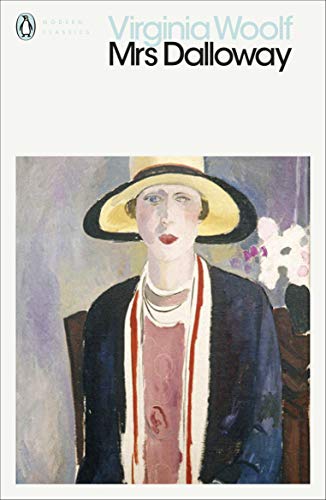
Virginia Woolf, Mrs Dalloway (1925, Penguin Classics 2020) from page 103 to end

As I expected, it took me just two months to read Mrs Dalloway three pages a day. If you haven’t read it, I recommend doing it slowly in just this way: three pages at a time seems to be just about perfect.

The book looks for the person behind the public-facing name Mrs Dalloway, to create a kind of literary cubist portrait: beneath the skin of the upper-crust English lady whose life centres on giving parties for the right people are the remains of a glorious, multi-faceted creature who once lived with grace and passion. We see her from many angles, through the eyes of her husband (who barely sees her), her daughter, a resentful working class history teacher, a maid, a man whose proposal of marriage she rejected in spite of their mutual passion, a woman who was also drawn to her when young, an older aristocratic woman of the type played so splendidly by Maggie Smith, and more

In one way the book is about the disappointment of youthful hopes and expectations. For example, Sally Seton, who once ran naked down the corridors of an country mansion, is now Lady something or other with six sons and insists that she is completely happy. Clarissa herself is married to Richard who is at best a mediocre politician. Peter Walsh, her former suitor, has spent most of his life in India, unhappily married and now caught up in an awkward affair. And quite unconnected to Clarissa until the final pages is Septimus Smith, a soldier returned from the trenches of the ‘Great War’ with what we would now call PTSD. He is haunted by the image of a friend who was killed in the War, and in the end (spoiler alert, but the book is a hundred years old after all) kills himself in desperation. When Clarissa learns of his death, she is playing hostess at her party, to which the whole book has been building. Suddenly she is alone and grapples with thoughts of her own mortality.

I came to the book expecting it to be difficult and a bit airy-fairy. Maybe it is both. The English class system is rock solid in its pages, and though Clarissa is criticised as a snob, the basic viewpoint of the novel can’t be entirely absolved of that charge. But I wasn’t prepared for how much pleasure there is in the way the narrative glides among different points of view, for the almost Whitmanesque celebration of city life, for its laugh-out-loud moments, or, in the end, for the pervading sense pathos in a society and individual souls who have survived the momentous events of a World War and a pandemic. I wasn’t prepared for just how much, sentence by sentence and page by page, I enjoyed it.

it’s hard to pluck a passage out of context, but here is a bit I love. Peter Walsh is watching Clarissa as she escorts the Prime Minister from the party:

And now Clarissa escorted her Prime Minister down the room, prancing, sparkling, with the stateliness of her grey hair. She wore ear-rings, and a silver-green mermaid’s dress. Lolloping on the waves and braiding her tresses she seemed, having that gift still; to be; to exist; to sum it all up in the moment as she passed; turned, caught her scarf in some other woman’s dress, unhitched it, laughed, all with the most perfect ease and air of a creature floating in its element. But age had brushed her; even as a mermaid might behold in her glass the setting sun on some very clear evening over the waves. There was a breath of tenderness; her severity, her prudery, her woodenness were all warmed through now, and she had about her as she said goodbye to the thick gold-laced man who was doing his best, and good luck to him, to look important, an inexpressible dignity; an exquisite cordiality; as if she wished the whole world well, and must now, being on the very verge and rim of things, take her leave. So she made him think. (But he was not in love.)

Yeah, right! He wasn’t in love!

Maybe I should give To the Lighthouse a go.


I have written this blog post in Gadigal and Wangal country. I acknowledge Elders past and present of those clans, and welcome any First Nations readers.

Mrs Dalloway, report 1, and November verse 1

Virginia Woolf, Mrs Dalloway (1925, Penguin Classics 2020)

Since taking nearly two years to read Proust’s À la recherche du temps perdu six years ago, I’ve had a classic slow-read on the go most of the time. When I’ve embarked on one of these slow-reads I regularly come across mentions of the book elsewhere. It’s like that with my current project, Mrs Dalloway.

This month, a friend sent me a link to Zora Simic’s article in The Conversation, Trauma memoirs can help us understand the unthinkable. They can also be art. Here’s an excerpt:

Of all Woolf’s novels, Mrs Dalloway is the one most often read as semi-autobiographical and as a reckoning with unresolved trauma: of England’s in the wake of the first world war, and in the novelist’s own life. <big snip> Woolf has long been a lodestar for writers grappling with trauma – in their lives, and on the page, especially women writers.

Reading the first couple of pages, when upper-class Clarissa Dalloway is out in the early morning shopping for flowers and enjoying the life of the London streets, I couldn’t see much trauma. But then the scene broadens and darkens. By page 103, I’m now reading the book as mainly about aftermaths: Clarissa is recovering from an illness and enduring an unhappy marriage; the War and pandemic are still alive in collective memory; Peter Walsh, freshly returned from a decade in India, is still wounded by having been rejected by Clarissa many years earlier; returned soldier Septimus Smith is wandering London’s streets, hallucinating, suicidal, ‘shell-shocked’ and putting his Italian wife Lucrezia through hell. There’s plenty of trauma to go round.

I’m glad I’m reading this book just a few pages a day. It cries out for sharply focused reading, which I can just about sustain for three pages at a time. Read this way, the book is exhilarating. I had thought it was going to be the stream of consciousness of one upper-class Englishwoman. In fact there’s a whole array of characters, and the narrative voice flits among them. I say ‘flits’ because feels as if the narrator is an elf-like creature (I almost see her as Tinkerbell) who slips in and out of people’s minds, sometimes staying for barely a second, sometimes for several pages. Most of the characters are aristocrats of one sort or another, but not all. Lady Bruton’s maid Milly Brush has definite likes and dislikes as she stands impassively while her mistress entertains three gentlemen for lunch. One of those gentlemen is a bluff middle-class man with pretensions – he knows how to craft a publishable letter to The Times but believes women shouldn’t read Shakespeare for moral reasons. And Richard – Mr Dalloway – makes an appearance, buying flowers for Clarissa and resolving to tell her he loves her (which the reader knows is far too little, far too late). And so on. It’s much more complex, and funnier, than I expected.

Here’s page 78*:

And because it’s November**, here’s a verse drawn from it and the next page:

November Verse 1: Septimus Smith
He might have made a great accountant
but for Shakespeare, Keats and love
that set him scribbling with his fountain
pen all night. 'You need to tough-
en up, play football,' said his mentor.
War changed everything. He went to
fight in France and made a friend,
a cheerful manly friend, whose end
in Italy was sudden, brutal.
Mrs Woolf says War had taught
him not to feel, to set at nought
such loss. Sublime the total
calm he felt. But, come next year,
the sudden thunderclaps of fear.

I have written this blog post near what was once luxuriant wetland, in Gadigal and Wangal country, where I recently saw two rosellas (mulbirrang in Wiradjuri, I don’t know the Gadigal or Wangal name). I acknowledge Elders past and present of those clans, and welcome any First Nations readers.


My blogging practice is to focus on the page that coincides with my age, currently 78.
** Each November I aim to post 14 fourteen line stanzas on this blog (see here for an explanation, though that explanation incorrectly calls my verses sonnets)

Beginning Mrs Dalloway

Virginia Woolf, Mrs Dalloway (1925, Penguin Classics 2020)

I was listening to Christopher Lydon’s Open Source podcast when he interviewed Merve Emre, editor of The Annotated Mrs. Dalloway (Ms Emre is from the US, so her book adds a period to the novel’s name). Their enthusiasm for Woolf’s book made me realise it would be ideal one of my slow reads of the classics.

My introduction to the book was Stephen Daldry’s movie The Hours, which is based on Michael Cunningham’s novel of the same name and stars Nicole Kidman with a prosthetic nose. I’ve vaguely wanted to read Mrs Dalloway ever since, but been just as vaguely reluctant because of a general impression that the writing was beautiful but difficult.

So here goes. At three pages a day, it will probably take about two months. I don’t intend to delve into annotations and footnotes. Mercifully the copy I have from the library doesn’t have a learned introduction. Bearing in mind someone’s description of a classic as a work you cannot encounter for the first time, I’ll inevitably bring preconceptions to it, but I’ll try to read it as if it’s just a novel.

At this stage, six pages in, I’m loving it. I’m also glad I’m reading a few pages at a time, because – so far at least – I’d hate to be rushing it.

Albert Camus’ L’étranger

Albert Camus, L’étranger (1942, Methuen Educational 1970)

A month ago I announced that I was resuming my practice of reading a couple of pages from a classic text first thing each morning, starting with Camus’ L’étranger. The first book I did this with was Marcel Proust’s À la recherche du temps perdu, which took nearly two years. L’étranger has taken a single month.

In some ways, Camus is the anti-Proust. Look at their first sentences. Proust’s vast novel opens with his narrator yearning for his mother to come and say goodnight and then, famously, goes on marathons of introspection; Camus’ Meursault doesn’t make a big deal of his relationship with his mother, he resolutely refuses to perform emotions, and in the end pays a significant price for it. Here are their opening sentences:

Proust: Longtemps je me suis couché de bonne heure. (A long time ago I went to bed early.)

Camus: Aujourd’hui, maman est morte. (Today Mum died.)

It’s not hard to imagine that Camus had Proust’s work in mind, and deliberately did the opposite.

L’étranger is a classic, so I came to it already knowing a version of the plot. Meursault, a white man living in Algeria, shoots an Arab and when put on trial is unable to give a reason for doing it. In the trial much is made of the fact that he didn’t weep or give any sign of emotional upset at his mother’s death just a day earlier, and he is sentenced to death.

What surprised me on actually reading the text is that the murder isn’t completely arbitrary. Somehow I’d got the idea that he just pushes the man off a moving train, but it’s much more complex than that: in fact the shooting is the culmination of a series of encounters.

For me, more shocking than the murder, and more shocking than the fact that Meursault doesn’t weep at his mother’s vigil and funeral, is the way he takes it in his stride when his neighbour brutally beats a woman, and goes on an outing with the neighbour the next day as if nothing has happened.

Meursault’s lack of emotion is mystifying. We don’t like him, or empathise with him, but when his defence lawyer asks the court if he is being condemned to death for killing a man or for not weeping at his mother’s funeral we know that he’s naming something real.

I might have thought this was unrealistic, an existentialist fable, but the memory of Lindy Chamberlain told me otherwise. If not in the courtroom (and that’s debatable), then certainly in the press, she was widely condemned for not having what was deemed an appropriate display of emotion when her baby daughter went missing. Camus would have understood.

In the final moments of the book, when Meursault faces the prospect of the guillotine, he has a conversation with the prison chaplain. After Meursault has monosyllabically rejected the chaplain’s attempts to discuss the after-life, the priest says Meursault has a blind heart, and promises to pray for him. Meursault snaps. His deadpan manner is shattered, and leaping about with rage and joy he declares that nothing matters, that there is no meaning to life. In my reading the key moment comes after the outburst, when calm has been restored:

Comme si cette grande colère m’avait purgé du mal, vidé d’espoir, devant cette nuit chargée de signes et d’étoiles, je m’ouvrais pour la première fois à la tendre indifférence du monde.
[As if that great burst of anger had purged me of evil, emptied me of hope, faced with this night laden with signs and stars, I opened myself for the first time to the tender indifference of the world.]

‘The tender indifference of the world’. The absence of hope does not necessarily produce despair, but an openness to reality. And then, in case we feel that we can welcome Meursault back into the fold of people who behave ‘properly’, his final wish is that there will be a good crowd at his execution who will greet him with cries of hate – that way he will feel less alone.

I have no idea what it would have been like to read this as part of high school French. Would it have vanished from memory as surely as the book we did study, of which I remember only the title, Le drôle. The internet reveals that that is a 1933 children’s book, written by François Mauriac. I suspect that all the two books have in common is that they were written in French by Nobel laureates. Times change, probably for the better.

Beginning Albert Camus’ L’étranger

Albert Camus, L’étranger (1942, Methuen Educational 1970)

My practice of reading a couple of pages from a classic book every morning has been in abeyance since I finished reading Montaigne’s essays in January (final report at this link).

When a copy of L’Étranger turned up in a street library after Camus had cropped up in other reading – The Incorrigible Optimists Club and The Visionaries – I took it as a sign from the universe. I’ve read quite a lot about Camus, but not anything by him, except in excerpts and perhaps a play whose name I don’t remember. [Added later: I did read The Plague when I was 19, at my older brother’s bidding. I think I failed to think of it because I read it before I knew anything about Camus or existentialism, so it’s stored in a different file in my memory.]

My copy of the book has a protective plastic cover and the pencilled name of a former 6th form owner. There are pencilled notes on translation, but only on the first four pages (either her French got a lot better or she decided it wasn’t worth the effort to write). It also has some pedagogical apparatus – an introduction, a vocabulary, and a bibliography of critical studies, all of which I intend to ignore as far as possible.

I’ve just read Camus’ short avant-propos from 1955 in which he says that his protagonist, Meursault, becomes an outsider because, unlike the rest of us, he does not lie by exaggerating his feelings (‘majorer ses sentiments‘). Tomorrow morning I’ll start the text itself, and will report back in a month’s time.