
Niall Williams, The Fall of Light (Picador 2001, Picador ebook 2010)
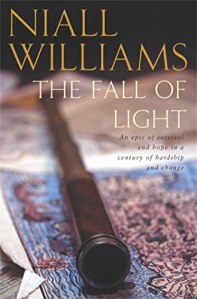
Before the meeting: The group has previously enjoyed three Niall Williams novels (my blog posts here, here, and here). This month’s chooser decided that we couldn’t have enough of this good thing.
The other novels have been set in the fictional Irish town of Faha. In so far as this one centres on a particular place, it is the real-life Scattery Island in the estuary of the Shannon River, though the action also wanders over three continents. According to a foreword, the novel is a family story that has passed down through generations, embellished on the way.
The story unfolds in 19th century Ireland. In the context of longstanding, brutal English occupation and the devastating potato famine, we follow the travails and adventures of the Foleys. First Emer the mother leaves. Then her husband Francis and their four sons set out across the width of Ireland, on what they see as an epic quest, seeking a new life in the West, in Galway. First Francis is swept away by a river in flood. Then the brothers are separated. Tomas the eldest falls catastrophically in love and flees for his life with his beloved. Of the next two brothers, twins, Finan finds his way to Africa, and Finbar becomes the leader of a community of Gypsies. The youngest brother, with the deeply Irish name Teige, has an uncanny facility with horses that opens possibilities for him. It’s all told in wonderfully musical prose with a touch of what you could call Celtic magic realism.
The family is dispersed – to Africa, to continental Europe, and to North America. The book is most vibrantly alive in the Irish sections. Finan’s life in Africa is told briefly at third hand. Finbar’s adventures with the Gypsies (probably not what they’d be called if the book were written now) left me unconvinced, though there are some wonderful moments, of which my favourite occurs when Finbar, who has waited outside the caravan where his partner was in labour, calls out, ‘How is my son?’ The midwife replies:
‘Your son has no penis.’ She watched as all the fathers’ heads came up and their eyes opened and their mouths dropped and there was a kind of moan that passed among them like a wind.
‘No penis! But two heads!’ she shouted, and bought her hands up to the sunken sides of her leathery face and leaned back and hooted a kind of hoo-hoo of owl-like laughter to the astonishment of all.
When I told a version of that to my grandchildren they were quick to guess that there were twin girls.
Two sons end up in North America. The westward trek in the USA, paralleling the one in Ireland, is a different kind of desolation – a solitary Meek’s Cutoff. But, like the Gypsy story, these sections lack the Irish sections’ vivid sense of place and I was always glad when the narrative returned to Ireland.
Though I infinitely prefer to read books in hard copy, I had to content myself this time with an ebook from the library. Where page 79* falls depends on your settings, but in my reading it occurs at about the one-third point. Francis and Teige, father and son, have been reunited against all odds. (You might have guessed that the shape of the story is separation and then arduously achieved, partial reunion.) After some time together Teige tells Francis that he has done what they all set out to do in the first place – he has seen the sea, and gone into it, even though he was afraid of its wildness. The father says he was ‘right to try it and keep well out of it’:
Another pause, then Teige added: ‘I didn’t though.’
‘You didn’t?’
The pony flicked her head. Her tail swished. The boy looked at her a moment and felt his father’s eyes upon him.
‘No,’ he said, ‘I still went in, three times.’
The father said nothing then. He sat there and the emotions he held made his lips quiver. He blinked. Dark clouds moved across the sky. The night fell and the stars came and went and wheeled above them and each lay down to the slender hope of their dreams.
This kind of interplay between understated dialogue, big emotions and romantic descriptions, all framed in a mild mockery, is one of the joys of the book. ‘The father said nothing then.’ We have followed Francis’s narrow escape from drowning, so know what lies behind his quivering lips and blink. Maybe the dark clouds and the stars are there to mark the passage of time, but they are also a way of showing the thing that can’t be said by these inarticulate characters: for Francis, the realisation that his son has dared to go into the ocean marks a great shift in his own emotional state. It lends strength to ‘the slender hope’ of his dreams.
You might wonder what that pony is doing there, flicking her head and swishing her tail. Teige has calmed her down and ridden her in a race for the Gypsies, after which she has become his steadfast companion. He is forever moving close to nervous horses, stroking them and speaking to them in language that isn’t quite words, calming them and coaxing them to do what their owners require. It’s an almost magical power that places him at the emotional heart of the book.
This stage of the narrative is a journey. Francis is looking for what will come to be known as Scattery Island – monks who saved him from drowning have given him directions. Both he and Teige are seeking the other sons and their mother.
Still on page 79:
The following day when they were passing a cottage a cry stopped them. The cottage was not unlike others, a small building of dark stone with crooked windows and a door open to the road even in that February. The cry was that of a woman, it came from the garden beyond. The Foleys stopped, the pony flicked her ears. Then Francis called out. There was no response and Francis looked to Teige who slid down the pony. Together they walked in around the cottage and found in a small garden a woman of fifty years trying to pull up from the earthen ridges the fallen body of her husband.
The landscape they travel through is full of suffering and death. Mostly there’s a generosity of spirit among the sufferers. Here Francis and Teige don’t hesitate before they stop to help, and in the nature of fairy tales – or family stories that have been polished and decorated by generations of telling – when they help this couple and their children they gain information that leads them forward dramatically in their quest.
I’ve mentioned Scattery Island a couple of times. The real-life island at the mouth of the Shannon River is better known as Inis Cathaigh (the link is to its Wikipedia page). It became a place of safety for a community of pilots during the Great Famine. How Francis and the other Foleys relate to that actual history is a beautiful invention.
The meeting: We met, unusually, in a pub. It was a beautiful space, though noisy, which made it hard to maintain a single conversation, even with the music turned down. we displaced a women’s baseball team (‘We don’t usually come to the pub on a Tuesday night in our uniforms’) and were displaced in turn by a group of young women toting laptops.
We had a terrific discussion of the book.
A number of us confessed that they had come to the book reluctantly. We’ve read three of his books already. Do we have to read one more? For some, it came alive when the famine appeared. For others, it was the language from the very beginning. I don’t think anyone wasn’t won over completely.
To generalise, we were all willing to forgive its faults because the story rattles along brilliantly, and the writing is wonderful. We differed on what the faults were. One man couldn’t bear the unrealistic elements of the romance between Teige and a wealthy Englishwoman – others (me included) were charmed by its improbabilities. Some loved the sequence where all the Gypsy women give birth on the same day, whereas other (me included) were irritated by the artifice. We were all, I think, unenthusiastic about the North American sections, and even more so by the almost perfunctory treatment of the brother who goes to Africa.
Someone pointed out that it’s a book about men, that the women aren’t fully developed characters. (This observation casts an interesting light on the midwife’s joke I quoted above – the character’s assumption that a baby is a sly indication that the narration knows its male-centredness leaves out a lot.)
At the end of the book, the narrator reveals that Teige is his ancestor. Some of us took this to be an authorial statement – and an explanation for why the narrative is less ‘tight’ than other Williams novels: this is a version of his own family story, so was obliged to go where the actual history had gone, even if fancifully. I’m inclined to think the narrator is separate from the author.
Someone observed that the book is suffused with love, especially love among the Foley men. we agreed that this is true of the book, and it led to a number of us telling stories about their siblings, mainly brothers. There was a theme of connections being lost or broken and re-established after a period. I didn’t realise it at the time, but this was an astonishing echo of the book’s shape.
One question remained unresolved. How do you pronounce ‘Teige’. Everyone except me rhyme it with ‘intrigue’. I hear it as ‘tyke’ but with a soft end. Opinions welcome in the comments.
The Book Group members are all men of settler heritage. We met on Gadigal land. I wrote this blog post on the land of Gadigal and Wangal of the Eora Nation. I acknowledge Elders past and present and welcome any First Nations readers of the blog.
* My blogging practice is focus arbitrarily on the page of a book that coincides with my age, currently page 79.


