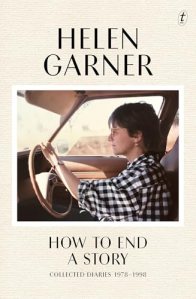
A generous friend gave me this whopping tome for my birthday this year.
Someone said, ‘It’s a book you dip into rather than read from start to finish.’ But I’m not much of a dipper, so I’ve decided to take it on as a slow read – five pages a day for six months or so. I loved doing that with Seamus Heaney’s letters. Why not with Helen Garner’s diaries?
The diaries were originally published in three volumes: Yellow Notebook (2019), One Day I’ll Remember This (2020), and How to End a Story (2021), covering the years 1978 to 1986, 1987 to 1995 and 1995 to 1988 respectively.
From what I’ve read elsewhere, I understand that Garner kept diaries for decades before the entries that begin Yellow Notebook, but she burned them all, and decided in 1978 to write readable diary, not necessarily for publication, but with attention to the crafting of sentences. Four decades after starting the first proper diary in a yellow notebook acquired for the purpose, she decided to publish, with minimal alterations, and none to spare her own feelings.
I’ve just read the first five pages. My initial response is to feel a little deprived that the entries aren’t dated, and people are identified only by a single initial. Any information about what relationship people have to Garner is to be deduced from the text – which is an odd bit of false reticence when of the two character mentioned so far one is clearly Garner’s daughter and the other seems to be a lover whose identity I imagine would be easy to discover. Similarly, there is no scaffolding to say where an entry was written: on the first pages Garner is feeling alone in a city, and only gradually does it merge that she’s in France, probably in Paris.
I’m probably just missing Christopher Reid’s helpful annotations in the Seamus Heaney book, and I’ll get used to this bare approach.
I hope to write a first monthly report towards the end of May.
I am a man of settler heritage who has been alive for almost a third of the time elapsed since Arthur Phillip claimed this continent for the British crown. I wrote this blog post on the land of Gadigal and Wangal of the Eora Nation. I acknowledge their Elders past and present and welcome any First Nations readers.
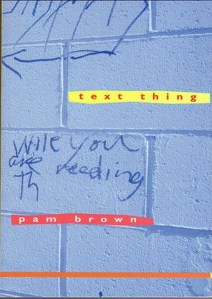
Since 1972, Pam Brown has published 23 books of poetry and almost as many chapbooks (chapbooks are tiny books of poetry, mostly too small to be given an ISBN). She has won major prizes, been an editor including for Jacket and Overland, and is a generous reader of other people’s books.
I enjoy her poetry, but I’m perplexed when it comes to writing about it. Before sitting down to write about Text Thing, approximately her eighteenth book, I looked back over my blog to see what I’d already written. It turns out there’s quite a lot, much revealing the extent of my ignorance about contemporary poetry. If the spirit moves you to read them, here are links to my encounters with Selected Poems 1972–1981, True Thoughts (2008), Home by Dark (2013), Missing Up (2016) and Stasis Shuffle (2021).
There are plenty of places you can go for illuminating accounts of Brown’s poetry. I especially like her 2003 interview with John Kinsella in Jacket2 where he memorably suggests that she has created her own subculture. Among many interesting things in that interview, she says something that’s relevant to page 79* of this book. Referring to the way her poems often include the names of friends without explanation, Brown says:
The … thing is that they’re signifiers. And somehow it’s also a call for community. That sounds corny and old-fashioned but poetry is a marginal art and we’re like the black market of culture — it lends a freedom to do that… include real people, names…
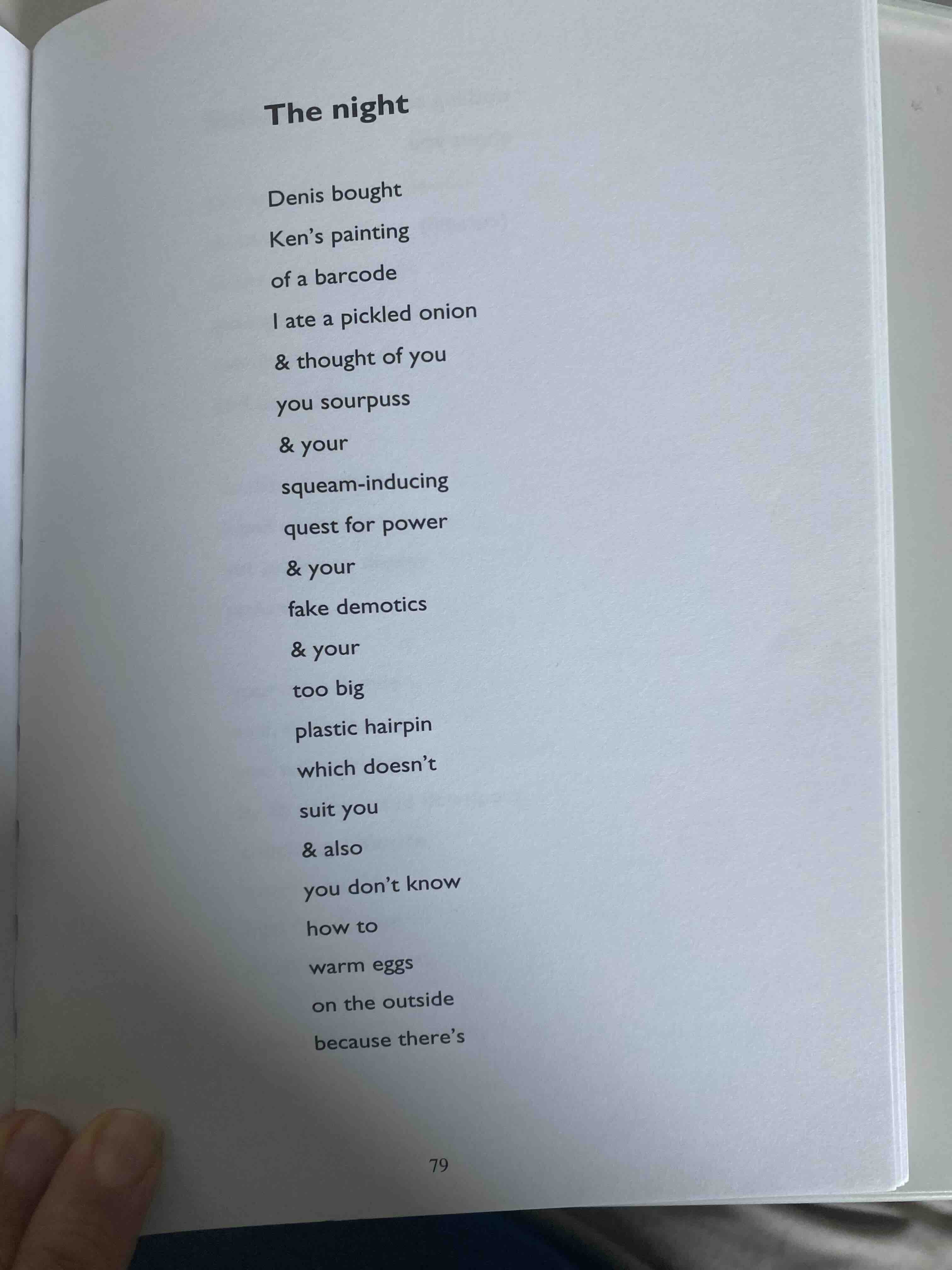
The poem that begins on page 79 is ‘The Night’:
And there are three lines over the page:
nothing cosy
about you.

(curses!)
This poem is uncharacteristically straightforward. Including the title, it consists of a single sentence whose syntax is almost simple enough to meet a primary schoolteacher’s specifications, followed by a one word exclamation. The poem’s speaker eats a pickled onion and is reminded of a friend (or perhaps a frenemy or a former lover?). She indulges in a little rant addressed to that person.
It makes me laugh and I’m not exactly sure how.
Maybe the poem invites me to imagine it being read by the person it’s addressed to. Would she/they (I’m assuming it’s not a man) be amused? Defensive? Dismissive? Retaliate in a poem of her own?
Having now read it a number of times, I realise that there’s quite a lot going on.
The night

Denis bought
Ken's painting
of a barcode
I ate a pickled onion
This opening clause sets the scene. I imagine the opening night of an art exhibition in a small gallery. Art is on sale and there are snacks, including pickled onions. ‘Ken’ is almost certainly Ken Bolton, poet and painter, named on the imprint page as the publisher of this book artist Ken Searle [see comment from Ken Bolton] . ‘Denis’ is probably a real person too, but his identity doesn’t matter, any more than that of the poem’s ‘you’ does. What does matter is that all four people in the poem – ‘I’, ‘you’, Ken and Denis – are on first-name terms, and seem to belong to some kind of creative community – perhaps Brown’s ‘black market of culture’. Only when I read the poem out loud (to the long-suffering Emerging Artist) did I realise that there’s a lovely contrast between the briefly mentioned masculine, transactional world of buying and selling where even the artwork is an emblem of commerce, and the feminine, relational world of the rest of the poem.
I ate a pickled onion
& thought of you
you sourpuss
Is it ridiculous of me to compare Brown’s pickled onion to Proust’s madeleine? Probably. But the taste of this pickled onion, like the smell of the madeleine, transports the poem’s speaker from the external world to the internal one of emotion-charged memory. The word ‘sourpuss’ explains the connection. Then there’s something disarming in the string of qualities, each introduced by an ampersand, with the attention-grabbing words ‘squeam’ (which Merriam-Webster says is a back formation from ‘squeamish’) and ‘demotics’ (which in this context I take to mean the adoption of working-class manners and language, like a recent Australian Prime Minister giving himself an Aussie-sounding nickname). There’s a nice comedy in the transition from criticising an off-putting quest for power and calculated manner to a silly schoolyard insult:
& your
squeam-inducing
quest for power
& your
fake demotics
& your
too big
plastic hairpin
which doesn't
suit you
You almost expect that to go ‘which doesn’t / suit you / anyway‘ with a teenage emphasis. The first two insults carry the ring of truth. The third reflects back on the speaker.
Learned people refer to Pam Brown’s gift for sprezzatura, a casual appearance that conceals the work that went into it. The veering off in the next line – the fifth to start with an ampersand – is a nice example. I can’t read the opening ‘& also’ without thinking of an angry teenager. Brown’s world of allusion is almost certainly more sophisticated than mine – but I think of Mary-Anne Fahy’s gum-chewing Kylie Mole from the 1990s. (Come to think of it, this book was published in 2002, so Kylie Mole may well have been in Brown’s mind.) So it feels like an easy, natural follow-on from the big plastic hairpin. Then, as if it’s a perfectly natural next step, the poem turns into an intimate attack:
& also
you don't know
how to
warm eggs
on the outside
Well, maybe it’s not explicitly intimate, but the lines do suggest a shared domesticity in the past. I’m not sure what it means to ‘warm eggs / on the outside’. This conjured in my mind in image of hands holding eggs gently, imparting body heat to them. Why anyone would want to do that, or why not knowing how to do it was a moral failure wasn’t immediately clear. Then I reflected that if you’re baking a cake, a pavlova, or even an omelette, it’s a good idea to let the eggs warm up for a while ‘on the outside’ of the fridge: so there’s a practical meaning. But – for me at least – the image of motherly, protective, feminine warmth persists. And that justifies the final twist of the knife:
because there's
nothing cosy
about you.
I’m not usually one to notice perfectly conventional punctuation, but I love that full stop at the end. Back in 2002, Millennials probably weren’t yet expressing horror at Boomers’ ending text messages with a full stop, which they saw as unreasonably aggressive. This one fits their reading perfectly.
The full stop may the end of the rant, but it’s not the end of the poem:
(curses!)
The exclamation is a response to everything that has gone before. I love how many ways it can be read: ‘(Did I really just say that?)’, ‘(Do I still have all these feelings about her?)’, ‘(I was having such a nice time before I bit that pickled onion!)’, ‘Why did I ever let her into my life?)’. Or: ‘(And now I hurl curses in your direction!)’, ‘(I’ll sum it all up in the one word!)’. Given that Pam Brown often quotes from other poets and popular culture, or even odd bits of graffiti or commercial copy, it doesn’t seem wrong to hear an echo of comics like Popeye here. No time at all on Google gave me an example.
That’s just one poem. If I were to find a way that it’s representative of the whole book, I’d say it’s something about interruption. The cover illustration, attributed to Kurt Brereton, is of graffiti that reads ‘wile you are reeding th’. The book is full of interruptions, asides, distractions. ‘The Night’ can be read as being about one more distraction. But such a rich one!
I am a man of settler heritage who has been alive for almost a third of the time elapsed since Arthur Phillip claimed this continent for the British crown. I wrote this blog post on the land of Gadigal and Wangal of the Eora Nation. I acknowledge their Elders past and present and welcome any First Nations readers of the blog.
* My blogging practice is to focus on the page that coincides with my age, currently 79.
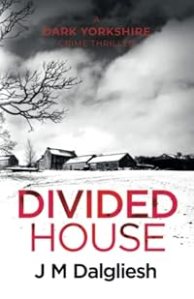
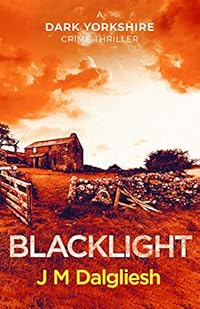
J. M. Dalgliesh, Divided House and Blacklight (both independently published 2018), 2019 audiobook narrated by Greg Patmore
On long car trips, I used to read while the not-yet–Emerging Artist drove. Now, my vocal cords have lost stamina, we have fallen back on audiobooks. For our recent trip to Brisbane, we picked the first instalment of the Dark Yorkshire series – three novels in all. We managed to listen to two of them. We were under the vague impression that we were about to listen to some P. D. James novels featuring her detective Adam Dalgleish. We were wrong.
J. M. (not Adam) Dalgliesh is evidently one of the top ten best-selling authors on Amazon, and Dark Yorkshire was his first, extremely popular series.
In the first book, Divided House, Detective Inspector Nathaniel Caslin has to deal with dead bodies, a cyber-pornography set-up, corrupt colleagues, distrust from his superiors based on past honourable rule-bending, a curmudgeonly inability to deal with digital media (which makes it a surprise to learn he is only in his thirties), a marriage that is falling apart, and all the tropes of a good crime thriller.
This is the kind of storytelling that is consumed rather than engaged with in any reciprocal way. These days I consume it almost exclusively on screen, and mostly the small screen.
The plot is a bit too convoluted for my travel-weary attention span. Award-winning narrator Greg Patmore does a fine job for the most part, though I would have preferred that he didn’t try so hard to give each of the many characters a different voice, especially the women. It seemed that he was focusing on the women characters’ femininity at the expense of other qualities, by speaking in almost-falsetto. I occasionally had to remind myself that the woman character Caslin finds himself attracted to isn’t written as trans – she just sounds that way.
Caslin is also the hero of the second book, Blacklight. This time he’s dealing with a serial killer, and/or MI5. Not my favourite story type. But he does have a female partner, and once I accepted Greg Patmore’s version of a woman policeman’s voice, her bristly relationship with Caslin added some humour to proceedings.
J. M. Dalgliesh’s website has this to say about his books:
Penned in the style of crime thrillers with a touch of Scandinavian noir, readers who enjoy dark atmospheric mysteries will find his books a must-read.
If you can ignore the image of penned readers conjured up by the syntax of that quote, then these books may be for you.
David Malouf died on Wednesday. You can read a lot about him elsewhere. The Guardian, for instance, has an excellent obituary by Jennifer King, and a personal reflection from Christos Szoltas. In blogland, Lisa at ANZ Litlovers Litblog has posted an overview of his work. This post is a much more partial thing.
My mind is buzzing with memories of the man. I can’t claim him as a friend, but I first met him more than 50 years ago and have had memorable encounters with him over the years. I want to write about some of them before numbing grief sets in.
I was an EngLit student at Sydney University in the late 1960s when David came back to Australia after some years in the UK. He was a wonderful lecturer who communicated his enthusiasm and love for the writers he was discussing. I remember the delight and awe with which he described Norman Mailer’s sentences – long, looping, sometimes going on for more than a page. I remember him discussing images of food in one of the Jacobean playwrights, bringing out the horror beneath the comedy of the characters’ greed: I don’t think he used the words capitalism or colonialism but he made us feel them – or at least he made me feel them, because he told me after the lecture that he’d seen me looking more and more nauseated as he spoke.
At poetry readings, I remember feeling his translations of Horace as a gift. They spoke of morning light glinting off milk churns beside a country road. I’d studied Latin for years, and loved Virgil and Catullus, but it hadn’t occurred to me until then that the Roman poets wrote about experiences very like ours – mine.
In my two years as a postgrad student I saw more of him. I loved the way he used four-letter words, with the same precise enunciation as he used with all language. I loved his glee when he told an anecdote about Philip Roth, then notorious for the novel Portnoy’s Complaint: a woman who was introduced to Roth at a cocktail party shuddered when he offered to shake hands, and said she’d rather not. And I loved this erudite man’s childlike hilarity when he told us about coming out of a movie and seeing that an academic colleague friend had spilled chocolate ice cream all down his white shirt front.
When he was living in Tuscany and I was planning a trip there, in early 1979, somehow I had a conversation with him. He said that if I went to Campagnatico and asked for il professore Australiano, someone would show me the way to his door. (While I may have been bold enough to propose a visit, I didn’t have the gall to actually knock on his door.)
One day in 2015, I was walking up Broadway in Sydney’s inner west when I saw a man in a grey tracksuit coming towarsds me. He looked like David Malouf, but I had never seen him other than impeccably turned out. Indeed it was him, and the first thing he said was that he had realised he was running late for a poetry reading at Gleebooks and didn’t have time to change into decent clothes. I may be conflating two meetings on Broadway, but I’m pretty sure that that is also the occasion when he showed me his right hand covered in blood. He had been holding a bleeding spot on his left arm. Alarmed, I produced a handkerchief, but it had obviously been used for other purposes and he politely declined the offer. ‘It’s not a big deal,’ he said. ‘when you’re old, you bleed easily.’ He was 81. I’m now 79 and I can confirm that he was right. ‘Besides,’ he said, ‘if I go home to Chippendale with blood on my hands like this, it might be good for my reputation. They’ll think I’ve murdered someone.’ And then, even as he was bleeding and embarrassed to be seen in public in tracky-daks, he chatted appreciatively and illuminatingly about the poetry he’d just heard, some of which couldn’t have been further from the kind of things he wrote himself.
Four or five years ago I was on holiday on Magnetic Island and caught the ferry across to Townsville to go to a reading by David at the Mary Who? bookshop. He read beautifully, as always. In question time, a woman wearing a ‘No More Coal’ t-shirt commented, with more than a touch of reproach, that there were surely more important things to write about than memories of childhood. ‘What,’ she asked, ‘do you think are the important things poetry should be addressing.’ Without missing a beat, he said, ‘I think the most interesting thing in the world is a three year old child.’ At that age, he said, a person is just looking out at the world and putting together their own model of what’s there, and it’s fascinating to witness.
A poem that I’m pretty sure he read on that occasion, and that I heard him read many times over about two decades, is ‘Seven last words of the emperor Hadrian’. He always presented it almost as a technical exercise: the full meaning of the Latin couldn’t be captured in a single translation, so he had seven goes at it. What I didn’t hear him say is that the poem struck a deep chord for him as his own mortality made itself felt. I’ve just listened to a recording of him reading it on the University of Queensland website. Have a listen at this link.
David wrote Quarterly Essay number 41, The Happy Life. I happened to run into him soon after the correspondence on it was published in the subsequent issue. I remarked that it was interesting that all the correspondents wrote about how beloved he is. ‘Yes,’ he said, deflecting effortlessly, ‘it wasn’t the kind of essay they’re used to and they didn’t quite know what to do with it.’
Now I, and you if you want, can say how much we have loved him, and he can’t deflect any more.
No longer the Premier’s Literary Awards, the NSW Literary Awards shortlist has been announced. As usual, I’ve read or seen very few of them (I’ve included images of those)and have a couple more on my TBR shelf. The State Library of NSW website is a little unwieldy – here’s the list in more accessible form. All the links are to the library’s site, including the judges’ comments.
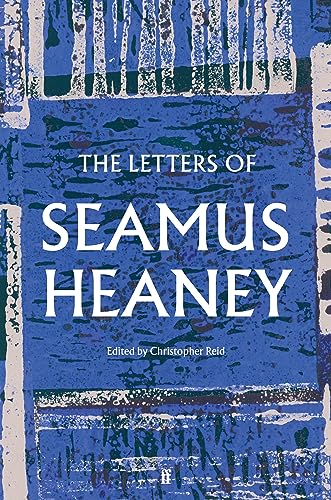
I’m sad to have finished my daily reading of Seamus Heaney. Though very few if any of the letters in this 800 pages were written with publication in mind, Christopher Reid has gathered them into a wonderful book.
In his last years, Heaney is still apologising for the lateness of his replies to other people’s letters or gifts of books. His excuses are generally wonderful – lists of lectures and readings given, honours received, holidays taken with his wife Marie. Sometimes he encloses a poem. In his final years he complains that he hasn’t been able to write any poetry. He seems cheerfully resigned to having to ‘stand on his hind legs’ and be a famous poet. More than once he explains that he won’t attend an event where a friend is being honoured because he has found that – because of ‘the N word’ – his presence tends to steal the limelight. (Do I need to explain that in this case N is for Nobel?)
He replies generously to graduate students asking him if they’re on the right track. His letters to translators are fascinating. He does a spectacular job of refusing requests without giving offence. He is a wonderful model of how to respond to other people’s writing. He struggles to protect his privacy and that of his family, to avoid the commodification of his personal life that must seem inevitable to many people who become famous. He is reluctant to give interviews about his book Human Chain, because some of its poems are more intensely personal than previous ones: he knows the interview will ask about these personal things, and he won’t go there.
As the decades pass, he increasingly types his letter on a laptop, sometimes offering the excuse that his handwriting has gone all wobbly as a result of a stroke. But he doesn’t use email. I think I’m right that there is only one electronic communication in the book, which is the text he sent to Marie when he was being wheeled into the operating theatre, just before he died:
Noli timere
Reid gives the translation, ‘Don’t be afraid,’ and tells us that the text went viral. But he leaves the reader to savour the way this final message epitomises so much of the book. It feels like a biblical quote – the first thing Jesus said after his resurrection was ‘Noli me tangere’. And though Heaney was no longer a practising Catholic, the language, imagery and stories of his Catholic childhood were still at the heart of his creativity, and often turn up in his correspondence. Latin was part of that, and important in its own right: he would often write ‘Gaudens gaudeo’ in a letter when there was reason to celebrate, and he translated Book 6 of the Aeneid in his last years.
Most movingly, this final text is addressed to Marie. She has been a constant presence, through marriage, parenthood, illness striking both of them, her occasionally mentioned creative endeavours. When the letters mention holidays, ceremonial occasions, social events, it’s often ‘Marie and I’. He quotes her opinions. She is intimately part of who is is. And this is the only time in the book that he speaks to her.
I’m going to miss my daily contact with this lovely mind.
I have written this blog post, punctuated by a walk by the beach in a windy darkness, face pricked by flying sand particles, on Awabakal country. I acknowledge Elders past and present, and welcome any First Nations readers.
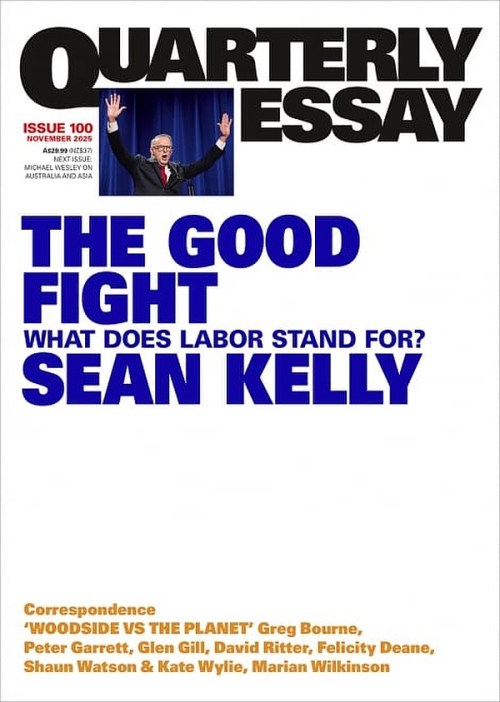
The subtitle of this Quarterly Essay seems even more relevant now than it did three months ago when it was published, as our Labor governments make mealy mouthed statements of concern about the ongoing genocide in Gaza or the genocidal rhetoric emanating from the White House and the Pentagon, give the go-ahead to climate vandalism by fossil-fuel companies, follow right-wing advisers in responding to the horrific killing of Jews in Bondi last year, come down hard on protest – oh, you name it!
But I was glad that the essay was more than a prolonged wail about Anthony Albanese et al‘s timidity or worse, perfidy. Instead, it’s a thoughtful essay in the original sense of the word, an attempt – Kelly starts out with a question that he doesn’t know the answer to, and he still doesn’t have a definite answer by the end. And my practice of holding off on reading Quarterly Essays until I can read the correspondence in the following issue paid off beautifully.
Kelly is a Labor man, adviser to former Labor Prime Ministers. Like Anthony Albanese he had a working class Catholic childhood. He tells us briefly that he knows Albanese, and likes him – enough to refrain from the fake-familiarity of nicknames. He frames his discussion as the inevitable tension between ideals (call them beliefs) and pragmatism (things you have to do to stay in government). He argues convincingly that it’s a mistake to adopt a strategy of going slowly with reforms in order to hold onto government long enough to make substantial change. The Whitlam government moved fast, he points out, and came a cropper, but it changed Australia society. Albanese’s assertion that he wants Labor to be the natural party of government, that he wants it to represent all interests, sounds good, but it’s largely a formula for futility.
There is an interesting discussion of the decline of the two-party system. The current impressive degree of unity in the ALP, Kelly argues, is not a good thing. Vigorous debate is a way of refining policy, and the ALP has outsourced the arguments from the left to the Greens, where they can be dismissed as hostility. The current disarray in the Coalition is not useful either – if a good part of Labor’s raison d’être is in ‘fighting Tories’, to use Albanese’s phrase, where do you go when the Tories are doing it for you?
Page 47* quotes Graham Freudenberg, legendary speechwriter for Labor leaders including Gough Whitlam and Bob Hawke. He described the ALP as ‘a collective memory in action’. Kelly comments:
That collective memory, driven by emotion, has inevitably harked back to Labor’s longest period in government: a period in which Labor won the approval of the Australian people at five successive elections, and for which it has since garnered much praise, including from its usual critics.
He is talking about the Hawke-Keating government. The current Labor government, he argues, is striding away from what it sees as the failures of its most recent predecessors and moving towards the ‘glittering memory’ of those years:
Hawke and Keating are both Labor heroes for good reason. Their government introduced Medicare, saved the Franklin River, acted on the High Court’s land rights judgment.
But, he goes on, they also deregulated the economy in ways that the right would have been proud of, and this is what they are mostly remembered for. On page 80, he laments:
The remarkable fact is that Labor, which has historically been so good at mythologising its past, has in this case effectively allowed the right to choose what will dominate its collective memory.
Keating’s personal boldness haunts this essay. Kelly quotes him in his final pages saying that ‘great political leaders have the instincts of artists’:
I always believe in leadership there are only two ingredients: imagination and courage.
This idea should be taken seriously, Kelly says:
I think it should be taken particularly seriously because of the way we have more lately come to think of politicians as technocrats, types of elevated bureaucrats.
We can sense artistic heat in Albanese, he says, but he doesn’t say – he doesn’t have to say – that Albanese is more commonly seen as fitting the technocrat, elevated-bureaucrat description. Then, with an almost Montaigne-like swerve, he discusses the writer Ella Ferrante’s creative process, ending the essay with this paragraph:
After establishing a consistent tone, she breaks out of her calmness. There is, she admits, a risk: that the calm will not be able to be recovered. or that the readers will no longer believe in that calm. But it is that risk that gives her writing life.
Correspondence in Quarterly Essay 101 (Blind Spot by Michael Wesley) is well worth reading. The learned correspondents correct Kelly on a number of facts. The one that stands out for me is Judith Brett, whose contribution is in effect a brief and enlightening essay on the word ‘socialism’:
What socialism has meant in Australian political debate has not been opposition to capitalism but belief in the creative and ameliorative capacities of the state to reduce inequality and advance the common good.
There’s quite a bit more, all worth reading, but it’s tangential to Kelly’s central argument. That is, he may be wrong when he says that Albanese has abandoned Labor’s socialist objective by catering to business interests, but his concern stands, and in his reply to correspondents he has interesting things to say about Albanese in relation to that formulation.
The other correspondents include a number of Labor insiders, but it rises well above the inside-baseball dangers of such discussions. They have interesting things to say about the history, about Kelly’s philosophical questions, and about the special dangers of the present moment.
I’ll give the last word to Kelly, whose final question, sadly, suggests an answer in the negative:
The correspondents agreed this was a strange time. I think so too. But it is possible that all of us are wrong: that this is not a special moment, but another moment of change and turmoil in an endless series. We think our era is unique, but we are – like most of those before us – wrong. In that case, Albanese Labor will be graded the way most Labor governments are: did it contribute to the improvement of Australian society in ways that are permanent and important?
I am a man of settler heritage who has been alive for almost a third of the time elapsed since Arthur Phillip claimed this continent for the British crown. I wrote this blog post on the land of Gadigal and Wangal of teh Eora Nation, where the nights are lasting longer but the days are still warm. I acknowledge their Elders past and present and welcome any First Nations readers of the blog.
* My blogging practice is to focus on the page that coincides with my age, currently 79. When, as in this Quarterly Essay, there is no page 79, I revert to ’47, my birth year.