
Sean Kelly, The Good Fight: What Does Labor Stand For? (Quarterly Essay 100, 2025)
– plus correspondence in Quarterly Essay 101
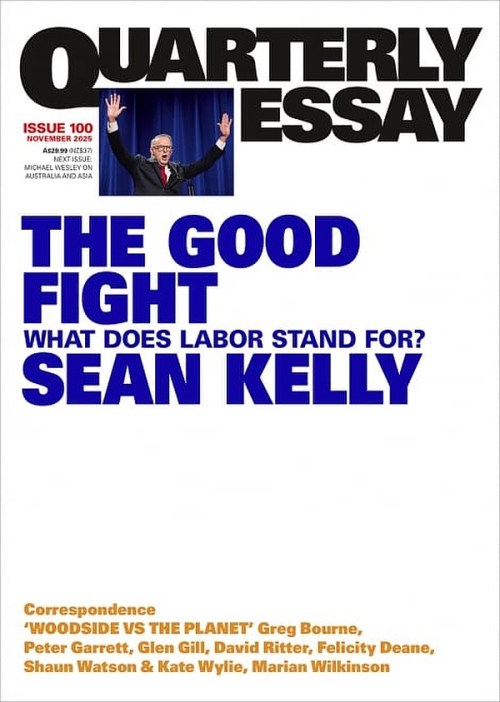
The subtitle of this Quarterly Essay seems even more relevant now than it did three months ago when it was published, as our Labor governments make mealy mouthed statements of concern about the ongoing genocide in Gaza or the genocidal rhetoric emanating from the White House and the Pentagon, give the go-ahead to climate vandalism by fossil-fuel companies, follow right-wing advisers in responding to the horrific killing of Jews in Bondi last year, come down hard on protest – oh, you name it!
But I was glad that the essay was more than a prolonged wail about Anthony Albanese et al‘s timidity or worse, perfidy. Instead, it’s a thoughtful essay in the original sense of the word, an attempt – Kelly starts out with a question that he doesn’t know the answer to, and he still doesn’t have a definite answer by the end. And my practice of holding off on reading Quarterly Essays until I can read the correspondence in the following issue paid off beautifully.
Kelly is a Labor man, adviser to former Labor Prime Ministers. Like Anthony Albanese he had a working class Catholic childhood. He tells us briefly that he knows Albanese, and likes him – enough to refrain from the fake-familiarity of nicknames. He frames his discussion as the inevitable tension between ideals (call them beliefs) and pragmatism (things you have to do to stay in government). He argues convincingly that it’s a mistake to adopt a strategy of going slowly with reforms in order to hold onto government long enough to make substantial change. The Whitlam government moved fast, he points out, and came a cropper, but it changed Australia society. Albanese’s assertion that he wants Labor to be the natural party of government, that he wants it to represent all interests, sounds good, but it’s largely a formula for futility.
There is an interesting discussion of the decline of the two-party system. The current impressive degree of unity in the ALP, Kelly argues, is not a good thing. Vigorous debate is a way of refining policy, and the ALP has outsourced the arguments from the left to the Greens, where they can be dismissed as hostility. The current disarray in the Coalition is not useful either – if a good part of Labor’s raison d’être is in ‘fighting Tories’, to use Albanese’s phrase, where do you go when the Tories are doing it for you?
Page 47* quotes Graham Freudenberg, legendary speechwriter for Labor leaders including Gough Whitlam and Bob Hawke. He described the ALP as ‘a collective memory in action’. Kelly comments:
That collective memory, driven by emotion, has inevitably harked back to Labor’s longest period in government: a period in which Labor won the approval of the Australian people at five successive elections, and for which it has since garnered much praise, including from its usual critics.
He is talking about the Hawke-Keating government. The current Labor government, he argues, is striding away from what it sees as the failures of its most recent predecessors and moving towards the ‘glittering memory’ of those years:
Hawke and Keating are both Labor heroes for good reason. Their government introduced Medicare, saved the Franklin River, acted on the High Court’s land rights judgment.
But, he goes on, they also deregulated the economy in ways that the right would have been proud of, and this is what they are mostly remembered for. On page 80, he laments:
The remarkable fact is that Labor, which has historically been so good at mythologising its past, has in this case effectively allowed the right to choose what will dominate its collective memory.
Keating’s personal boldness haunts this essay. Kelly quotes him in his final pages saying that ‘great political leaders have the instincts of artists’:
I always believe in leadership there are only two ingredients: imagination and courage.
This idea should be taken seriously, Kelly says:
I think it should be taken particularly seriously because of the way we have more lately come to think of politicians as technocrats, types of elevated bureaucrats.
We can sense artistic heat in Albanese, he says, but he doesn’t say – he doesn’t have to say – that Albanese is more commonly seen as fitting the technocrat, elevated-bureaucrat description. Then, with an almost Montaigne-like swerve, he discusses the writer Ella Ferrante’s creative process, ending the essay with this paragraph:
After establishing a consistent tone, she breaks out of her calmness. There is, she admits, a risk: that the calm will not be able to be recovered. or that the readers will no longer believe in that calm. But it is that risk that gives her writing life.
Correspondence in Quarterly Essay 101 (Blind Spot by Michael Wesley) is well worth reading. The learned correspondents correct Kelly on a number of facts. The one that stands out for me is Judith Brett, whose contribution is in effect a brief and enlightening essay on the word ‘socialism’:
What socialism has meant in Australian political debate has not been opposition to capitalism but belief in the creative and ameliorative capacities of the state to reduce inequality and advance the common good.
There’s quite a bit more, all worth reading, but it’s tangential to Kelly’s central argument. That is, he may be wrong when he says that Albanese has abandoned Labor’s socialist objective by catering to business interests, but his concern stands, and in his reply to correspondents he has interesting things to say about Albanese in relation to that formulation.
The other correspondents include a number of Labor insiders, but it rises well above the inside-baseball dangers of such discussions. They have interesting things to say about the history, about Kelly’s philosophical questions, and about the special dangers of the present moment.
I’ll give the last word to Kelly, whose final question, sadly, suggests an answer in the negative:
The correspondents agreed this was a strange time. I think so too. But it is possible that all of us are wrong: that this is not a special moment, but another moment of change and turmoil in an endless series. We think our era is unique, but we are – like most of those before us – wrong. In that case, Albanese Labor will be graded the way most Labor governments are: did it contribute to the improvement of Australian society in ways that are permanent and important?
I am a man of settler heritage who has been alive for almost a third of the time elapsed since Arthur Phillip claimed this continent for the British crown. I wrote this blog post on the land of Gadigal and Wangal of teh Eora Nation, where the nights are lasting longer but the days are still warm. I acknowledge their Elders past and present and welcome any First Nations readers of the blog.
* My blogging practice is to focus on the page that coincides with my age, currently 79. When, as in this Quarterly Essay, there is no page 79, I revert to ’47, my birth year.


