
Toby Davidson, The Grand Reopening (Puncher & Wattmann 2025)
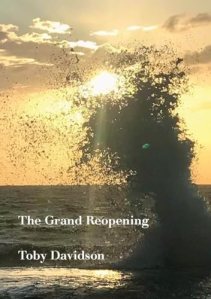
I know Toby Davidson mainly as a Francis Webb enthusiast. He did a beautiful job of editing the Collected Poems (UWA Publishing 2011) and has organised an annual Francis Webb reading for more than a decade.
Toby is also a poet in his own right. The Grand Reopening is his third collection. My blog post about his first, Beast Language, is at this link.
The Grand Reopening is a post-Covid-lockdown book. There are poems featuring haircuts, live-streamed funerals, the Great Resignation, ambivalence about going to the pub and the theatre. There are poems about crank conspiracies and an ‘Aussie Nazi’.
These poems are engaging, and they reward repeat reading, but the one that stands out has nothing to do with Covid. ‘His Blood Whisper Scolds the Deathless Intelligence’, a poem in sixteen parts, accounts for nearly half the book. It features Klippel-Trenaunay Syndrome (KPS), a rare congenital condition which, according to a helpful note:
affects limbs, especially legs, and is characterised by cutaneous capillary malformation (‘port wine stain’), higher temperature, variable or overgrown veins, tissue, bone and the internal sensation of pronounced or incompetent circulation.
The poem picks up on the word ‘pronounced’. Its speaker is a ‘slewed susurrus / spokeswhisperer / for the Syndrome’. The ‘Deathless Intelligence’ that it scolds is something like divine inspiration – creativity that comes and goes.
At the book’s launch last year, Toby Davidson said that he lives with KPS. So the poem’s narrative elements, mainly dealing with medical interventions and the experiences of ‘Child-He’, are autobiographical or at least autobiography-adjacent. It’s a portrait of the artist as a young man living with KPS, with the device of Syndrome-as-narrator allowing for distance and so reflection on meaning. In a back cover blurb, Kevin Hart says that this poem ‘enters the mind and heart and simply will not leave’. I agree.
Page 79*, happily, falls in the middle of this wonderful long poem. It’s the first of Section XII’s two pages:
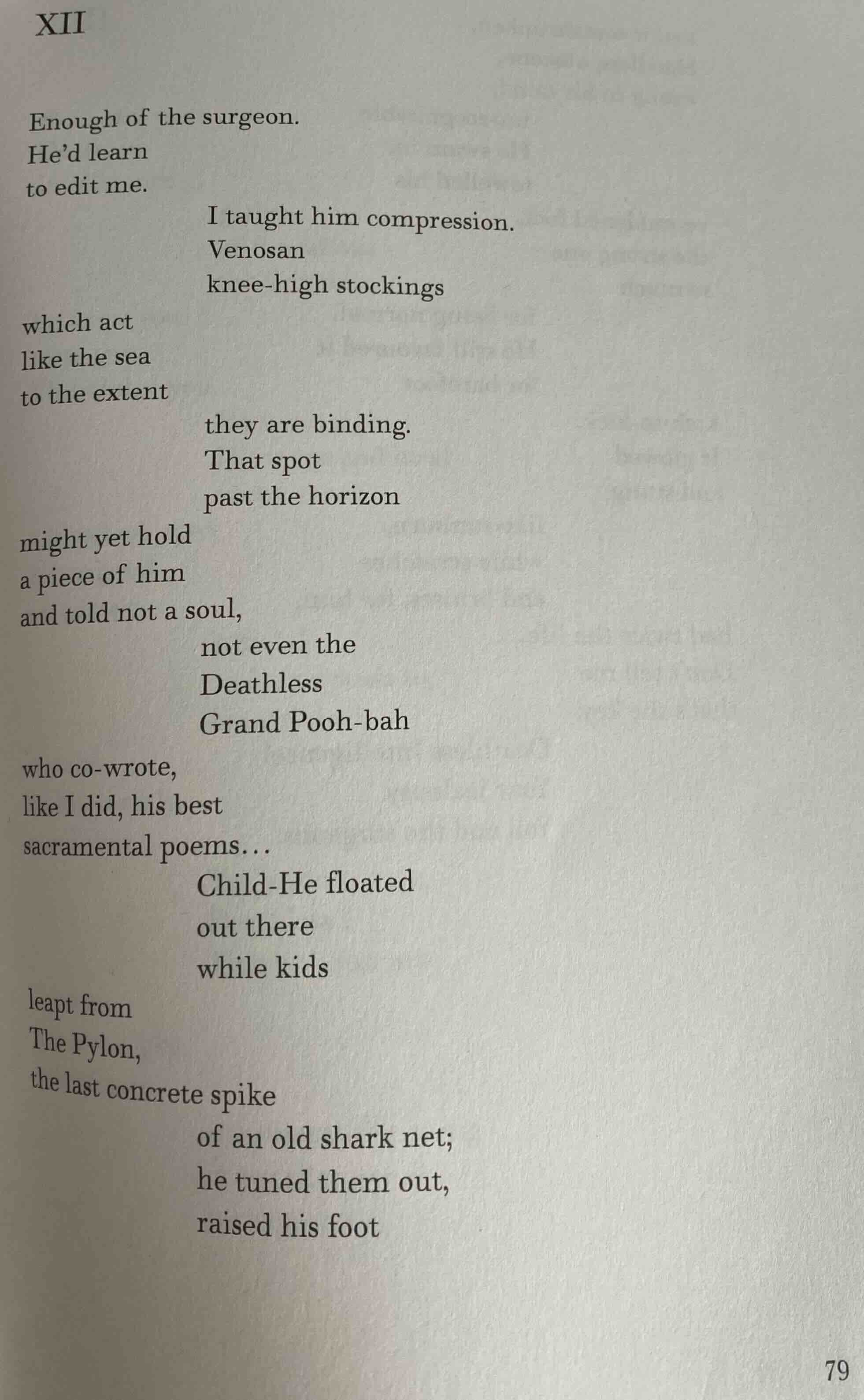
The first thing you’ll notice is the patterning of words on the page. The whole poem is structure this way: in stanzas made up of three short lines, with alternate stanzas indented. The effect is of a slow heartbeat, a hypnotic to-and-fro, an expectation of call-and-response that is never consistently met but never totally disappointed. It reminds me of the way religious communities recite the Psalms antiphonally: the sides of the chapel recite/chant alternate lines. On this page you can see the call and response pattern in pairings like: ‘he’d learn’ / ‘I taught’; ‘spot’ / ‘piece’; ‘not a soul’ / ‘not even’; ‘floated’ / ‘leapt’; then ‘leapt’ /’raised his foot’.
The overall narrative moves along in this poem. Where previous sections have dealt with diagnostic and other medical interventions, here the whisperer takes the credit for the un-intrusive, non-surgical intervention of compression. Venosan compression stockings (they exist, I looked them up) bring relief. Paradoxically, and antiphonally, the sea brings relief in its vastness – but the main narrative of this section is about the discovery that that relief is temporary. In an earlier section, Child-He realises he can be alone, unaccompanied by the Blood Whisper, only in his dreams. Here he goes swimming alone, telling no one. On the next page he looks at the foot raised at the end of this one:
and it was shrunken,
bloodless, obscene,
wrong in his mind
_____________unrecognisable.
The emotional impact of the incident is summed up in the lines:
so much
_____________for being normal
The narrative conveys with a gut-punch something of the emotional reality of growing up with a congenital condition. The poem has other interests as well. What to make of this?
_____________not even the
_____________Deathless
_____________Grand Pooh-bah
who co-wrote,
like I did, his best
sacramental poems...
(The Deathless Intelligence collects a number of nicknames. The Gilbertian ‘Deathless Poo-bah’ is as disrespectful as they get.)
The Blood Whisper’s assertion that it is co-author of ‘his poems’ is part of what makes the long poem so engrossing. It’s not a simple body–mind opposition. The poet has two co-authors. One is the Deathless Intelligence, something like the traditional concept of a Muse, or the Christian tradition’s divine inspiration. The poem reaches for an understanding of how the physical reality – in this case a syndrome affecting the circulation – can also contribute to the creative process.
I’m a long way from grasping this poem. I’ll keep coming back to it. I’d love to hear in the comments from anyone who has engaged with it.
But that’s all I’ve got time for now.
I am an Australian man of settler heritage. I’ve written this blog post on the land of Gadigal and Wangal of the Eora nation. I acknowledge Elders past and present of those clans, and welcome any First Nations readers.


