Tag Archives: letters

The Letters of Seamus Heaney, third and final progress report

Christopher Reid (editor), The Letters of Seamus Heaney (Faber & Faber 2023)
– pages 599–800
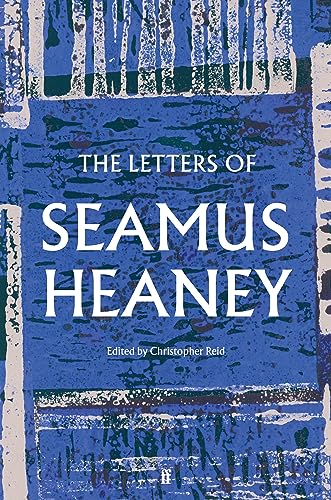
I’m sad to have finished my daily reading of Seamus Heaney. Though very few if any of the letters in this 800 pages were written with publication in mind, Christopher Reid has gathered them into a wonderful book.

In his last years, Heaney is still apologising for the lateness of his replies to other people’s letters or gifts of books. His excuses are generally wonderful – lists of lectures and readings given, honours received, holidays taken with his wife Marie. Sometimes he encloses a poem. In his final years he complains that he hasn’t been able to write any poetry. He seems cheerfully resigned to having to ‘stand on his hind legs’ and be a famous poet. More than once he explains that he won’t attend an event where a friend is being honoured because he has found that – because of ‘the N word’ – his presence tends to steal the limelight. (Do I need to explain that in this case N is for Nobel?)

He replies generously to graduate students asking him if they’re on the right track. His letters to translators are fascinating. He does a spectacular job of refusing requests without giving offence. He is a wonderful model of how to respond to other people’s writing. He struggles to protect his privacy and that of his family, to avoid the commodification of his personal life that must seem inevitable to many people who become famous. He is reluctant to give interviews about his book Human Chain, because some of its poems are more intensely personal than previous ones: he knows the interview will ask about these personal things, and he won’t go there.

As the decades pass, he increasingly types his letter on a laptop, sometimes offering the excuse that his handwriting has gone all wobbly as a result of a stroke. But he doesn’t use email. I think I’m right that there is only one electronic communication in the book, which is the text he sent to Marie when he was being wheeled into the operating theatre, just before he died:

Noli timere

Reid gives the translation, ‘Don’t be afraid,’ and tells us that the text went viral. But he leaves the reader to savour the way this final message epitomises so much of the book. It feels like a biblical quote – the first thing Jesus said after his resurrection was ‘Noli me tangere’. And though Heaney was no longer a practising Catholic, the language, imagery and stories of his Catholic childhood were still at the heart of his creativity, and often turn up in his correspondence. Latin was part of that, and important in its own right: he would often write ‘Gaudens gaudeo’ in a letter when there was reason to celebrate, and he translated Book 6 of the Aeneid in his last years.

Most movingly, this final text is addressed to Marie. She has been a constant presence, through marriage, parenthood, illness striking both of them, her occasionally mentioned creative endeavours. When the letters mention holidays, ceremonial occasions, social events, it’s often ‘Marie and I’. He quotes her opinions. She is intimately part of who is is. And this is the only time in the book that he speaks to her.

I’m going to miss my daily contact with this lovely mind.


I have written this blog post, punctuated by a walk by the beach in a windy darkness, face pricked by flying sand particles, on Awabakal country. I acknowledge Elders past and present, and welcome any First Nations readers.

The Letters of Seamus Heaney, progress report 2

Christopher Reid (editor), The Letters of Seamus Heaney (Faber & Faber 2023)
– pages 390-598

Over the month since my first progress report on reading Seamus Heaney’s collected letters, he has aged from 53 in 1992 to 64 in 2003. Among other things, he has translated Beowulf, written a couple of translations/versions of ancient Greek plays, won the Nobel Prize, had a number of friends die, become much in demand as a public person, travelled a lot including to Tasmania in 1994, and still managed to produce a number of books of poetry. Increasingly his personal letters (as opposed to ‘correspondence’) have been written in planes and airports. He uses a laptop and a fax machine but has stayed away from email for fear that he’d ‘be inundated entirely with queries from grad students and indeed grade schoolers doing their essays’. And always there’s a yearning for moments of solitude and recollection.

I’m enjoying hugely my morning read of seven or eight pages. Apart from anything else it’s a joy to pay attention to someone other than the Attention-Seeker-in-Chief at Mar-a-Lago. I can’t add much in general to what I said in my first progress report (at this link). Here are some snippets.

Heaney writes to his translators, clarifying meanings for them – and giving us fascinating insights into the poetry and the art of translation. Most recently in my reading is an explanation handwritten at the bottom of a fax from Jerzy Illg. Illg’s fax asks for an explanation of the phrase ‘the Bushmills killed’ in the poem ‘The Bookcase’. Heaney writes (page 593, probably 23 May 2003):

‘To kill the bottle’ means to finish off all the drink. So it’s late in the evening and the Bushmills bottle is empty … You know how it is –
Best – Seamus

I’m sure I didn’t know what the phrase meant when I read the poem. So thank you, Jerzy Illg.

There’s a lot of verbal playfulness in many of Heaney’s letters. He’ll slip in a phrase from Wordsworth or Hopkins or a contemporary poet, and Christopher Reid the editor will usually add a helpful explanation of the reference. One that that I loved, that Reid didn’t explain: Heaney and his wife Marie are heading off for a brief holiday, and he describes it as a period of ‘silence, exile and sunning’ – a reference to a much quoted phrase from James Joyce, Portrait of the Artist as a Young Man, ‘silence, exile, and cunning’. I laughed out loud at Reid’s note at the end of a letter to fellow poet Derek Mahon in October 1997. Congratulating Mahon on a recently published book. The letter reads, in part:

I couldn’t place one [of your poems] above the other in my mind just now, just have this Baudelairean dusk-mood of gratitude. I see Milosz calls poetry a dividend from ourselves: high-yields, mon vieux.

After explaining the references, Reid writes: ‘Below the signature, in Mahon’s hand, on the actual letter in the Emory archive: “Pompous ass.”‘ Oh, I think, not everyone enjoys Heaney’s playfulness.

My pleasure in the third moment I’ll mention is less mean-spirited.

In January 2000 (page 519), in a letter to musician Liam O’Flynn, Heaney writes:

I’ve been fiddling with this Japanese form called the tanka – two lines longer than the haiku, and a development of it – consisting of five lines of five-seven-five-seven-seven syllables. It’s like a wee pastry cutter I nick into the ould dough inside the head, just to give it shape.

That is such a wonderful descritption of why I love the tight form of the Onegin stanza: it too is a ‘wee pastry cutter’ that can ‘nick into the ould dough inside the head, just to give it shape’.

I’m now reading letters Heaney wrote while working on books that I read soon after they were published, and evidently before I blogged about every book I read: Beowulf, Electric Light, District and Circle and Human Chain. I’m already sad that there are just 100 pages of the book, 10 years of letter-writing, and one month of reading to go.


I have written this blog post on the land of Gadigal and Wangal of the Eora nation, as the sun rises later and tiny lizards bask while they can. I acknowledge Elders past and present of those clans, and welcome any First Nations readers.

The Letters of Seamus Heaney, progress report 1

Christopher Reid (editor), The Letters of Seamus Heaney (Faber & Faber 2023)
– pages 1– 389

In early December when I announced that I was embarking on a slow read of this book, I promised a progress report ‘in a month or so’. Given that so many of Heaney’s letters begin with some version of ‘Forgive me for not writing before now,’ maybe it’s appropriate that I’m more than a month late with this blog post.

In these two months, seven or eight pages a day, Heaney has aged from 25 in 1964 to 53 in 1992. He has married (to Marie, constantly referred to in the letters) and his two children have grown to adulthood. He has progressed from earning a living as a school teacher to being Poetry Professor at Oxford, and being in demand for lectures, readings and appearances in Ireland, the UK, the USA and occasionally in Europe. He has a number of books of poetry published, distinguished critics have engaged with his work, and he has won prizes. He has collaborated with Ted Hughes in editing two anthologies for children. He is part of Field Day, a Dublin organisation that presents plays and publishes pamphlets and books. He has become Famous Seamus – I phrase I got from the late Les Murray. He has been deeply embarrassed by being included in an anthology of contemporary British poets. He has fought off well-meaning attempts to, as he sees it, ‘commodify’ his early life. He has been been criticised by feminists and Irish nationalists.

Editor Christopher Reid has a brief head note at the beginning of each year, and follows most letters with brief explanatory notes (for example, on page 236, ‘”Frank” was the Faber editor Frank Pike (b. 1936)’). These minimal interventions allow the letters to tell their own story. What results is an intimate self-portrait and a partial, impressionistic autobiography. I’m enjoying it immensely, and I imagine that readers who are familiar with Heaney’s poetry – and that of his contemporaries and near-contemporaries – would enjoy it even more.

Today I have reached the half-way point, where eight pages of photographs bisect a 1992 letter to Ted Hughes – one of the photos being Heaney with Carol Hughes at Ted’s funeral in 1999.

The letter is one of the longer ones in the collection, and is a good illustration of why the letters make such good reading.

First he invites Hughes to visit him and Marie in their cottage in County Wicklow, which he describes as a refuge::

All you commended to me a year ago about gathering towards the focal point of self and surety and fate comes through as a breathing truth when I’m down here on my own. I’m by now like one of those hens that ‘laid away’ – the nest is out under the nettles, not in the orange-box compartments in the henhouse.

After that charming image of himself as a wayward chook, he writes, ‘But I digress,’ and writes a couple of paragraphs about poetic matters: mainly about how Hugh MacDiarmid is a good example of something Hughes had written recently (Christopher Reid makes an educated guess at what piece of writing he refers to.) I haven’r read any of MacDiarmid’s poetry or Hughes’s criticism so this mostly sails past me, except for the fabulously unguarded description of some of MacDiarmid’s verse as ‘the looney embrace of the Tolstoyan do-goodery combined with the McGonagallish tendency in the natural run of his speech’. (Reid lets the McGonagall reference go unexplained – if you need to know here’s a link to the Wikipedia page about his most famous poem.)

But it’s a personal letter, and after engaging with Hughes’s recent work, he sympathises with him over recent criticisms of him to do with ‘Sylvia’. It’s not clear what he’s referring to, but at this time (1992), Hughes was publishing poems about his relationship with Sylvia Plath, and reinforcing the view of him in some circles as responsible for her tragic suicide. Heaney is unambiguously supportive and characterises the criticisms as:

obtuseness and hostility and galvanised vindictiveness combined helplessly at first and then proceeded wilfully against you.

That’s all very well, and can be read as old white men banding together. But then, most interestingly, he refers to his own, lesser feminism-related tribulations. An anthology of Irish poetry recently published by Field Day, the organisation on whose board Heaney sits, has been roundly criticised. Heaney is remarkably undefensive:

the book sins indefensibly in many areas: no women editors, no ‘feminist discourse’ section …; too much ‘non-revisionist’ historical perspective.

Acknowledging this, he can tell Hughes that the criticism has nevertheless rocked him:

Vah! But I am more alive than before to the immense rage which man-speak, or even men speaking, now produces, The historical tide is running against almost every anchor I can throw towards what I took to be the holding places.

These letters aren’t written for publication. This isn’t a statement of position, but something said to a friend.

And he encloses a poem. Christopher Reid can tell us which poem it was, and I can look it up and enjoy it.

Page after page this book gives such privileged glimpses of the life, work and times of a very fine poet. In the next couple of years, he gets the Nobel Prize. I imagine his time out under the nettles gets even more precious.


I have written this blog post on the land of Gadigal and Wangal of the Eora nation. I acknowledge Elders past and present of those clans, and welcome any First Nations readers.

Starting the Letters of Seamus Heaney

Christopher Reid (editor), The Letters of Seamus Heaney (Faber & Faber 2023)

Since reading À le recherche du temps perdu over a couple of years starting in September 2019, I’ve done a similar slow read of a number of classics: Saint Augustine’s Confessions, Wordsworth’s The Prelude, Virginia Woolf’s Mrs Dalloway, and so on.

The Letters of Seamus Heaney doesn’t quite fit the original concept – paradoxically, give that Heaney is such a fine poet, it’s too prosaic. But the book was a gift, I want to read it because I love Heaney’s poetry, and I’m pretty sure I’d have trouble staying awake if I approached it like a novel. So here goes, starting out at 7 or 8 pages a day. I’ll keep my copy of Opened Ground: Poems 1966–1996 beside me as I read the pages, so I may be able to look up poems as they are mentioned.

The first letters collected here were written when Heaney was in his mid 20s, on the verge of publication of his first book of poems, Death of Naturalist. He marries, becomes a father, worries about money and employment …

I’ll report on progress in a month or so.


I have written this blog post on the land of Gadigal and Wangal of the Eora nation. I acknowledge Elders past and present of those clans, and welcome any First Nations readers.