
Christopher Reid (editor), The Letters of Seamus Heaney (Faber & Faber 2023)
– pages 599–800
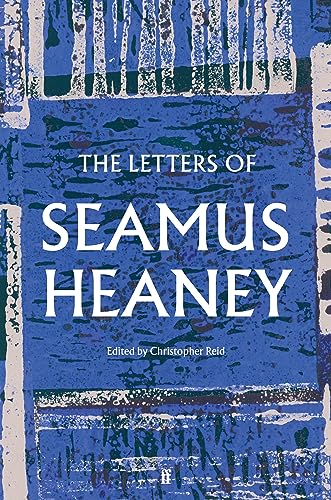
I’m sad to have finished my daily reading of Seamus Heaney. Though very few if any of the letters in this 800 pages were written with publication in mind, Christopher Reid has gathered them into a wonderful book.
In his last years, Heaney is still apologising for the lateness of his replies to other people’s letters or gifts of books. His excuses are generally wonderful – lists of lectures and readings given, honours received, holidays taken with his wife Marie. Sometimes he encloses a poem. In his final years he complains that he hasn’t been able to write any poetry. He seems cheerfully resigned to having to ‘stand on his hind legs’ and be a famous poet. More than once he explains that he won’t attend an event where a friend is being honoured because he has found that – because of ‘the N word’ – his presence tends to steal the limelight. (Do I need to explain that in this case N is for Nobel?)
He replies generously to graduate students asking him if they’re on the right track. His letters to translators are fascinating. He does a spectacular job of refusing requests without giving offence. He is a wonderful model of how to respond to other people’s writing. He struggles to protect his privacy and that of his family, to avoid the commodification of his personal life that must seem inevitable to many people who become famous. He is reluctant to give interviews about his book Human Chain, because some of its poems are more intensely personal than previous ones: he knows the interview will ask about these personal things, and he won’t go there.
As the decades pass, he increasingly types his letter on a laptop, sometimes offering the excuse that his handwriting has gone all wobbly as a result of a stroke. But he doesn’t use email. I think I’m right that there is only one electronic communication in the book, which is the text he sent to Marie when he was being wheeled into the operating theatre, just before he died:
Noli timere
Reid gives the translation, ‘Don’t be afraid,’ and tells us that the text went viral. But he leaves the reader to savour the way this final message epitomises so much of the book. It feels like a biblical quote – the first thing Jesus said after his resurrection was ‘Noli me tangere’. And though Heaney was no longer a practising Catholic, the language, imagery and stories of his Catholic childhood were still at the heart of his creativity, and often turn up in his correspondence. Latin was part of that, and important in its own right: he would often write ‘Gaudens gaudeo’ in a letter when there was reason to celebrate, and he translated Book 6 of the Aeneid in his last years.
Most movingly, this final text is addressed to Marie. She has been a constant presence, through marriage, parenthood, illness striking both of them, her occasionally mentioned creative endeavours. When the letters mention holidays, ceremonial occasions, social events, it’s often ‘Marie and I’. He quotes her opinions. She is intimately part of who is is. And this is the only time in the book that he speaks to her.
I’m going to miss my daily contact with this lovely mind.
I have written this blog post, punctuated by a walk by the beach in a windy darkness, face pricked by flying sand particles, on Awabakal country. I acknowledge Elders past and present, and welcome any First Nations readers.


