Tag Archives: Diary

How to End a Story, report 2

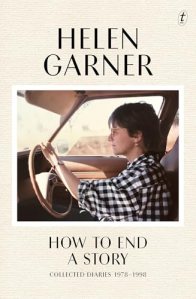
Helen Garner, How to End a Story: Collected Diaries 1978–1998 (Text Publishing 2025)
– pages 194 to 353, mid 1986 to partway through 1988

Helen Garner’s diaries continue to give me joy, five pages first thing each day.

A lot has happened since my last post. The character known as V has appeared and Garner’s relationship with him has become a dominant narrative thread. Even if a kind blog-friend hadn’t sent me a key to some of the people in the diaries, I would have guessed that V is novelist Murray Bail, who was to become Garner’s third husband. At this stage they are besottedly in love and Helen is spending a lot of time travelling back and forth between her home on Melbourne and hotels and other temporary abodes in Sydney, where V lives.

Other things are happening. Books are published and reviewed (she mainly quotes the negative ones). She appears at literary festivals all over the world and converses with the famous. She writes a screenplay, probably for Last Days at Chez Nous. A benefactor gives her money to buy a small house in rural Victoria. She moves out of the home she has shared with her daughter. Other young people come and go in her life. She has a religious experience and someone she calls ‘my nun’ appears. It’s hard to believe that this is less than two years in a life.

In today’s reading, there are 24 entries, ranging in length from a single short sentence to half a page. She watches Passage to India on the television and goes to the Australian Opera production of La Forza del Destino. She and a woman writer friend have an alarming conversation with an unnamed male poet about child abuse. She records a dream or two. She writes about the stars in Primrose Gully (‘How small they were, how far away’) and the ‘astonishing beauty of Sydney in early winter’. (I just went walking in sunlit rain yesterday in Sydney in early winter, and I was astonished too.) She quarrels with the friend she lives with, ‘perhaps for the first time’. She records snippets of conversation, some overheard, some of which she is a part.

Diaries are often places where people write their misgivings and doubts rather than their considered opinions. There’s a lot of that in the entries about V. If it was a movie the audience would be silently crying out, ‘Don’t do it, Helen! Get out while you can!’ In today’s reading alone, she receives a letter from him that makes her want to shake him and fantasise calling it all off. She visits an art gallery with him and finds it impossible to tell him why a particular painting means something to her, partly for fear that he’ll tease her and laugh at her. She imagines him reproaching her for her reading habits. And she agonises over what their affair means for his wife, though they don’t seem to be able to talk about that – as in this on page 253:

‘His father went to jail.’
‘What for?’
‘Theft, I think. Embezzling, maybe.’
‘Embezzling’s creepy, isn’t it,’ I said. ‘Worse than straight-out theft. It’s the betrayal of someone’s trust over a long period.’
Horrified that he might think I was referring obliquely to his behaviour towards his wife. But he didn’t seem to notice, and went on talking.

But every now and then, almost by accident, we get a glimpse of why she’s in the relationship:

In Neilsen Park the astonishing beauty of Sydney in early winter: tremendous towers of cloud coloured delicately in greys and pinks, boats sliding or toiling, clear cool air. How can that hard-looking mouth be so soft?

I believe Garner when she says she didn’t alter the text of these diaries except to protect people’s identities (though not all the identities are well protected). I expect that she left entries things out. I’m in awe of her moral fortitude in deciding over and over again what to leave in.


I am a man of settler heritage. I wrote this blog post on the astonishingly beautiful land of Gadigal and Wangal of the Eora Nation. I acknowledge their Elders past and present and welcome any First Nations readers.

How to End a Story, report 1

Helen Garner, How to End a Story: Collected Diaries 1978–1998 (Text Publishing 2025)
– pages 1 to 193.

Someone at the recent Sydney Writers’ Festival said that we ought to stretch our attention spans by reading for twenty minutes at a time – or it may have been by reading twenty pages at one sitting. That’s probably good advice, but I’ve now been reading just five pages of Helen Garner’s diaries every morning for a little over a month, and I’m convinced this is the best way to read them.

I expected the experience to be similar to reading Seamus Heaney’s letters in the same way (first of several blog posts here). But a diary entry is a different beast from a letter, even one written to an intimate friend. Garner is not concerned to present an acceptable face or to spare people’s feelings. I expect she has done some sparing in the editing – by anonymising most people, and probably by cutting some entries – but this is not a public face on display.

The diaries were, however, meant to be well written, to wrangle her observations and reflections into precise words. Nearly two-thirds of the way in the first volume, Yellow Notebook, narrative threads have emerged. Her second marriage, to a man identified only as ‘F’, has come to an end after a long period of bitter rows, and she is coming to terms with her new unpartnered life. Her first novel, Monkey Grip, won a prize on the first page, in 1978. Now, in 1986, she seems to go to a lot of writers’ festivals where people are all too happy to give their opinions about The Children’s Bach (1984) and sometimes mistake her for a staff member. A film she wrote the script for goes to Cannes – she doesn’t name the film (it was Two Friends, directed by Gillian Armstrong) or say any more about it. There’s a thread to do with religion: she senses the approach of what she calls ‘The Mighty Force’, and the thread has peaked in a brief entry (on page 185): ‘ I dread having to become a Christian.’ Perhaps related to that is her deep friendship with ‘J’, transparently Tim Winton (they laugh at gossips who assume they’re sleeping together).

I won’t be surprised if some time in the next decade or so an annotated edition of the diaries appears with notes identifying people and places, and elaborating on contexts. Without that apparatus, it’s like reading the ghost of an autobiography – tantalising, but still oddy satisfying.

There are dreams, conversations, snippets from her reading and film-going, lovely moments with her daughter and sister, irritating moments with various men, deft little pen portraits both physical and psychological, and entries that amount to prose poems.

There’s is a recurring fascination with murder, especially child murder. Several gruesome news items make their way into the diary, and then in 1985 she attends her first trial. Here she is talking to the father of a murdered girl:

I asked him if I could come to the trial.
‘Why do you want to?’
‘First because I thought you might like people to be with you. And second because I’m curious.’
The real truth would be in reverse order. In fact the real truth is part 2. The first is cosmetic, though it is true also, in another way.

How could she have known that this interest would lead to her brilliant non-fiction books Joe Cinque’s Consolation (2004) and This House of Grief (2014), both published well after the end date of these collected diaries.

In today’s reading there’s a long, gruesome account of a visit to the dentist, a number of notes on possible books and stories to write, comments on movies (Visconti’s Bellissima) and books (she reads surreptitiously from a novel about a sadomasochistic affair at Readings book shop), snippets from conversations, descriptions of nature, quotes from a reader and a critic. Here’s a sample just from these five pages:

A micro-fiction:

At the school concert a girl’s proud father says, ‘I love you!’ and squeezes her in his arms. She shrieks, ‘Ewww,YUCK!’ and fights to break free. He grips tighter with a demonic grin

A delicious name-drop (‘the law student’ is her lodger):

Raymond Carver called collect when I wasn’t home, and the law student, confused, caused him to hang up.

A neighbourly conversation:

Out near the rubbish bins I ask my neighbour if she knows anything about Melanie Klein. ‘I absolutely detest psychoanalysis,’ she snaps. I bet you do. Look at your life.

A gruesome moment observed:

Outside the post office the dog shat out a tapeworm. It trailed behind her and I had to put my foot on it to snap it off.

A tiny addition to the underlying narrative:

Spring comes. People fall in love – or they will, when the sunny breezes blow and exams are soon and cafe tables are put out on the pavements. Will I? I can’t imagine who with?

I’m so glad she decided to publish these diaries. I’m pretty sure I’m also glad I’m not ‘the neighbour’, ‘the law student’ or even the ‘proud father’.


I am a man of settler heritage who has been alive for almost a third of the time since Arthur Phillip raised his flag on the shores of Warrane. I wrote this blog post on the land of Gadigal and Wangal of the Eora Nation. I acknowledge their Elders past and present and welcome any First Nations readers.

Starting How to End a Story

Helen Garner, How to End a Story: Collected Diaries 1978–1998 (Text Publishing 2025)

A generous friend gave me this whopping tome for my birthday this year.

Someone said, ‘It’s a book you dip into rather than read from start to finish.’ But I’m not much of a dipper, so I’ve decided to take it on as a slow read – five pages a day for six months or so. I loved doing that with Seamus Heaney’s letters. Why not with Helen Garner’s diaries?

The diaries were originally published in three volumes: Yellow Notebook (2019), One Day I’ll Remember This (2020), and How to End a Story (2021), covering the years 1978 to 1986, 1987 to 1995 and 1995 to 1988 respectively.

From what I’ve read elsewhere, I understand that Garner kept diaries for decades before the entries that begin Yellow Notebook, but she burned them all, and decided in 1978 to write readable diary, not necessarily for publication, but with attention to the crafting of sentences. Four decades after starting the first proper diary in a yellow notebook acquired for the purpose, she decided to publish, with minimal alterations, and none to spare her own feelings.

I’ve just read the first five pages. My initial response is to feel a little deprived that the entries aren’t dated, and people are identified only by a single initial. Any information about what relationship people have to Garner is to be deduced from the text – which is an odd bit of false reticence when of the two character mentioned so far one is clearly Garner’s daughter and the other seems to be a lover whose identity I imagine would be easy to discover. Similarly, there is no scaffolding to say where an entry was written: on the first pages Garner is feeling alone in a city, and only gradually does it merge that she’s in France, probably in Paris.

I’m probably just missing Christopher Reid’s helpful annotations in the Seamus Heaney book, and I’ll get used to this bare approach.

I hope to write a first monthly report towards the end of May.


I am a man of settler heritage who has been alive for almost a third of the time elapsed since Arthur Phillip claimed this continent for the British crown. I wrote this blog post on the land of Gadigal and Wangal of the Eora Nation. I acknowledge their Elders past and present and welcome any First Nations readers.