
Pam Brown, Guess the Experience (Hunter Publishers 2025)
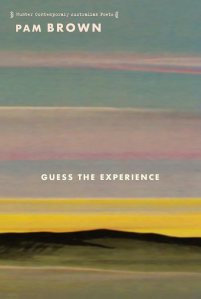
I’ve been ruminating on Guess the Experience for about a month now. More precisely, I’ve been trying to find words for what I enjoy about it – and I have enjoyed it a lot.
It’s not the kind of poetry you can memorise to recite at weddings, funerals, sleepless nights, break-ups, or fallings-in-love.*
It doesn’t have a compelling narrative or a straightforward argument.
Rather than try for generalities, I’ll stick to page 79**, and see what I come up with.
Page 79 is part of an eight-page poem, ‘pulp to reform’. An endnote informs/reminds us that Pulp was a British art-rock band. In 2022, commenting on a facebook headline, ‘Pulp to Reform’, Melbourne poet Michael Farrell said it sounded like the title of a Pam Brown poem. She rose to the challenge and wrote the poem. As far as I can tell, the poem doesn’t relate to the band at all (though I did go looking: ‘Common People‘ was their song).
The poem is made up of six sections ranging from 11 to 27 lines long. It’s not always clear how the sections relate to each other. In fact it came as a surprise to me on first reading when the last lines referred back to the opening. The first section begins:
this is
__my first interview
____since my death
And the poem ends:
from this cardboard coffin
________some final words –
So the poem’s set-up is clear: the speaker is giving a posthumous interview. But it doesn’t deliver on that promise. The final section acknowledges as much, and also contains a description of the poetry. Here it is in full:
this interview
has digressed

i'm not sure
what you want
____to know

is it
about the poetry?

all
___accidental

from this cardboard coffin
________some final words –
Pretty much everything between the opening lines and ‘this interview / has digressed’ is digression. But if you want to know about the poetry, the speaker says, I can tell you it is ‘all accidental’. The speaker obviously isn’t Pam Brown herself – Pam Brown isn’t dead, for one thing. But ‘all / accidental’ isn’t a bad description of how this poetry feels. Having said that, there’s always a sense of discipline in the lines.
But I’ve got ahead of myself.
Page 79 is roughly the first half of the poem’s third section. In my reading the first section has set up the situation and given an elliptical account of the speaker’s death (‘I swallowed / a cotton bud’ – comedy rather than tragedy) – and of the kinds of health fads she had lived among. The second, she recalls working in the kitchen. Georges Perec is mentioned and apparently quoted – ‘question your teaspoons’. The reference was obscure to me, and in my usual lazy manner I was happy to accept it as adding flavour. But because I’m blogging about the poem I went hunting and found this wonderfully illuminating quote from Perec’s 1973 essay, ‘Approaches to What?’ (at this link):
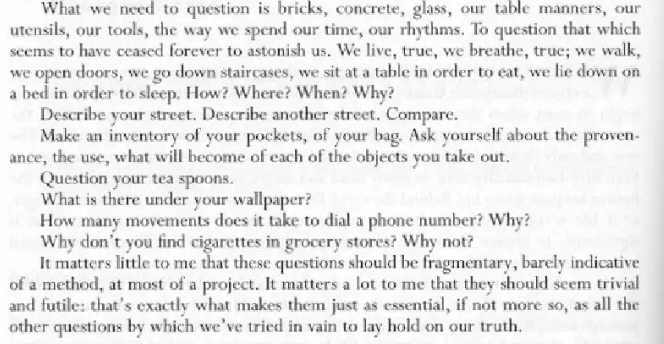
It turns out the reference isn’t just adding flavour. The speaker has been noticing details in the kitchen sink (‘little transparent / purplish white globes’), Perec’s essay comes to mind and, crucially, Perec’s injunction, ‘Describe your street,’ prompts the transition to the next section, the one on page 79 (ignore the first two words):
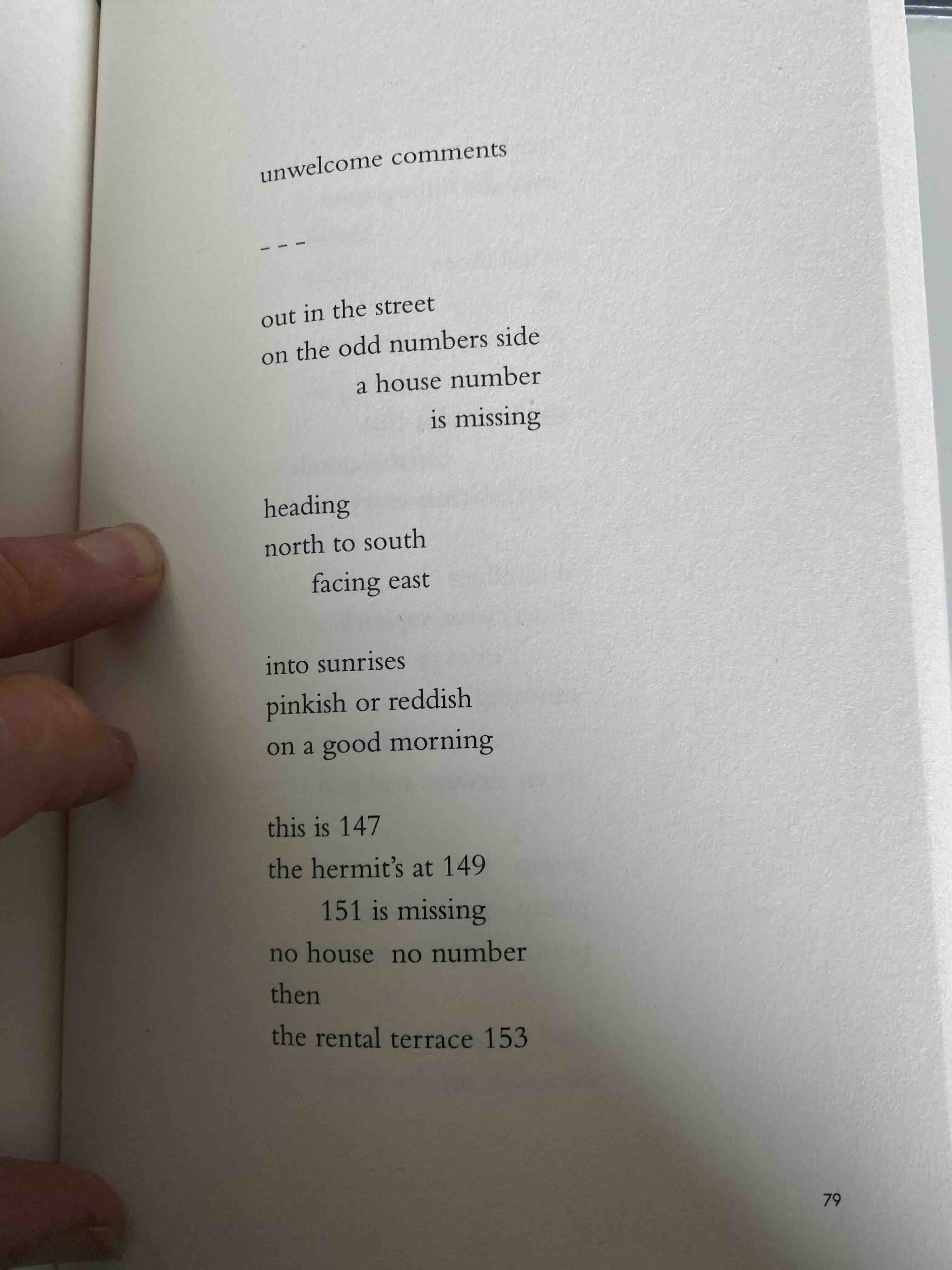
out in the street
on the odd numbers side
________a house number
________-_____is missing

heading
north to south
_-__facing east

into sunrises
pinkish or reddish
on a good morning

this is 147
the hermit's at 149
__-__151 is missing
no house_ no number
then
the rental terrace 153
On first reading I enjoyed this page for a completely idiosyncratic reason. My six-year-old grandson is currently fascinated by numbers, and his fascination is contagious. He loves it, for example, that we are in unit 43, across the landing is 41, the unit directly under us is 40. And now I love it too. These lines feed directly into that fascination. Having done my research and come to a reading that makes sense of what the lines are doing in the context of the poem as a whole, the initial pleasure stays in place, but feels less idiosyncratic: the poem is drawing attention to such trivial details as ways by which, as Georges Perec puts it, we try ‘to lay hold on our truth’.
This section of the poem continues – it takes up the ‘sunrises / pinkish or reddish’, with a description of an inner-city dawn. In the following sections, the speaker remembers, as it were, that she is speaking after having died, and recollects that when alive she was ‘always polite / & / friendly’, speaking a little Greek at the deli and regretting that she never took up an offer to go to Samos. It all feels arbitrary, until it reaches the final lines I quoted above, ending with an inclusive dash.
The word that comes to mind is immersion. The poem creates the illusion that you (that is, the reader) are privy to the poet’s mind – not to her finished, carefully utterances, but the turmoil of actual, distractible thinking in an actual inner-suburban place, ‘all / accidental’ but enjoyable as evidence that the human mind is, after all, the most complex entity in the known universe.
My copy of the book was a generous gift from the author.
I am a man of settler heritage. I wrote this blog post as the days are beginning to lengthen and get colder on the land of Gadigal and Wangal. I acknowledge their Elders past and present and welcome any First Nations readers of the blog.
* I just remembered a funeral where Laurie Anderson’s ‘O Superman‘ was played as the mourning congregation watched a slideshow of the deceased’s life, so anything is possible.
**My blogging practice is to focus on the page that coincides with my age, currently 79.


