
Brian Purcell, The Leaving (Flying Island 2021)
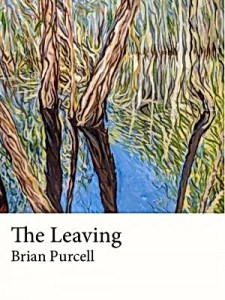
I enjoyed Brian Purcell’s 2025 poetry collection, Filmworks (my blogpost here). It turns out that Brian is not only one of the poets in the Flying Islands Pocket Poets Series, he also does some of the work of fulfilling subscription orders for the series. For $120 a year, subscribers receive a bundle, usually of ten books. When Brian was packaging up my bundle in January, he kindly added a copy of this book, his first, with a friendly inscription, and a limited-edition T-shirt sporting the cover of Filmworks, which I wear with pleasure.
The gesture is very much in the spirit of the Flying Island Poetry Community, which is all about relationships with a touch of the gift economy.
It’s a reminder that to read a book, perhaps especially a book of poetry, is basically to enter into a relationship with its author. The reader might sit at the writer’s feet to learn; might seethe at being hectored; might weep for the writer’s suffering or share in their joy; might laugh at their jokes, be in awe of their skill … the possibilities are endless.
Many of the poems in The Leaving have a strong sense of place, whether they are coastal New South Wales or places that the poet visits further afield. He makes an excellent travelling companion. I was completely on board when I read these lines in the first poem in the book, ‘Westerly at Bongil Beach’, loving the way they draw back the curtain on the process of composition. He tries to grasp the clouds, and manages to clasp a haiku, then shows us the haiku:
I reach up to grasp the torn dishcloth of clouds
_____-------______ nature's dictionary opens
______-------_____ I clasp a haiku

______-------_____ the sand-laced wind
______-------_____ keeps shifting scrawling
________-------___ you will never win
No shame in that defeat.
Another poem where I felt strong fellow-feeling is ‘Angels Descending’, which recalls an encounter with a nun in a Catholic childhood:
Is this the way you receive the Host?
Stick it out further!
She grabbed his tongue.
He would never forgive that indignity
or the way the stiff white collar pressed
red marks into
her cool white skin.
Such an indignity was never visited on me, but I will never forget the rage-flushed face of Sister Mary Bride who taught me when I was five. The boy in this poem is eight, but his focus on the detail of the nun’s skin rings absolutely true for me.
The Christian reference in the title of the poem on page 78*, ‘Good Friday at Kungala’, seems at first glance much less significant. The poem captures a moment on a public holiday in a small New South Wales country town:

In the first two and last two stanzas, the poem’s speaker walks his dogs. In the middle two stanzas something else happens.
Good Friday at Kungala

Vivid new growth
by the railway track
dogs turn around
to see I keep up

thankful for solitude
rain never stops
full moon obscured
frogs croak at night
A man enjoys being alone, in connection with his dogs. There’s not much about Kungala on the internet but every general article mentions that the North Coast railway runs through it. There is no railway station there, and the first lines of the poem create a sense that it’s not a particularly busy line. It’s unpleasant weather, but not an unpleasant time and place to be.
So the next two stanzas are unexpected:
for sale everything not
nailed down
one man howling
in ragged undergrowth

days to die alone
no one within earshot
unless a partner
draws the curtains back
The first stanzas evoke a place that’s off the beaten track. In these stanzas the speaker’s attention turns to the social meanings of that. Everything is for sale – the place is dying. The speaker is ‘thankful for solitude’, but his mind goes to what that isolation can mean: a man takes days to die, howling. The reference to the partner who didn’t draw the curtains back hints at further darkness to the story.
The abruptness of this shift is a reminder that poetry needs to be read slowly, creatively. The poem doesn’t tell us what to feel, but leaves space around the words for us to form our own responses. If the poem is a film script, the reader is invited to be director, actors and cinematographer.
rags of ochre cloth
hang from the trees
the dog drops its stick
at my feet

stooping in the cold
my arm's stiff and weak
the dog outruns
my most forceful throw
Back to the dogs and details of the environment (‘the rags of ochre cloth’ sound like something that just happened to be there on the day, though if you read the Good Friday reference as central, they might suggest the torn curtain in the temple on that day). The speaker is suddenly aware of his own comparative frailty and discomfort (cold, stiff and weak in eight words). But the vitality of the dogs keeps him pushing against his limits.
Maybe the Good Friday reference does carry some weight after all. A man has died in agony, and another man spends a moment reflecting on that. It’s a long way from church, but the Stations of the Cross are not completely forgotten.
I am an Australian man of settler heritage. I read The Leaving on Wulgurukaba land, on beautiful Yunbenun (aka Magnetic Island). I acknowledge their Elders past and present, including their sustained struggle to have the island’s long history acknowledged. I also acknowledge the Elders of Gadigal and Wangal. on whose land I live and have written this blog post. I welcome any First Nations readers and commenters.
* My blogging practice is to focus on the page that coincides with my age, currently 79. Here page 79 is blank except for the title of the book’s third section, ‘Between earth and sky’, so I’m looking at the facing page..


