Tag Archives: Brian Purcell

Brian Purcell’s Leaving

Brian Purcell, The Leaving (Flying Island 2021)
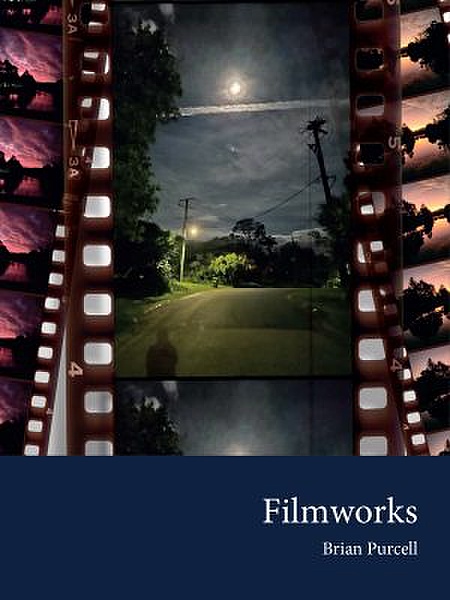
I enjoyed Brian Purcell’s 2025 poetry collection, Filmworks (my blogpost here). It turns out that Brian is not only one of the poets in the Flying Islands Pocket Poets Series, he also does some of the work of fulfilling subscription orders for the series. For $120 a year, subscribers receive a bundle, usually of ten books. When Brian was packaging up my bundle in January, he kindly added a copy of this book, his first, with a friendly inscription, and a limited-edition T-shirt sporting the cover of Filmworks, which I wear with pleasure.

The gesture is very much in the spirit of the Flying Island Poetry Community, which is all about relationships with a touch of the gift economy.

It’s a reminder that to read a book, perhaps especially a book of poetry, is basically to enter into a relationship with its author. The reader might sit at the writer’s feet to learn; might seethe at being hectored; might weep for the writer’s suffering or share in their joy; might laugh at their jokes, be in awe of their skill … the possibilities are endless.

Many of the poems in The Leaving have a strong sense of place, whether they are coastal New South Wales or places that the poet visits further afield. He makes an excellent travelling companion. I was completely on board when I read these lines in the first poem in the book, ‘Westerly at Bongil Beach’, loving the way they draw back the curtain on the process of composition. He tries to grasp the clouds, and manages to clasp a haiku, then shows us the haiku:

I reach up to grasp the torn dishcloth of clouds
_____-------______ nature's dictionary opens
______-------_____ I clasp a haiku

______-------_____ the sand-laced wind
______-------_____ keeps shifting scrawling
________-------___
you will never win

No shame in that defeat.

Another poem where I felt strong fellow-feeling is ‘Angels Descending’, which recalls an encounter with a nun in a Catholic childhood:

Is this the way you receive the Host?
Stick it out further!
She grabbed his tongue.
He would never forgive that indignity
or the way the stiff white collar pressed
red marks into
her cool white skin.

Such an indignity was never visited on me, but I will never forget the rage-flushed face of Sister Mary Bride who taught me when I was five. The boy in this poem is eight, but his focus on the detail of the nun’s skin rings absolutely true for me.

The Christian reference in the title of the poem on page 78*, ‘Good Friday at Kungala’, seems at first glance much less significant. The poem captures a moment on a public holiday in a small New South Wales country town:

In the first two and last two stanzas, the poem’s speaker walks his dogs. In the middle two stanzas something else happens.

Good Friday at Kungala

Vivid new growth
by the railway track
dogs turn around
to see I keep up

thankful for solitude
rain never stops
full moon obscured
frogs croak at night

A man enjoys being alone, in connection with his dogs. There’s not much about Kungala on the internet but every general article mentions that the North Coast railway runs through it. There is no railway station there, and the first lines of the poem create a sense that it’s not a particularly busy line. It’s unpleasant weather, but not an unpleasant time and place to be.

So the next two stanzas are unexpected:

for sale everything not 
nailed down
one man howling
in ragged undergrowth

days to die alone
no one within earshot
unless a partner
draws the curtains back

The first stanzas evoke a place that’s off the beaten track. In these stanzas the speaker’s attention turns to the social meanings of that. Everything is for sale – the place is dying. The speaker is ‘thankful for solitude’, but his mind goes to what that isolation can mean: a man takes days to die, howling. The reference to the partner who didn’t draw the curtains back hints at further darkness to the story.

The abruptness of this shift is a reminder that poetry needs to be read slowly, creatively. The poem doesn’t tell us what to feel, but leaves space around the words for us to form our own responses. If the poem is a film script, the reader is invited to be director, actors and cinematographer.

rags of ochre cloth 
hang from the trees
the dog drops its stick
at my feet

stooping in the cold
my arm's stiff and weak
the dog outruns
my most forceful throw

Back to the dogs and details of the environment (‘the rags of ochre cloth’ sound like something that just happened to be there on the day, though if you read the Good Friday reference as central, they might suggest the torn curtain in the temple on that day). The speaker is suddenly aware of his own comparative frailty and discomfort (cold, stiff and weak in eight words). But the vitality of the dogs keeps him pushing against his limits.

Maybe the Good Friday reference does carry some weight after all. A man has died in agony, and another man spends a moment reflecting on that. It’s a long way from church, but the Stations of the Cross are not completely forgotten.


I am an Australian man of settler heritage. I read The Leaving on Wulgurukaba land, on beautiful Yunbenun (aka Magnetic Island). I acknowledge their Elders past and present, including their sustained struggle to have the island’s long history acknowledged. I also acknowledge the Elders of Gadigal and Wangal. on whose land I live and have written this blog post. I welcome any First Nations readers and commenters.


* My blogging practice is to focus on the page that coincides with my age, currently 79. Here page 79 is blank except for the title of the book’s third section, ‘Between earth and sky’, so I’m looking at the facing page..
Flying Island’s 100 Poets

Brian Purcell & Kit Kelen (editors), 100 Poets (Flying Islands 2025)

Most poetry anthologies are implicitly made up of poems that are ‘the best’ in some way or at least the editors’ favourites chosen from a much bigger field of lesser or less loved work. Though the editors of 100 Poets have necessarily been selective, the point here is not that these hundred poems are Winners. Instead, the book is offered as an introduction to a poetic community.

Flying Islands, the brainchild of Kit Kelen, is a non-profit publisher, and a community of poets and readers of poetry. Over the last decade and a half, they have published 100 pocket-sized books of poetry (I’ve read an enjouyed about 20). They have features award-winning poets, grumpy old poets who complain about the lack of recognition elsewhere, and brand new poets flexing their wings. They have included translation, mostly from Chinese to English or vice versa – Kit Kelen is an emeritus professor at Macao University, and Flying Islands has partnered with Macao-based community publisher ASM (the Association of Stories in Macao). They have had a wonderful variety of style, form, tone and subject matter. All of that is represented in 100 Poets.

This book, pocket-sized like the rest, is the hundredth in the series. Each of 100 poets previously published in the series has a single page – a couple of them fit two short poems onto their page, but none take more than a page. Not every notable Australian poet is represented here – there’s no David Malouf, Eileen Chong or John Kinsella, for instance, and not very much from the world of Spoken Word – but it’s hard to imagine a better introduction to the basic ecology of contemporary Australian poetry.

I was going to list the poets from the book who have appeared in this blog. It’s a long list, and not all of them are there because I read their Flying Islands publications. But it would just be a list of names with links. Instead, here is my favourite title, from Tricia Dearborn:

Perimenopause as a pitched battle between the iron supplements and the flooding

And, in keeping with the blog’s tradition, here’s the poem that appears on page 78, ‘The Sleepover’ by Gillian Swain, whose Flying Islands book is My Skin Its Own Sky (2019):

The first nine lines evoke a pleasant childhood memory. Even if, like me, you never slept over at a friend’s place when you were young, the details – the barbies, the giggling friends brushing their teeth together, the child bodies in adult-sized sleeping bags, the model aeroplanes on the friend’s ceiling – capture brilliantly thrilling combination of intimacy and strangeness that is a sleepover.

Lines 10 and 11 form a finely judged transition from that memory to the very different current situation. They move from the past to the present tense, and the child’s perspective carries over to the different reality – the bed that moves up and down already suggests a hospital, but is presented as a novelty:

like the way your bed moves up and down like 
all the colours the flowers bring

And line 12 lands us firmly in the grim present.

to this grey room.

The person addressed in the first lines is now in a hospital bed.

The interplay of benign memory and grim present continues in the rest of the poem: the three friends once again enjoying each other’s presence long into the night. There is giggling again, and stories. The friendship is as alive as ever, but one of the three friends is dying.

The final lines hold this complex emotional reality in a neat paradox. The imminent death of a friend is not trivialised – but nor is the joy of friendship.

the wrong reasons and  tonight 
your deathbed
is joyous.

The person I have known longest apart from my two sisters died early this year. Our childhood friendhsip wasn’t of the giggling, sleepover variety, but the last time I saw him we did pay more attention to what we enjoyed with and about each other than to what we all knew was coming. The poem resonates strongly for me.

Multiply that by 100 – or to be honest by maybe 75, because not every poem in the book sings to me – and you have quite an experience. I look forward to Flying Islands’ Second 100.


I finished this blog post on the land of Wandandian of the Yuin Nation, whose beaches are said to have the whitest sand on the planet. I acknowledge their Elders past and present, and welcome any First Nations readers.

November verse 8

Inspired by Filmworks, Brian Purcell’s book of poems about movies, here’s a little verse responding to Kathryn Bigelow’s recent movie, which was written brilliantly by Noah Oppenheim:

November verse 8: A House of Dynamite

Someone's screen reveals a missile
armed and launched from who knows where.
The world could end in eighteen minutes.
Can we stop it in the air,
find the lever, aim and pull it,
hit that bullet with a bullet?
Missed! The dot moves on the screen
towards Chicago. Better phone
your loved ones with a dire warning.
Only question now, too late,
is, how should we retaliate?
Idris Elba holds, that morning,
codings that could kill us all.
One day that could be Donald's call.

Sorry!


I have written this blog post on the land of Gadigal and Wangal of the Eora nation. I acknowledge Elders past and present of all those clans, and welcome any First Nations readers.

Brian Purcell’s Filmworks

Brian Purcell, Filmworks (Flying Islands 2025)

Brian Purcell is a painter as well as a poet. He was lyricist and singer with the rock band Distant Locust, which gets a consistent rating of four stars (out of five) on rateyourmusic.com. He’s been involved in community literature for decades – in 2010 he founded the Bellingen Readers and Writers Festival, which celebrated ’15 years of storytelling magic’ in June this year.

Filmworks is a collection of 41 poems, all but one of them named with film titles. The exception, ‘Reason’, has the subtitle ‘Man Ray’s films of the 1920s’, so it’s barely an exception at all.

Here’s a random selection of opening lines to give you an idea of the range of movies that make the cut and the range of poetic responses to them.

An autobiographic note in the first poem in the book, ‘2001’:

A small boy beneath a big screen
that begins to split, somersault, explode
at the beginning of an infinite journey.

Notice the lower case ‘depression’ in ‘Top Hat’, so that it can signify both the context of the movie’s creation and a mental state that it may help with:

A parallel universe
where depression does not exist

High level showbiz gossip in ‘The Misfits’:

Her husband wrote the part for her
as a farewell gift.

Details of the movie are evoked vividly in ‘Blue Velvet’, though this is not how I remember the film beginning, probably another example of my unreliable memory:

The crushed blue velvet gently moving
at the beginning of the film
hangs down like an enchanted sea
or a field where fabulous creatures roam.

In ‘The Imitation Game’ – dedicated, of course, to Alan Turing – the film is a springboard for a poem on our attention economy:

Secrets
we all have them
and they kill us.

I love this book. It feels like an extended conversation with another film lover, a conversation that can go anywhere, and does. And not a Marvel Universe blockbuster in sight. It makes me want to do a similar collection of poems about my own favourite movies.


I have written this blog post on the land of Gadigal and Wangal of the Eora nation . I acknowledge Elders past and present of all those clans, and welcome any First Nations readers.