Category Archives: Page 79

Alison Bechdel, Are You My Mother? at the book group

Alison Bechdel, Are You My Mother?: A Comic Drama (Mariner Books 2013)
Before the meeting: When I was unexpectedly designated to be Chooser this month. I turned to my to-be-read shelf for a relatively quick read, and found Are You My Mother? It’s a comic, so can be read fairly quickly. I’d loved the two Alison Bechdel books I’d read previously. What could go wrong? I recommended it, and only then started reading it. Almost immediately I regretted my decision, but it was pointed out to me on WhatsApp that the rules of the Book Group make no provision for regrets or withdrawals. I did suggest, meekly, that people might like look at either Fun Home or Spent (links are to my blogposts) as supplementary readings.

So why did I get cold feet?

We-e-e-ll. One of the things I loved about the other two books was their complexity. They are both hugely intertextual: their largely autobiographical narratives are interwoven with motifs from classical myth, modern literature and social theory; many frames include drawings of piles of books with titles visible; some frames include painstakingly drawn text – from people’s letters or from books. Both books treat gender and sexuality with great nuance, as well as humour. The narrative style switches back and forth in time, and there are often moments when the captions tell one story while the images tell another, and the relationship between the two is not glaringly obvious. In both, the process of writing the book is part of the narrative.

Beginning with a title taken from a famous children’s picture book, Are You My Mother? has all those virtues, but it takes them to a whole other level. The epigraph from Virginia Woolf is fair warning: ‘For nothing was simply one thing.’

The book’s subject is Alison’s relationship to her mother. (In this blog post I refer to Alison as the main character and Bechdel as the creator. It’s only fair to assume that they are not absolutely the same person!) Alison goes to a string of therapists and reads a lot of psychoanalytic theory. She gets interested in Donald Winnicott and the book interweaves the story of his life and some of his theory with Alison’s story. All of that is interesting, but when Alison’s introspection gets caught up in the weeds of psychoanalytic jargon, not just Winnicott’s but also Freud’s, Lacan’s and Alice Miller’s, it becomes overwhelming. I got fixated on the word cathexis and the related verb to cathect. I still don’t know what they mean and I’m past caring. Where the dream that kicks off Spent is brilliantly comic (a woman leaps naked from her bed and shoots out the window at an attacking tiger), the dreams that start each section of this book just reinforce the truism about about other people’s dreams being boring (see discussion of page 79 below). And the recursive stuff about writing the book we are now reading gets way beyond a joke.

It’s not terrible, far from it. Winnicott is the creator of one of my favourite sentences about human beings: ‘There’s no such thing as a baby, there’s always a baby and someone,’ so I was interested to learn more about his theories and his life (his life was, um, weird, but he was great with young children). I was interested to learn more about Alice Miller’s thinking. I’ve heard people talk about the mirror phase of child development: now I think I know what it is. And – most importantly – the actual narrative about Alison’s childhood is engaging.

Alison’s mother emerges as an interesting character – because she’s an amateur actor, there are lots of enjoyable theatre scenes. And there are wonderful bits of straightforward family life, which I am happy to read as ‘simply one thing’, whatever Virginia Woolf might say. Here’s a more or less random page, page 169:
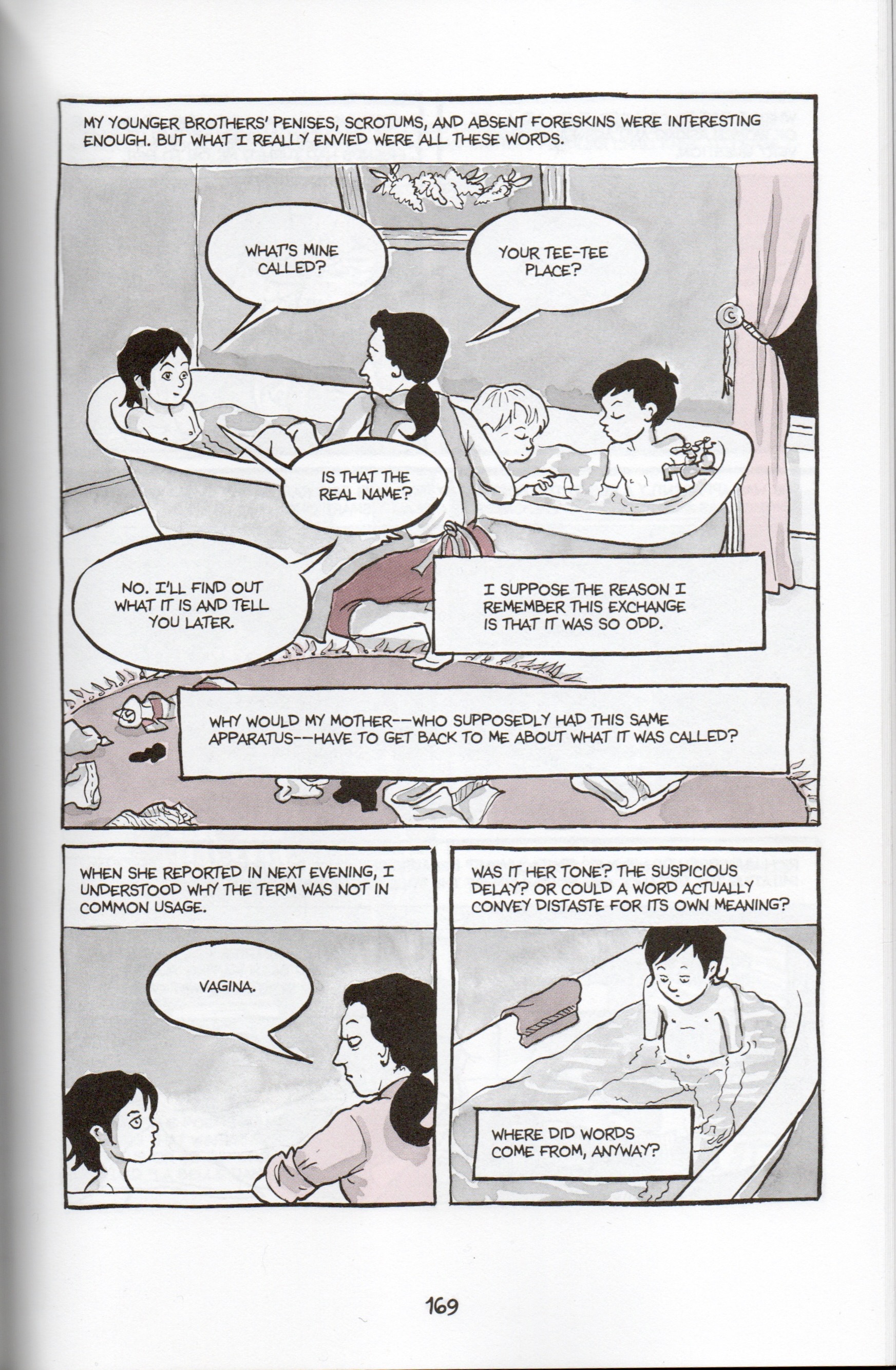
OK, so it’s not one thing. It’s about language, gender, sexuality, the mother-daughter relationship. And if you look at what the images are doing, you also see that young Alison is alone at one end of the tub while her brothers play together at the other end, and Alison’s facial expression in the final frame is eloquent. Also notice Bechdel’s characteristic use of non-male-gazey nudity (there’s quite a lot of adult female nudity in the book). This page is rich, emotionally engaging story-telling, and that’s true of much of the book. The subtle use of colour is also characteristic.

I was going to leave it there, but I feel bound to my practice of looking at page 79*. In this book, page 79 is part of the dream that starts Chapter Three, which has the Winnicott-derived title ‘True and False Self’.

The current therapist comes to Alison’s office, where, dreamlike, it’s no big deal that Alison is not wearing pants. The therapist massages her neck and shoulders, finishes briskly, and, on this page, takes her trousers away to mend them.
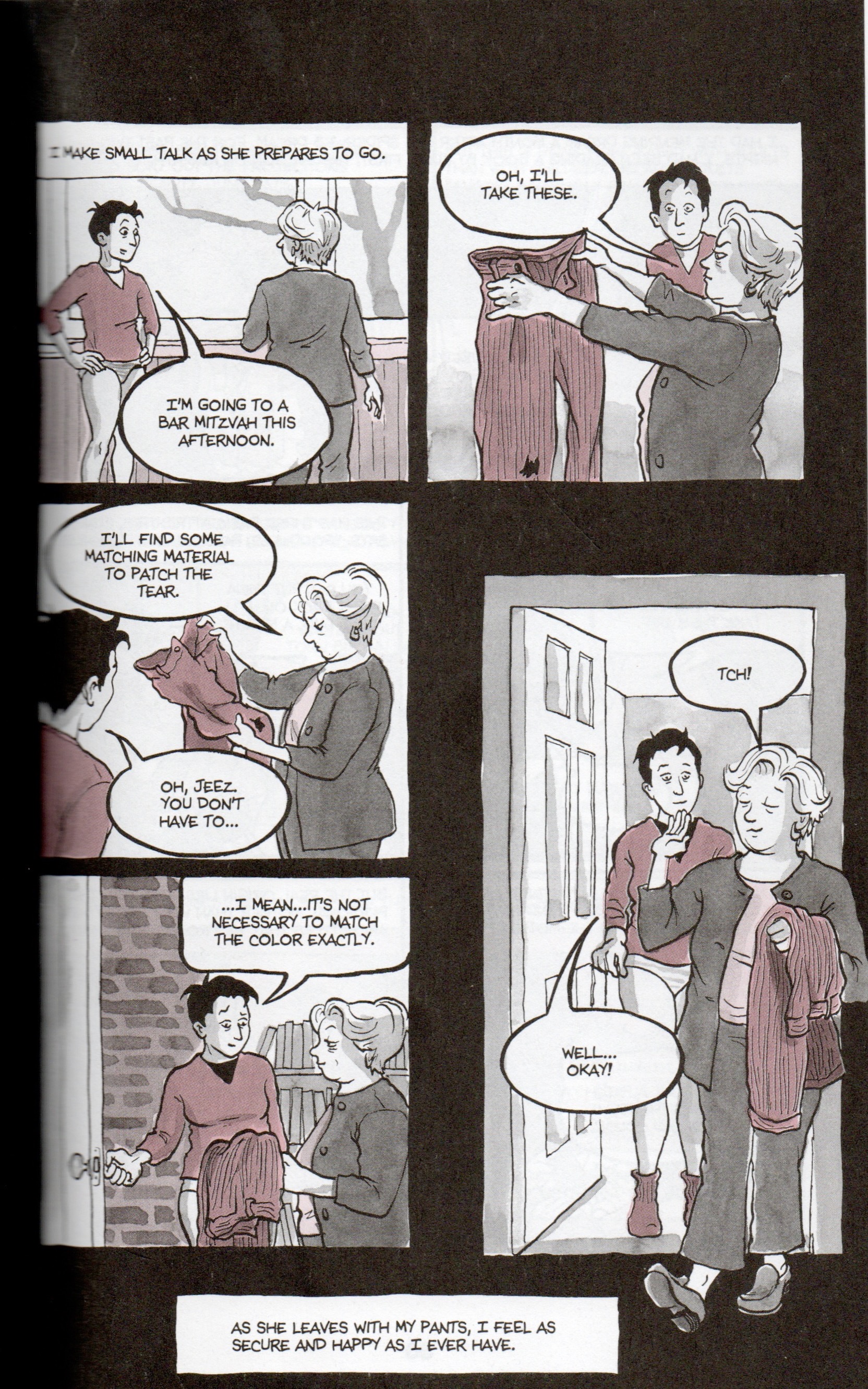
It turns out on the following pages that Alison has been reading Jung, and at her next therapy session expounds on her own interpretation of the dream. The therapist gives her interpretation. Transference is mentioned, and there’s a dubiously relevant quote from Winnicott’s paper, ‘Ego Distortions in Terms of True and False Self’. A number of frames tell a story, presumably a memory, of Alison’s mother patching her jeans, but without matching the colour. Which somehow leads to a scene where her mother asks young Alison if she loves her, and Alison feels put on the spot as no one in their family ever talks like that. And so it goes.

Maybe it’s a book that would reward rereading, even study. On first reading, it’s far too convoluted and recursive for my ageing brain.

Just before the meeting: I chatted about the book with a therapist friend, who said that most of the bits of the book I quoted to her were standard psychological theory. In the course of the conversation, I opened to a number of pages at random and found, to my mild surprise, that every page had something interesting going on. Evidently it’s a good book to dip back into.

The meeting: Sadly, the only member of the Group who couldn’t come is the only one who is well versed in psych theory. Nevertheless, we had an excellent eclectic meal and a rich conversation, much of which was about Alison Bechdel’s books. Among us we had read Fun Home, Are You My Mother?, The Secret to Superhuman Strength, and Spent, though no one had read all four. No one had read Dykes to Watch Out For, though someone had sighted it in a bookshop.

Impossible to summarise the conversation! A couple of chaps had an almost visceral reaction against psychobabble (my word), which made Are You My Mother? pretty much unreadable. One man spoke eloquently about Fun Home, in particular how moving he found its final movement. Spent, on the other hand, he found diverting but lacking depth. We spent some time admiring the artwork, and the sometimes complex relationship between image and text. One man felt he was seeing things he had no business seeing – he was partly talking about the sex scenes (especially, someone said, the toe-sucking) but also the intensely private introspection.

When someone said they were irritated by Alison’s self-absorption, someone else floated the idea that she (the character) was being sent up, seen as slightly ridiculous. If you look at the expressions on the faces of her succession of therapists, it was suggested, you see that they are pretty irritated by her as well. The question of how funny the book is was left open. (I think those who had read Spent agreed that it’s unambiguously funny.

Someone named a phenomenon that I have experienced, though not with this book. He said he just read it. That is, he was never engaged, but had it all pass before him like an interesting object that made no personal meaning. My guess is that this was about the medium – maybe comics ask to be read using different faculties from the ones used to read straightforward text. As a counter example, someone held up a spread in Fun Home that consisted of maybe 20 almost identical images of two characters in the front seat of a car and spoke of how well that scene caught the awkward conversation between the father and his adult daughter.

I don’t imagine that Alison Bechdel created this book with the explicit intention of having it discussed by a rowdy group of old, white, mainly straight men. But I don’t think she would have minded our conversation.


All the members of the Book Group are men of settler heritage. We met and I wrote this blog post on the land of Gadigal and Wangal of the Darug Nation. I acknowledge their Elders past and present and welcome any First Nations readers.


* My blogging practice is to focus on the page that coincides with my age, currently 79.
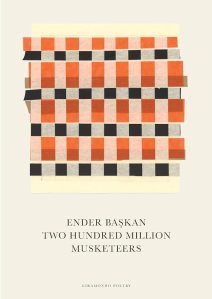
Ender Başkan’s Two Hundred Million Musketeers

Ender Başkan, Two Hundred Million Musketeers (Giramondo 2025)

This book won the 2026 Prime Minister’s Literary Award for Poetry. I imagine the judging panel having a great time sitting around the table reading aloud to each other.

The book’s nineteen poems flow like a river in spate, swerving from subject to subject, but keeping control. Most of them are in short lines with no punctuation apart from an occasional question mark, slash or exclamation mark, as if the poet is too busy to pay attention to such fiddly stuff, but lets the line breaks and rhythm do the punctuation work. I found myself reading fast, as if riding a wave.

The first poem comes with ungainly title, ‘Here Is The Shirt, (Get) Off My Back / Swimming In The Afternoon’. Possibly because I currently spend a fair amount of time with young grandchildren, I was in thrall from its opening lines:

if you want an alarm clock to work 
make sure you
place it out of reach
but never mind
our mutual friends are awake and so are we
549am
i am dad
im on demand
raaah-biiiish truuuuuuck!
i run out to see the bin flung up and over
with you

Life is rich and full, and who needs alarm clocks?

In this poem and the rest of the book the poet’s two young daughters emerge as fully loveable characters. I wonder how they’d get on with the two young girls who are similarly alive and interesting in Toby Fitch’s ‘Morning Walks in a Time of Plague’ (blogged about by me at this link).

As well as the arduous joys of parenthood, poems deal with work in a bookshop – ‘Erotics of Bookselling’ puts that work front and centre, but it’s often there incidentally. The poet travels with his family to his native Türkiye, celebrates his Melbourne neighbours, makes his political affiliations clear, grapples with the migrant experience, all with tremendous vitality and wit. A couple of lines in ‘Hot Water’ (on page 48) might stand in as a general description:

and the poem is a psychic luna park of associations
that just come when the soil is ready

Page 79* is the fourth of seven pages of the poem ‘Monolingualism Swamp’. That title may sound ominous, but there’s nothing ponderous or strident about the poem itself. The poet and his family are in Türkiye, he enjoys the way languages flow in Istanbul’s spice market (‘turkish arabic english russian’), and wonders:

i was gifted two languages
whattabout me kids?
they say growing up bilingual is good for your brain

When one of his daughters asks if he reads Turkish books, he feels ‘her monolingual pain’. Later in the poem he buys seven books to take home. The poem ends:

ill read these books in turkish
my daughters will see me
___thumbing the dictionary

That’s the skeleton of the narrative, but it leaves out the ‘psychic luna park of associations’. Page 79 is almost entirely taken up with a digression. A story from possibly ten years earlier, before the children were born, it pretty much stands by itself as a narrative poem:

Here’s the text, including a couple of scene-setting lines from the previous page, and omitting the last three line of the page, which move back into the poem’s present:

in 2016 I had a little desk here
in an artisans building on the third floor
next door a fitter and turner
trembling walls 
he brings me tea
you wanna come to friday prayers? 
looking at my world map on the wall he says 
turkeys in the centre of the world bro 
right in the centre not like austria thats off-centre
australia!
even worse wheres that? in the ass-end! 
one day we left work at the same time 
walked side by side
he had just bought a pair of timberland boots 
and was feeling pumped 
his last pair lasted seven years
and were easily worth the two weeks wages 
do you make money writing? 
not really
why do you write? 
its a habit
do you write in turkish? 
mostly english
do people read books in austria? 
not much
in turkey no one reads
they like pornos you should write pornos then youll make money 
you have a point... 

Every time I read it I smile.

I love this cameo appearance of an actual Turkish man in the middle of the poem’s ruminations about language. It’s a portrait created almost entirely out of speech, either direct or reported. For him, being bilingual isn’t a big deal – he speaks English with a North American accent (‘bro’, ‘wanna’), and his world view is cheerfully and unapologetically Turkey-centric. Islamic observance is integrated into daily life, and is a way of checking out a foreigner.

It’s a good example of the way Başkan’s lines flow. You may have to think for a brief moment at the tenth line – ‘australia’ – to check who’s speaking. But that pause for thought creates a natural break in the rhythm before the fitter and turner’s response, and you can feel the poet’s pleasure in recording that response.

I am grateful to the Giramondo Publishing Company for my copy of Two Hundred Million Musketeers. The publicity material accompanying it included an author’s note, in which Başkan says he returned to writing when his first child was learning to talk: ‘Mumbo jumbo and jibber jabber filled our home.’ The poetry in this book brings the exuberance of jibber jabber to the preoccupations of an adult life, from the difficulty of ordering takeaway coffee from people who can’t pronounce your name to the many crises of late capitalism. I’m so glad the judges of the Prime Minister’s Literary Awards prompted me to take it from the shelf.


I am a man of settler heritage living on Gadigal Wangal country, where the days are suddenly warmer and magpies seem to be everywhere. I acknowledge Elders past, present and emerging for their continuing custodianship of this land, and welcome any First Nations readers.


* My blogging practice is to focus on the page that coincides with my age, currently 79.
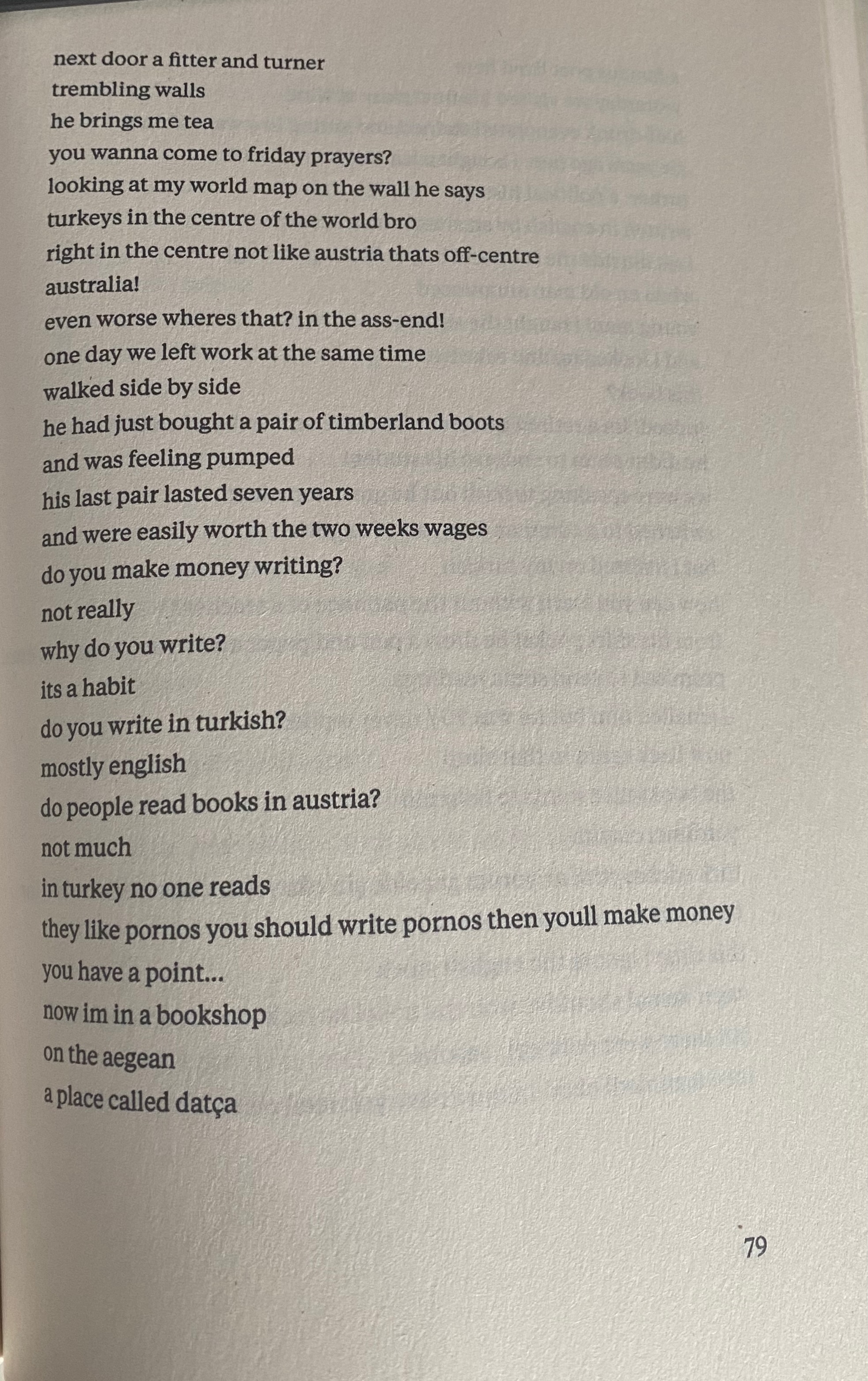
Omar Musa’s Fierceland and the Book Club

Omar Musa, Fierceland (Penguin 2025)

Before the meeting: This is a fabulously ambitious novel.

Two children in a village in Sabah in northern Borneo are taken into the forest by their father on an excursion that turns out to be the beginning of his ruthless acquisition of ever-increasing areas of jungle to turn them into ecologically disastrous palm oil plantations. While there, the children witness brutally murderous treatment of an Indigenous man whom they have come to love. The rest of their lives is dominated by that experience, and by their troubled relationship with a father who represents the worst of rapacious, extractive capitalism.

Omar Musa is a brilliant spoken-word performer (see the YouTube below where he is accompanied on cello by his wife, Muriel Roberts Musa). The novel, his second, is not confined to a naturalistic mode of storytelling. In its opening pages the forest speaks, and the language cries out to be read aloud, even chanted. Here’s a taste:

mud-gravy & gizzard stones, steeple my long luminous bones & carnal green – the unseen seen – green is God naming itself, green is the sprawl, rot & fern-tickle of time – my steaming velvet a sprung floor for trickster tango – orang, hutan, orangutan, mousedeer, leopard, vampire ghost – black loam & clay blue-grey, sequinned by skulls, I wear my sapblooded heart on sleeve

The forest has further chapters, but as the palm-oil plantations spread, it has less to say and becomes less exuberant, until its final utterance is just a few plaintive words.

The main story unfolds in alternate chapters focusing on the two children, Rozana (known as Roz) and Harun – first in 1998 when they witness the terrible violence, then over the decades as they live with the privilege that comes from their father’s enormous wealth. They are sent to separate boarding schools in Sydney, where Roz, after a troubled adolescence, becomes an unsuccessful artist (and there is some finely honed satire of artists exploiting their diasporic status). Harun makes a mint from a virtual reality forest creation in Los Angeles. They return to their tiny village in 2018 when their father dies, and they inherit enormous wealth – unfairly distributed between them, but enormous all the same. They have both come to understand the devastation that their father has caused to the environment and Indigenous people, and the inheritance brings their ethical dilemma into focus.

The story is enriched by historical excursions – into 19th century Venetian glass-making, the beginnings of Malaysia’s palm-oil industry in a trade visit to Nigeria in the 1970s, tables as emblematic of colonisation. There are elements of what I’ll risk calling magical realism: mainly figures from Malaysian folklore like the vengeful female ghost, the pontianak. A character known affectionately as Crazy Auntie, a poet living in exile in Sydney, is the voice of reason – speaking against extractive capitalism. Roz’s redemption as an artist comes when she creates an installation based on Crazy Auntie’s poem, ‘The Song of the Wood’, translated into the more than 50 languages of Sabah: the book gives us 15 versions of the poem, printed in white on a mildly decorated black background. The English version ends:


Kill a language and a forest dies
Kill a forest and a language dies

Children of ash –

Be gentle with my heart.

While I was thinking about this book, I heard a radio program about some children of top Nazis (it’s at this link) who are facing the implications of their origins. And I thought of a close relative who is currently researching how our recent ancestors, sugar farmers in Queensland, benefited from the blackbirding of Pacific Islanders. Roz and Harun’s ethical quandary resonates.

I don’t think the book entirely succeeds. There are bits where you can feel things being hammered into shape. The conclusion (no spoilers) has a poetic logic but leaves too many questions unanswered. There’s a moment on page 132 when I nearly stopped reading. It’s in the chapter that tells the story of a glass bead, a murrina (but also a macguffin), from its creation in mid-nineteenth century Venice, through its passage from owner to owner until it ends up in the forest of Sabah. As a poetic history of colonisation, it’s laboured, but it works, until the moment early in the twentieth century when the Rajah of Pandasan, then owner of the bead, plays chess with a Polish visitor named Josef Teodor Konrad Korzeniowski. The Pole asks the Rajah what he will find if he keeps going upriver:

You get to the heart.
The Pole’s eyes light up. The heart? The heart of … darkness?
No, you fool, says the Rajah, laughing. The heart of spirit. The heart of light. Follow any River and you’ll get to a mountain peak. – no place on earth is more full of light.

Josef … Konrad, ‘The heart of … darkness?’ Get it?

Happily, this awkward knowingness is not at all typical, and I’m glad I decided to read on.

Page 79* gives you a better idea of the writing.

It’s 1978, 20 years before the inciting incident in the jungle of Borneo. Yusuf is the main characters’ father. Here he is a young man, a recently graduated engineer, in Nigeria with a group of Malaysians to explore ‘the age old cultivation’ of oil palms. At the start of the page, Yusuf is telling their genial Nigerian host, Ekben, that ‘he had grown to hate poverty with a passion that most people reserved for other human beings… He spoke unashamedly about his long-term plans. How he would have many sons and start an empire. He’d come to realise he was less an engineer and more a businessman, he said, although the engineering would come in handy.’

In this quiet moment where one young man proclaims his ambitions to another lies the seed of ecological and genocidal disaster. The novel doesn’t follow Yusuf’s career – in fact, the first full sentence on this page is the only account it gives of the career’s overarching shape.

He would go first into logging, where endless riches awaited, and then put to use the skills he had learned here.
—Working for the government? asked Ekpen.
Yusuf looked around.
—Working for myself, but with the government’s help. When I have a family, I’Il do anything to make their lives better than the one I had.
—Anything? asked Ekpen.
Yusuf paused for a moment, and in that moment, Ekpen cut in.
— I come from a wealthy family, so maybe I see these things a tad differently. But I can see that, in both of our countries, there are many opportunities now that didn’t exist before. It’s a new world.
— It takes a hard man to make his way in a hard land, replied Yusuf.
— Be careful, my friend, said Ekpen.

You get a taste here of the breadth and generosity of Musa’s imagination. However great the harm Yusuf is to do, there are real forces compelling him: the hatred of poverty, the harsh realities of his society, a fierce commitment to his family. As this is a flashback, the reader knows that Yusuf’s decision to go after those ‘endless riches’ will lead to the destruction of his family’s happiness and much more.

Yusuf strode into the market as if it was the one in Sandakan where he had once sold trinkets to make ends meet. He was looking for a gift for his new wife Jenab, a name he was still getting used to calling her, and another for his best friend Nurhanizah, who had just finished her studies and moved into a raucous sharehouse in Sydney.

This moment reminds us that Nurhanizah, ‘Crazy Auntie’, who is to become Yusuf’s main moral antagonist, and whom he will destroy, was once his best friend. She too is westernised, but the values that go with a ‘raucous sharehouse’ pit her against him. We’re also reminded that Yusuf’s loyal wife, Jenab, was once named Ruth. In the underlying schematic of the novel, it’s an outsider who is willing to support Yusuf’s rapacity.

The final paragraph on the page is an example of the kind of writing that makes the book live. Whatever Musa’s characters might be up to, his prose celebrates the vibrant reality of communal life, in Nigeria as well as in Malaysia.

The kaleidoscopic mayhem of the marketplace was a universe unto itself, a pinballing, jangling, chattering, humming orchestra of commerce and capital, voices rising in gossip and aggravation and trade, meat and fish lying on newspaper, some fresh, some flyblown, some smoking and drying in the sun, piles of chillies, okra, cassava, fufu wrapped in plastic, machines cleverly devised from spare parts into utensils for grinding and blending, the roar of these machines, and more upon more, the chatter of people hustling for every square inch, foot or naira in this city, wearing football jerseys and batik, the whole market like one giant textile woven from many different threads, creating a oneness that then frayed into disparate parts again.

This vision of the market celebrates organic, messy, apparently chaotic life that moves from oneness to disparate parts and then back. It’s like the jungle, in contrast to the regimented rows of the palm-oil plantations.

Incidentally, one of the small pleasures of the book is the use of non-English words without explanation. This page’s action is taking place in Benin City, Nigeria, so the two words that are new (to me) are Nigeria-specific: naira is not a measure of space as the context may suggest, but the Nigerian currency; and fufu is just what you’d expect from the context, a food – ‘a pounded meal found in West African cuisine’ according to Wikipedia. Elsewhere, the scattering of Malaysian and (I think) Arabic words contribute to the rich sense of place that is one of the beauties of the novel.

At the meeting: We started out the night with non-alcoholic prosecco, which meant that I could join in the toasting for a change. The excellent meal prepared mainly by the Mid-career Artist culminated in her signature pavlova. Then we discussed Douglas Stuart’s John of John, and finally turned our attention to Fierceland, which we had picked because it won the 2026 Miles Franklin Award.

It tended to divide us. One person didn’t read much of it and didn’t care to say why. Another felt an overwhelming sense of dread and stopped reading before the halfway point. Another said that too much of the book was taken up with ‘devices’: the history of the bead/murrina was just one of them. She didn’t much care for the chapters where the forest speaks.

One person gave an eloquent account of the book as a work of great ambition that fails to fulfil that ambition but is still an admirable and enjoyable work. I felt as if she was reading my mind. We could have done without the little chapter about tables and colonisation; the genre-busting inclusion of fifteen pages on which the same poem appeared in fifteen different languages is a darling that could have been murdered; and so on. But without them it would have been a less interesting book.

One person felt that a didactic element made some parts tedious. Others (including me) didn’t register it as didactic, though we did feel that we were learning things we thought we already knew, which must be one of the things that successful fiction does.

In these conversations we sometimes flick back and forth between the two books, but that didn’t happen this time. Maybe there’s the germ of an exam question there: ‘What don’t John of John and Fierceland have in common? Do not compare and contrast.’


The Book Club’s five members, all of settler heritage, met on Wangal and Gadigal land, which is where I wrote this blog post. I gratefully acknowledge the Elders past and present of all those Nations and welcome any First Nations readers of this blog.


* My blogging practice is to focus on the page that coincides with my age, currently 79.

Douglas Stuart’s John of John and the Book Club

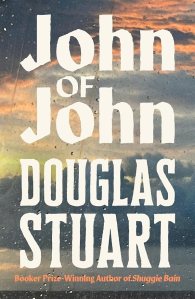
Douglas Stuart, John of John (Pan Macmillan 2026)

Before the meeting: I love this book.

It’s set on a remote Scottish island where Gaelic is still spoken in a fiercely pious religious community. Cal is a young, gay fine arts graduate who has come home from Edinburgh because, according to his father in one of their painful weekly phone calls, his grandmother is ill – the book’s opening sentence is, ‘Her feet were as purple as calf liver.’ The young man’s full name is Calum John, and on the genealogy-conscious island he is identifiable as John of John. John McLeod, his father, is a church elder and weaver – stern, ascetic, hardworking, painfully honest and a harsh parent. John’s wife, Cal’s mother, has long since left him and been ostracised by the religious community as a result. It’s not a spoiler to tell you that John, the father, has a long-term, secret, sexual relationship with another man, his neighbour Innes.

Chapters mostly alternate between Cal’s and John’s points of view. A rich portrait of the remote community emerges. A good part of this is in the language – not just the occasional Gaelic dialogue and the bilingual chapter numbering (a h-aon / one to fichead ‘s a sia / twenty-six), but in the English words that feel as if they belong in that place. On page 20 in chapter 2 for example, there are five words that were new to me:

  • croft (which I previously thought signified a small farm, but here refers to the house on the farm)
  • harling (here ‘painted an almost painful white’, this is roughcast – plaster mixed with small stones or shells, which I recognised in a scene in 35 Up one night this week)
  • rickle (a loose heap), skive (to pare or scrape, as in leather)
  • semmit (a vest or undershirt).

The meaning of all five is clear enough from context, but they enrich that context.

The plot revolves around the relationships of the three men and Ella, John’s mother-in-law who has been young Cal’s protector and a thorn in the side to John. Cal resumes the exhausting work of weaving at his father’s loom, and deals with unfinished business with other people of his generation, including a woman he was expected to marry and a man his own age who no longer wants to have sex with him. John must deal with Innes’s increasing impatience with their secrecy. More than once, John lashes out violently at Cal, and it’s a measure of the strength of the writing that we understand why Cal not only stays on the island but dutifully tells anyone he meets that the terrible bruising on his face was caused by a fall. It’s partly that Cal feels he has failed to make it on the mainland, but deeper than that is ancient family loyalty. Nobody believes him about the fall, but no one intervenes, and we understand that too.

A potential sexual triangle develops between Cal, John and Innes, which would make great comedy-of-manners if the stakes weren’t so high for all of them. For Cal, to be out as Gay would mean exile back to his mainland life. For the others it would mean the end of their lives as they know it, and for John especially it would mean facing his deep sense of shame. All the same, I must ask at the book group if other people laughed at the scene where Cal tries it on with Innes – I didn’t, but I cringed.

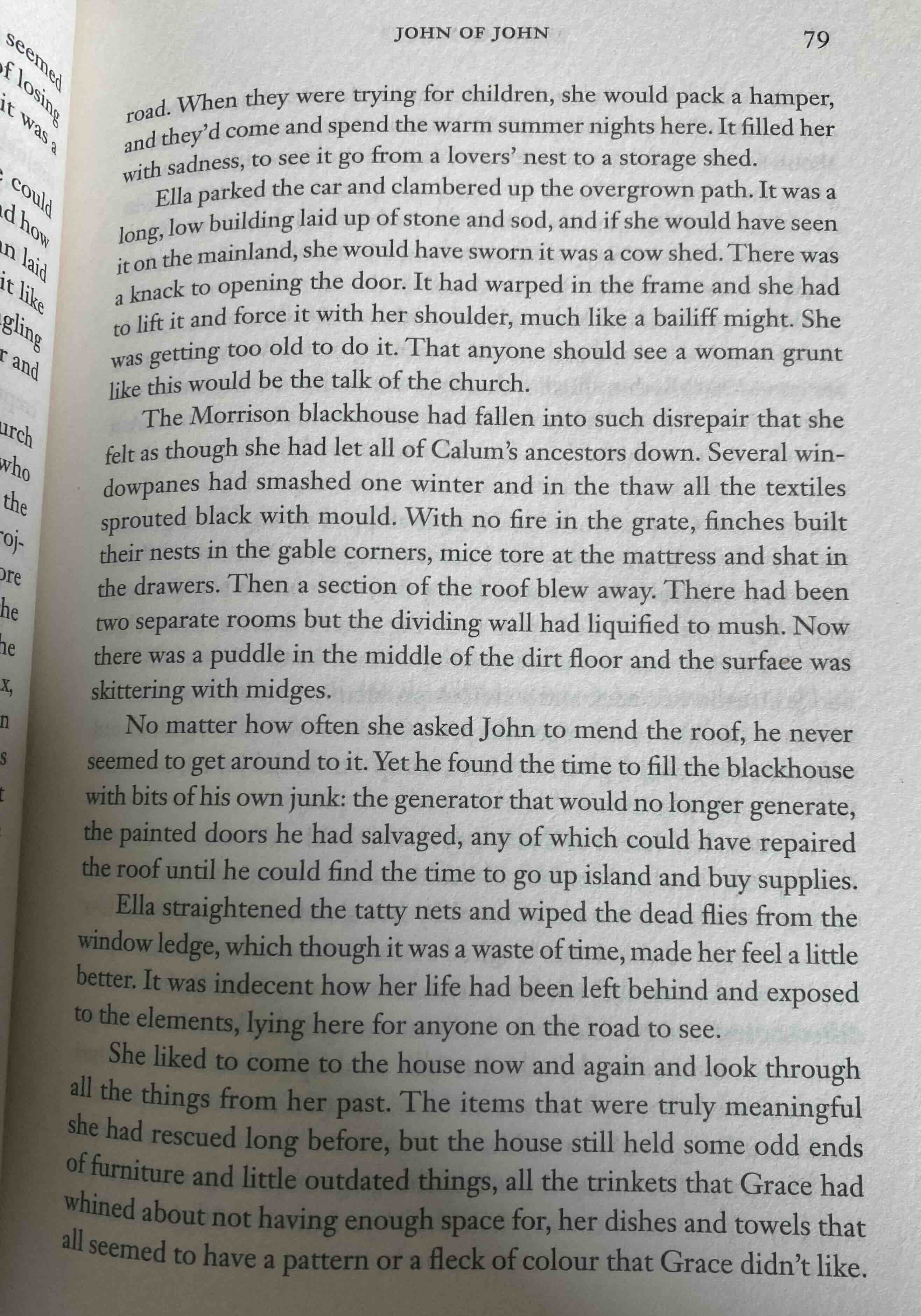
Page 79 is in Chapter a sia / six, one of the few that has a focus on someone other than John or Cal. This is Ella’s chapter. It gives her backstory – how as a young Glaswegian woman during the Second World War she had enjoyed the high life and resisted the attention of a taciturn man from the islands – Old Calum as he came to be known – until she got pregnant by a serviceman and Calum asked her to marry him. In this chapter we meet Grace, Cal’s mother, for the first time, and see Ella’s behind-the-scenes manoeuvrings to make Cal’s time on the island tolerable.

But page 79 itself is taken up entirely with Ella’s visit to a derelict blackhouse. A blackhouse, according to my web research, is a type of house that used to be common in the Scottish highlands and islands, built of stone with a thatch roof (‘laid up of stone and sod’, as Stuart puts it). (Wikipedia has photos.)

The page doesn’t move the plot forward, but the elegiac tone that suffuses the book comes into focus here. The state of the blackhouse works as a metaphor: the old ways of the island are on the way out, partly because of the different morality of the younger generations (Cal isn’t the only one touched by 21st century sexual mores), and partly because the traditional work of small farms and hand weaving is coming to an end.

Ella parked the car and clambered up the overgrown path. It was a long, low building laid up of stone and sod, and if she would have seen it on the mainland, she would have sworn it was a cow shed. There was a knack to opening the door. It had warped in the frame and she had to lift it and force it with her shoulder, much like a bailiff might. She was getting too old to do it. That anyone should see a woman grunt like this would be the talk of the church.

There’s so much happening in that short paragraph. We’re reminded that things are different from ‘on the mainland’, and that moralistic surveillance is everywhere. The clambering, shouldering and grunting keep the narrative firmly in the physical reality.

The Morrison blackhouse had fallen into such disrepair that she felt as though she had let all of Calum’s ancestors down. Several windowpanes had smashed one winter and in the thaw all the textiles sprouted black with mould. With no fire in the grate, finches built their nests in the gable corners, mice tore at the mattress and shat in the drawers. Then a section of the roof blew away. There had been two separate rooms but the dividing wall had liquified to mush. Now there was a puddle in the middle of the dirt floor and the surface was skittering with midges.

This is still intensely physical, but there’s also a reminder of the importance of tradition in this place, even for an outsider like Ella – ‘she felt as though she had let all of Calum’s ancestors down’. In the first chapter, on the ferry to the island, a woman asks Cal, ‘And who do you belong to?’ and he replies, ‘I’m John of John of Iain of Iain the Breabadair.’ Even for Cal with his long, dyed-blonde hair and his arty ways, ancestry is important. Breabadair means ‘weaver’ – Cal’s family have been weaving for five generations.

She liked to come to the house now and again and look through all the things from her past. The items that were truly meaningful she had rescued long before, but the house still held some odd ends of furniture and little outdated things, all the trinkets that Grace had whined about not having enough space for, her dishes and towels that all seemed to have a pattern or a fleck of colour that Grace didn’t like.

This may be the first appearance of Cal’s mother, Grace. As you might expect, there are interesting revelations to come about why Ella is living with her hostile son-in-law rather than her daughter, and about why Grace left John all those years ago, leaving Cal with him. But here there are just hints of mother-daughter tensions, of Grace as someone who knows her own mind and, though Ella might call it whining, can hold out for what she wants.

At the meeting: We had a terrific discussion of this book. I asked if other people had laughed at the scene where Calum tries to seduce Innes.Nobody had. They agreed it was weird but, as one of the women said, men do weird things. Weird or absurd, believable or not, I think we all agreed that it was poignant, saw it as a measure of Cal’s desperation for closeness and perhaps for a sexualised version of fatherly affection.

But the conversation really kicked off when one person said she found the whole thing unbelievable. Why did Cal stay on the island where he wasn’t welcome, and life was full of drudgery and violence? Why did John’s wife not blab about his homosexuality when she left him all those years ago? Why didn’t she take her sone with her? Why did Innes keep hoping after all this time? How did John manage to have a long-term homosexual relationship while genuinely adhering to stern puritan religious beliefs, preaching and practice?

They were good questions, and the rest of us fumbled around for answers. The importance of attachment to the place was mooted. The way small, isolated communities command loyalty. Cal is young – in his early 20s – and, like a number of unnamed friends of one person, unable to take the initiatives necessary to improve his life.

We spent a lot of time trying to work out what happens at the end of the book. It’s hard to say much here without spoiling, but I think we ended up deciding that while John’s future course is clear, Cal’s is up in the air: he has a momentary fantasy of how it will go, but on closer reading it seems unlikely that that’s how things will come to pass. The very final moments are inconclusive, though when we focused on the word bellwether, at least aspects of it became clearer.

Someone had looked up Harris tweed, and informed us that it is hand woven cloth whose production on rugged Scottish islands is rigorously policed. This is the kind of cloth that Calum and his ancestors have been producing.

We discussed this book in tandem with Omar Musa’s Fierceland. We had a great conversation about each book, but there was no crossover at all.


The Book Club’s five members, all of settler heritage, met on Wangal and Gadigal land, which is where I wrote this blog post. I gratefully acknowledge the Elders past and present of those Nations and welcome any First Nations readers of this blog.


* My blogging practice is to focus on the page that coincides with my age, currently 79.

Pam Brown’s Guess the Experience

Pam Brown, Guess the Experience (Hunter Publishers 2025)

I’ve been ruminating on Guess the Experience for about a month now. More precisely, I’ve been trying to find words for what I enjoy about it – and I have enjoyed it a lot.

It’s not the kind of poetry you can memorise to recite at weddings, funerals, sleepless nights, break-ups, or fallings-in-love.*

It doesn’t have a compelling narrative or a straightforward argument.

Rather than try for generalities, I’ll stick to page 79**, and see what I come up with.

Page 79 is part of an eight-page poem, ‘pulp to reform’. An endnote informs/reminds us that Pulp was a British art-rock band. In 2022, commenting on a facebook headline, ‘Pulp to Reform’, Melbourne poet Michael Farrell said it sounded like the title of a Pam Brown poem. She rose to the challenge and wrote the poem. As far as I can tell, the poem doesn’t relate to the band at all (though I did go looking: ‘Common People‘ was their song).

The poem is made up of six sections ranging from 11 to 27 lines long. It’s not always clear how the sections relate to each other. In fact it came as a surprise to me on first reading when the last lines referred back to the opening. The first section begins:

this is
__my first interview
____since my death

And the poem ends:

from this cardboard coffin
________some final words –

So the poem’s set-up is clear: the speaker is giving a posthumous interview. But it doesn’t deliver on that promise. The final section acknowledges as much, and also contains a description of the poetry. Here it is in full:

this interview
has digressed

i'm not sure
what you want
____to know

is it
about the poetry?

all
___accidental

from this cardboard coffin
________some final words –

Pretty much everything between the opening lines and ‘this interview / has digressed’ is digression. But if you want to know about the poetry, the speaker says, I can tell you it is ‘all accidental’. The speaker obviously isn’t Pam Brown herself – Pam Brown isn’t dead, for one thing. But ‘all / accidental’ isn’t a bad description of how this poetry feels. Having said that, there’s always a sense of discipline in the lines.

But I’ve got ahead of myself.

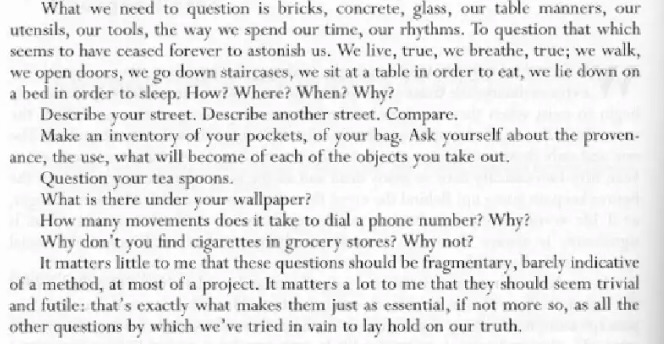
Page 79 is roughly the first half of the poem’s third section. In my reading the first section has set up the situation and given an elliptical account of the speaker’s death (‘I swallowed / a cotton bud’ – comedy rather than tragedy) – and of the kinds of health fads she had lived among. The second, she recalls working in the kitchen. Georges Perec is mentioned and apparently quoted – ‘question your teaspoons’. The reference was obscure to me, and in my usual lazy manner I was happy to accept it as adding flavour. But because I’m blogging about the poem I went hunting and found this wonderfully illuminating quote from Perec’s 1973 essay, ‘Approaches to What?’ (at this link):

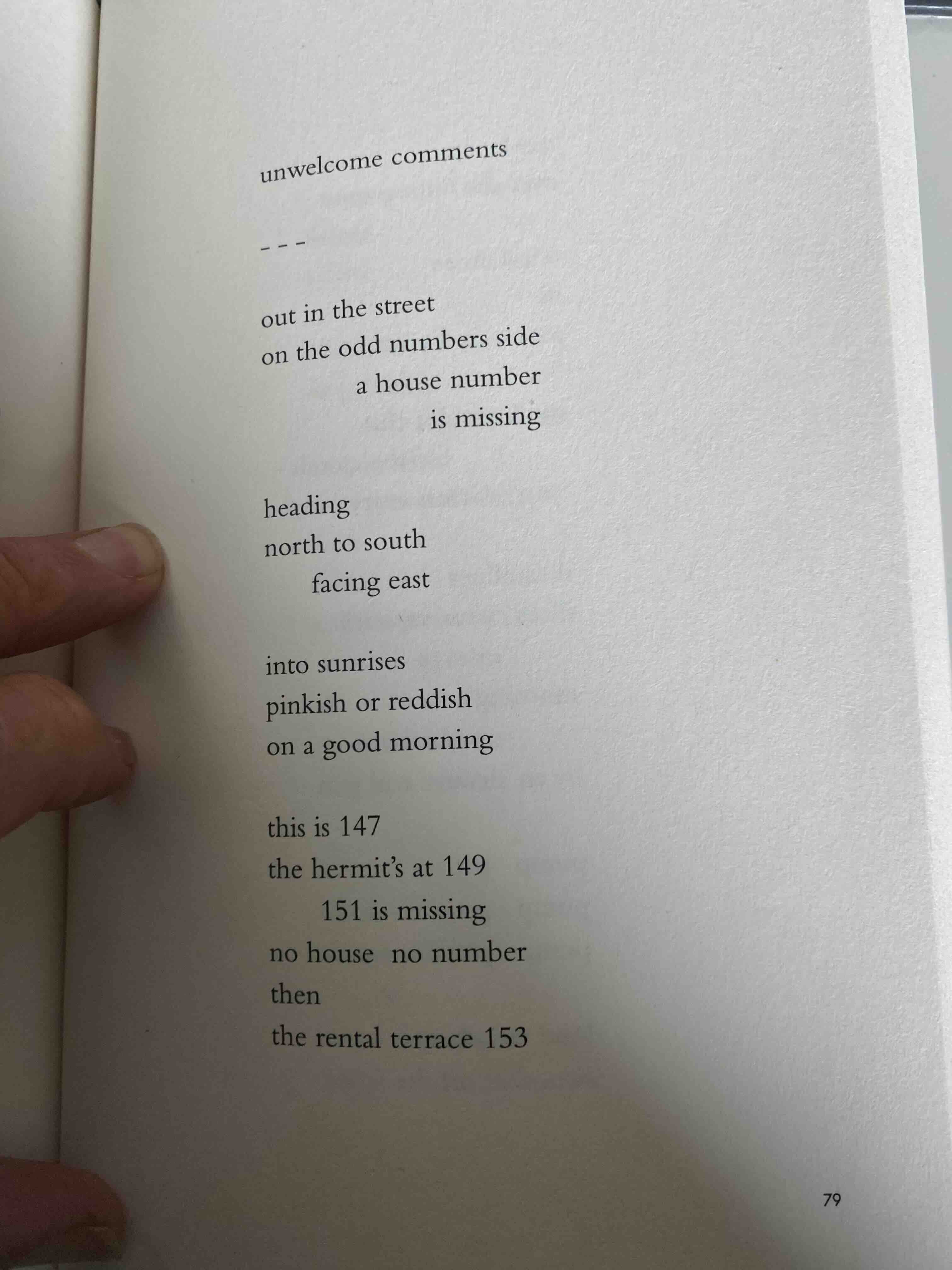
It turns out the reference isn’t just adding flavour. The speaker has been noticing details in the kitchen sink (‘little transparent / purplish white globes’), Perec’s essay comes to mind and, crucially, Perec’s injunction, ‘Describe your street,’ prompts the transition to the next section, the one on page 79 (ignore the first two words):


out in the street
on the odd numbers side
________a house number
________-_____is missing

heading
north to south
_-__facing east

into sunrises
pinkish or reddish
on a good morning

this is 147
the hermit's at 149
__-__151 is missing
no house_ no number
then
the rental terrace 153

On first reading I enjoyed this page for a completely idiosyncratic reason. My six-year-old grandson is currently fascinated by numbers, and his fascination is contagious. He loves it, for example, that we are in unit 43, across the landing is 41, the unit directly under us is 40. And now I love it too. These lines feed directly into that fascination. Having done my research and come to a reading that makes sense of what the lines are doing in the context of the poem as a whole, the initial pleasure stays in place, but feels less idiosyncratic: the poem is drawing attention to such trivial details as ways by which, as Georges Perec puts it, we try ‘to lay hold on our truth’.

This section of the poem continues – it takes up the ‘sunrises / pinkish or reddish’, with a description of an inner-city dawn. In the following sections, the speaker remembers, as it were, that she is speaking after having died, and recollects that when alive she was ‘always polite / & / friendly’, speaking a little Greek at the deli and regretting that she never took up an offer to go to Samos. It all feels arbitrary, until it reaches the final lines I quoted above, ending with an inclusive dash.

The word that comes to mind is immersion. The poem creates the illusion that you (that is, the reader) are privy to the poet’s mind – not to her finished, carefully utterances, but the turmoil of actual, distractible thinking in an actual inner-suburban place, ‘all / accidental’ but enjoyable as evidence that the human mind is, after all, the most complex entity in the known universe.

My copy of the book was a generous gift from the author.


I am a man of settler heritage. I wrote this blog post as the days are beginning to lengthen and get colder on the land of Gadigal and Wangal. I acknowledge their Elders past and present and welcome any First Nations readers of the blog.


* I just remembered a funeral where Laurie Anderson’s ‘O Superman‘ was played as the mourning congregation watched a slideshow of the deceased’s life, so anything is possible.
**My blogging practice is to focus on the page that coincides with my age, currently 79.

Moreno Giovannoni’s Immigrants

Moreno Giovannoni, The Immigrants: Fabula Mirabilis, or, A Wonderful Story (Black Inn 2025)

An author’s note describes this book beautifully:

While based on real events, this is a work of the imagination in which names have been changed, characters and scenes created and facts distorted for dramatic purposes in order to tell, in a fantasy kind of way, the story of the Italian community, and the story of my family, who lived in Mitrefò and district in the 196os. It is told as I remember it and it is therefore imperfect but nevertheless true.
(Page 1)

The note goes on to say that Bafaloriva, where much of the action happens, is a fictional place, not Buffalo River, and Mitrefò is not Myrtleford. Apart from amplifying the disclaimer about literal accuracy, this makes another point: naming a place in what has been called Australitalian signifies not just a mangling of the name, but a difference in the way the place is experienced.

Giovannoni’s first book, The Fireflies of Autumn, was framed as stories told by emigrant Ugo Giovannoni about his home town, San Ginese in northern Italy. The Immigrants tells the story of Ugo’s emigration to Australia, his life in Victoria, mainly farming tobacco, and his two failed attempts to return to Italy. And it tells the story of his young wife Morena and their two sons, especially Moreno (known as Morè – ‘only an Italian can say that properly’). And the story of the community of people who travelled from all over Italy to the area around Mitrefò in the years after World War Two, looking for a better life. ‘For a better life’ is a phrase that recurs, gathering heavy irony as it goes.

The book’s subtitle, ‘Fabula Mirabilis, or, A Wonderful Story’ led me to expect something almost cosy, tales of immigrant life bathed in a nostalgic glow. There is some of that in the vitality of the community, the young boy’s pleasure in the natural environment, even the details of the work of tobacco farming as it then was, backbreaking but somehow noble. But there is much more. What emerges is a picture of immigrant experience that is truly revelatory: food, language, yearning for home, religion, the attitudes of most ‘Australians’, marital strife – all these elements and more combine to powerful effect. It’s not a continuous narrative. Stories repeat and overlap in a mixture of memories of childhood, remembered conversations with Ugo and Morena when they confided in their son, court documents, and passages of pure invention.

There are seven sections called ‘grotesques’, case histories of murder, violence, madness, despair, mostly drawing on official court or hospital documents, Some of these are stomach-churningly hard to read, and they serve as reminders that the stakes were high. My blogging practice is to focus on the page that coincides with my age, currently 79. Page 79 of The Immigrants is a version of the coroner’s report into the death of a child from a tiger snake’s bite in 1973. It’s a powerful conclusion to the third ‘grotesque’, but not what I would pick as a representative page.

When ‘the immigrant son’ is a young adult, he finds a book on the history of the district, written by ‘an amateur historian, an English settler’. He expects to learn the history of the Italians in the area, but finds instead much information about the Indigenous population and stories of the town council etc:

Of the Italian tobacco growers, there is barely a mention.
That night he discovers that of 280 pages in the book, thirty contain, here and there, a passing reference to the cultivation of tobacco. The word Italian appears twice in the whole book. The index does not contain the word Italian.
Over time he has learnt that whenever the stories of the immigrants are told, they are told by the Australians or those whom the Australians have captured. Immigrant stories are never told with love and clarity. Always with humour and ridicule.
(page 215)

This book is a significant contribution to fixing that, with humour but absolutely no ridicule. So it’s part of the great reimagining of Australian history that has come in the last half century. It’s also something of an elegy for tobacco farming. And an elegy in a deeper sense as well:

Two weeks before [Ugo] dies, he tells his son he has seen la Bettina, the old woman who is Death. His son has never heard that rare Tuscan term before and is unable to trace the usage of the word or its origins. By the time Ugo dies, there is nobody left in San Ginese who knows about la Bettina.
Moreno realises that with Ugo’s death, other things will also disappear, from Tuscany and from the English colony.

As my regular readers know, I come from Innisfail in North Queensland, whose story it would be impossible to tell without including Italians. My classmates at school had names like Brunello, Quagliata and Gugliotto. When I saw my first professional theatre, the travelling production of Ray Lawler’s Summer of the Seventeenth Doll, I was thrilled to have the existence of north Queensland acknowledged, but as a 12 year old I felt that the play got it wrong by making its two canecutters Anglo, when according to my experience they should have been Italian, Maltese, or Yugoslavian.

It’s been a matter of quiet pride for me that my mother’s father, a magistrate, learned Italian and would intervene from the bench in the 1940s when Italian defendants were represented by lawyers who didn’t understand what their clients were saying.

So the book spoke to me personally. It pulled me up and asked me to look at my life from a different perspective. As a child, I had no idea that when I was eating ‘the brown lump of meat and the mush of potato, carrot and peas the Australians eat’ (page 136), the Pasinetti family down the road were probably eating what we these days would recognise as decent food. I had no idea of the drama and sometimes tragedy of migration that was playing out around me.

This is a book that has expanded my world.


I am an Australian man of settler heritage. I wrote this blog post on Gadigal and Wangal country, where it is my good fortune to live as the days are growing longer and warmer. I acknowledge Elders past and present of those Nations, and I welcome any First Nations readers and commenters.

.

Paul Lynch’s Prophet Song at the Book group

Paul Lynch, Prophet Song (Faber & Faber 2023)

Before the meeting: The Book Group is going through an Irish phase. Several Irish novels ago, one of our number said, ‘This is a beautifully written Irish novel, but does the world really need another beautifully written Irish novel?’ Yet that same man was this month’s Chooser, and here we are.

I remember reading a little about Prophet Song when it won the Booker Prize in 2023. The Booker then as now has a bit of a reputation for choosing grim novels, and this choice sounded true to form. I wasn’t planning to read it.

But, as has happened before, what the Book Group wants …

It is a beautifully written Irish novel, and an unremitting dystopian tale. It begins with two policemen knocking on the door of Larry Stack, a reacher and union leader in Dublin. In a reasonably pleasant chat, they warn him to call off a strike he is organising. And it goes from there.

The strike happens. Larry and others are arrested and disappear. More people begin to silently disappear as the government claims emergency powers, and key positions at all levels of society – schools, hospitals, local councils – are filled with cold-eyed people wearing party insignia. The Republic of Ireland becomes a full-blown police state, all as experienced by Larry’s wife, Eilish: first her husband is disappeared, then her oldest son goes into hiding to avoid the draft and we assume joins the rebel forces; she is pushed out of her job. Things get worse from there. The quiet suburban street becomes a war zone, and when the rebels take it over things don’t get any better. Eilish lives through all of this, while searching for her husband, doing her best to care for her three remaining children, and looking after her father who, symbolically enough, has dementia.

And it’s Ireland! Coming to it so soon after reading Patrick Radden Keefe’s Say Nothing (link is to my blog post), where – in the real world – rebels would cross the border from Northern Ireland to find refuge in the Republic, I kept thinking it was an impossible fantasy: ‘It couldn’t happen there!’ But then I’d think of ICE in Minneapolis, and even the NSW police at a pro-Gazan demonstration earlier this year, and my blood would run cold.

I don’t think it’s a spoiler to say there is no happy ending. With one exception, for which I am hugely grateful, any time I feared the worst, the worst is what happened.

As in Margaret Atwood’s The Handmaid’s Tale, it feels as if each step in the destruction of a free society is something that has happened, recently, somewhere in the real world. It’s a deeply chilling book.

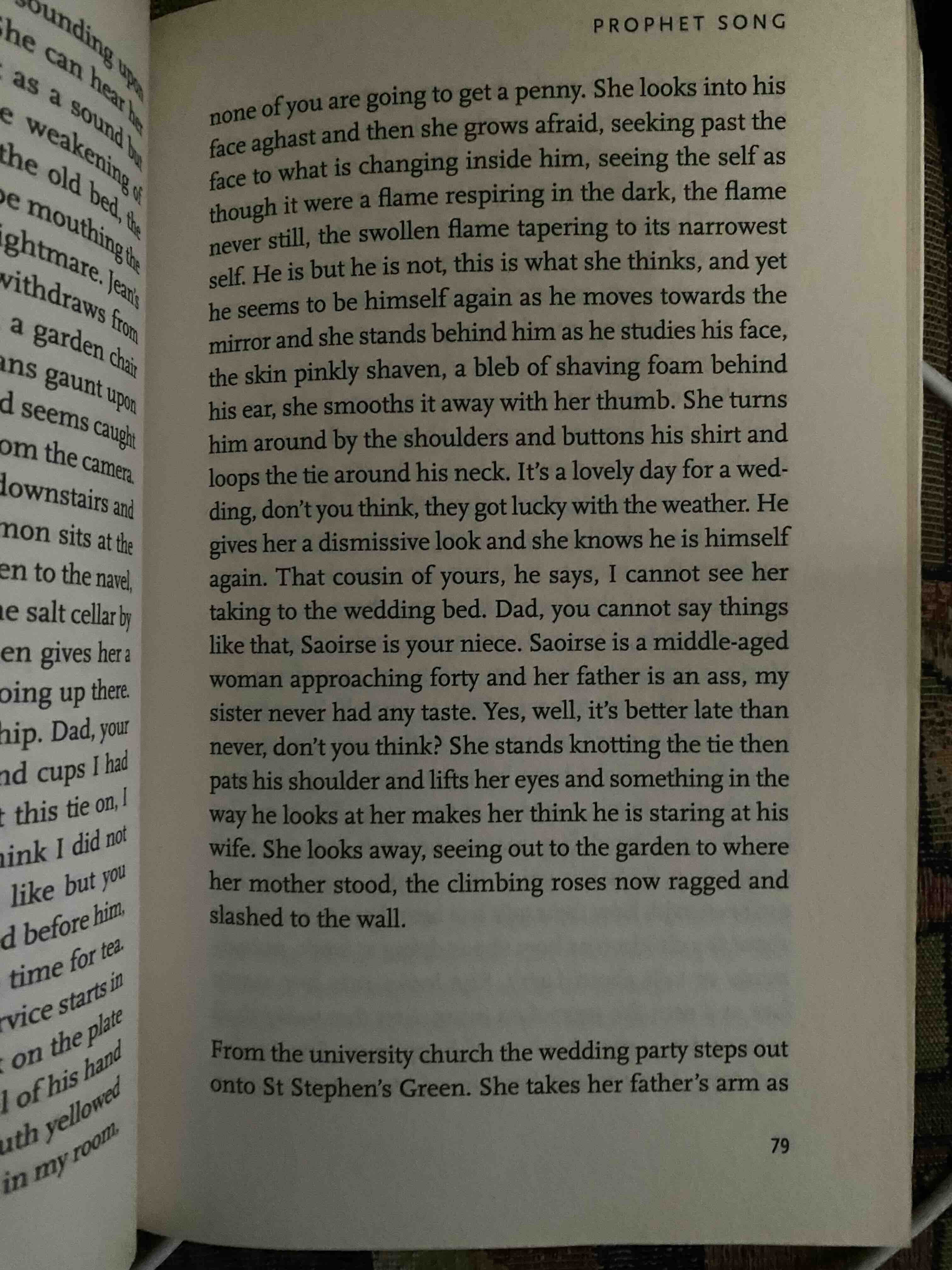
Page 79* is a nice example of the writing style. It’s one of those moments when life goes on despite everything – Eilish is helping her father get ready for a family wedding, and he has just said something appallingly curmudgeonly, in the manner of ancient Irishmen familiar from TV shows like Father Ted and Derry Girls.

Typically, most of the page is one long paragraph:

She looks into his face aghast and then she grows afraid, seeking past the face to what is changing inside him, seeing the self as though it were a flame respiring in the dark, the flame never still, the swollen flame tapering to its narrowest self. He is but he is not, this is what she thinks, and yet he seems to be himself again as he moves towards the mirror and she stands behind him as he studies his face, the skin pinkly shaven, a bleb of shaving foam behind his ear, she smooths it away with her thumb. She turns him around by the shoulders and buttons his shirt and loops the tie around his neck. It’s a lovely day for a wedding, don’t you think, they got lucky with the weather. He gives her a dismissive look and she knows he is himself again. That cousin of yours, he says, I cannot see her taking to the wedding bed. Dad, you cannot say things like that, Saoirse is your niece. Saoirse is a middle-aged woman approaching forty and her father is an ass, my sister never had any taste. Yes, well, it’s better late than never, don’t you think? She stands knotting the tie then pats his shoulder and lifts her eyes and something in the way he looks at her makes her think he is staring at his wife. She looks away, seeing out to the garden to where her mother stood, the climbing roses now ragged and slashed to the wall.

If this was punctuated conventionally, it would be broken up into at least four paragraphs. The dialogue would be in quote marks. Such breaks and marks would allow breathing space, but the overwhelming sense in this book is that there is no such thing: the forces of oppression and chaos are constantly closing in. Here, in their absence, the father’s dementia has a similar effect. Even the glimmer of relief, the thing signalling that he is his old self, is a bit of mean-spirited sexism. Unlike Father Ted he’s not funny, but this the nearest thing to comic relief the book offers. Then even that glimmer of relief is quelled by Eilish’s horror as she realises he is confused about her identity.

The final sentence, where Eilish looks out to the garden, is an example of a recurring motif. The book begins with Eilish looking out longingly to the dark of her garden. Her daughter Molly ties a white ribbon to one of their trees for every day Larry is missing. Here the climbing roses, ragged and slashed, are metaphors for Simon’s mental state – and the state of the land.

At the meeting: As usual we had a not-overthought and nonetheless excellent meal that included dolmades, pastizzi, some excellent salads, chicken wings and Aldi ice creams. Also as usual, we had a terrific conversation about the book. Everyone agreed that it’s excellent, beautifully written. Some couldn’t finish it because the way it chimed with what’s happening in the world made it unbearable. Some were alienated in some way by the focus on maternal issues. This is an all-male group: this alienation wasn’t about lack of empathy; in fact, as one man said, it was too much empathy that made it overwhelming.

We had an interesting discussion around the question, Why didn’t Eilish leave much earlier? There was an apparent disagreement about whether she was acting rationally or not, but my sense is that we were using the word rationally in different ways. Sure, it was 99 per cent sure that Larry has been killed and it makes sense for Eilish to save herself and her remaining children. But there is also the one per cent, and it makes sense to stay in the hope of reunion. Whether it was rational or not, we all agreed that it was profoundly human. One man’s Jewish grandparents had sent their son, his father, out of Nazi Germany but had stayed behind themselves, and been murdered. Like Eilish they knew the danger, but like her they couldn’t bear to leave their lives. (I should add that some people read Eilish as naively unaware of how bad things were getting.)

I floated my sense of Eilish’s father’s dementia as largely symbolic, less compellingly realistic than the rest of her family. That didn’t get much traction. In fact, someone pointed out that even though he was demented, he understood the dangers clearly enough and complied with his other daughter’s plans to extract him. Even with dementia, as a member of a generation that had lived when Nazism was taking over in Germany, he understood what was happening better than the younger ones.

Someone said he had enjoyed the book (if that’s the word), but wondered if its unremitting descent into chaos and misery really works. He likened it to Omar Musa’s Fierceland (which is on my To Be Read Very Soon list, and which he gave a general thumbs-down to), and compared them both unfavourably to Lloyd Jones’s Mister Pip. His argument was waylaid by a dispute about whether the Book Group had actually read Mister Pip at some time. (I’ve just checked, and if so it was before either he or I joined. But I did read it – and I’ve just retrieved my ancient blog post that indicates I didn’t much like it – so I probably would have disagreed with him.)

The discussion of the book morphed into conversation about guns, pig-shooting, school cadets, the challenges of AI, grandchildren, truffle hunting, and (can this be?) not Donald Trump at all.


All the members of the Book Group are men of settler heritage. We met and I wrote this blog post on the land of Gadigal and Wangal of the Darug Nation. I acknowledge their Elders past and present and welcome any First Nations readers.


* My blogging practice is to focus on the page that coincides with my age, currently 79.
Florence Knapp’s Names

Florence Knapp, The Names (2025)

Florence Knapp was a guest at this year’s Sydney Writers’ Festival. I didn’t attend any of her events, but I loved the podcast of her conversation with Claire Nichols (at this link). Whether it was her personal charm or the way her book’s premise touched something in me, I reserved the book at my local library immediately, and behold, instead of a six-month wait, it was ready for me to pick up almost immediately.

The premise is straightforward enough. Cora, who is trapped in a dangerously abusive marriage, has to register the birth of her newborn son. Her husband instructs her to name the baby after himself – Gordon. Her nine-year-old daughter, Maia, wants him to be named Bear. Cora toys with calling him Julian, and escaping punishment by pointing out that the name means sky father, and so is a tribute to her husband.

That much is laid out in a prologue, set in October 1987. The rest of the novel tells what follows on from each of the choices. First in 1987, then every seven years until 2022, there are three chapters, headed ‘Bear’, ‘Julian’ and ‘Gordon’, and three radically different versions of the life of the family emerge.

Early on I wondered if there was much point to actually reading the book, once the premise was laid out. Maybe it was enough that the premise turns a spotlight on the ambivalence that I imagine most people have about their names, making me wonder, for example, how my life might have gone if, say, I had been named Arthur after my mother’s father (my father’s name was already taken), or something outlandish like Bandicoot, rather than Jonathan because, as my mother said, it sounds nicer than John.

But I’m glad I persisted with Florence Knapp’s story rather than my own. The lives of all three boys and their families are gripping, full of unexpected turns, each in its own way moving. The differences made by the different namings are wonderfully convincing, in big ways as well as small – from the drama of father Gordon’s immediate responses to tiny developments down the track. For example, when the baby is named on Maia’s suggestion, she forms a powerful protective bond with him. When he is called Julian, she becomes protective of her mother. When he is Gordon, they eventually form an alliance, but it is hard won. Taken as a whole, its a nuanced set of variations the theme of domestic violence and its long shadows.

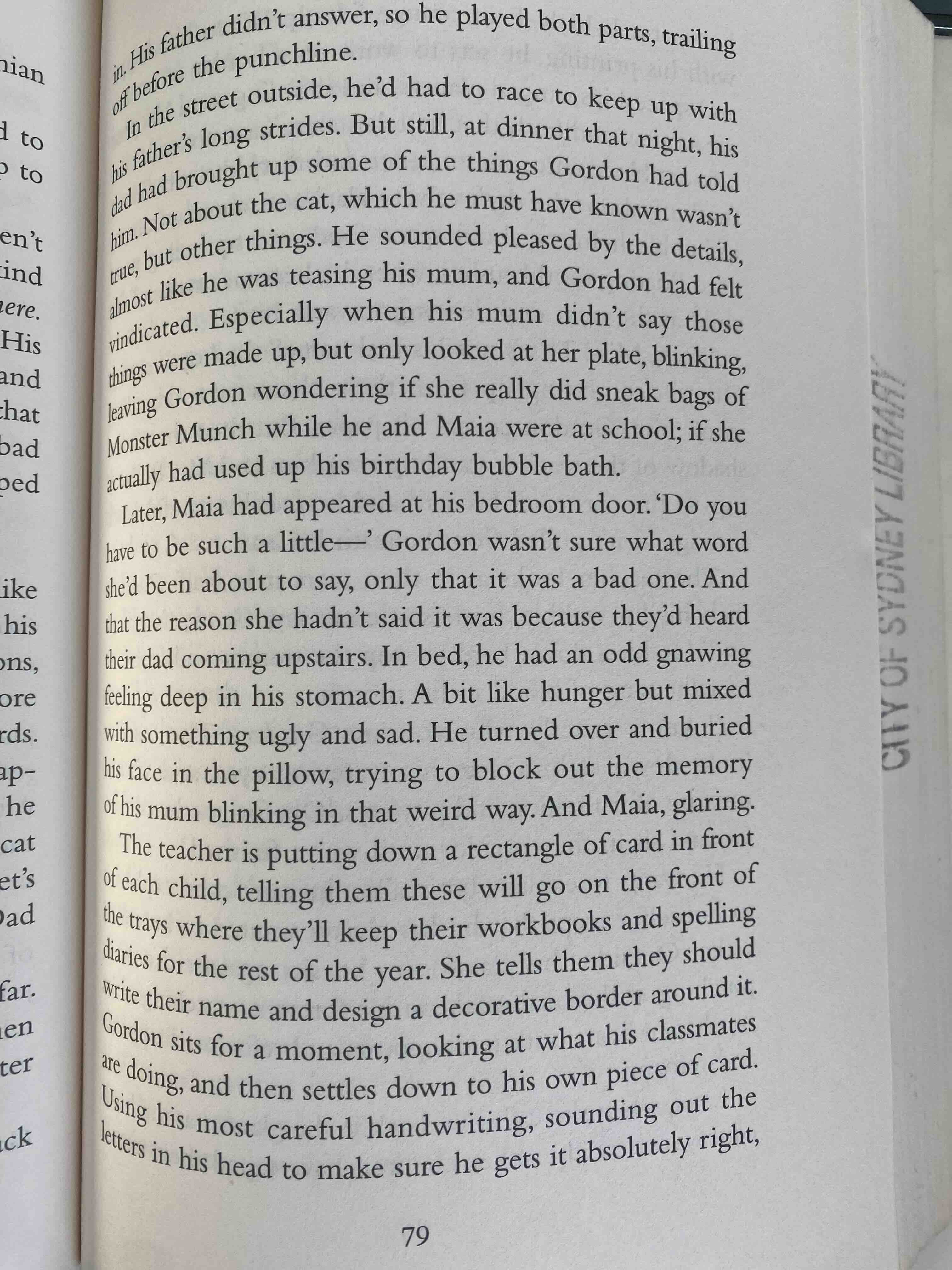
Page 79* falls in Gordon’s section of 1994, when he is seven years old. Unlike the Bear and Julian, Gordon is taken under his father’s wing. On this page, father and son return from a special time at Pizza Express where the father asks, ‘What has Mummy been up to while I’ve been at work?’ Seeing that he gets an interested response when he says, ‘And one time, she said a bad word,’ the son makes up other maternal misdemeanours, including one that involves a stray cat. We fear for young Gordon’s soul.

Though I pick on page 79 arbitrarily, it’s interesting how often the page includes key moments in a book. Here, we have the moment when young Gordon gets an inkling of how his father is using him.

At dinner that night, his dad had brought up some of the things Gordon had told him. Not about the cat, which he must have known wasn’t true, but other things. He sounded pleased by the details, almost like he was teasing his mum, and Gordon had felt vindicated. Especially when his mum didn’t say those things were made up, but only looked at her plate, blinking, leaving Gordon wondering if she really did sneak bags of Monster Munch while he and Maia were at school; if she actually had used up his birthday bubble bath.

This puzzlement is given a nudge by Maia. On another timeline she is Bear’s besotted protestor. On this one she becomes Gordon’s moral guide:

Later, Maia had appeared at his bedroom door. ‘Do you have to be such a little–’ Gordon wasn’t sure what word she’d been about to say, only that it was a bad one. And that the reason she hadn’t said it was because they’d heard their dad coming upstairs. In bed, he had an odd gnawing feeling deep in his stomach. A bit like hunger but mixed with something ugly and sad. He turned over and buried his face in the pillow, trying to block out the memory of his mum blinking in that weird way. And Maia, glaring.

It would have been tempting to make young Gordon the replica of his father that old Gordon wants, but he is torn. At this point we feel the seven-year-old’s moral unease. In the last part of the page, Gordon makes a bid to break free of the destiny brought by his name.

The teacher is putting down a rectangle of card in front of each child, telling them these will go on the front of the trays where they’ll keep their workbooks and spelling diaries for the rest of the year. She tells them they should write their name and design a decorative border around it. Gordon sits for a moment, looking at what his classmates are doing, and then settles down to his own piece of card. Using his most careful handwriting, sounding out the letters in his head to make sure he gets it absolutely right, he writes L-U-K-E in orange felt-tip.

It’s no spoiler to say that the teacher doesn’t let him get away with it, but tears his card up, and writes his name in shockingly undecorated black on a new card. He is saddled with the name and all it brings with it. It would be a spoiler to say whether Florence Knapp allows him to escape or if she ruthlessly follows through on the logic of nominal determinism.

I loved that boy, and would happily have spent a lot more time with him, all three of him.


I am a man of settler heritage living on Gadigal Wangal country, where the days are suddenly warmer and magpies seem to be everywhere. I acknowledge Elders past, present and emerging for their continuing custodianship of this land, and welcome any First Nations readers.


* My blogging practice is to focus on the page that coincides with my age, currently 79.
Magdalena Ball’s High Wire Step

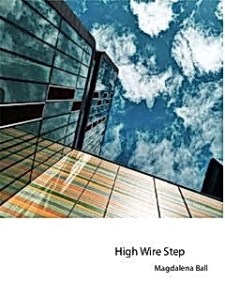
Magdalena Ball, High Wire Step (Flying Island 2018)

This is the third book by Magadalena Ball I’ve read. The others were Density of Compact Bone (2021) and Bobish (2023). Links are to my blog posts. I enjoyed those very different books a lot, so when High Wire Step arrived as one of the past publications included in my 2026 subscription from Flying Island, I was happy.

I still am happy. But I find myself unable to make any easy generalisation about the book. Each of its 40 poems stands alone and expects a reader to take time to savour it.

For instance, ‘Giantess’ is a monologue by the character who let Jack into her husband’s kitchen when he arrived from the beanstalk – beginning ‘I took a chance / opening the door’. There are a number of elegiac poems, and some enigmatic poems that seem to be childhood memories. There’s a longer poem, ‘Art of the Deal’, which begins:

While I grew up in lower Manhattan's
housing project
the pre-dawn cusp of gentrification
there was a shadow rising

and goes on to be a poem in which Donal Trump walks as he probably couldn’t in these Trump-saturated days. There’s a poem about the designer card game mille bornes, which begins ‘This is not a game.’

You get an idea of the diversity.

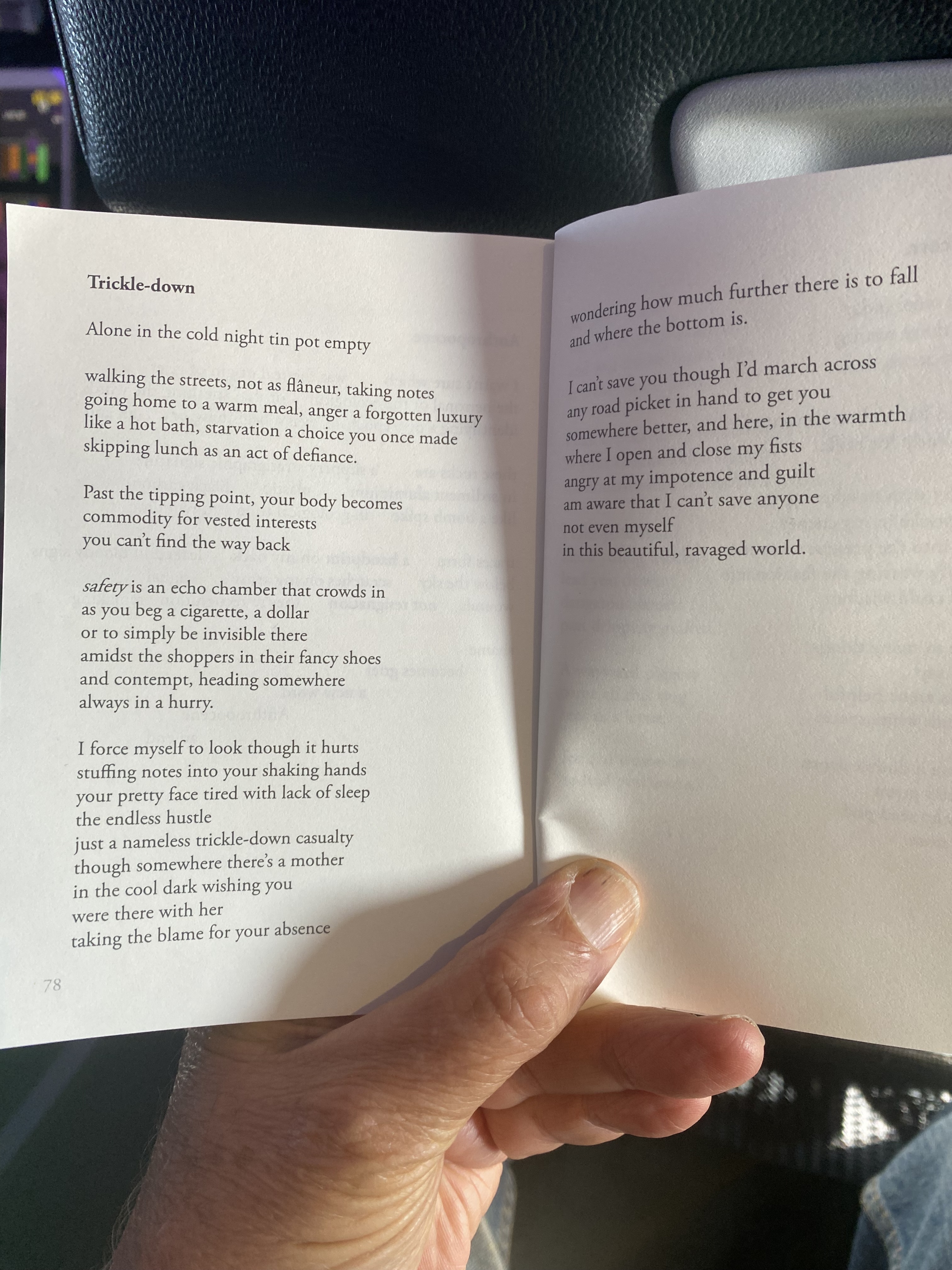
‘Trickle-down’, on page 78–79*, is a nice sample. It springs from a brief encounter – or even non-encounter – of a kind that happens often in city life. The poem’s main speaker passes a young woman begging in the street:

Trickle-down

The title suggests that the poem relates to the term ‘trickle-down economics’, government policy that favours the wealthy with the professed belief that the benefits will trickle down to those less wealthy.

What follows is not exactly a dialogue, but the poem has two characters. The first is evoked in the short opening line:

Alone in the cold night tin pot empty

The second, the poem’s main speaker, takes four lines to be introduced:

walking the streets, not as flâneur, taking notes 
going home to a warm meal, anger a forgotten luxury
like a hot bath, starvation a choice you once made
skipping lunch as an act of defiance.

It’s not a glib contrast between someone begging and someone well-off and smug, or even someone idly observing ‘as flâneur, taking notes’. She’s on her way home from work, and there are elliptical bits of backstory, perhaps flashes of memory prompted by the sight of the begging woman. Once she was angry and defiant, but never experienced deprivation except by choice. The paradox of anger as a luxury suggests a life with dulled emotions, where the person is ground down by life’s demands

It’s interesting that the phrase ‘a choice you once made’ is the first time a personal pronoun appears. Until then the two characters have been implied in the naming of objects (the tin pot, the warm meal, the hot bath), emotions (anger) or actions (walking, defiance, skipping lunch). The poem takes its time to focus on the people.

Once there was anger, choice, defiance. The implication is that these are no longer there. There must have been a point where that changed. Acknowledging this, the poem completes the introduction of the passerby:

Past the tipping point, your body becomes 
commodity for vested interests
you can't find the way back

She is caught up in the urban rat race. I like the fine touch of ‘your body becomes / commodity’. It’s not even an individualised commodity, just part of a general substance.

In the next stanza, there is a different you, who sees the world from where she sits at the edge of the footpath:

safety is an echo chamber that crowds in 
as you beg a cigarette, a dollar
or to simply be invisible there
amidst the shoppers in their fancy shoes
and contempt, heading somewhere
always in a hurry.

Now there’s an I for the first time. The passerby snaps out of her numb state and becomes the speaker of the poem. She wasn’t taking notes, but now she forces herself to look, to notice details about the other woman, to reflect briefly on the way the economic system creates such poverty, to imagine something of the other woman’s life at least in general terms. This mental act of compassionate witness is as important as giving money:

I force myself to look though it hurts 
stuffing notes into your shaking hands
your pretty face tired with lack of sleep
the endless hustle
just a nameless trickle-down casualty
though somewhere there's a mother
in the cool dark wishing you were there with her
taking the blame for your absence
wondering how much further there is to fall
and where the bottom is.

The final stanza brings together words and images from earlier. She is warm, angry (is it still a luxury?), would march (as oppose to shopping in fancy shoes or being always in a hurry), guilty (like the begging woman’s mother). She forms fists, whereas the other woman hands were shaking. And the opening words of the stanza echoes ‘safety‘ from earlier:

I can't save you though I'd march across 
any road picket in hand to get you
somewhere better, and here, in the warmth
where I open and close my fists
angry at my impotence and guilt
am aware that I can't save anyone
not even myself
in this beautiful, ravaged world.

The last line is a final harking back: the begging woman’s pretty, sleep-deprived face becomes in retrospect a metaphor (or do I mean a synecdoche) for the state of the world.

I think it would be a mistake to read this as a manifesto of despair. I think it’s more a waking from numbness: by allowing (forcing?) herself to feel for this individual, the speaker has opened the possibility of acknowledging what she sees happening in the big picture. Certainly, that last line feels like a door swinging open to a vast panorama: anger is no longer a forgotten luxury.

You can find out more about the marvellous Magdalena Ball at her website, at this link.

And that’s my last post for Poetry Month 2026. I managed to post about nine books (not all of them read this month), and go to two live events – the Red Room’s National Poetry Month Gala and the penultimate Annual Francis Webb Reading. Poetry lives!


I am an Australian man of settler heritage. I read High Wire Step on Wulgurukaba land, on beautiful Yunbenun (aka Magnetic Island), and have written this blog post on Gadigal and Wangal country, which is just as beautiful but not as warm. I acknowledge Elders past and present of all those Nations, and I welcome any First Nations readers and commenters.


* My blogging practice is to focus on the page that coincides with my age, currently 79.
Shida Bazyar’s Nights are Quiet in Tehran at the Book Club

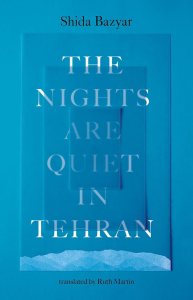
Shida Bazyar, The Nights Are Quiet in Tehran (2016, translation from German by Ruth Martin, Scribe 2025)

Before the meeting: This novel invites readers into the world of leftist Iranians who allied with Islamists against the Shah in the 1970s, only to face exile or worse under the rule of the Ayatollahs. Though it was written before Trump’s first presidential term, and Ruth Martin’s wonderfully readable translation was published before his current war on Iran, it takes on extra power when read in the context of those events.

It is the story of one Iranian family told in four slices of time: 1979, the year the Shah was deposed and the Islamic Republic was established; 1989, when the family is living in exile in Germany; 1999, when the regime relaxes a little and some family members visit Tehran; 2009, when once again the streets of Tehran are full of protests in the Green Movement, and the exiles watch the brutal repression unfold on social media. An undated epilogue tentatively suggests a brighter future.

Each section has a different narrator. In the first, youthful Behraz tells how he and his two close male friends see their hopes for a socialist revolution dashed, and though in his political fervour he believes there is no time for romance, he is drawn to the beautiful Nahid. In the second, ten years later, Nahid is married to Behraz. She describes their life in Germany and remembers the events that led to their flight from Iran. In the third, their eldest daughter, Laleh, takes up the story, describing a visit to Tehran, her first experience of noisy, exuberant family life, and the quiet revelation of the fates of Behraz’s friends. In the fourth, Mohad/Mo, who was a rowdy little boy in the previous section, now deals with the dual identity of dissipated German university student and Iranian exile.

Shida Bazyar is a German writer whose parents, like Behzad and Nahid, were communist activists in Iran in the lead-up to the 1979 revolution. They left the country in 1988 and – unlike Laleh and Mo – Shida was born in Germany. The book clearly draws on the author’s family’s experience, both in the youthful activism against the Shah and then against the Ayatollah, and in the experience of exile. Especially in the third section, when teenage Laleh returns to Tehran, the writing feels so alive it must be drawing on actual experience. (I’ll stand by that statement even though Shida Bazyar was born in 1988, so was one year old at the time of the fictional visit.)

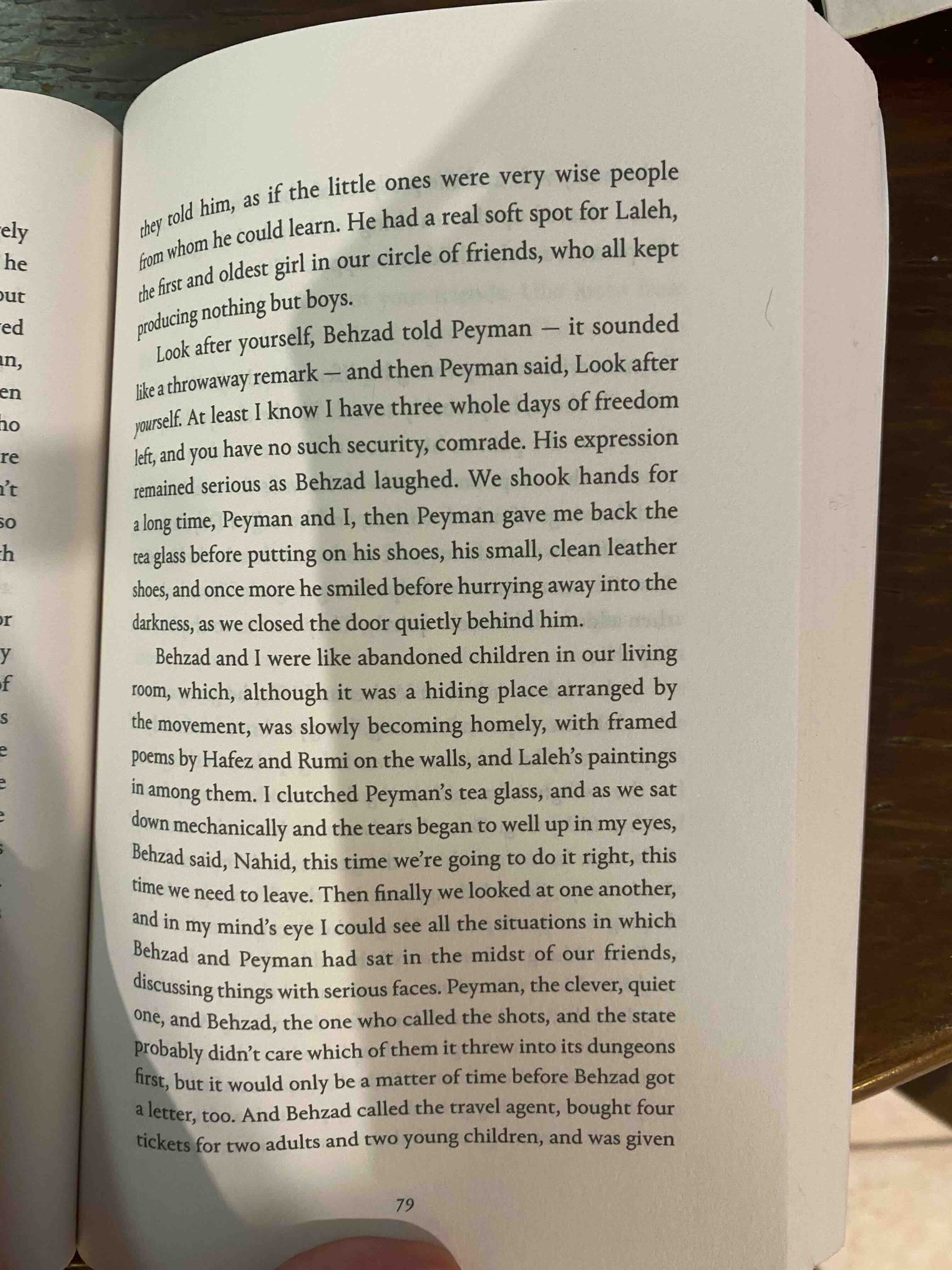
A look at page 79* gies you an idea of the quality of the writing – including the fluency of the translation.

It’s part of Nahid’s narrative. She is remembering the moment when they decided to leave Iran, early in the 1980s. Behraz’s friend Peyman is visiting their safe house to tell them he has received a letter requiring him to turn himself in to the Islamic regime, which they all know means he is to be arrested for his communist activism. It’s a quiet, decisive moment in their lives:

Look after yourself, Behzad told Peyman – it sounded like a throwaway remark – and then Peyman said, Look after yourself. At least I know I have three whole days of freedom left, and you have no such security, comrade. His expression remained serious as Behzad laughed. We shook hands for a long time, Peyman and I, then Peyman gave me back the tea glass before putting on his shoes, his small, clean leather shoes, and once more he smiled before hurrying away into the darkness, as we closed the door quietly behind him.

The emotional intensity of the moment is conveyed entirely through gesture: Peyman has accepted the oblgatory glass of tea, but he has not sat down, and at parting he shakes Nahid’s hand ‘for a long time’. The door closes quietly behind him as he disappears into the darkness, and we know it’s the last time Nahid and Behzad will see him. (It’s not a spoiler to say that in Laleh’s narrative, when they meet up with Peyman’s widow ten years later, the emotion is much more on the surface.) The paragraph is also a beautiful example of how the novel portrays character. Nahid wants us to know that Peyman is anything but a performative martyr. He plays with children, and takes their words seriously, and when he is about to surrender himself to the regime, he manages a deadpan joke about the danger hanging over his friend.

Once Peyman has gone, the composure breaks:

Behzad and I were like abandoned children in our living room, which, although it was a hiding place arranged by the movement, was slowly becoming homely, with framed poems by Hafez and Rumi on the walls, and Laleh’s paintings in among them. I clutched Peyman’s tea glass, and as we sat down mechanically and the tears began to well up in my eyes, Behzad said, Nahid, this time we’re going to do it right, this time we need to leave. Then finally we looked at one another, and in my mind’s eye I could see all the situations in which Behzad and Peyman had sat in the midst of our friends, discussing things with serious faces. Peyman, the clever, quiet one, and Behzad, the one who called the shots, and the state probably didn’t care which of them it threw into its dungeons first, but it would only be a matter of time before Behzad got a letter, too.

That paragraph is mostly important in the flow of the novel as giving a flashback to the moment Behzad and Nahid decide to leave Iran and come to Germany. On paying closer attention to it for this blog post, I noticed something that slipped by me on first reding.

Nahid mentions Hafez and Rumi, two towering figures in Persian/Iranian culture. Her attachment to them was something that drew Behzad to her in the first place, and here they have an honoured place on the wall with little Laleh’s paintings – emblematic reminders that there is more to the life of these characters and this nation than endless struggle. Yet nowhere in the novel is either of them quoted.

A few pages later, the couple discuss a poem by Bertolt Brecht. The poem is ‘Thoughts on the Duration of Exile‘, but even though it is eminently relevant to their situation, it is only indirectly named and quoted. It’s clear from this and other moments that poetry is important to Nahid, and probably to Behzad as well. Readers aren’t given a direct look at any of it.

Then I realised that something similar happens in earlier parts of the novel. The main action, from one point of view, is the characters’ activism. Yet there are very few specifics about that activism: Behraz drives a car full of leaflets, but we don’t know what is in them or what is to be done with them. He spends time with other revolutionaries in a captured barracks, but what they do there is passed over in silence. We know that he is risking his freedom, even his life, but we don’t know what he is doing.

Some readers may find this effect frustrating or evasive. I didn’t. This isn’t an educational documentary about Iranian culture and history, it’s a story of how that history affects the lives of one small family – and by implication, many more.

The book was written before the Women, Life Freedom demonstrations of 2022 (link here) and its brutal repression. Things were so bad that in mid 2026 members of the Iranian diaspora in Sydney were demonstrating in favour of Trump’s invasion. As I was reading the last pages of the book, Donald Trump was reported as saying he would ‘beat the f***ing s**t out of Iran. The grief that permeates the book’s last pages seems more insistent and the hopeful epilogue more unrealistic with every passing news flash.

At the meeting:

It turned out that for a couple of us the stories in this book gave them insights into things they had been told or noticed about Iranians in their lives. And conversely, stories they had heard from those friends helped in their appreciation of the book. A small example: in Laleh’s section, Iranians presen their visiting family members with gifts in plastic bags – when this happened our group member’s acquaintance she had though it was just her Iranian family being offhand, but the book makes it seem a matter of cultural difference.

We were all engaged by the book. A couple of people – maybe everyone except me – found the first section, Behraz’s narrative, hard to follow and a bit boring. Weirdly, I liked his narrative because of its clarity. I think I read it with the utterly confusing opening of Sofi Oksanen,’s When the Doves Disappeared (link is to my blog post) fresh in my mind: I knew where the characters’ allegiances lay and wasn’t bothered by the lack of specifics about their activities.

We generally agreed that the two women’s narratives – that is, Nahid’s and Laleh’s – were the most engrossing. Nahid’s account of the experience of exile and Laleh’s wrestle with dual identity were especially strong. No one was particularly convinced by young Mo’s activism – he goes to demos about student fees and watches videos about Iran only because his German girlfriend wants him to. At least that’s how one person read him. My sense of him is kinder than that, and I found his section very moving as a picture of a young man more or less adrift from his cultural moorings, along with the horror of the repression of the Green Revolution.

We read the book along with Ann Patchett’s Whistler. When I blogged about Whistler, I mentioned that we did a little karaoke at the end of the evening. It says something about the difference between the books if I mention here that we also heard about the youthful political struggles on one member and current tribulations of a family member of another.


I read The Nights Are Quiet in Tehran and wrote the first part of this blog post on Wulgurukaba country, on the beautiful island of Yunbenun. The Book Club’s five members, all of settler heritage, met on Gadigal land, and I wrote the rest of the blog post on Wangal and Gadigal land. I gratefully acknowledge the Elders past and present of all those Nations and welcome any First Nations readers of this blog.


* My blogging practice is to focus on the page that coincides with my age, currently 79.