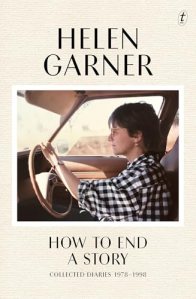
I’m loving spending a little time each morning – five pages worth – with grumpy, self-questioning, acutely observing, word-loving Helen Garner. I’m now well into the third volume, and it’s reading more and more like a novel, with a clear narrative line.
This is the story of a marriage break-up. I imagine that even readers who come to the book with no prior knowledge would read it that way. As a reader, you know where it’s heading, but these are diary entries, so you know that the woman writing them has no idea of the shape of the story. Of course, the woman who edited the diaries for publication did know, and some sculpting of the narrative must surely happened in the selection process.
Since my last post, The First Stone has been published, and has created a storm, most of it in the form of attacks from feminists. This doesn’t take up a lot of space, but it’s interesting to read that Garner undertook to write a response to every letter she received. How glad she must be that the book was published before the age of social media.
True Stories, a collection of essays, is published. She agonises over whether to include ‘Why Does the Women Get All the Pain?’, the Digger article about the time she decided to answer school students’ questions about sex with complete frankness. (I’ve just checked my copy. It’s in there.) She worries that V, her husband, doesn’t know about that period of her life, and she has serious misgivings about the ethics. She needn’t have worried about V’s reaction – she notices that the bookmark in his copy of the book doesn’t progress very far at all.
But the main game is the marriage. The diaries record excruciating rows. V is working on a novel. (V is Murray Bail. The novel is Eucalyptus, which was published to great critical acclaim in 1998, probably after the period covered by these diaries.) He needs the flat to himself when he’s working, so Helen has to be elsewhere. It’s hard on her to be shut out of her own home, and he repeatedly dismisses her complaints. And then a couple of times when she can’t be in the house because he is working, she sees him in the street with another woman, a sculptor known as X. When she confronts him about this, he says she’s being unreasonable. Meanwhile she has started going to therapy, and the therapist – known only as ‘she’ – leads her to see her desire to escape the marriage as part of a long-term habit of running from difficulty. So she is determined to stick it out, make it work. Oh dear!
In today’s reading, I’m about a third into 1997. There’s some respite from the marital difficulties, just a couple of moments in five pages: he goes out to dinner with X, and there’s just a frisson of mutual awkwardness. Later she has a brief conversation with X in which X says she hates ‘people who tell lies’. Garner makes no comment, but that remark has an almost radioactive quality on the page. And there’s this:
V says that women’s writing ‘lacks an overarching philosophy’. I don’t even know what this means. Also, I don’t care.
She spends time on the phone with her francophone second husband, translating an interview with Thomas Bernhard. V eagerly takes it around to X, who ‘thought it was terrific’, though she has a small suggestion that makes Helen bristle..
Helen is still enjoying the novelty of working on a computer: she writes her first movie review for the Australian Review of Books, and it takes her less than three hours, typed ‘straight on to the computer’!
A US aircraft carrier comes to Sydney:
The streets of the Cross swarm with sailors. Some of the white ones are raw-looking boys, guzzling Coke, carrying bags full of boomerangs; others, especially the Black ones, are young and slender, their skin smooth and gleaming under the brilliant white of the gob caps. They stand about in twos and threes, murmuring to each other: ‘Yo. Yo. Hey, man. Wassup? Wass happnin’?’
And later she sees a sweet note from one of the sailors in the prayer-request book at her church.
She visits the Korean baths in Kings Cross, now long closed down. After going to Church at Easter, she takes the image of the angel rolling the stone from the open grave to her therapy session, and weeps for the first time in her therapist’s presence. Then she and her friend R compare notes about therapy: they decide R has a fear of bottomless grief and H is scared that if she let herself get really angry she’d ‘wreck the room or something’.
And after a short entry about a possible story about a hysterectomy, the last entry I read today is a nice example of the way the tone in this book shifts wildly from one line to the next:
Saw the Beavis and Butthead movie last night. It’s not as good as the TV show but I loved its utter grossness and moronic stupidity.
She doesn’t say if she went with V. I hope so. I hope he enjoyed it too. I think both hopes are in vain.
I am a man of settler heritage. I wrote this blog post on the land of Gadigal and Wangal of the Darug Nation. I acknowledge their Elders past and present and welcome any First Nations readers.
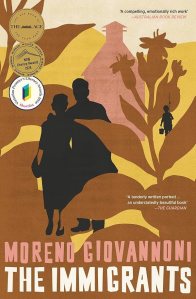
While based on real events, this is a work of the imagination in which names have been changed, characters and scenes created and facts distorted for dramatic purposes in order to tell, in a fantasy kind of way, the story of the Italian community, and the story of my family, who lived in Mitrefò and district in the 196os. It is told as I remember it and it is therefore imperfect but nevertheless true. (Page 1)
The note goes on to say that Bafaloriva, where much of the action happens, is a fictional place, not Buffalo River, and Mitrefò is not Myrtleford. Apart from amplifying the disclaimer about literal accuracy, this makes another point: naming a place in what has been called Australitalian signifies not just a mangling of the name, but a difference in the way the place is experienced.
Giovannoni’s first book, The Fireflies of Autumn, was framed as stories told by emigrant Ugo Giovannoni about his home town, San Ginese in northern Italy. The Immigrants tells the story of Ugo’s emigration to Australia, his life in Victoria, mainly farming tobacco, and his two failed attempts to return to Italy. And it tells the story of his young wife Morena and their two sons, especially Moreno (known as Morè – ‘only an Italian can say that properly’). And the story of the community of people who travelled from all over Italy to the area around Mitrefò in the years after World War Two, looking for a better life. ‘For a better life’ is a phrase that recurs, gathering heavy irony as it goes.
The book’s subtitle, ‘Fabula Mirabilis, or, A Wonderful Story’ led me to expect something almost cosy, tales of immigrant life bathed in a nostalgic glow. There is some of that in the vitality of the community, the young boy’s pleasure in the natural environment, even the details of the work of tobacco farming as it then was, backbreaking but somehow noble. But there is much more. What emerges is a picture of immigrant experience that is truly revelatory: food, language, yearning for home, religion, the attitudes of most ‘Australians’, marital strife – all these elements and more combine to powerful effect. It’s not a continuous narrative. Stories repeat and overlap in a mixture of memories of childhood, remembered conversations with Ugo and Morena when they confided in their son, court documents, and passages of pure invention.
There are seven sections called ‘grotesques’, case histories of murder, violence, madness, despair, mostly drawing on official court or hospital documents, Some of these are stomach-churningly hard to read, and they serve as reminders that the stakes were high. My blogging practice is to focus on the page that coincides with my age, currently 79. Page 79 of The Immigrants is a version of the coroner’s report into the death of a child from a tiger snake’s bite in 1973. It’s a powerful conclusion to the third ‘grotesque’, but not what I would pick as a representative page.
When ‘the immigrant son’ is a young adult, he finds a book on the history of the district, written by ‘an amateur historian, an English settler’. He expects to learn the history of the Italians in the area, but finds instead much information about the Indigenous population and stories of the town council etc:
Of the Italian tobacco growers, there is barely a mention. That night he discovers that of 280 pages in the book, thirty contain, here and there, a passing reference to the cultivation of tobacco. The word Italian appears twice in the whole book. The index does not contain the word Italian. Over time he has learnt that whenever the stories of the immigrants are told, they are told by the Australians or those whom the Australians have captured. Immigrant stories are never told with love and clarity. Always with humour and ridicule. (page 215)
This book is a significant contribution to fixing that, with humour but absolutely no ridicule. So it’s part of the great reimagining of Australian history that has come in the last half century. It’s also something of an elegy for tobacco farming. And an elegy in a deeper sense as well:
Two weeks before [Ugo] dies, he tells his son he has seen la Bettina, the old woman who is Death. His son has never heard that rare Tuscan term before and is unable to trace the usage of the word or its origins. By the time Ugo dies, there is nobody left in San Ginese who knows about la Bettina. Moreno realises that with Ugo’s death, other things will also disappear, from Tuscany and from the English colony.
As my regular readers know, I come from Innisfail in North Queensland, whose story it would be impossible to tell without including Italians. My classmates at school had names like Brunello, Quagliata and Gugliotto. When I saw my first professional theatre, the travelling production of Ray Lawler’s Summer of the Seventeenth Doll, I was thrilled to have the existence of north Queensland acknowledged, but as a 12 year old I felt that the play got it wrong by making its two canecutters Anglo, when according to my experience they should have been Italian, Maltese, or Yugoslavian.
It’s been a matter of quiet pride for me that my mother’s father, a magistrate, learned Italian and would intervene from the bench in the 1940s when Italian defendants were represented by lawyers who didn’t understand what their clients were saying.
So the book spoke to me personally. It pulled me up and asked me to look at my life from a different perspective. As a child, I had no idea that when I was eating ‘the brown lump of meat and the mush of potato, carrot and peas the Australians eat’ (page 136), the Pasinetti family down the road were probably eating what we these days would recognise as decent food. I had no idea of the drama and sometimes tragedy of migration that was playing out around me.
This is a book that has expanded my world.
I am an Australian man of settler heritage. I wrote this blog post on Gadigal and Wangal country, where it is my good fortune to live as the days are growing longer and warmer. I acknowledge Elders past and present of those Nations, and I welcome any First Nations readers and commenters.
Before the meeting: The Book Group is going through an Irish phase. Several Irish novels ago, one of our number said, ‘This is a beautifully written Irish novel, but does the world really need another beautifully written Irish novel?’ Yet that same man was this month’s Chooser, and here we are.
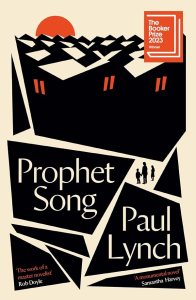
I remember reading a little about Prophet Song when it won the Booker Prize in 2023. The Booker then as now has a bit of a reputation for choosing grim novels, and this choice sounded true to form. I wasn’t planning to read it.
But, as has happened before, what the Book Group wants …
It is a beautifully written Irish novel, and an unremitting dystopian tale. It begins with two policemen knocking on the door of Larry Stack, a reacher and union leader in Dublin. In a reasonably pleasant chat, they warn him to call off a strike he is organising. And it goes from there.
The strike happens. Larry and others are arrested and disappear. More people begin to silently disappear as the government claims emergency powers, and key positions at all levels of society – schools, hospitals, local councils – are filled with cold-eyed people wearing party insignia. The Republic of Ireland becomes a full-blown police state, all as experienced by Larry’s wife, Eilish: first her husband is disappeared, then her oldest son goes into hiding to avoid the draft and we assume joins the rebel forces; she is pushed out of her job. Things get worse from there. The quiet suburban street becomes a war zone, and when the rebels take it over things don’t get any better. Eilish lives through all of this, while searching for her husband, doing her best to care for her three remaining children, and looking after her father who, symbolically enough, has dementia.
And it’s Ireland! Coming to it so soon after reading Patrick Radden Keefe’s Say Nothing (link is to my blog post), where – in the real world – rebels would cross the border from Northern Ireland to find refuge in the Republic, I kept thinking it was an impossible fantasy: ‘It couldn’t happen there!’ But then I’d think of ICE in Minneapolis, and even the NSW police at a pro-Gazan demonstration earlier this year, and my blood would run cold.
I don’t think it’s a spoiler to say there is no happy ending. With one exception, for which I am hugely grateful, any time I feared the worst, the worst is what happened.
As in Margaret Atwood’s The Handmaid’s Tale, it feels as if each step in the destruction of a free society is something that has happened, recently, somewhere in the real world. It’s a deeply chilling book.
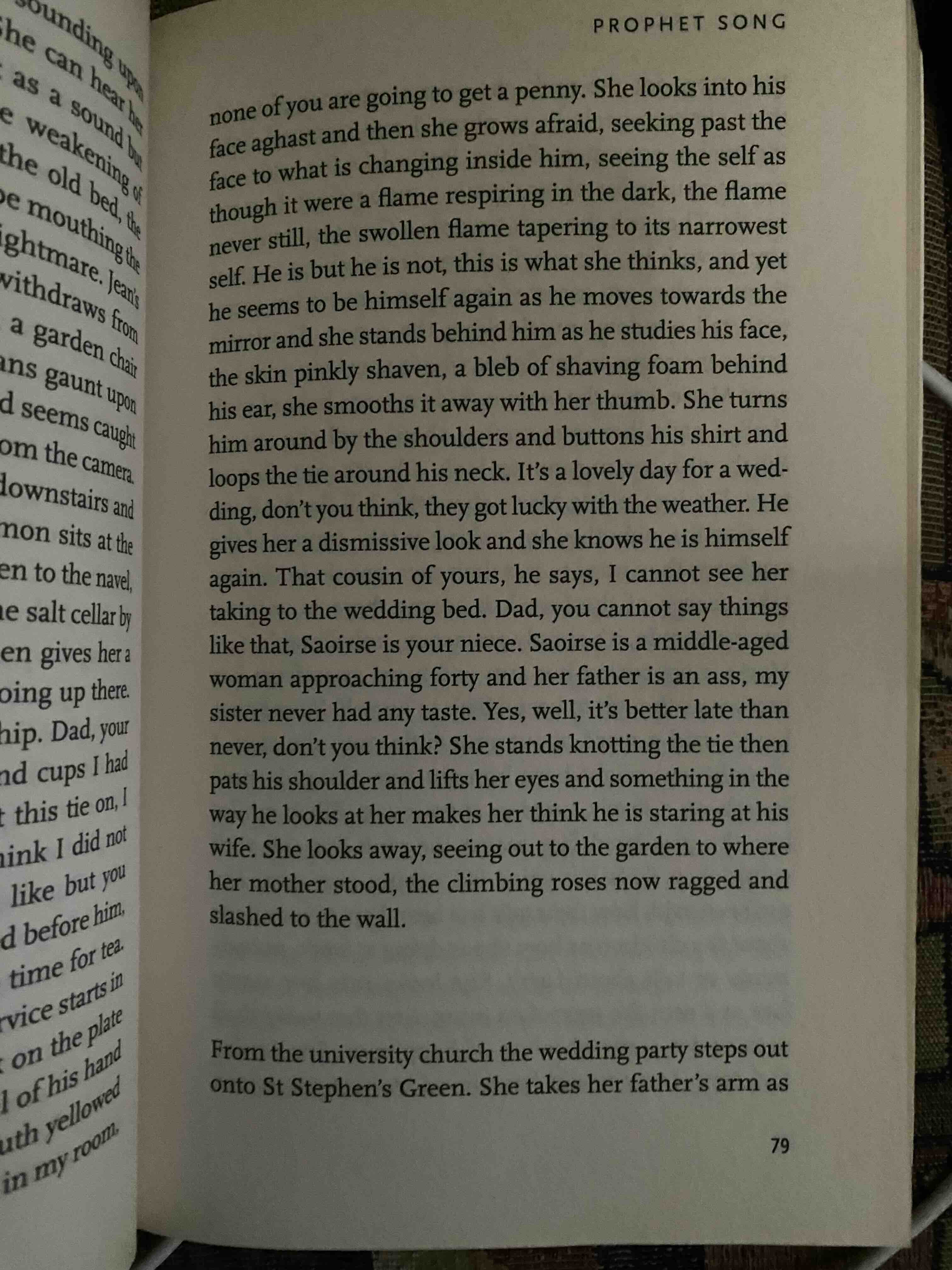
Page 79* is a nice example of the writing style. It’s one of those moments when life goes on despite everything – Eilish is helping her father get ready for a family wedding, and he has just said something appallingly curmudgeonly, in the manner of ancient Irishmen familiar from TV shows like Father Ted and Derry Girls.
Typically, most of the page is one long paragraph:
She looks into his face aghast and then she grows afraid, seeking past the face to what is changing inside him, seeing the self as though it were a flame respiring in the dark, the flame never still, the swollen flame tapering to its narrowest self. He is but he is not, this is what she thinks, and yet he seems to be himself again as he moves towards the mirror and she stands behind him as he studies his face, the skin pinkly shaven, a bleb of shaving foam behind his ear, she smooths it away with her thumb. She turns him around by the shoulders and buttons his shirt and loops the tie around his neck. It’s a lovely day for a wedding, don’t you think, they got lucky with the weather. He gives her a dismissive look and she knows he is himself again. That cousin of yours, he says, I cannot see her taking to the wedding bed. Dad, you cannot say things like that, Saoirse is your niece. Saoirse is a middle-aged woman approaching forty and her father is an ass, my sister never had any taste. Yes, well, it’s better late than never, don’t you think? She stands knotting the tie then pats his shoulder and lifts her eyes and something in the way he looks at her makes her think he is staring at his wife. She looks away, seeing out to the garden to where her mother stood, the climbing roses now ragged and slashed to the wall.
If this was punctuated conventionally, it would be broken up into at least four paragraphs. The dialogue would be in quote marks. Such breaks and marks would allow breathing space, but the overwhelming sense in this book is that there is no such thing: the forces of oppression and chaos are constantly closing in. Here, in their absence, the father’s dementia has a similar effect. Even the glimmer of relief, the thing signalling that he is his old self, is a bit of mean-spirited sexism. Unlike Father Ted he’s not funny, but this the nearest thing to comic relief the book offers. Then even that glimmer of relief is quelled by Eilish’s horror as she realises he is confused about her identity.
The final sentence, where Eilish looks out to the garden, is an example of a recurring motif. The book begins with Eilish looking out longingly to the dark of her garden. Her daughter Molly ties a white ribbon to one of their trees for every day Larry is missing. Here the climbing roses, ragged and slashed, are metaphors for Simon’s mental state – and the state of the land.
At the meeting: As usual we had a not-overthought and nonetheless excellent meal that included dolmades, pastizzi, some excellent salads, chicken wings and Aldi ice creams. Also as usual, we had a terrific conversation about the book. Everyone agreed that it’s excellent, beautifully written. Some couldn’t finish it because the way it chimed with what’s happening in the world made it unbearable. Some were alienated in some way by the focus on maternal issues. This is an all-male group: this alienation wasn’t about lack of empathy; in fact, as one man said, it was too much empathy that made it overwhelming.
We had an interesting discussion around the question, Why didn’t Eilish leave much earlier? There was an apparent disagreement about whether she was acting rationally or not, but my sense is that we were using the word rationally in different ways. Sure, it was 99 per cent sure that Larry has been killed and it makes sense for Eilish to save herself and her remaining children. But there is also the one per cent, and it makes sense to stay in the hope of reunion. Whether it was rational or not, we all agreed that it was profoundly human. One man’s Jewish grandparents had sent their son, his father, out of Nazi Germany but had stayed behind themselves, and been murdered. Like Eilish they knew the danger, but like her they couldn’t bear to leave their lives. (I should add that some people read Eilish as naively unaware of how bad things were getting.)
I floated my sense of Eilish’s father’s dementia as largely symbolic, less compellingly realistic than the rest of her family. That didn’t get much traction. In fact, someone pointed out that even though he was demented, he understood the dangers clearly enough and complied with his other daughter’s plans to extract him. Even with dementia, as a member of a generation that had lived when Nazism was taking over in Germany, he understood what was happening better than the younger ones.
Someone said he had enjoyed the book (if that’s the word), but wondered if its unremitting descent into chaos and misery really works. He likened it to Omar Musa’s Fierceland (which is on my To Be Read Very Soon list, and which he gave a general thumbs-down to), and compared them both unfavourably to Lloyd Jones’s Mister Pip. His argument was waylaid by a dispute about whether the Book Group had actually read Mister Pip at some time. (I’ve just checked, and if so it was before either he or I joined. But I did read it – and I’ve just retrieved my ancient blog post that indicates I didn’t much like it – so I probably would have disagreed with him.)
The discussion of the book morphed into conversation about guns, pig-shooting, school cadets, the challenges of AI, grandchildren, truffle hunting, and (can this be?) not Donald Trump at all.
All the members of the Book Group are men of settler heritage. We met and I wrote this blog post on the land of Gadigal and Wangal of the Darug Nation. I acknowledge their Elders past and present and welcome any First Nations readers.
* My blogging practice is to focus on the page that coincides with my age, currently 79.
[This post was originally published on 19 July 2008 on my earlier blog. I’m retrieving it here as Lloyd Jones’s Mister Pip got a mention in the Book Group’s discussion of Paul Lynch’s Prophet Song]
As I may have mentioned previously, our six-member Book Club has a general ban on talking about books at any length. The routine business of the evening is to swap books, eat and play cards, in that order. The swapping is highly ritualised: each of us offers three books, and each – in an order determined by drawing cards from the pack – borrows three books from the pool of offerings; before that happens we do ‘returns’ and ‘retentions’ from the previous meeting. Each book is given a score out of 5 by the offerer and the returner, and up to 30 seconds of discussion is permitted.
At our most recent meeting, by tacit agreement, we didn’t play cards, and lingered over dinner instead. In a striking departure from SOP, someone asked, ‘What did everyone think of The Spare Roomthen?’ It had transpired during the swapping that everyone had read that book, and now it turned out that everyone had an opinion about it.
One person, who has made a film about death and bereavement, was intensely critical of the way Character Helen avoids facing up to death and her avoidance is not challenged by the book. (I actually think this is wrong – I read the last pages of the book as undermining and even invalidating much of Character Helen’s version of events.) Another, who had serious cancer some time ago, was gobsmacked by Character Helen’s lack of compassion – she couldn’t see how anyone could write such a character and expect readers to be sympathetic to her. Yet another saw the whole issue of death as the occasion rather than the subject of the book, whose actual focus is on the way in relationships between women expectations and commitments have to be constantly adjusted and renegotiated.
I don’t know what I think, except that I loved the way the book took a narrative about emotional subtleties and made something like an action tale out of it, and (I didn’t say this) I regard the scene where Character Helen sets out to reassure her guest that she hasn’t been a complete failure as unintentionally ironic – I mean, reading other people’s novels in manuscript makes a life meaningful? Ice-cold comfort, I would have thought. So there you go, Helen Garner got us talking.
I came away from the meeting with four books, the first of which was a retention from the previous meeting (I’d only managed 10 pages or so in the six weeks between meetings, not an uncommon occurrence):
At the meeting, someone mentioned World War One Chick Lit, a genre I hadn’t heard named before. I don’t think Pat Barker’s Regeneration trilogy would fit that description, since quite a lot of its action takes place in the trenches. Life Class, on the other hand, probably does. The War doesn’t start until after more than a hundred pages of unrequited love among London art students. It does include graphically described mutilation and suffering in a hospital and nearby village close to the front in Ypres. There’s an ongoing discussion of how an artist should respond to the war, the main options being to ignore it because it’s just something that happens to people rather than being chosen by them, to glorify it (there’s a spectacularly noxious quote from the Futurist manifesto), or to do one’s best to tell the truth about it even though one’s work might be unshowable.
Even though Pat Barker includes an end note listing a number of biographies of artists who lived through those times, the debate pretty much sticks with the headlines, and the book amounts ends up being a footnote to the trilogy, a tale of young love thwarted by the War, not through the death of one lover, but by the creation of an uncrossable gulf between the two of them. Perhaps I’m missing something, but at times it felt as if there were two or even three different affairs being described: was her love unrequited as she felt, or his as he felt, or was she playing a manipulative, bisexual game as a third character claimed and was never contradicted. I didn’t know, and I’m sorry to say I didn’t really care.
I loved Jeanette Winterson’s opening address for the Sydney Writers’ Festival this year, and perhaps even more her chat with Romana Koval on the Book Show, which covered some of the same ground. So even though I’d been largely bored by The Stone Gods, which I’d scored at the previous Book Club meeting, I picked up Art Objects with hope in my heart. The book and I got off to a bad start with the epigraph, ‘If truth is that which lasts, then …’: I muttered under my breath, ‘If truth has nothing to do with lasting or otherwise, then there’s no point reading the rest of that sentence.’ But after that initial skirmish I was, alternately, putty in Jeanette’s hands and driven nuts by her indulgences.
The thread that runs through these essays is an argument for taking art seriously, for the need for the reader or viewer of art to work. This is wonderful, and there are bright flashes of insight on every page. She’s a brilliant and passionate advocate for things that are very dear to my heart, and yet … somehow her pentecostal rhapsodies leave me cold, and on occasion her self-proclaimed love for words can be hard to distinguish from love of the sound of her own voice. It’s probably telling that having read her lively, intelligent, lyrical essays on Gertrude Stein and Virginia Woolf, I felt not the slightest stirrings of desire to read any of their works. Here’s a fine passage from the essay ‘The Semiotics of Sex’, that touches on the literature vs literacy debate (I still have my calico bag from the 2004 literacy convention, which sports the wistful slogan, real texts • real lives • real learning • real pleasure):
Learning to read is more than learning to group the letters on a page. Learning to read is a skill that marshals the entire resources of body and mind. I do not mean the endless dross-skimming that passes for literacy, I mean the ability to engage with a text as you would another human being. To recognise it in its own right, separate, particular, to let it speak in its own voice, not in a ventriloquism of yours. To find its relationship to you that is not its relationship to anyone else. To recognise, at the same time, that you are neither the means nor the method of its existence and that the love between you is not mutual suicide. The love between you offers an alternative paradigm; a complete and fully realised vision in a chaotic unrealised world. Art is not amnesia, and the popular idea of books as escapism or diversion misses altogether what art is. There is plenty of escapism and diversion to be had, but it cannot be had from real books, real music, real theatre.
See what I mean? These are things that cry out to be said, but it’s preaching to the choir – and I do mean preaching.
On the other hand, how about this evocation of the context of her advocacy of the imagination, from ‘Imagination and Reality’:
Children who are born into a tired world as batteries of new energy are plugged into the system as soon as possible and gradually drained away. At the time when they become adult and conscious they are already depleted and prepared to accept the world of shadows. Those who have kept their spirit find it hard to nourish it and between the ages of twenty and thirty, many are successfully emptied of all resistance. I do not think it is an exaggeration to say that most of the energy of most of the people is being diverted into a system which destroys them. Money is no antidote. If the imaginative life is to be renewed it needs its own coin.
She’s still preaching, but here I feel the urge to bang a tambourine accompaniment. Teresa Nielsen Hayden memorably said in her classic blog post, Things I Believe: ‘I believe we’re bound to occasionally confuse God with His creation. The part of creation I most frequently confuse with God is the English language.’ Jeanette Winterson should be forgiven if she occasionally makes the same mistake, and preaches accordingly.
‘Why is Dickens a great writer and Trollope hardly a writer at all?’ was one of the stand-out aggravating lines in Jeanette Winterson’s book. It provides a nice segue, though, to Mister Pip, in which Dickens is introduced as ‘the greatest English writer of the nineteenth century’, and whose plot revolves around Bougainvillean village schoolchildren being transported into another world through having Great Expectations read to them – so that they become in some measure Jeanette’s ideal readers.
Consensus at the Book Club was that Mister Pip was superb. I struggled, and failed, to like it. I was uneasy from the start about the first person narration by Matilda, a black village child during the Bougainvillean civil war and blockade of the early 90s who falls in love with Dickens’s Pip and witnesses terrible brutality. The voice never rang true for me – and though some of what I took to be false notes (there’s a Somerset-Maugham-ish explanation of the suddenness of nightfall in the tropics, for example, as if Matilda somehow thinks of non-tropical experience as the norm) are accounted for by Matilda’s later life as told in the final chapters, I never came to trust the voice, and the book never made sense: the last remaining white man on the island reads Great Expectations to the schoolchildren, and when the book is destroyed by soldiers, along with all the houses and possessions of the villagers, he and the children have a project of retrieving the whole narrative; then there are some scenes of hideous brutality; Matilda and a handful of other villagers escape to live in Australia; she becomes a Dickens scholar, and at the end of her narrative decides to go back to her village.
Maybe my problem with the book boils down to its being set in a real time and place, but presenting a kind of allegory about colonialism. Monstrous things did happen in Bougainville in the early 90s while the White world largely turned our collective back, and Lloyd Jones manifestly – and laudably – wants us to acknowledge that. But, almost certainly in spite of its author’s intentions, this book (in my reading) ends up exploiting the horror for literary and, as it turned out, prize-winning effect.
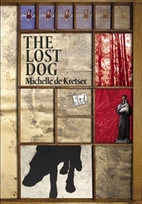
The Lost Dog, on the other hand, has a voice to die for. The phrase ‘jewelled prose’ came to mind: there’s hardly a sentence, and probably not a paragraph without a glowing adjective, a finely cut phrase, a many-faceted image or a sharply glittering epigram, though I don’t think you’d find any extended metaphors as laboured as that one. I was so captivated by the prose that I’d reached about the halfway point before I started to wonder if there was a plot; fortunately, just about then Michelle De Kretser started to give clues about where the book was heading. I remember someone saying of the movie Stand By Me that almost everything in it was there to allow the movie to get away with the one moment of tenderness between two boys. It’s not quite that simple with The Lost Dog – in fact, there’s nothing simple about this book – but after all its playing with time, its ruminations about modernism and post-colonialism, its playing around with references to Henry James (the point-of-view character, Tom, has just finished writing a book on James when this book opens and he loses his dog), it gives us climactic moments affirming simple human/animal realities. (The beautiful cover was designed by excellent blogger Ampersand Duck, who had clearly read the book. The book I borrowed is hardcover and a pleasure to hold in the hand.)
A general footnote: one of Jeanette Winterson’s tendentious remarks was ‘”Write from your own experience” is fine for the writing class, useless for the writer.’ Well, not entirely useless I think. Part of my difficulty with the Lloyd Jones book was that I believed the book when it was talking about Dickens, but not about Bougainvillean culture: I’m sure he did a lot of research, but it doesn’t feel experienced in the book. On the other hand, the only moments that rang false for me in The Lost Dog were those when Tom does something sexual when alone: as if that had to be included to make him a proper man. I’d bet good money, on the other hand, that Tom’s bi-cultural experience has a lot in common with Michelle’s, and that Matilda’s is a long way from Lloyd’s.
Addition: Tipped off by a review of the latest Meanjin in today’s Spectrum (supplement of Sydney Morning Herald), I found Ampersand Duck’s post about designing The Lost Dog‘s cover. It’s a terrific post, but I just want to quote this, in a self-congratulatory way: ‘For me, the most alluring part of the job was that part of my brief was to read the book properly. Hooray!’ I thought as much!
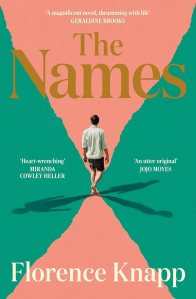
Florence Knapp was a guest at this year’s Sydney Writers’ Festival. I didn’t attend any of her events, but I loved the podcast of her conversation with Claire Nichols (at this link). Whether it was her personal charm or the way her book’s premise touched something in me, I reserved the book at my local library immediately, and behold, instead of a six-month wait, it was ready for me to pick up almost immediately.
The premise is straightforward enough. Cora, who is trapped in a dangerously abusive marriage, has to register the birth of her newborn son. Her husband instructs her to name the baby after himself – Gordon. Her nine-year-old daughter, Maia, wants him to be named Bear. Cora toys with calling him Julian, and escaping punishment by pointing out that the name means sky father, and so is a tribute to her husband.
That much is laid out in a prologue, set in October 1987. The rest of the novel tells what follows on from each of the choices. First in 1987, then every seven years until 2022, there are three chapters, headed ‘Bear’, ‘Julian’ and ‘Gordon’, and three radically different versions of the life of the family emerge.
Early on I wondered if there was much point to actually reading the book, once the premise was laid out. Maybe it was enough that the premise turns a spotlight on the ambivalence that I imagine most people have about their names, making me wonder, for example, how my life might have gone if, say, I had been named Arthur after my mother’s father (my father’s name was already taken), or something outlandish like Bandicoot, rather than Jonathan because, as my mother said, it sounds nicer than John.
But I’m glad I persisted with Florence Knapp’s story rather than my own. The lives of all three boys and their families are gripping, full of unexpected turns, each in its own way moving. The differences made by the different namings are wonderfully convincing, in big ways as well as small – from the drama of father Gordon’s immediate responses to tiny developments down the track. For example, when the baby is named on Maia’s suggestion, she forms a powerful protective bond with him. When he is called Julian, she becomes protective of her mother. When he is Gordon, they eventually form an alliance, but it is hard won. Taken as a whole, its a nuanced set of variations the theme of domestic violence and its long shadows.
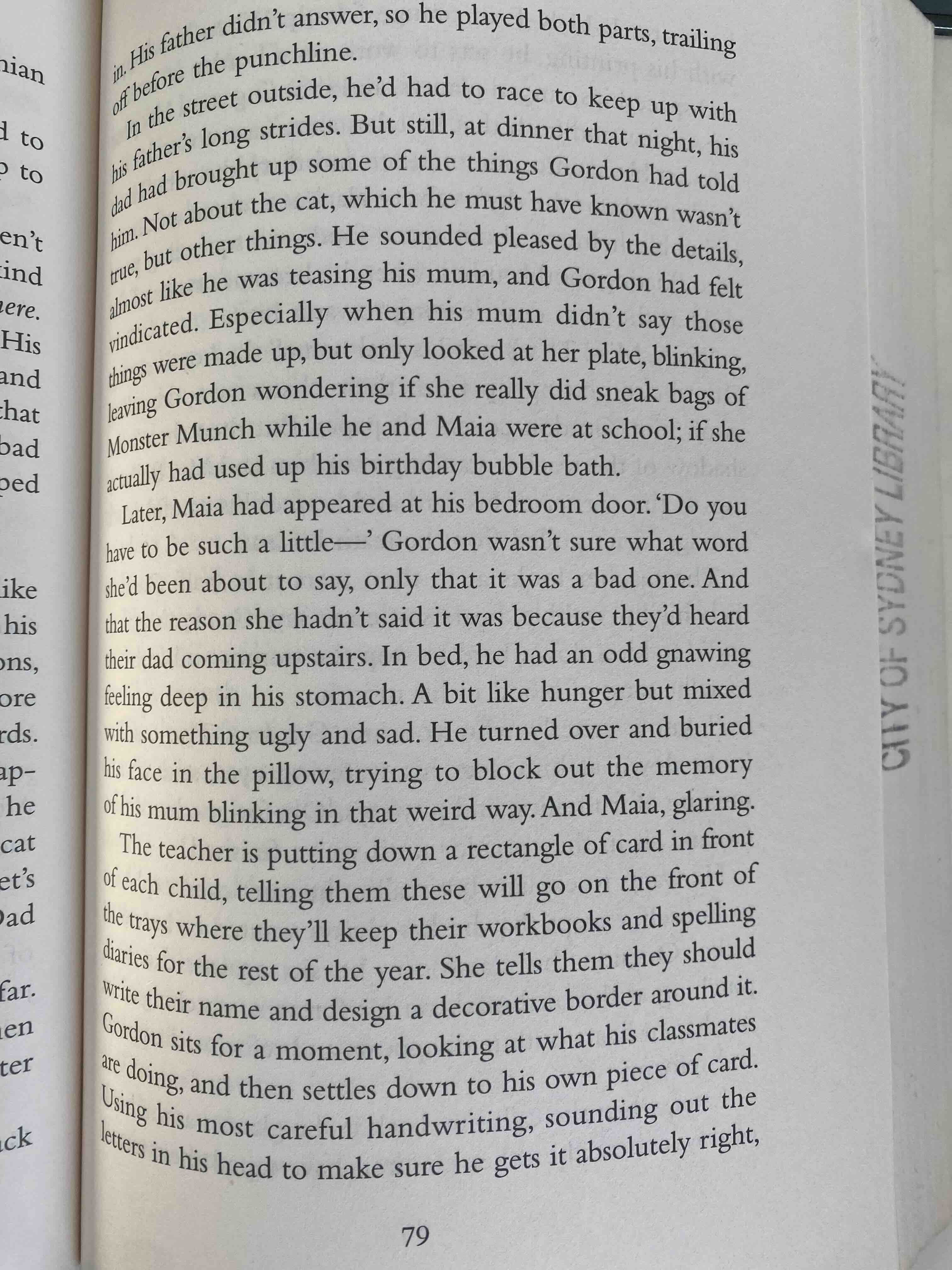
Page 79* falls in Gordon’s section of 1994, when he is seven years old. Unlike the Bear and Julian, Gordon is taken under his father’s wing. On this page, father and son return from a special time at Pizza Express where the father asks, ‘What has Mummy been up to while I’ve been at work?’ Seeing that he gets an interested response when he says, ‘And one time, she said a bad word,’ the son makes up other maternal misdemeanours, including one that involves a stray cat. We fear for young Gordon’s soul.
Though I pick on page 79 arbitrarily, it’s interesting how often the page includes key moments in a book. Here, we have the moment when young Gordon gets an inkling of how his father is using him.
At dinner that night, his dad had brought up some of the things Gordon had told him. Not about the cat, which he must have known wasn’t true, but other things. He sounded pleased by the details, almost like he was teasing his mum, and Gordon had felt vindicated. Especially when his mum didn’t say those things were made up, but only looked at her plate, blinking, leaving Gordon wondering if she really did sneak bags of Monster Munch while he and Maia were at school; if she actually had used up his birthday bubble bath.
This puzzlement is given a nudge by Maia. On another timeline she is Bear’s besotted protestor. On this one she becomes Gordon’s moral guide:
Later, Maia had appeared at his bedroom door. ‘Do you have to be such a little–’ Gordon wasn’t sure what word she’d been about to say, only that it was a bad one. And that the reason she hadn’t said it was because they’d heard their dad coming upstairs. In bed, he had an odd gnawing feeling deep in his stomach. A bit like hunger but mixed with something ugly and sad. He turned over and buried his face in the pillow, trying to block out the memory of his mum blinking in that weird way. And Maia, glaring.
It would have been tempting to make young Gordon the replica of his father that old Gordon wants, but he is torn. At this point we feel the seven-year-old’s moral unease. In the last part of the page, Gordon makes a bid to break free of the destiny brought by his name.
The teacher is putting down a rectangle of card in front of each child, telling them these will go on the front of the trays where they’ll keep their workbooks and spelling diaries for the rest of the year. She tells them they should write their name and design a decorative border around it. Gordon sits for a moment, looking at what his classmates are doing, and then settles down to his own piece of card. Using his most careful handwriting, sounding out the letters in his head to make sure he gets it absolutely right, he writes L-U-K-E in orange felt-tip.
It’s no spoiler to say that the teacher doesn’t let him get away with it, but tears his card up, and writes his name in shockingly undecorated black on a new card. He is saddled with the name and all it brings with it. It would be a spoiler to say whether Florence Knapp allows him to escape or if she ruthlessly follows through on the logic of nominal determinism.
I loved that boy, and would happily have spent a lot more time with him, all three of him.
I am a man of settler heritage living on Gadigal Wangal country, where the days are suddenly warmer and magpies seem to be everywhere. I acknowledge Elders past, present and emerging for their continuing custodianship of this land, and welcome any First Nations readers.
* My blogging practice is to focus on the page that coincides with my age, currently 79.