
Douglas Stuart, John of John (Pan Macmillan 2026)
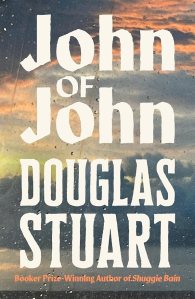
Before the meeting: I love this book.
It’s set on a remote Scottish island where Gaelic is still spoken in a fiercely pious religious community. Cal is a young, gay fine arts graduate who has come home from Edinburgh because, according to his father in one of their painful weekly phone calls, his grandmother is ill – the book’s opening sentence is, ‘Her feet were as purple as calf liver.’ The young man’s full name is Calum John, and on the genealogy-conscious island he is identifiable as John of John. John McLeod, his father, is a church elder and weaver – stern, ascetic, hardworking, painfully honest and a harsh parent. John’s wife, Cal’s mother, has long since left him and been ostracised by the religious community as a result. It’s not a spoiler to tell you that John, the father, has a long-term, secret, sexual relationship with another man, his neighbour Innes.
Chapters mostly alternate between Cal’s and John’s points of view. A rich portrait of the remote community emerges. A good part of this is in the language – not just the occasional Gaelic dialogue and the bilingual chapter numbering (a h-aon / one to fichead ‘s a sia / twenty-six), but in the English words that feel as if they belong in that place. On page 20 in chapter 2 for example, there are five words that were new to me:
- croft (which I previously thought signified a small farm, but here refers to the house on the farm)
- harling (here ‘painted an almost painful white’, this is roughcast – plaster mixed with small stones or shells, which I recognised in a scene in 35 Up one night this week)
- rickle (a loose heap), skive (to pare or scrape, as in leather)
- semmit (a vest or undershirt).
The meaning of all five is clear enough from context, but they enrich that context.
The plot revolves around the relationships of the three men and Ella, John’s mother-in-law who has been young Cal’s protector and a thorn in the side to John. Cal resumes the exhausting work of weaving at his father’s loom, and deals with unfinished business with other people of his generation, including a woman he was expected to marry and a man his own age who no longer wants to have sex with him. John must deal with Innes’s increasing impatience with their secrecy. More than once, John lashes out violently at Cal, and it’s a measure of the strength of the writing that we understand why Cal not only stays on the island but dutifully tells anyone he meets that the terrible bruising on his face was caused by a fall. It’s partly that Cal feels he has failed to make it on the mainland, but deeper than that is ancient family loyalty. Nobody believes him about the fall, but no one intervenes, and we understand that too.
A potential sexual triangle develops between Cal, John and Innes, which would make great comedy-of-manners if the stakes weren’t so high for all of them. For Cal, to be out as Gay would mean exile back to his mainland life. For the others it would mean the end of their lives as they know it, and for John especially it would mean facing his deep sense of shame. All the same, I must ask at the book group if other people laughed at the scene where Cal tries it on with Innes – I didn’t, but I cringed.
Page 79 is in Chapter a sia / six, one of the few that has a focus on someone other than John or Cal. This is Ella’s chapter. It gives her backstory – how as a young Glaswegian woman during the Second World War she had enjoyed the high life and resisted the attention of a taciturn man from the islands – Old Calum as he came to be known – until she got pregnant by a serviceman and Calum asked her to marry him. In this chapter we meet Grace, Cal’s mother, for the first time, and see Ella’s behind-the-scenes manoeuvrings to make Cal’s time on the island tolerable.
But page 79 itself is taken up entirely with Ella’s visit to a derelict blackhouse. A blackhouse, according to my web research, is a type of house that used to be common in the Scottish highlands and islands, built of stone with a thatch roof (‘laid up of stone and sod’, as Stuart puts it). (Wikipedia has photos.)
The page doesn’t move the plot forward, but the elegiac tone that suffuses the book comes into focus here. The state of the blackhouse works as a metaphor: the old ways of the island are on the way out, partly because of the different morality of the younger generations (Cal isn’t the only one touched by 21st century sexual mores), and partly because the traditional work of small farms and hand weaving is coming to an end.
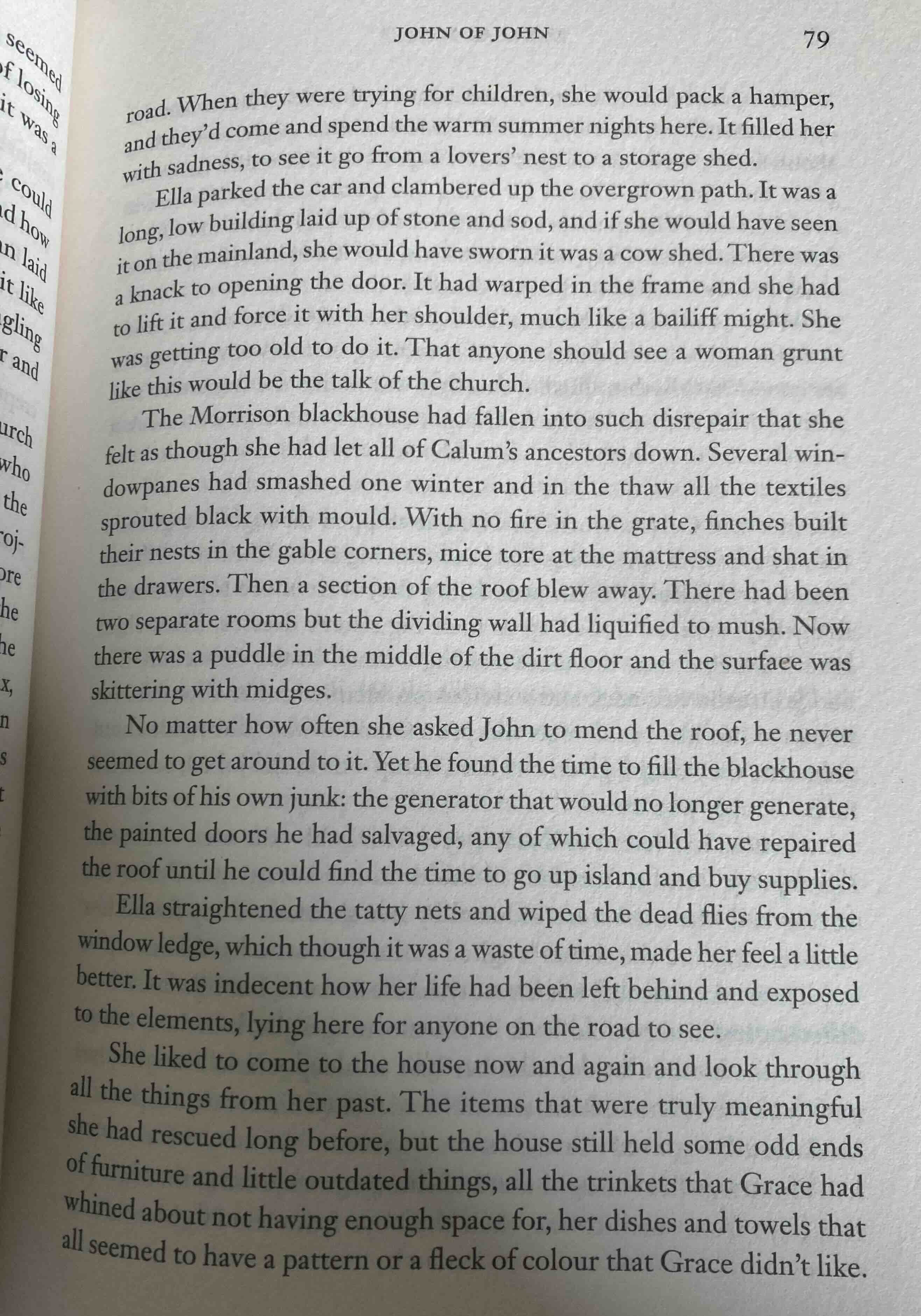
Ella parked the car and clambered up the overgrown path. It was a long, low building laid up of stone and sod, and if she would have seen it on the mainland, she would have sworn it was a cow shed. There was a knack to opening the door. It had warped in the frame and she had to lift it and force it with her shoulder, much like a bailiff might. She was getting too old to do it. That anyone should see a woman grunt like this would be the talk of the church.
There’s so much happening in that short paragraph. We’re reminded that things are different from ‘on the mainland’, and that moralistic surveillance is everywhere. The clambering, shouldering and grunting keep the narrative firmly in the physical reality.
The Morrison blackhouse had fallen into such disrepair that she felt as though she had let all of Calum’s ancestors down. Several windowpanes had smashed one winter and in the thaw all the textiles sprouted black with mould. With no fire in the grate, finches built their nests in the gable corners, mice tore at the mattress and shat in the drawers. Then a section of the roof blew away. There had been two separate rooms but the dividing wall had liquified to mush. Now there was a puddle in the middle of the dirt floor and the surface was skittering with midges.
This is still intensely physical, but there’s also a reminder of the importance of tradition in this place, even for an outsider like Ella – ‘she felt as though she had let all of Calum’s ancestors down’. In the first chapter, on the ferry to the island, a woman asks Cal, ‘And who do you belong to?’ and he replies, ‘I’m John of John of Iain of Iain the Breabadair.’ Even for Cal with his long, dyed-blonde hair and his arty ways, ancestry is important. Breabadair means ‘weaver’ – Cal’s family have been weaving for five generations.
She liked to come to the house now and again and look through all the things from her past. The items that were truly meaningful she had rescued long before, but the house still held some odd ends of furniture and little outdated things, all the trinkets that Grace had whined about not having enough space for, her dishes and towels that all seemed to have a pattern or a fleck of colour that Grace didn’t like.
This may be the first appearance of Cal’s mother, Grace. As you might expect, there are interesting revelations to come about why Ella is living with her hostile son-in-law rather than her daughter, and about why Grace left John all those years ago, leaving Cal with him. But here there are just hints of mother-daughter tensions, of Grace as someone who knows her own mind and, though Ella might call it whining, can hold out for what she wants.
At the meeting: We had a terrific discussion of this book. I asked if other people had laughed at the scene where Calum tries to seduce Innes.Nobody had. They agreed it was weird but, as one of the women said, men do weird things. Weird or absurd, believable or not, I think we all agreed that it was poignant, saw it as a measure of Cal’s desperation for closeness and perhaps for a sexualised version of fatherly affection.
But the conversation really kicked off when one person said she found the whole thing unbelievable. Why did Cal stay on the island where he wasn’t welcome, and life was full of drudgery and violence? Why did John’s wife not blab about his homosexuality when she left him all those years ago? Why didn’t she take her sone with her? Why did Innes keep hoping after all this time? How did John manage to have a long-term homosexual relationship while genuinely adhering to stern puritan religious beliefs, preaching and practice?
They were good questions, and the rest of us fumbled around for answers. The importance of attachment to the place was mooted. The way small, isolated communities command loyalty. Cal is young – in his early 20s – and, like a number of unnamed friends of one person, unable to take the initiatives necessary to improve his life.
We spent a lot of time trying to work out what happens at the end of the book. It’s hard to say much here without spoiling, but I think we ended up deciding that while John’s future course is clear, Cal’s is up in the air: he has a momentary fantasy of how it will go, but on closer reading it seems unlikely that that’s how things will come to pass. The very final moments are inconclusive, though when we focused on the word bellwether, at least aspects of it became clearer.
Someone had looked up Harris tweed, and informed us that it is hand woven cloth whose production on rugged Scottish islands is rigorously policed. This is the kind of cloth that Calum and his ancestors have been producing.
We discussed this book in tandem with Omar Musa’s Fierceland. We had a great conversation about each book, but there was no crossover at all.
The Book Club’s five members, all of settler heritage, met on Wangal and Gadigal land, which is where I wrote this blog post. I gratefully acknowledge the Elders past and present of those Nations and welcome any First Nations readers of this blog.
* My blogging practice is to focus on the page that coincides with my age, currently 79.


