
Eunice Andrada, Kontra (Giramondo 2025)
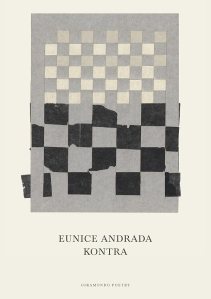
Kontra, the third book of poetry by Eunice Andrada, has won the Victorian Premier’s Award for Poetry and is shortlisted for other awards, including the 2026 Prime Minister’s Literary Awards.
Andrada’s previous books, Flood Damages and TAKE CARE (links are to my blog posts) deal a lot with female suffering, especially in the context of colonisation, with what Andrada calls ‘bare vulnerability’. Kontra‘s poems focus mainly on the figure of the kontrabida, the villainess in Filipino soap operas that viewers love to hate. It comes at the same subject from a different angle, and it’s a book in which the women fight back.
Whereas the soap opera (or teleseryes) heroine, the bida, tends to be virtuously well behaved, the kotrabida is ferocious and glamorous, though doomed to loss and humiliation, or worse. Andrada sets out to give her a fuller life. She says in an author’s note:
The kontrabida always arrives fully formed, without a backstory. I couldn’t find out what she thought by going off the information that was presented through teleserye storylines. Through poems that oscillate between her and me, I wanted to piece together her lineage, and in doing so, look at my own. I was thinking about my blood lineage and my poetic lineage, the women who have hurt me and healed me, and the poets who shaped me.
I have never seen a Filipino soap opera – the closest I’ve come is an event billed as a Bading Talent Show at the Marrickville Bowling Club, in which a number of men in spectacular drag gave off the kind of energy I now recognise as belonging to the kontrabida.
If I were to stick to my usual practice of looking at page 79*, I would now discuss ‘Speaking of Love’, which has the explanatory subtitle, ‘cento for women slain in operas – may you live in love forever’. A cento, as you may know, is a poem made up of lines taken from other poems. This poem does a beautiful job of repurposing lines to give the slain women an alternative, active fate.
But I’m breaking my rule to talk a little about the book’s second section.
There are three sections: ‘Kontra’, ‘Operá’ and ‘Bida’. ‘Kontra’ and ‘Bida’ feature the teleseryes characters. ‘Operá’ mostly leaves the world of teleseryes behind. It consists of a 25-page multi-part poem, described in an author’s note as a dyptich.
On the right-hand side of each spread, the poet responds to a painting by Artemisia Gentileschi, Judith Slaying Holofernes, with the introductory heading ‘[Florence, 2023]’. In case the painting is as unknown to you as the teleseryes are to me, you can see it at this link. It refers to the story in the Book of Judith, which is not considered part of the biblical canon by Jews or Protestants, but counts for the Catholic and Orthodox churches.
On the left, with the introductory heading ‘[Korte Suprema, 2025]’, poems riff on the subject of divorce in the Filipino context, and include personal accounts of family violence. The title ‘operá’ is defined on the section title page as a verb, ‘to perform a surgical operation’: some of the left-hand pages includes short instructional sections labelled ‘operá’ – thought experiments, perhaps, or magic procedures, or metaphorical surgeries.
The diptych sequence folds personal history, Philippine law, and mainstream western art into a single whole. For me, the Gentileschi painting acts as a bridge enabling me to connect with the world of the teleseryes, and to the book’s complex humanity, rather than leaving me on the outside looking in.
Hee’s a sample spread:
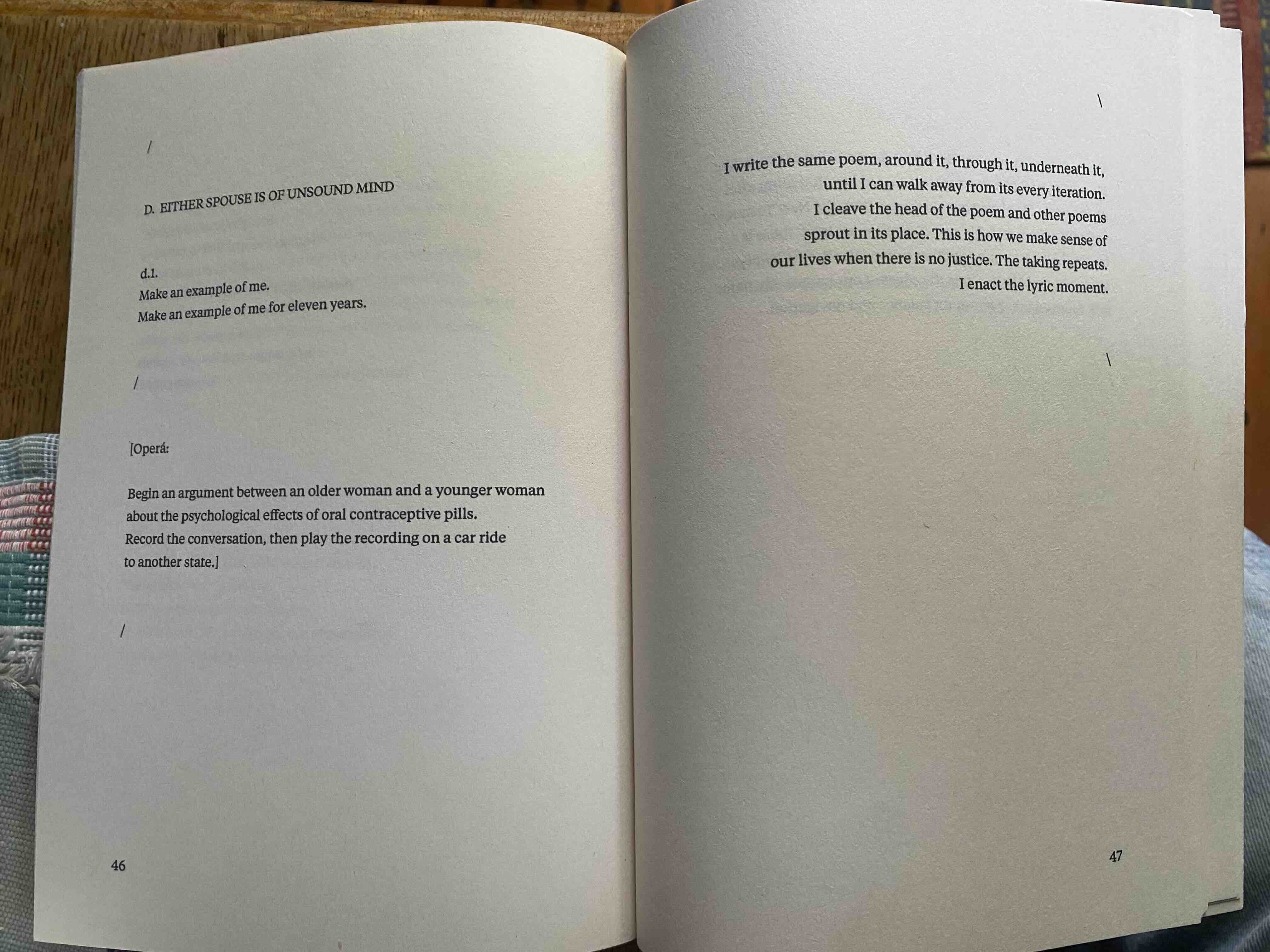
You see how it works. There are four components on the page. Let me walk you through them:
First on the left,
D. EITHER SPOUSE IS OF UNSOUND MIND
The sequence features five of these headings, numbered A to E. They give the conditions under which a woman may remarry while divorce remains illegal under Philippine law: A, Death of a spouse; B, Presumptive death; C, Alternative reality (I’m pretty sure that the law’s term for this is annulment); D, as on this page, Either spouse is on unsound mind; and E, introducing the final part of the sequence, Leaving the country.
Presented baldly in capitals, these headings create a restricting framework. Each of them is followed immediately by a spelling-out of its implications, sometimes as on this page offering a subclause, sometimes in extended narrative verse. The brevity of the response on this page builds on the narrative of family suffering that has followed ‘Presumptive death’.
d.1.
Make an example of me.
Make an example of me for eleven years.
It’s not clear who is speaking here. Because of the context, I first read it as the daughter of an abusive marriage where a woman is trapped. It could equally be the woman trapped in the marriage. Someone speaks back with passion to the impersonal legal language.
Then:
[Operá:
Begin an argument between an older woman and a younger woman
about the psychological effects of oral contraceptive pills.
Record the conversation, then play the recording on a car ride
to another state.]
In the sequence in general, the bracketed instructions imply that there is always something one can do. This is the only one that involves another person, It evokes the massive generational shift from Catholic-dominated Filipino culture to a more liberal secular mindset. Oral contraceptives aren’t recent news, and nor are car rides, but here they both represent modernity.
All of that is very Philippines specific. On the right-hand side, the speaker continues her contemplation of the 17th century Italian painting. In other parts of the sequence she has contemplated the painting, identifying with Artemisia Gentileschi as a rape survivor who went on to be a creative artist. Realising that Gentileschi returned to the Biblical story a number of times, she has sought out other versions. On this spread, the right-hand side of the diptych sequence takes a metapoetic turn:
I write the same poem, around it, through it, underneath it,
until I can walk away from its every iteration.
I cleave the head of the poem and other poems
sprout in its place. This is how we make sense of
our lives when there is no justice. The taking repeats.
I enact the lyric moment.
Like Gentileschi, the speaker of the poem returns again and again to the same subject. Holofernes – now a symbolic figure – must be beheaded many times before ‘I’ can walk away from him. Cleaving its head is a brutal metaphor for resolving a poem’s issue – and I guess the process of writing poetry may at times feel brutal. But the subject stays alive through many iterations – or, in the imagery of this poem, sprouts new heads.
Gentileschi was raped as a young woman, and although her rapist was found guilty he was never punished. The poem suggests that her repeated depiction of the violence against Holofernes was a way of making sense of her life in the absence of justice. And not just her, but ‘we’. The I of the poem returns to the mistreatment of women and children – in the left-hand pages of this dyptich but not only there. There’s a fine reaching out in solidarity over the centuries and across cultural difference.
‘I enact the lyric moment.’ I don’t know if writing lyric poetry has ever before been compared to a bloody beheading.
There’s a lot more to this poem and to the book. I’m glad it’s being noticed by the awards judges.
I am grateful to the Giramondo Publishing Company for my copy.
I wrote this blog post in Gadigal Wangal country, where it is my great joy to live. I acknowledge Elders past, present and emerging for their continuing custodianship of this land.
* My blogging practice is to focus on the page that coincides with my age, currently 79.


