
Toby Fitch, Ill Lit Pop (Flying Island Poets 2018)

There’s a thing in contemporary poetry where a poem is created by doing something to another piece of writing. A mechanical example is n+7, in which every noun in the original passage is replaced by the seventh noun after it in the dictionary. Depending what dictionary you use, ‘Friends, Romans, countrymen, lend me your ears’ might become, ‘Fringes, romps, courage, lend me your earshot.’
There are other, less mechanical techniques. In a cento, a form that has been around for a very long time, each line of the new poem is made up of a line from another poem. There are erasures, cut-ups, flarf (see Wikipedia description here), and more. They can be fun and challenging to do, and the results can be intriguing, hilarious, or sometimes just plain mystifying to read.
Toby Fitch does a lot of that kind of thing. His book before Ill Lit Pop was The Bloomin’ Notions of Other & Beau (Vagabond Press 2016) – say its name aloud and you might realise that the book has something to do with Illuminations by Arthur Rimbaud. In 2021’s Sydney Spleen (Giramondo, my blog post here), he applies N+ 7 viciously to some Scott Morrison’s speeches.
Ill Lit Pop includes similar play. An end note lists ‘sources’ for each of the book’s 21 poems. They all do something to – or with, or through – other pieces of writing. The ‘sources’ include Kurt Cobain, Ice House, Taylor Swift, Walt Whitman, Arthur Rimbaud and William Blake. If my reading of the book’s title is correct, it suggests that many of the poems take pop lyrics and make them obscure, as in poorly illuminated pop music.
Probably the poem that speaks most directly to me is ‘Let’s Dance’ [or, as the contents pages puts it, ‘Let’s Dance (da da-da-da da-da-da)’], a more or less traditional poem responding to David Bowie’s fabulous video of his song by that name. It begins:
It wasn't Stravinsky's rite of spring
to plonk Uluru on his album cover
but it led Bowie to the beach-blonde pub
summer dance-off
To read the rest of the poem you’ll have to find a copy of the book. You can see the video at this link.
In the less traditional poems, I generally find myself bemused.
Page 47* will give you a taste. It’s the last page of ‘Evening of the Bot Man’, which has the explanatory subtitle ‘(A bad lip reading of Rimbaud)‘. The note on sources names ‘selected lines of Le bateau ivre, Arthur Rimbaud’.
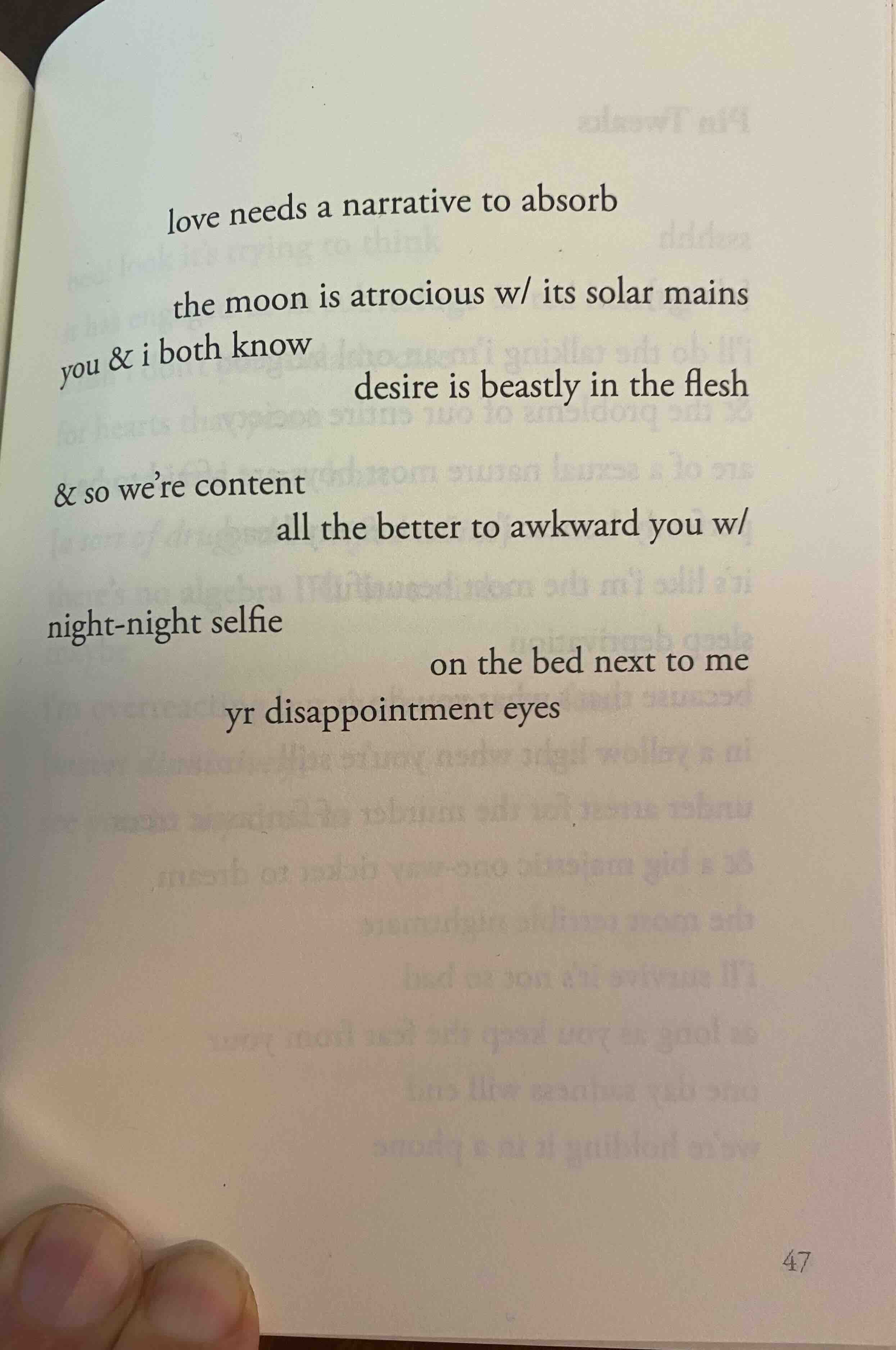
I think I get the idea of bad lip reading. Here’s how I imagine this poem was created. Toby Fitch watched someone perform Le bateau ivre, probably in the original French, with the sound turned down, and wrote words in English that roughly fitted what he saw. Then, I’m guessing, he read through what he had written and selected the bits that looked interesting, tidied them up a bit, and perhaps nudged them towards some kind of meaning. Maybe it’s a process a little like reading tealeaves or playing with a ouija board. Or like interpreting dreams – the lipreader’s unconscious mind surely has a role in deciding what words to see.
I don’t think there’s much point to reading it alongside Rimbaud’s poem – I tried and failed. The title, ‘Evening of the Bot Man’, could be a tidied-up version of ‘the bot man’s evening’, which is a plausible bad lip reading of ‘le bateau ivre’. Such comparative reading for the rest of the poem would be a lot of work, and probably not very productive. So the poem needs to be read in its own right.
In the first four pages, nothing makes obvious sense, but there are some wonderful surrealist phrases.A random sample includes ‘tweeting pics / of the cooked black rain’, ‘icy poles exalting / among purple columns of lard’, or ‘July fizzing w/ quadrupeds’. But a narrative thread emerges from the apparent chaos. The poem is addressed to someone, and the speaker has done something he regrets:
a single sexy night saw me regret
___________________________the fallout of my life
's pleasure dome
__________________________u shivered non-plussed
the Furies all slow-clapped
our marriage
Such is the nature of the piece that as I read I wondered if it was me or Toby Fitch who decided that was part of a through narrative line. Whichever, oncec I’ve seen it, it’s definitely there, and the poem continues with self-recrimination and perhaps some excuse-making.
So these final lines, on page 47, read almost coherently, beginning with a meta moment:
_______love needs a narrative to absorb
People need narratives – and the nominally arbitrary process of bad lip reading has urned one up.
_______the moon is atrocious w/ its solar mains
you & i both know
__________________desire is beastly in the flesh
These lines invoke the biblical phrase, ‘The spirit is willing but the flesh is weak,’ putting it in an astronomical rather than theological context – the moon in relationship to the sun. ‘There’s a hint of forgiveness in ‘you and I both know’. And so …
& so we're content
______________all the better to awkward you w/
night-night selfie
___________________________on the bed next to me
_________yr disappointment eyes
The issue – arising from that ‘single sexy night’ – is not resolved. Things are still awkward. The speaker and his spouse have reached an awkward detente. Disappointment is still there, but so is contentment.
None of which has anything to do with the Rimbaud’s most famous Symbolist poem, whose surface narrative is all about a boat sailing drunkenly down a river. Rimbaud has provided the text from which the new text has arisen. If you can find the poem I’d love to hear other people’s readings of it.
I am an Australian man of settler heritage. I’ve written this blog post on Wulgurukaba land, on beautiful Yunbenun (aka Magnetic Island). I acknowledge their Elders past and present, including their sustained struggle to have the island’s long history acknowledged, and I welcome any First Nations readers and commenters.
* My blogging practice is to focus on the page that coincides with my age, currently 79. When a book has fewer than 79 pages, as this one does, I look at page 47, the year of my birth minus 1900.


