
Shida Bazyar, The Nights Are Quiet in Tehran (2016, translation from German by Ruth Martin, Scribe 2025)
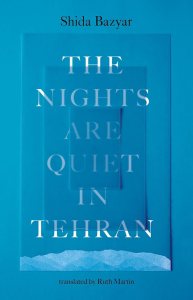
Before the meeting: This novel invites readers into the world of leftist Iranians who allied with Islamists against the Shah in the 1970s, only to face exile or worse under the rule of the Ayatollahs. Though it was written before Trump’s first presidential term, and Ruth Martin’s wonderfully readable translation was published before his current war on Iran, it takes on extra power when read in the context of those events.
It is the story of one Iranian family told in four slices of time: 1979, the year the Shah was deposed and the Islamic Republic was established; 1989, when the family is living in exile in Germany; 1999, when the regime relaxes a little and some family members visit Tehran; 2009, when once again the streets of Tehran are full of protests in the Green Movement, and the exiles watch the brutal repression unfold on social media. An undated epilogue tentatively suggests a brighter future.
Each section has a different narrator. In the first, youthful Behraz tells how he and his two close male friends see their hopes for a socialist revolution dashed, and though in his political fervour he believes there is no time for romance, he is drawn to the beautiful Nahid. In the second, ten years later, Nahid is married to Behraz. She describes their life in Germany and remembers the events that led to their flight from Iran. In the third, their eldest daughter, Laleh, takes up the story, describing a visit to Tehran, her first experience of noisy, exuberant family life, and the quiet revelation of the fates of Behraz’s friends. In the fourth, Mohad/Mo, who was a rowdy little boy in the previous section, now deals with the dual identity of dissipated German university student and Iranian exile.
Shida Bazyar is a German writer whose parents, like Behzad and Nahid, were communist activists in Iran in the lead-up to the 1979 revolution. They left the country in 1988 and – unlike Laleh and Mo – Shida was born in Germany. The book clearly draws on the author’s family’s experience, both in the youthful activism against the Shah and then against the Ayatollah, and in the experience of exile. Especially in the third section, when teenage Laleh returns to Tehran, the writing feels so alive it must be drawing on actual experience. (I’ll stand by that statement even though Shida Bazyar was born in 1988, so was one year old at the time of the fictional visit.)
A look at page 79* gies you an idea of the quality of the writing – including the fluency of the translation.
It’s part of Nahid’s narrative. She is remembering the moment when they decided to leave Iran, early in the 1980s. Behraz’s friend Peyman is visiting their safe house to tell them he has received a letter requiring him to turn himself in to the Islamic regime, which they all know means he is to be arrested for his communist activism. It’s a quiet, decisive moment in their lives:
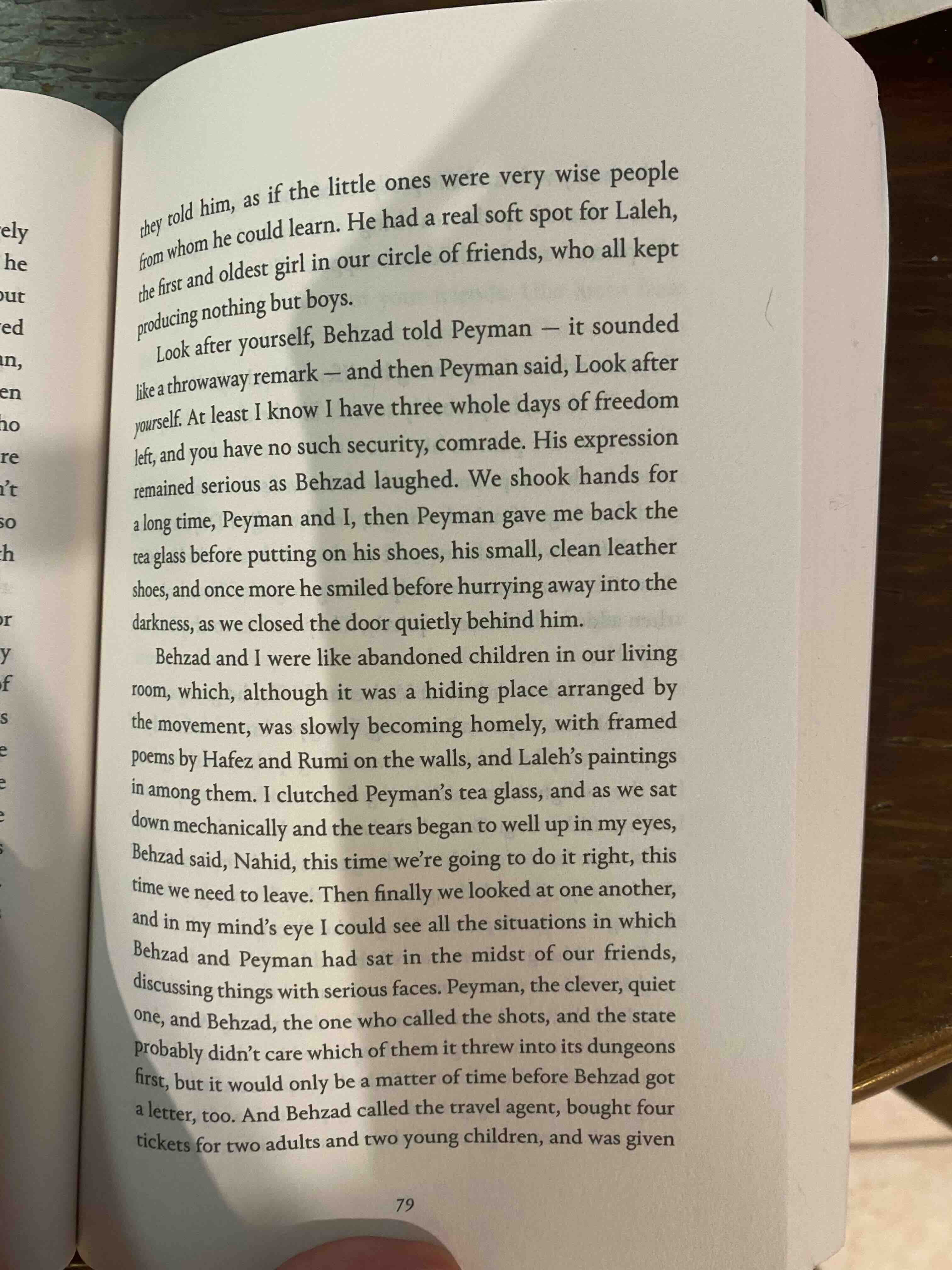
Look after yourself, Behzad told Peyman – it sounded like a throwaway remark – and then Peyman said, Look after yourself. At least I know I have three whole days of freedom left, and you have no such security, comrade. His expression remained serious as Behzad laughed. We shook hands for a long time, Peyman and I, then Peyman gave me back the tea glass before putting on his shoes, his small, clean leather shoes, and once more he smiled before hurrying away into the darkness, as we closed the door quietly behind him.
The emotional intensity of the moment is conveyed entirely through gesture: Peyman has accepted the oblgatory glass of tea, but he has not sat down, and at parting he shakes Nahid’s hand ‘for a long time’. The door closes quietly behind him as he disappears into the darkness, and we know it’s the last time Nahid and Behzad will see him. (It’s not a spoiler to say that in Laleh’s narrative, when they meet up with Peyman’s widow ten years later, the emotion is much more on the surface.) The paragraph is also a beautiful example of how the novel portrays character. Nahid wants us to know that Peyman is anything but a performative martyr. He plays with children, and takes their words seriously, and when he is about to surrender himself to the regime, he manages a deadpan joke about the danger hanging over his friend.
Once Peyman has gone, the composure breaks:
Behzad and I were like abandoned children in our living room, which, although it was a hiding place arranged by the movement, was slowly becoming homely, with framed poems by Hafez and Rumi on the walls, and Laleh’s paintings in among them. I clutched Peyman’s tea glass, and as we sat down mechanically and the tears began to well up in my eyes, Behzad said, Nahid, this time we’re going to do it right, this time we need to leave. Then finally we looked at one another, and in my mind’s eye I could see all the situations in which Behzad and Peyman had sat in the midst of our friends, discussing things with serious faces. Peyman, the clever, quiet one, and Behzad, the one who called the shots, and the state probably didn’t care which of them it threw into its dungeons first, but it would only be a matter of time before Behzad got a letter, too.
That paragraph is mostly important in the flow of the novel as giving a flashback to the moment Behzad and Nahid decide to leave Iran and come to Germany. On paying closer attention to it for this blog post, I noticed something that slipped by me on first reding.
Nahid mentions Hafez and Rumi, two towering figures in Persian/Iranian culture. Her attachment to them was something that drew Behzad to her in the first place, and here they have an honoured place on the wall with little Laleh’s paintings – emblematic reminders that there is more to the life of these characters and this nation than endless struggle. Yet nowhere in the novel is either of them quoted.
A few pages later, the couple discuss a poem by Bertolt Brecht. The poem is ‘Thoughts on the Duration of Exile‘, but even though it is eminently relevant to their situation, it is only indirectly named and quoted. It’s clear from this and other moments that poetry is important to Nahid, and probably to Behzad as well. Readers aren’t given a direct look at any of it.
Then I realised that something similar happens in earlier parts of the novel. The main action, from one point of view, is the characters’ activism. Yet there are very few specifics about that activism: Behraz drives a car full of leaflets, but we don’t know what is in them or what is to be done with them. He spends time with other revolutionaries in a captured barracks, but what they do there is passed over in silence. We know that he is risking his freedom, even his life, but we don’t know what he is doing.
Some readers may find this effect frustrating or evasive. I didn’t. This isn’t an educational documentary about Iranian culture and history, it’s a story of how that history affects the lives of one small family – and by implication, many more.
The book was written before the Women, Life Freedom demonstrations of 2022 (link here) and its brutal repression. Things were so bad that in mid 2026 members of the Iranian diaspora in Sydney were demonstrating in favour of Trump’s invasion. As I was reading the last pages of the book, Donald Trump was reported as saying he would ‘beat the f***ing s**t out of Iran. The grief that permeates the book’s last pages seems more insistent and the hopeful epilogue more unrealistic with every passing news flash.
At the meeting:
It turned out that for a couple of us the stories in this book gave them insights into things they had been told or noticed about Iranians in their lives. And conversely, stories they had heard from those friends helped in their appreciation of the book. A small example: in Laleh’s section, Iranians presen their visiting family members with gifts in plastic bags – when this happened our group member’s acquaintance she had though it was just her Iranian family being offhand, but the book makes it seem a matter of cultural difference.
We were all engaged by the book. A couple of people – maybe everyone except me – found the first section, Behraz’s narrative, hard to follow and a bit boring. Weirdly, I liked his narrative because of its clarity. I think I read it with the utterly confusing opening of Sofi Oksanen,’s When the Doves Disappeared (link is to my blog post) fresh in my mind: I knew where the characters’ allegiances lay and wasn’t bothered by the lack of specifics about their activities.
We generally agreed that the two women’s narratives – that is, Nahid’s and Laleh’s – were the most engrossing. Nahid’s account of the experience of exile and Laleh’s wrestle with dual identity were especially strong. No one was particularly convinced by young Mo’s activism – he goes to demos about student fees and watches videos about Iran only because his German girlfriend wants him to. At least that’s how one person read him. My sense of him is kinder than that, and I found his section very moving as a picture of a young man more or less adrift from his cultural moorings, along with the horror of the repression of the Green Revolution.
We read the book along with Ann Patchett’s Whistler. When I blogged about Whistler, I mentioned that we did a little karaoke at the end of the evening. It says something about the difference between the books if I mention here that we also heard about the youthful political struggles on one member and current tribulations of a family member of another.
I read The Nights Are Quiet in Tehran and wrote the first part of this blog post on Wulgurukaba country, on the beautiful island of Yunbenun. The Book Club’s five members, all of settler heritage, met on Gadigal land, and I wrote the rest of the blog post on Wangal and Gadigal land. I gratefully acknowledge the Elders past and present of all those Nations and welcome any First Nations readers of this blog.
* My blogging practice is to focus on the page that coincides with my age, currently 79.


