
Paul Lynch, Prophet Song (Faber & Faber 2023)
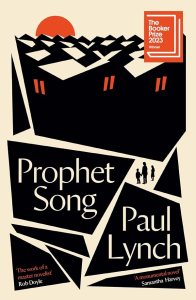
Before the meeting: The Book Group is going through an Irish phase. Several Irish novels ago, one of our number said, ‘This is a beautifully written Irish novel, but does the world really need another beautifully written Irish novel?’ Yet that same man was this month’s Chooser, and here we are.
I remember reading a little about Prophet Song when it won the Booker Prize in 2023. The Booker then as now has a bit of a reputation for choosing grim novels, and this choice sounded true to form. I wasn’t planning to read it.
But, as has happened before, what the Book Group wants …
It is a beautifully written Irish novel, and an unremitting dystopian tale. It begins with two policemen knocking on the door of Larry Stack, a reacher and union leader in Dublin. In a reasonably pleasant chat, they warn him to call off a strike he is organising. And it goes from there.
The strike happens. Larry and others are arrested and disappear. More people begin to silently disappear as the government claims emergency powers, and key positions at all levels of society – schools, hospitals, local councils – are filled with cold-eyed people wearing party insignia. The Republic of Ireland becomes a full-blown police state, all as experienced by Larry’s wife, Eilish: first her husband is disappeared, then her oldest son goes into hiding to avoid the draft and we assume joins the rebel forces; she is pushed out of her job. Things get worse from there. The quiet suburban street becomes a war zone, and when the rebels take it over things don’t get any better. Eilish lives through all of this, while searching for her husband, doing her best to care for her three remaining children, and looking after her father who, symbolically enough, has dementia.
And it’s Ireland! Coming to it so soon after reading Patrick Radden Keefe’s Say Nothing (link is to my blog post), where – in the real world – rebels would cross the border from Northern Ireland to find refuge in the Republic, I kept thinking it was an impossible fantasy: ‘It couldn’t happen there!’ But then I’d think of ICE in Minneapolis, and even the NSW police at a pro-Gazan demonstration earlier this year, and my blood would run cold.
I don’t think it’s a spoiler to say there is no happy ending. With one exception, for which I am hugely grateful, any time I feared the worst, the worst is what happened.
As in Margaret Atwood’s The Handmaid’s Tale, it feels as if each step in the destruction of a free society is something that has happened, recently, somewhere in the real world. It’s a deeply chilling book.
Page 79* is a nice example of the writing style. It’s one of those moments when life goes on despite everything – Eilish is helping her father get ready for a family wedding, and he has just said something appallingly curmudgeonly, in the manner of ancient Irishmen familiar from TV shows like Father Ted and Derry Girls.
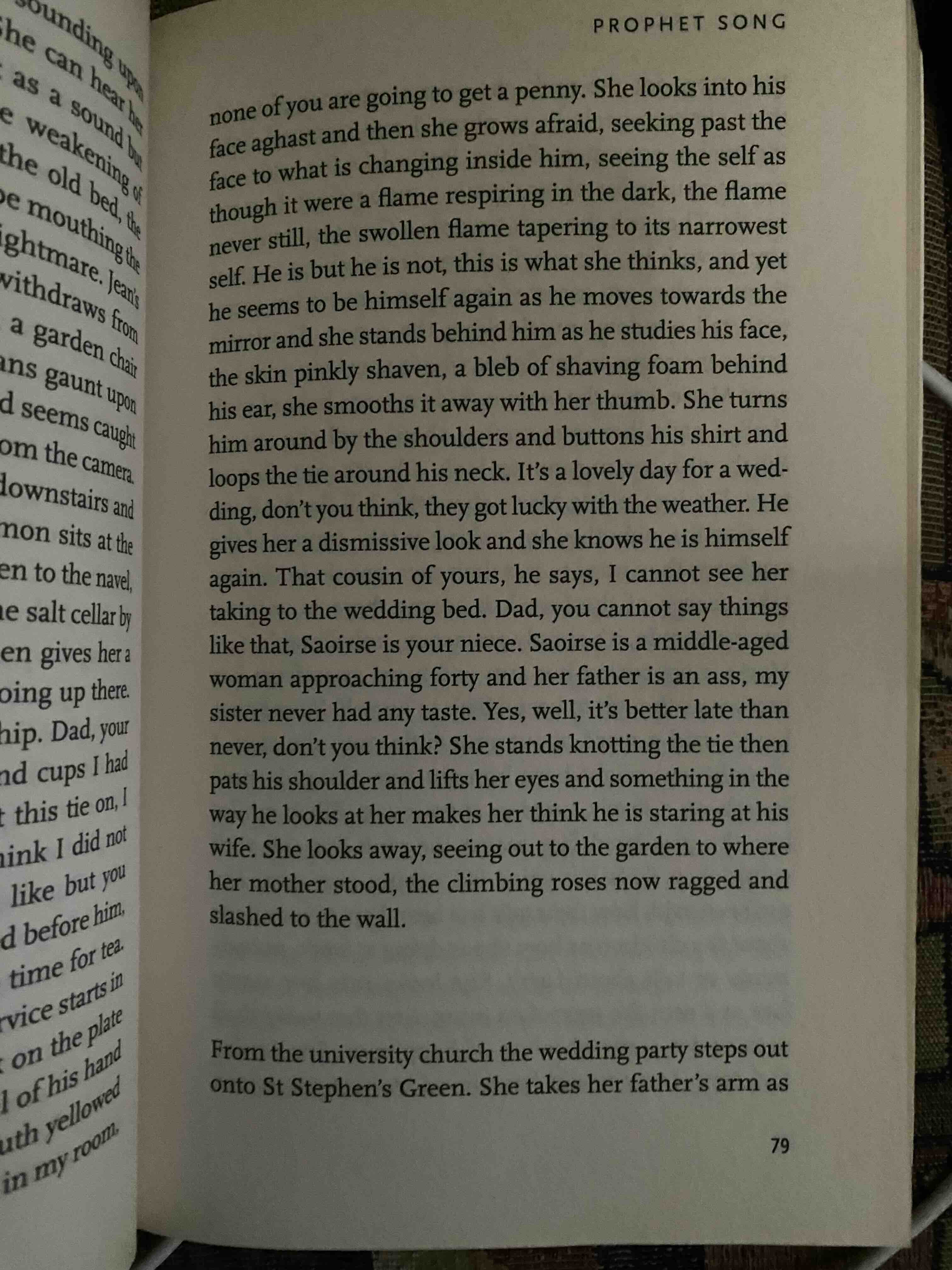
Typically, most of the page is one long paragraph:
She looks into his face aghast and then she grows afraid, seeking past the face to what is changing inside him, seeing the self as though it were a flame respiring in the dark, the flame never still, the swollen flame tapering to its narrowest self. He is but he is not, this is what she thinks, and yet he seems to be himself again as he moves towards the mirror and she stands behind him as he studies his face, the skin pinkly shaven, a bleb of shaving foam behind his ear, she smooths it away with her thumb. She turns him around by the shoulders and buttons his shirt and loops the tie around his neck. It’s a lovely day for a wedding, don’t you think, they got lucky with the weather. He gives her a dismissive look and she knows he is himself again. That cousin of yours, he says, I cannot see her taking to the wedding bed. Dad, you cannot say things like that, Saoirse is your niece. Saoirse is a middle-aged woman approaching forty and her father is an ass, my sister never had any taste. Yes, well, it’s better late than never, don’t you think? She stands knotting the tie then pats his shoulder and lifts her eyes and something in the way he looks at her makes her think he is staring at his wife. She looks away, seeing out to the garden to where her mother stood, the climbing roses now ragged and slashed to the wall.
If this was punctuated conventionally, it would be broken up into at least four paragraphs. The dialogue would be in quote marks. Such breaks and marks would allow breathing space, but the overwhelming sense in this book is that there is no such thing: the forces of oppression and chaos are constantly closing in. Here, in their absence, the father’s dementia has a similar effect. Even the glimmer of relief, the thing signalling that he is his old self, is a bit of mean-spirited sexism. Unlike Father Ted he’s not funny, but this the nearest thing to comic relief the book offers. Then even that glimmer of relief is quelled by Eilish’s horror as she realises he is confused about her identity.
The final sentence, where Eilish looks out to the garden, is an example of a recurring motif. The book begins with Eilish looking out longingly to the dark of her garden. Her daughter Molly ties a white ribbon to one of their trees for every day Larry is missing. Here the climbing roses, ragged and slashed, are metaphors for Simon’s mental state – and the state of the land.
At the meeting: As usual we had a not-overthought and nonetheless excellent meal that included dolmades, pastizzi, some excellent salads, chicken wings and Aldi ice creams. Also as usual, we had a terrific conversation about the book. Everyone agreed that it’s excellent, beautifully written. Some couldn’t finish it because the way it chimed with what’s happening in the world made it unbearable. Some were alienated in some way by the focus on maternal issues. This is an all-male group: this alienation wasn’t about lack of empathy; in fact, as one man said, it was too much empathy that made it overwhelming.
We had an interesting discussion around the question, Why didn’t Eilish leave much earlier? There was an apparent disagreement about whether she was acting rationally or not, but my sense is that we were using the word rationally in different ways. Sure, it was 99 per cent sure that Larry has been killed and it makes sense for Eilish to save herself and her remaining children. But there is also the one per cent, and it makes sense to stay in the hope of reunion. Whether it was rational or not, we all agreed that it was profoundly human. One man’s Jewish grandparents had sent their son, his father, out of Nazi Germany but had stayed behind themselves, and been murdered. Like Eilish they knew the danger, but like her they couldn’t bear to leave their lives. (I should add that some people read Eilish as naively unaware of how bad things were getting.)
I floated my sense of Eilish’s father’s dementia as largely symbolic, less compellingly realistic than the rest of her family. That didn’t get much traction. In fact, someone pointed out that even though he was demented, he understood the dangers clearly enough and complied with his other daughter’s plans to extract him. Even with dementia, as a member of a generation that had lived when Nazism was taking over in Germany, he understood what was happening better than the younger ones.
Someone said he had enjoyed the book (if that’s the word), but wondered if its unremitting descent into chaos and misery really works. He likened it to Omar Musa’s Fierceland (which is on my To Be Read Very Soon list, and which he gave a general thumbs-down to), and compared them both unfavourably to Lloyd Jones’s Mister Pip. His argument was waylaid by a dispute about whether the Book Group had actually read Mister Pip at some time. (I’ve just checked, and if so it was before either he or I joined. But I did read it – and I’ve just retrieved my ancient blog post that indicates I didn’t much like it – so I probably would have disagreed with him.)
The discussion of the book morphed into conversation about guns, pig-shooting, school cadets, the challenges of AI, grandchildren, truffle hunting, and (can this be?) not Donald Trump at all.
All the members of the Book Group are men of settler heritage. We met and I wrote this blog post on the land of Gadigal and Wangal of the Darug Nation. I acknowledge their Elders past and present and welcome any First Nations readers.
* My blogging practice is to focus on the page that coincides with my age, currently 79.


I read (or rather, listened to) this a couple of years ago. Almost unbearable as you say, but so well sustained, and so believable given what we know of the world. I think it changed my view of what’s possible. And while I also wanted Eilish to leave I understood her reluctance. Last week I read my father’s cousin’s book about surviving WW2 as a Jewish man, including a series of camps, each one worse than the previous one. He talks about why they didn’t leave – including not having the means – but mainly not believing that what they were seeing would happen to them.
LikeLiked by 1 person
‘Changed my view of what’s possible’ – exactly! Was it read by Paul Lynch?
LikeLiked by 1 person
No, read by Gerry O’Brien. And very fine he was too.
LikeLiked by 2 people