
Moreno Giovannoni, The Immigrants: Fabula Mirabilis, or, A Wonderful Story (Black Inn 2025)
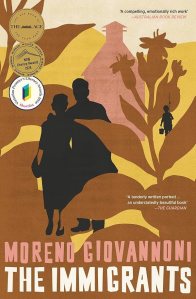
An author’s note describes this book beautifully:
While based on real events, this is a work of the imagination in which names have been changed, characters and scenes created and facts distorted for dramatic purposes in order to tell, in a fantasy kind of way, the story of the Italian community, and the story of my family, who lived in Mitrefò and district in the 196os. It is told as I remember it and it is therefore imperfect but nevertheless true.
(Page 1)
The note goes on to say that Bafaloriva, where much of the action happens, is a fictional place, not Buffalo River, and Mitrefò is not Myrtleford. Apart from amplifying the disclaimer about literal accuracy, this makes another point: naming a place in what has been called Australitalian signifies not just a mangling of the name, but a difference in the way the place is experienced.
Giovannoni’s first book, The Fireflies of Autumn, was framed as stories told by emigrant Ugo Giovannoni about his home town, San Ginese in northern Italy. The Immigrants tells the story of Ugo’s emigration to Australia, his life in Victoria, mainly farming tobacco, and his two failed attempts to return to Italy. And it tells the story of his young wife Morena and their two sons, especially Moreno (known as Morè – ‘only an Italian can say that properly’). And the story of the community of people who travelled from all over Italy to the area around Mitrefò in the years after World War Two, looking for a better life. ‘For a better life’ is a phrase that recurs, gathering heavy irony as it goes.
The book’s subtitle, ‘Fabula Mirabilis, or, A Wonderful Story’ led me to expect something almost cosy, tales of immigrant life bathed in a nostalgic glow. There is some of that in the vitality of the community, the young boy’s pleasure in the natural environment, even the details of the work of tobacco farming as it then was, backbreaking but somehow noble. But there is much more. What emerges is a picture of immigrant experience that is truly revelatory: food, language, yearning for home, religion, the attitudes of most ‘Australians’, marital strife – all these elements and more combine to powerful effect. It’s not a continuous narrative. Stories repeat and overlap in a mixture of memories of childhood, remembered conversations with Ugo and Morena when they confided in their son, court documents, and passages of pure invention.
There are seven sections called ‘grotesques’, case histories of murder, violence, madness, despair, mostly drawing on official court or hospital documents, Some of these are stomach-churningly hard to read, and they serve as reminders that the stakes were high. My blogging practice is to focus on the page that coincides with my age, currently 79. Page 79 of The Immigrants is a version of the coroner’s report into the death of a child from a tiger snake’s bite in 1973. It’s a powerful conclusion to the third ‘grotesque’, but not what I would pick as a representative page.
When ‘the immigrant son’ is a young adult, he finds a book on the history of the district, written by ‘an amateur historian, an English settler’. He expects to learn the history of the Italians in the area, but finds instead much information about the Indigenous population and stories of the town council etc:
Of the Italian tobacco growers, there is barely a mention.
That night he discovers that of 280 pages in the book, thirty contain, here and there, a passing reference to the cultivation of tobacco. The word Italian appears twice in the whole book. The index does not contain the word Italian.
Over time he has learnt that whenever the stories of the immigrants are told, they are told by the Australians or those whom the Australians have captured. Immigrant stories are never told with love and clarity. Always with humour and ridicule.
(page 215)
This book is a significant contribution to fixing that, with humour but absolutely no ridicule. So it’s part of the great reimagining of Australian history that has come in the last half century. It’s also something of an elegy for tobacco farming. And an elegy in a deeper sense as well:
Two weeks before [Ugo] dies, he tells his son he has seen la Bettina, the old woman who is Death. His son has never heard that rare Tuscan term before and is unable to trace the usage of the word or its origins. By the time Ugo dies, there is nobody left in San Ginese who knows about la Bettina.
Moreno realises that with Ugo’s death, other things will also disappear, from Tuscany and from the English colony.
As my regular readers know, I come from Innisfail in North Queensland, whose story it would be impossible to tell without including Italians. My classmates at school had names like Brunello, Quagliata and Gugliotto. When I saw my first professional theatre, the travelling production of Ray Lawler’s Summer of the Seventeenth Doll, I was thrilled to have the existence of north Queensland acknowledged, but as a 12 year old I felt that the play got it wrong by making its two canecutters Anglo, when according to my experience they should have been Italian, Maltese, or Yugoslavian.
It’s been a matter of quiet pride for me that my mother’s father, a magistrate, learned Italian and would intervene from the bench in the 1940s when Italian defendants were represented by lawyers who didn’t understand what their clients were saying.
So the book spoke to me personally. It pulled me up and asked me to look at my life from a different perspective. As a child, I had no idea that when I was eating ‘the brown lump of meat and the mush of potato, carrot and peas the Australians eat’ (page 136), the Pasinetti family down the road were probably eating what we these days would recognise as decent food. I had no idea of the drama and sometimes tragedy of migration that was playing out around me.
This is a book that has expanded my world.
I am an Australian man of settler heritage. I wrote this blog post on Gadigal and Wangal country, where it is my good fortune to live as the days are growing longer and warmer. I acknowledge Elders past and present of those Nations, and I welcome any First Nations readers and commenters.
.


