
Ender Başkan, Two Hundred Million Musketeers (Giramondo 2025)
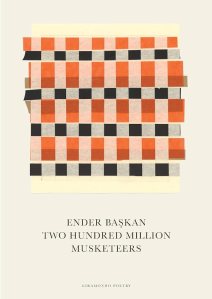
This book won the 2026 Prime Minister’s Literary Award for Poetry. I imagine the judging panel having a great time sitting around the table reading aloud to each other.
The book’s nineteen poems flow like a river in spate, swerving from subject to subject, but keeping control. Most of them are in short lines with no punctuation apart from an occasional question mark, slash or exclamation mark, as if the poet is too busy to pay attention to such fiddly stuff, but lets the line breaks and rhythm do the punctuation work. I found myself reading fast, as if riding a wave.
The first poem comes with ungainly title, ‘Here Is The Shirt, (Get) Off My Back / Swimming In The Afternoon’. Possibly because I currently spend a fair amount of time with young grandchildren, I was in thrall from its opening lines:
if you want an alarm clock to work
make sure you
place it out of reach
but never mind
our mutual friends are awake and so are we
549am
i am dad
im on demand
raaah-biiiish truuuuuuck!
i run out to see the bin flung up and over
with you
Life is rich and full, and who needs alarm clocks?
In this poem and the rest of the book the poet’s two young daughters emerge as fully loveable characters. I wonder how they’d get on with the two young girls who are similarly alive and interesting in Toby Fitch’s ‘Morning Walks in a Time of Plague’ (blogged about by me at this link).
As well as the arduous joys of parenthood, poems deal with work in a bookshop – ‘Erotics of Bookselling’ puts that work front and centre, but it’s often there incidentally. The poet travels with his family to his native Türkiye, celebrates his Melbourne neighbours, makes his political affiliations clear, grapples with the migrant experience, all with tremendous vitality and wit. A couple of lines in ‘Hot Water’ (on page 48) might stand in as a general description:
and the poem is a psychic luna park of associations
that just come when the soil is ready
Page 79* is the fourth of seven pages of the poem ‘Monolingualism Swamp’. That title may sound ominous, but there’s nothing ponderous or strident about the poem itself. The poet and his family are in Türkiye, he enjoys the way languages flow in Istanbul’s spice market (‘turkish arabic english russian’), and wonders:
i was gifted two languages
whattabout me kids?
they say growing up bilingual is good for your brain
When one of his daughters asks if he reads Turkish books, he feels ‘her monolingual pain’. Later in the poem he buys seven books to take home. The poem ends:
ill read these books in turkish
my daughters will see me
___thumbing the dictionary
That’s the skeleton of the narrative, but it leaves out the ‘psychic luna park of associations’. Page 79 is almost entirely taken up with a digression. A story from possibly ten years earlier, before the children were born, it pretty much stands by itself as a narrative poem:
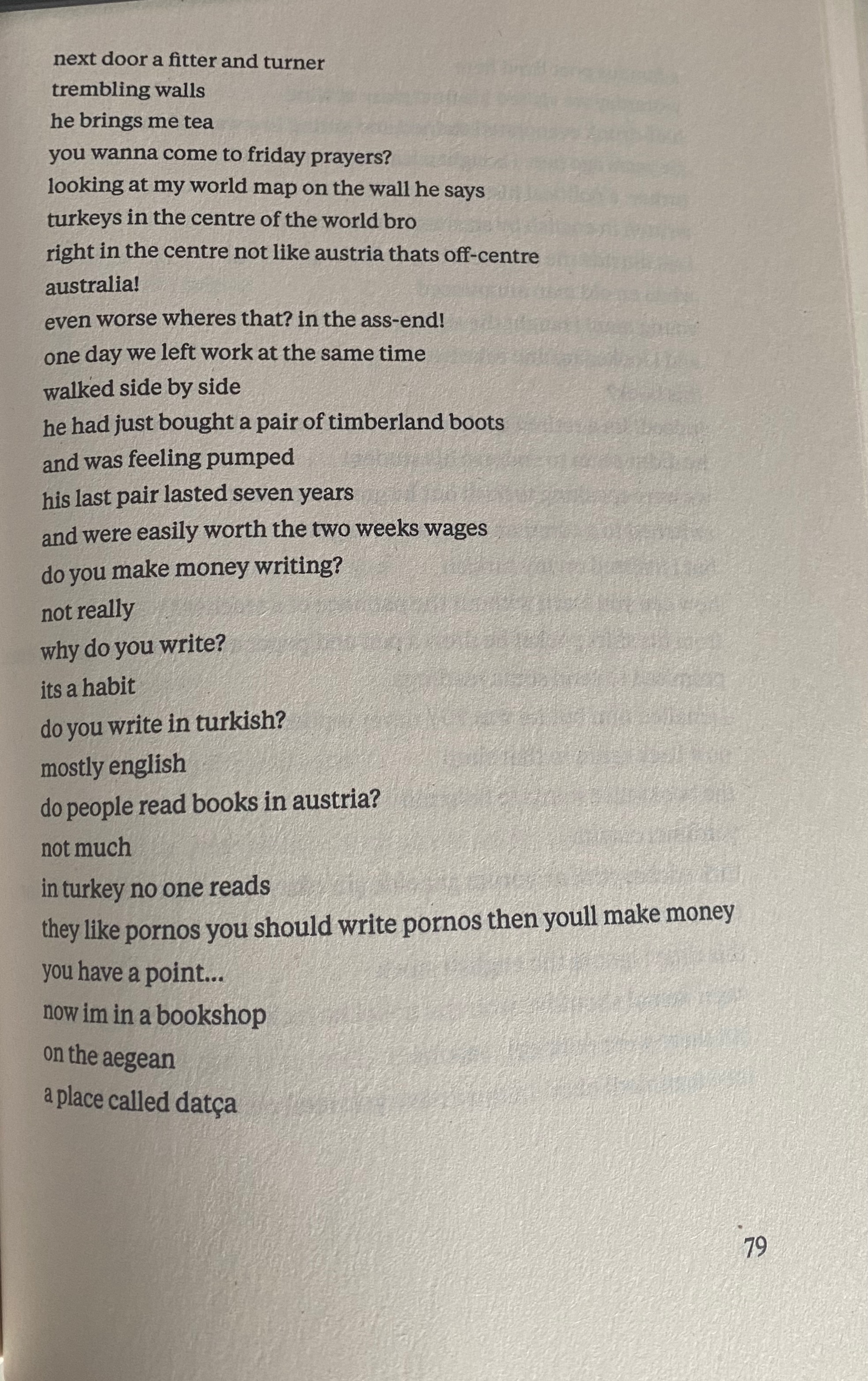
Here’s the text, including a couple of scene-setting lines from the previous page, and omitting the last three line of the page, which move back into the poem’s present:
in 2016 I had a little desk here
in an artisans building on the third floor
next door a fitter and turner
trembling walls
he brings me tea
you wanna come to friday prayers?
looking at my world map on the wall he says
turkeys in the centre of the world bro
right in the centre not like austria thats off-centre
australia!
even worse wheres that? in the ass-end!
one day we left work at the same time
walked side by side
he had just bought a pair of timberland boots
and was feeling pumped
his last pair lasted seven years
and were easily worth the two weeks wages
do you make money writing?
not really
why do you write?
its a habit
do you write in turkish?
mostly english
do people read books in austria?
not much
in turkey no one reads
they like pornos you should write pornos then youll make money
you have a point...
Every time I read it I smile.
I love this cameo appearance of an actual Turkish man in the middle of the poem’s ruminations about language. It’s a portrait created almost entirely out of speech, either direct or reported. For him, being bilingual isn’t a big deal – he speaks English with a North American accent (‘bro’, ‘wanna’), and his world view is cheerfully and unapologetically Turkey-centric. Islamic observance is integrated into daily life, and is a way of checking out a foreigner.
It’s a good example of the way Başkan’s lines flow. You may have to think for a brief moment at the tenth line – ‘australia’ – to check who’s speaking. But that pause for thought creates a natural break in the rhythm before the fitter and turner’s response, and you can feel the poet’s pleasure in recording that response.
I am grateful to the Giramondo Publishing Company for my copy of Two Hundred Million Musketeers. The publicity material accompanying it included an author’s note, in which Başkan says he returned to writing when his first child was learning to talk: ‘Mumbo jumbo and jibber jabber filled out home.’ The poetry in this book brings the exuberance of jibber jabber to the preoccupations of an adult life, from the difficulty of ordering takeaway coffee from people who can’t pronounce your name to the many crises of late capitalism. I’m so glad the judges of the Prime Minister’s Literary Awards prompted me to take it from the shelf.
I am a man of settler heritage living on Gadigal Wangal country, where the days are suddenly warmer and magpies seem to be everywhere. I acknowledge Elders past, present and emerging for their continuing custodianship of this land, and welcome any First Nations readers.
* My blogging practice is to focus on the page that coincides with my age, currently 79.


