
Helen Garner, How to End a Story: Collected Diaries 1978–1998 (Text Publishing 2025)
– pages 354, mid 1988 to page 458, six pages into 1991.
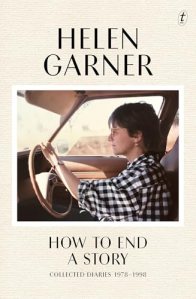
Since my last nominally monthly report on my progress with Helen Garner’s diaries I’ve spent a couple of weeks away. The Garner book is completely unsuitable for aeroplane travel, so this report is running late and I have fewer pages to report on.
One of the joys of the diaries is the elliptical narrative that emerges. At this stage of my reading, it seems that the whole 770 pages tells the story of Garner’s relationship with her third husband, the novelist known in these pages as V. In the first entries she is still married to F, a marriage which ends acrimoniously, though by now she and F are friendly again, as he helps clean up a translation of Monkey Grip and attends performances by Helen’s daughter. Then V appears and is one of two men she is having a fling with. She chooses between them, realises she is in love with V and embarks on a serious relationship with him, guiltily because he is married. He leaves his wife and for a time they live together secretly in Sydney, where Helen pines for her Melbourne home and community. Now they have moved together to Melbourne, where she is much happier and he is feeling uprooted. In the last couple of days of my reading the possibility of marriage has been mentioned, not by Helen or V but by a friend – recorded without comment in the diary.
This compelling story is embedded in a host of sharp observations of the world, notes on the progress of her writing, the twists and turns of other relationships, world events, the writerly life.
In today’s reading the main narrative advance comes in an entry where V says he finds it very hard to work in Melbourne. An otherwise unidentified ‘novelist from New York’ comments that whereas ‘traditionally’ in marriage the woman goes to live on the man’s turf, V has left his own territory and come entirely on to Helen’s:
He has no family and no kids, he’s estranged from his wife of twenty-four years, he has sold his piece of property, and he’s here.
This is a sweet note that makes one realise that the many diary entries about quarrels in which V comes off as arrogant, patriarchal, dismissive of the woman’s point of view are far from being the whole picture. The move to Melbourne was his suggestion, in response to Helen’s discontent in Sydney.
And there’s so much else in today’s five pages:
Helen submits Cosmo Cosmolino to Y (probably Diana Gribble), her publisher, they have a laughter-filled editing session, then she labours at some painful rewriting, and is scared that with this book she ‘will come a cropper’. She sees a fine cut of The Last Days of Chez Nous, and enjoys it, then is cranky when she receives faxes (faxes!) ‘demanding further dialogue for post-synching’. She mentions writing a review of David Marr’s biography of Patrick White, and delights in her father’s comment, ‘I think the writer of that book will be … enchanted by what you said about it.’
There are events from the wide world: Rajiv Gandhi is assassinated. There are notes on her reading (The Diary of the Rev Francis Kilvert) and music listened to, reports on conversations (notably one about sex on international flights – ‘For once I was entirely innocent’), a death, a divorce, a bust-up with an important woman friend. A friend becomes a grandmother. Her friend J (evidently Tim Winton) is interviewed on TV.
I like to end these reports with one entry. Here’s my favourite from today (page 458):
Out walking as it was getting light, V and I passed a blackbird singing on a wire. A very beautiful song, melodic, generously paced, sweet. V laughed: ‘I build good nests. I find many worms.’
I am a man of settler heritage. I wrote this blog post on the land of Gadigal and Wangal of the Darug Nation. I acknowledge their Elders past and present and welcome any First Nations readers.


