
[This post was originally published on 19 July 2008 on my earlier blog. I’m retrieving it here as Lloyd Jones’s Mister Pip got a mention in the Book Group’s discussion of Paul Lynch’s Prophet Song]
As I may have mentioned previously, our six-member Book Club has a general ban on talking about books at any length. The routine business of the evening is to swap books, eat and play cards, in that order. The swapping is highly ritualised: each of us offers three books, and each – in an order determined by drawing cards from the pack – borrows three books from the pool of offerings; before that happens we do ‘returns’ and ‘retentions’ from the previous meeting. Each book is given a score out of 5 by the offerer and the returner, and up to 30 seconds of discussion is permitted.
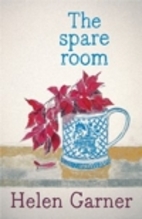
At our most recent meeting, by tacit agreement, we didn’t play cards, and lingered over dinner instead. In a striking departure from SOP, someone asked, ‘What did everyone think of The Spare Room then?’ It had transpired during the swapping that everyone had read that book, and now it turned out that everyone had an opinion about it.
One person, who has made a film about death and bereavement, was intensely critical of the way Character Helen avoids facing up to death and her avoidance is not challenged by the book. (I actually think this is wrong – I read the last pages of the book as undermining and even invalidating much of Character Helen’s version of events.) Another, who had serious cancer some time ago, was gobsmacked by Character Helen’s lack of compassion – she couldn’t see how anyone could write such a character and expect readers to be sympathetic to her. Yet another saw the whole issue of death as the occasion rather than the subject of the book, whose actual focus is on the way in relationships between women expectations and commitments have to be constantly adjusted and renegotiated.
I don’t know what I think, except that I loved the way the book took a narrative about emotional subtleties and made something like an action tale out of it, and (I didn’t say this) I regard the scene where Character Helen sets out to reassure her guest that she hasn’t been a complete failure as unintentionally ironic – I mean, reading other people’s novels in manuscript makes a life meaningful? Ice-cold comfort, I would have thought. So there you go, Helen Garner got us talking.
I came away from the meeting with four books, the first of which was a retention from the previous meeting (I’d only managed 10 pages or so in the six weeks between meetings, not an uncommon occurrence):
Pat Barker, Life Class (Hamish Hamilton 2007)
Jeanette Winterson, Art Objects: Essays on Ecstasy and Effrontery (Vintage 1996)
Lloyd Jones, Mister Pip (Text Publishing, 2006)
Michelle De Kretser, The Lost Dog (Allen & Unwin 2008)
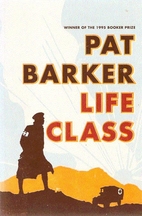
At the meeting, someone mentioned World War One Chick Lit, a genre I hadn’t heard named before. I don’t think Pat Barker’s Regeneration trilogy would fit that description, since quite a lot of its action takes place in the trenches. Life Class, on the other hand, probably does. The War doesn’t start until after more than a hundred pages of unrequited love among London art students. It does include graphically described mutilation and suffering in a hospital and nearby village close to the front in Ypres. There’s an ongoing discussion of how an artist should respond to the war, the main options being to ignore it because it’s just something that happens to people rather than being chosen by them, to glorify it (there’s a spectacularly noxious quote from the Futurist manifesto), or to do one’s best to tell the truth about it even though one’s work might be unshowable.
Even though Pat Barker includes an end note listing a number of biographies of artists who lived through those times, the debate pretty much sticks with the headlines, and the book amounts ends up being a footnote to the trilogy, a tale of young love thwarted by the War, not through the death of one lover, but by the creation of an uncrossable gulf between the two of them. Perhaps I’m missing something, but at times it felt as if there were two or even three different affairs being described: was her love unrequited as she felt, or his as he felt, or was she playing a manipulative, bisexual game as a third character claimed and was never contradicted. I didn’t know, and I’m sorry to say I didn’t really care.
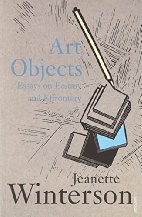
I loved Jeanette Winterson’s opening address for the Sydney Writers’ Festival this year, and perhaps even more her chat with Romana Koval on the Book Show, which covered some of the same ground. So even though I’d been largely bored by The Stone Gods, which I’d scored at the previous Book Club meeting, I picked up Art Objects with hope in my heart. The book and I got off to a bad start with the epigraph, ‘If truth is that which lasts, then …’: I muttered under my breath, ‘If truth has nothing to do with lasting or otherwise, then there’s no point reading the rest of that sentence.’ But after that initial skirmish I was, alternately, putty in Jeanette’s hands and driven nuts by her indulgences.
The thread that runs through these essays is an argument for taking art seriously, for the need for the reader or viewer of art to work. This is wonderful, and there are bright flashes of insight on every page. She’s a brilliant and passionate advocate for things that are very dear to my heart, and yet … somehow her pentecostal rhapsodies leave me cold, and on occasion her self-proclaimed love for words can be hard to distinguish from love of the sound of her own voice. It’s probably telling that having read her lively, intelligent, lyrical essays on Gertrude Stein and Virginia Woolf, I felt not the slightest stirrings of desire to read any of their works. Here’s a fine passage from the essay ‘The Semiotics of Sex’, that touches on the literature vs literacy debate (I still have my calico bag from the 2004 literacy convention, which sports the wistful slogan, real texts • real lives • real learning • real pleasure):
Learning to read is more than learning to group the letters on a page. Learning to read is a skill that marshals the entire resources of body and mind. I do not mean the endless dross-skimming that passes for literacy, I mean the ability to engage with a text as you would another human being. To recognise it in its own right, separate, particular, to let it speak in its own voice, not in a ventriloquism of yours. To find its relationship to you that is not its relationship to anyone else. To recognise, at the same time, that you are neither the means nor the method of its existence and that the love between you is not mutual suicide. The love between you offers an alternative paradigm; a complete and fully realised vision in a chaotic unrealised world. Art is not amnesia, and the popular idea of books as escapism or diversion misses altogether what art is. There is plenty of escapism and diversion to be had, but it cannot be had from real books, real music, real theatre.
See what I mean? These are things that cry out to be said, but it’s preaching to the choir – and I do mean preaching.
On the other hand, how about this evocation of the context of her advocacy of the imagination, from ‘Imagination and Reality’:
Children who are born into a tired world as batteries of new energy are plugged into the system as soon as possible and gradually drained away. At the time when they become adult and conscious they are already depleted and prepared to accept the world of shadows. Those who have kept their spirit find it hard to nourish it and between the ages of twenty and thirty, many are successfully emptied of all resistance. I do not think it is an exaggeration to say that most of the energy of most of the people is being diverted into a system which destroys them. Money is no antidote. If the imaginative life is to be renewed it needs its own coin.
She’s still preaching, but here I feel the urge to bang a tambourine accompaniment. Teresa Nielsen Hayden memorably said in her classic blog post, Things I Believe: ‘I believe we’re bound to occasionally confuse God with His creation. The part of creation I most frequently confuse with God is the English language.’ Jeanette Winterson should be forgiven if she occasionally makes the same mistake, and preaches accordingly.
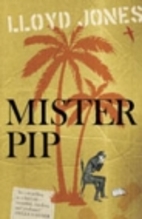
‘Why is Dickens a great writer and Trollope hardly a writer at all?’ was one of the stand-out aggravating lines in Jeanette Winterson’s book. It provides a nice segue, though, to Mister Pip, in which Dickens is introduced as ‘the greatest English writer of the nineteenth century’, and whose plot revolves around Bougainvillean village schoolchildren being transported into another world through having Great Expectations read to them – so that they become in some measure Jeanette’s ideal readers.
Consensus at the Book Club was that Mister Pip was superb. I struggled, and failed, to like it. I was uneasy from the start about the first person narration by Matilda, a black village child during the Bougainvillean civil war and blockade of the early 90s who falls in love with Dickens’s Pip and witnesses terrible brutality. The voice never rang true for me – and though some of what I took to be false notes (there’s a Somerset-Maugham-ish explanation of the suddenness of nightfall in the tropics, for example, as if Matilda somehow thinks of non-tropical experience as the norm) are accounted for by Matilda’s later life as told in the final chapters, I never came to trust the voice, and the book never made sense: the last remaining white man on the island reads Great Expectations to the schoolchildren, and when the book is destroyed by soldiers, along with all the houses and possessions of the villagers, he and the children have a project of retrieving the whole narrative; then there are some scenes of hideous brutality; Matilda and a handful of other villagers escape to live in Australia; she becomes a Dickens scholar, and at the end of her narrative decides to go back to her village.
Maybe my problem with the book boils down to its being set in a real time and place, but presenting a kind of allegory about colonialism. Monstrous things did happen in Bougainville in the early 90s while the White world largely turned our collective back, and Lloyd Jones manifestly – and laudably – wants us to acknowledge that. But, almost certainly in spite of its author’s intentions, this book (in my reading) ends up exploiting the horror for literary and, as it turned out, prize-winning effect.
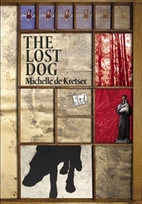
The Lost Dog, on the other hand, has a voice to die for. The phrase ‘jewelled prose’ came to mind: there’s hardly a sentence, and probably not a paragraph without a glowing adjective, a finely cut phrase, a many-faceted image or a sharply glittering epigram, though I don’t think you’d find any extended metaphors as laboured as that one. I was so captivated by the prose that I’d reached about the halfway point before I started to wonder if there was a plot; fortunately, just about then Michelle De Kretser started to give clues about where the book was heading. I remember someone saying of the movie Stand By Me that almost everything in it was there to allow the movie to get away with the one moment of tenderness between two boys. It’s not quite that simple with The Lost Dog – in fact, there’s nothing simple about this book – but after all its playing with time, its ruminations about modernism and post-colonialism, its playing around with references to Henry James (the point-of-view character, Tom, has just finished writing a book on James when this book opens and he loses his dog), it gives us climactic moments affirming simple human/animal realities. (The beautiful cover was designed by excellent blogger Ampersand Duck, who had clearly read the book. The book I borrowed is hardcover and a pleasure to hold in the hand.)
A general footnote: one of Jeanette Winterson’s tendentious remarks was ‘”Write from your own experience” is fine for the writing class, useless for the writer.’ Well, not entirely useless I think. Part of my difficulty with the Lloyd Jones book was that I believed the book when it was talking about Dickens, but not about Bougainvillean culture: I’m sure he did a lot of research, but it doesn’t feel experienced in the book. On the other hand, the only moments that rang false for me in The Lost Dog were those when Tom does something sexual when alone: as if that had to be included to make him a proper man. I’d bet good money, on the other hand, that Tom’s bi-cultural experience has a lot in common with Michelle’s, and that Matilda’s is a long way from Lloyd’s.
Addition: Tipped off by a review of the latest Meanjin in today’s Spectrum (supplement of Sydney Morning Herald), I found Ampersand Duck’s post about designing The Lost Dog‘s cover. It’s a terrific post, but I just want to quote this, in a self-congratulatory way: ‘For me, the most alluring part of the job was that part of my brief was to read the book properly. Hooray!’ I thought as much!


