
Alison Bechdel, Are You My Mother?: A Comic Drama (Mariner Books 2013)
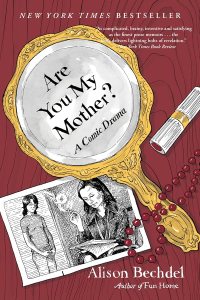
Before the meeting: When I was unexpectedly designated to be Chooser this month. I turned to my to-be-read shelf for a relatively quick read, and found Are You My Mother? It’s a comic, so can be read fairly quickly. I’d loved the two Alison Bechdel books I’d read previously. What could go wrong? I recommended it, and only then started reading it. Almost immediately I regretted my decision, but it was pointed out to me on WhatsApp that the rules of the Book Group make no provision for regrets or withdrawals. I did suggest, meekly, that people might like look at either Fun Home or Spent (links are to my blogposts) as supplementary readings.
So why did I get cold feet?
We-e-e-ll. One of the things I loved about the other two books was their complexity. They are both hugely intertextual: their largely autobiographical narratives are interwoven with motifs from classical myth, modern literature and social theory; many frames include drawings of piles of books with titles visible; some frames include painstakingly drawn text – from people’s letters or from books. Both books treat gender and sexuality with great nuance, as well as humour. The narrative style switches back and forth in time, and there are often moments when the captions tell one story while the images tell another, and the relationship between the two is not glaringly obvious. In both, the process of writing the book is part of the narrative.
Beginning with a title taken from a famous children’s picture book, Are You My Mother? has all those virtues, but it takes them to a whole other level. The epigraph from Virginia Woolf is fair warning: ‘For nothing was simply one thing.’
The book’s subject is Alison’s relationship to her mother. (In this blog post I refer to Alison as the main character and Bechdel as the creator. It’s only fair to assume that they are not absolutely the same person!) Alison goes to a string of therapists and reads a lot of psychoanalytic theory. She gets interested in Donald Winnicott and the book interweaves the story of his life and some of his theory with Alison’s story. All of that is interesting, but when Alison’s introspection gets caught up in the weeds of psychoanalytic jargon, not just Winnicott’s but also Freud’s, Lacan’s and Alice Miller’s, it becomes overwhelming. I got fixated on the word cathexis and the related verb to cathect. I still don’t know what they mean and I’m past caring. Where the dream that kicks off Spent is brilliantly comic (a woman leaps naked from her bed and shoots out the window at an attacking tiger), the dreams that start each section of this book just reinforce the truism about about other people’s dreams being boring (see discussion of page 79 below). And the recursive stuff about writing the book we are now reading gets way beyond a joke.
It’s not terrible, far from it. Winnicott is the creator of one of my favourite sentences about human beings: ‘There’s no such thing as a baby, there’s always a baby and someone,’ so I was interested to learn more about his theories and his life (his life was, um, weird, but he was great with young children). I was interested to learn more about Alice Miller’s thinking. I’ve heard people talk about the mirror phase of child development: now I think I know what it is. And – most importantly – the actual narrative about Alison’s childhood is engaging.
Alison’s mother emerges as an interesting character – because she’s an amateur actor, there are lots of enjoyable theatre scenes. And there are wonderful bits of straightforward family life, which I am happy to read as ‘simply one thing’, whatever Virginia Woolf might say. Here’s a more or less random page, page 169:
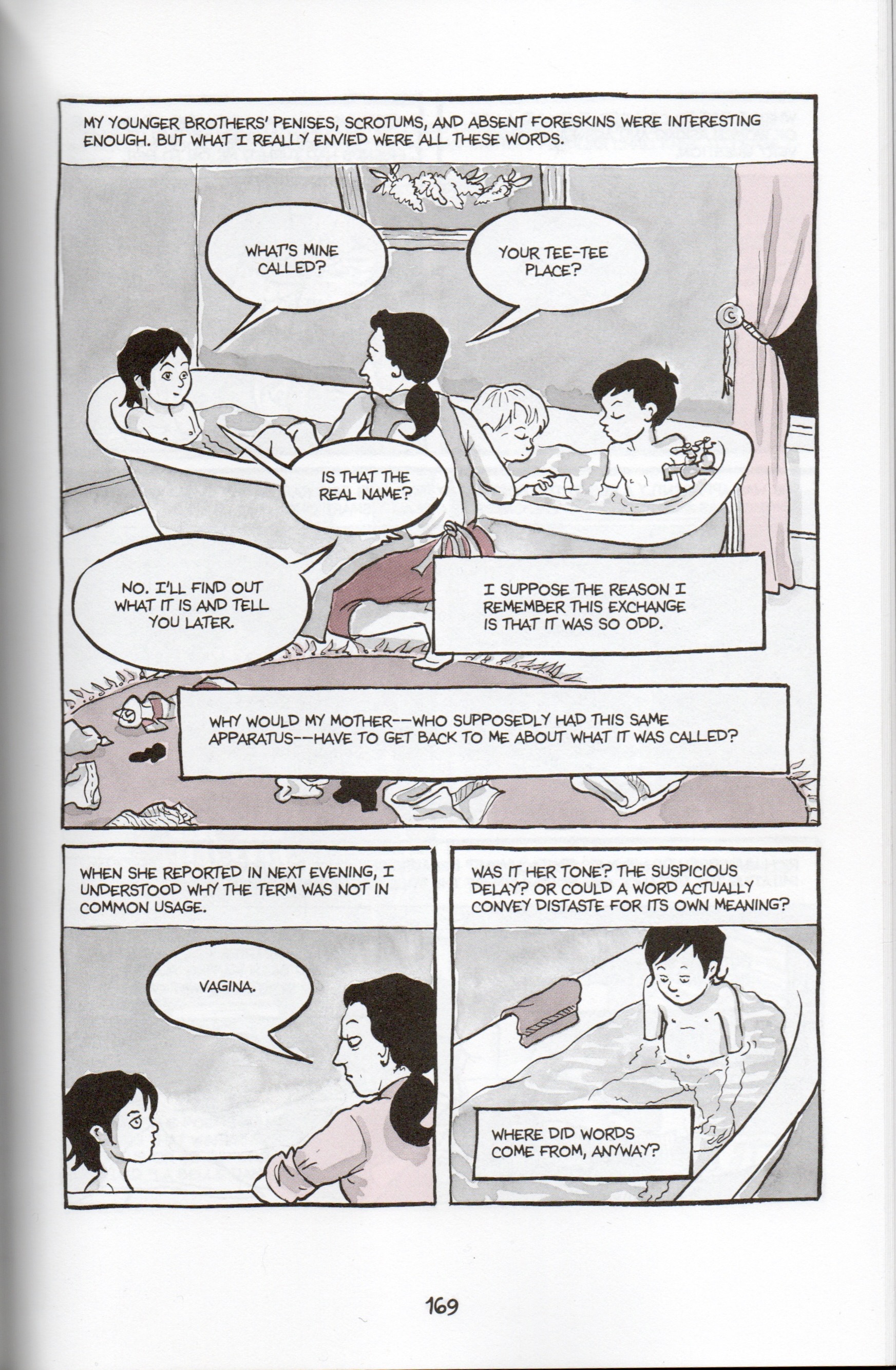
OK, so it’s not one thing. It’s about language, gender, sexuality, the mother-daughter relationship. And if you look at what the images are doing, you also see that young Alison is alone at one end of the tub while her brothers play together at the other end, and Alison’s facial expression in the final frame is eloquent. Also notice Bechdel’s characteristic use of non-male-gazey nudity (there’s quite a lot of adult female nudity in the book). This page is rich, emotionally engaging story-telling, and that’s true of much of the book. The subtle use of colour is also characteristic.
I was going to leave it there, but I feel bound to my practice of looking at page 79*. In this book, page 79 is part of the dream that starts Chapter Three, which has the Winnicott-derived title ‘True and False Self’.
The current therapist comes to Alison’s office, where, dreamlike, it’s no big deal that Alison is not wearing pants. The therapist massages her neck and shoulders, finishes briskly, and, on this page, takes her trousers away to mend them.
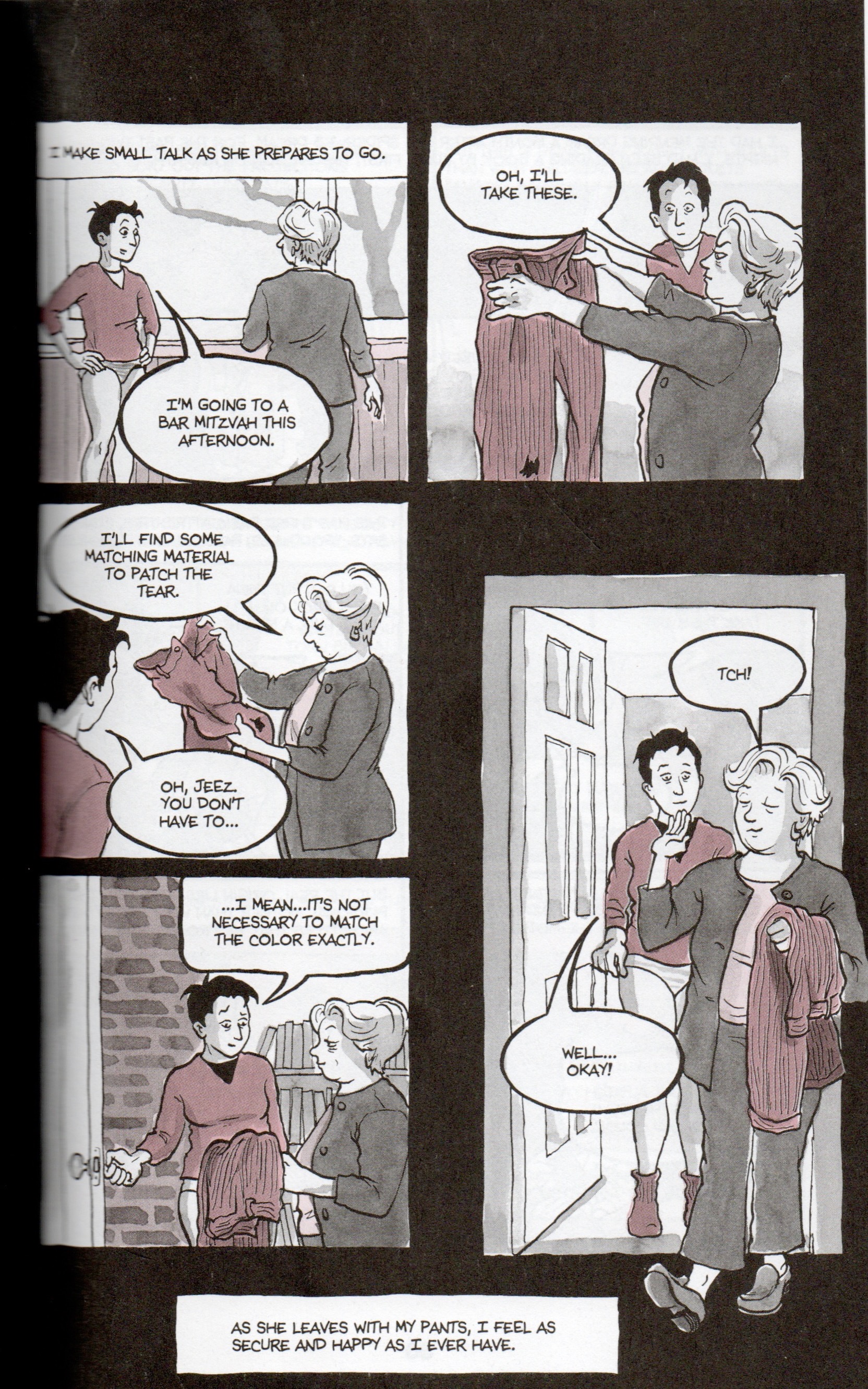
It turns out on the following pages that Alison has been reading Jung, and at her next therapy session expounds on her own interpretation of the dream. The therapist gives her interpretation. Transference is mentioned, and there’s a dubiously relevant quote from Winnicott’s paper, ‘Ego Distortions in Terms of True and False Self’. A number of frames tell a story, presumably a memory, of Alison’s mother patching her jeans, but without matching the colour. Which somehow leads to a scene where her mother asks young Alison if she loves her, and Alison feels put on the spot as no one in their family ever talks like that. And so it goes.
Maybe it’s a book that would reward rereading, even study. On first reading, it’s far too convoluted and recursive for my ageing brain.
Just before the meeting: I chatted about the book with a therapist friend, who said that most of the bits of the book I quoted to her were standard psychological theory. In the course of the conversation, I opened to a number of pages at random and found, to my mild surprise, that every page had something interesting going on. Evidently it’s a good book to dip back into.
The meeting: Sadly, the only member of the Group who couldn’t come is the only one who is well versed in psych theory. Nevertheless, we had an excellent eclectic meal and a rich conversation, much of which was about Alison Bechdel’s books. Among us we had read Fun Home, Are You My Mother?, The Secret to Superhuman Strength, and Spent, though no one had read all four. No one had read Dykes to Watch Out For, though someone had sighted it in a bookshop.
Impossible to summarise the conversation! A couple of chaps had an almost visceral reaction against psychobabble (my word), which made Are You My Mother? pretty much unreadable. One man spoke eloquently about Fun Home, in particular how moving he found its final movement. Spent, on the other hand, he found diverting but lacking depth. We spent some time admiring the artwork, and the sometimes complex relationship between image and text. One man felt he was seeing things he had no business seeing – he was partly talking about the sex scenes (especially, someone said, the toe-sucking) but also the intensely private introspection.
When someone said they were irritated by Alison’s self-absorption, someone else floated the idea that she (the character) was being sent up, seen as slightly ridiculous. If you look at the expressions on the faces of her succession of therapists, it was suggested, you see that they are pretty irritated by her as well. The question of how funny the book is was left open. (I think those who had read Spent agreed that it’s unambiguously funny.
Someone named a phenomenon that I have experienced, though not with this book. He said he just read it. That is, he was never engaged, but had it all pass before him like an interesting object that made no personal meaning. My guess is that this was about the medium – maybe comics ask to be read using different faculties from the ones used to read straightforward text. As a counter example, someone held up a spread in Fun Home that consisted of maybe 20 almost identical images of two characters in the front seat of a car and spoke of how well that scene caught the awkward conversation between the father and his adult daughter.
I don’t imagine that Alison Bechdel created this book with the explicit intention of having it discussed by a rowdy group of old, white, mainly straight men. But I don’t think she would have minded our conversation.
All the members of the Book Group are men of settler heritage. We met and I wrote this blog post on the land of Gadigal and Wangal of the Darug Nation. I acknowledge their Elders past and present and welcome any First Nations readers.
* My blogging practice is to focus on the page that coincides with my age, currently 79.


