
Pam Brown, Click Here for What We Do (Vagabond Press 2018)
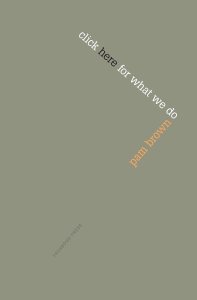
This book was shortlisted for the Prime Minister’s Literary Award for Poetry in 2019. I must have bought my copy around then. I put it on top of the high bookcase in my room, where it joined the hundred or so books waiting to be read, but unlike some of them (like Blood and Soil: A World History of Genocide and Extermination from Sparta to Darfur by Ben Kiernan) it had a strong likelihood of being taken down again. Alas, a slim volume, it slid down behind the bookshelf, where it stayed completely inaccessible until …
… we recently replaced the carpet. We emptied the bookshelves, put their contents in boxes, and moved boxes and bookshelves to another room. The book and I were reunited.
Such an accidental journey into obscurity and back couldn’t have happened to a more appropriate book. Interruptions, distractions, accidents abound in Pam Brown’s poetry. As she says on page 47, in ‘Left wondering’, the second of the four long poems that make up the book:
my attention's
__creaky scatterings assemble

__ __like iron shards
__patterning around
a weak magnetic field
It would be hard to find a better way of describing these poems. To read them is to have the sense of being immersed in a consciousness whose attention is scattered – you can feel a pattern forming, being disrupted, re-forming. Each of the long poems is broken up into many short sections separated by an asterisk. It’s often not clear how a section relates to the one before it: it might pick on a word that appears there and criticise it; it might make an associative leap; it might not connect at all. The poems’ speaker goes on plane trips, re-organises furniture in her house, chats with someone over coffee, engages with artists, writers, essayists, and quotes other poets. She is irritated by the ‘nightmarish greensleeves’ of Mr Whippy. It all feels wonderfully familiar to me – not so much the content (I’d never heard of Agnes Martin or Luis Alberto Arellano), as the way one’s mind wanders, hovers. circles, and sometimes gets somewhere. And while it feels spontaneous and random, at the same time there’s discipline in the making of the poems: they are a long way from being formless effusions.
The four poems in the book are ‘Combination soup’, ‘Left wondering’, ‘Susceptibility song’ and ‘A mockery’.
Page 79* is the first page of ‘Susceptibility song’:

It’s a nice, cosy set-up. The poem’s speaker is sitting up late at night, multitasking.
past one a.m.
___ you will have gone to bed
The word you is always interesting in a poem. Maybe at some level it always means the reader. But it also usually conjures up a third person, real or imaginary. If you here signifies a particular person, the poem never identifies them. The effect is simply to place the poem’s speaker in a relationship. Francis Webb once wrote that a poem is a meeting place of silences: the first two lines of this one set it up to be exactly that.
The next section, the rest of the page, expands the scene-setting:
the night like a night
___________ some moonlight
___________ some indigo to black

sporadic traffic swoosh
__________ no slower than the day

television streaming
___________________ comfortably

an average drama
______ sound down low__________

not watching

reading bits of a book
_____ making notes
I like ‘the night like a night’. It’s as if the poem starts out intending to give us an evocative simile but then thinks better of it: ‘Nah, it was just a night like any other.’ And gives just a little splash of colour. The qualifiers on the rest of the page emphasise the ordinariness of the moment: sporadic, average, comfortably. She’s not reading a book but bits of one. The television is on, but she’s not watching. It’s a kind of limbo.
A perfect place for the mind to go wandering, and an opening that makes one want to read on.
There are ten more pages.
First, there’s the book the poem’s speaker is ‘reading bits of’, in effect some of the notes she is making. She quotes a line from the blurb,’the discarded ideograms of history’, wonders what it means, decides the word ‘ideogram’ has been used incorrectly, explaining why in a two-word parenthesis – ‘ezra’s dictum’. I’m usually a pretty lazy reader, but because I’m blogging about the poem I looked things up. There are enough details to enable the book to be identified as Avenue (2012) a collection of poems by Michael O’Brien which is online at this link, so that we can read the two poems referred to by this poem; the blurb is by Geoffrey O’Brien; Ezra, of course, is Ezra Pound, who contended that ideograms were valuable as ways to resist ‘the lure of abstraction’, not whatever the blurb says they are.
But it wasn’t necessary to find all that out to enjoy the poem: the speaker picks up on the phrase, ‘the discarded ideograms of history,’ and the rest of the poem takes off on a meandering rumination on memory, history, time, the anthropocene, Queer Theory. She notices (is distracted by?) a spider ‘coating an insect in spittle’. She dreams, and watches TV. She gives some markers of time and place – including that she is writing on the night daylight saving ends, but at 10.52, a different time and presumably date from the opening page. She quotes, with acknowledgement, Yothu Yindi, Ellen van Neerven, Luis Buñuel and Les Murray, among others. Bob Dylan needs no acknowledgement:
tonight
____as I stand
inside the rain

irresolute

susceptible to uncertainty
She lists a number of terrorist killings from the news and then, in a piece of self-questioning that is quintessential Pam Brown:
does
a list
like that
do any work?

____*

that's a question
__ you've been asking
____for half a century

(wondering
___who'll be swift
________-to chide)
(This you is probably Brown herself, not the person addressed in the poem’s first lines.)
The poem is a wonderful ride, not really an essay, but more than a collection of moments or string of associations. If I seem to be saying nothing particularly clear about it, maybe that’s appropriate. Here’s how it ends, with a reminder that the subject it has been circling is to do with history, memory, finding a way of speaking :
the factual archive
the fatuous archive
____________awaits
the enormous familiar

begin whispering –
I am a man of settler heritage who has been alive for almost a third of the time since Arthur Phillip raised his flag on the shores of Warrane. I wrote this blog post on the currently blue-skied land of Gadigal and Wangal of the Eora Nation. I acknowledge their Elders past and present and welcome any First Nations readers.


