
Lee Lai, Cannon (Giramondo 2025)
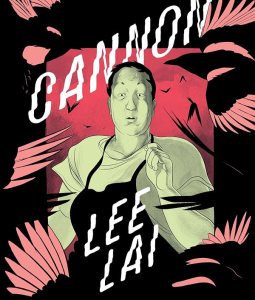
Cannon made history by being the first comic to win the prestigious Stella Prize. Unlike other prize winners it didn’t take long to become available at the library. This may be because the kind of people who borrow prize winners from libraries mostly aren’t persuaded that comics can be a good read. There’s a chance that the luridly unpleasant cover art is a further disincentive.
It’s their loss.
The story begins on the endpapers, which feature a scattered mess of kitchen items – a whisk, a spatula, a saucepan, glasses, straws, broken plates. The next pages, the equivalent of a pre-title sequence, begin with a full-page image of a restaurant with tables and chairs in a chaotic overturned state. Everything is dark grey, as if on an unlit night, except for a score of birds, pitch black but with white on their wings, perched on the furniture. On the next page a lumpish person sits on the floor, wearing white and black like the birds and breathing heavily (the lettering, ‘HUF’ and ‘HF’, floats in the gloom around her). She is joined by another starkly drawn black and white figure, tall, thin. We realise that the chaos has been caused by the first figure, and the second one has come to her aid. The story begins.
It takes a few more pages before it’s clear that the lumpish person is Cannon, a woman, and the other figure, also a woman, is her friend Trish. They are queer Asian women, and the book is mainly about their friendship. Not to give too much away, Cannon has a stressful job as a cook, and is caring for her disabled grandfather (much of whose grumpy dialogue is given in Chinese characters and untranslated). The black birds are hallucinations produced by Cannon’s increasingly agitated mental state. Trish is a writer, of comics, and though she is pretty much Cannon’s only close friend, she is secretly creating a book about her. So this book is about Cannon, and about someone writing a book about Cannon, and inevitably about how Cannon responds when she finds out that her friend is commodifying her in this way.
It’s sometimes funny, sometimes sexy (there are heterosexual as well as Lesbian encounters, not exactly safe to read on the couch with children, but not creepy), sometimes sexy and funny at the same time. There are family dynamics, wonderfully nuanced portrayals of relationships, some recursive references to being a token queer Asian comic creator. The austere black and white is occasionally punctuated by garish red when Trish and Cannon watch a horror movie on television or in intense moments. So much to enjoy and savour.
In the restaurant, Cannon is the one who keeps her cool while everyone else is losing it. But we see the beads of sweat on her forehead, and the birds of suppressed emotion. The restaurant-smashing scene doesn’t happen until page 221, and when it does it goes on for nine pages, to this reader’s intense relief!
Here’s page 79*:
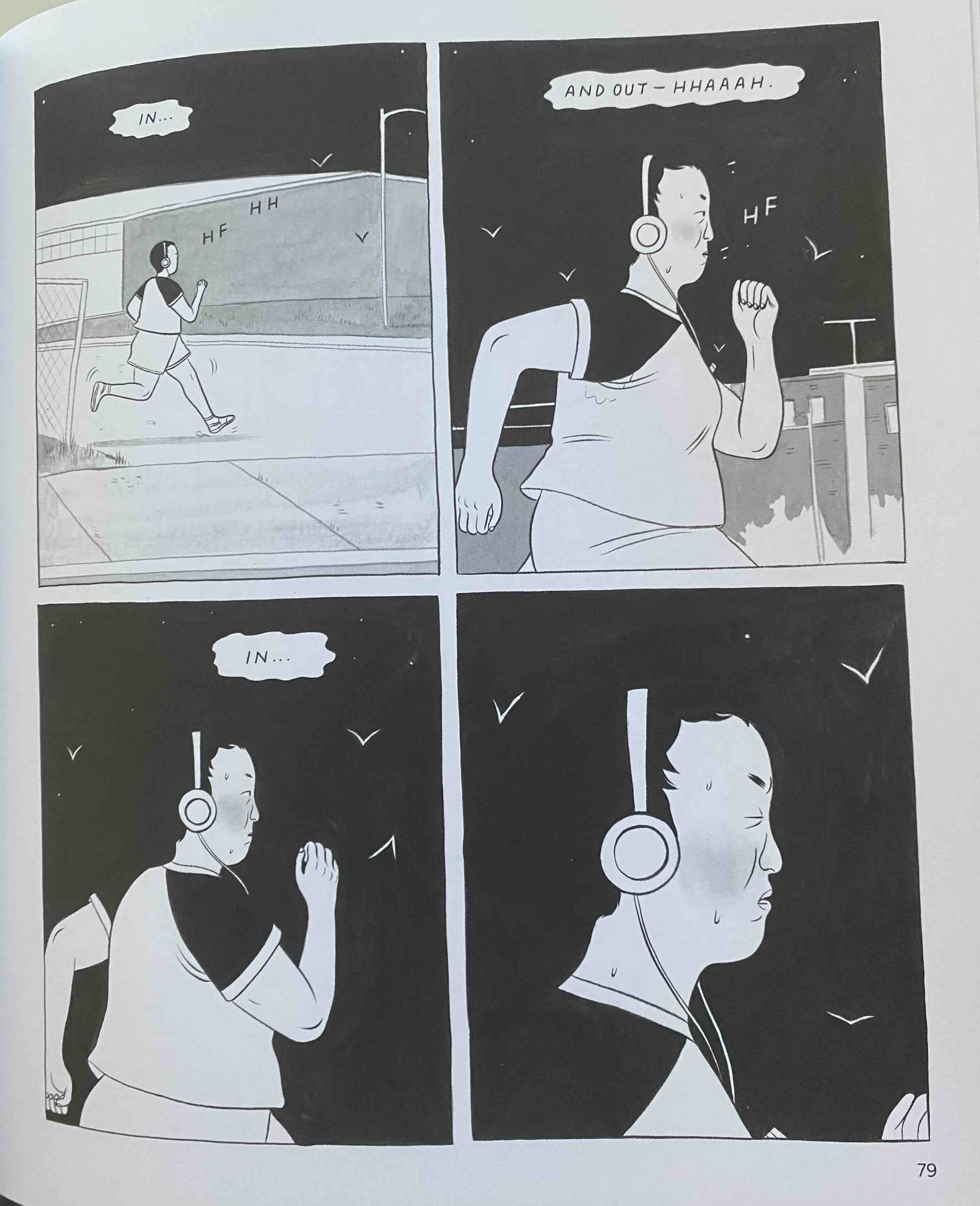
Cannon is going on a run at night, listening to a calming tape, with stylised birds in the background. If you picked this book up in a shop and turned to this page, and only this page, to see if you wanted to buy, you’d probably put it back on the shelf.
But in context it’s a different story. By this stage of the book we understand that running with the tape is Cannon’s way of staying on an even keel. Each time she goes for a run the narrative slows down and the reader takes time out with her. On this occasion, her grandfather has taken a turn for the worse, her mother refuses to help, and Trish’s sympathetic advice hasn’t helped. Six pages of her running are interspersed with other bits of story – Cannon remembers Trish intervening at school when a mean girl attacked her, Trish in the present does something that we only understand much later in the book. The birds are here, reduced to distant, barely noticeable shapes – the running is doing its job.
The art is deceptively simple. Cannon is not there to be looked at. The simple, elegant line drawings and uncluttered frames throughout don’t draw attention to themselves and allow the story to move along seamlessly. The plentiful white (and sometimes black, as on page 79) space opens up room for the reader to feel.
I wouldn’t have read this if not for the Stella Prize. I’m grateful.
I wrote this blog post on land of Wangal and Gadigal of the Darug Nation where just now the nights are cold but the days, as often as not, are cloudless and windless. I gratefully acknowledge the Elders past and present, and welcome any First Nations readers of this blog.
* My blogging practice is to focus on the page that coincides with my age, currently 79.


This is the first review of this book I’ve seen. It actually makes me want to read it for myself now when previously I just wanted interested. I love how you explain what the images are like, especially how the end papers serve to establish the scene, and the recurring motifs throughout and what they symbolise.
LikeLiked by 1 person
Oh Jonathan, I started my review of this a couple of weeks ago – at least I jotted down some overall thoughts before I forgot them as life has been busy and I know I couldn’t write my review then. Just this morning, having written up Warra Warra Wai, I put the book on my chair to do next. Such a beautiful book.
LikeLiked by 2 people
I look forward to reading your review.
LikeLike
I hope to finish it this week, but I’m against the clock as I prepare for an overseas trip and I’m – unusually – behind in my reviewing. How did this happen?!
LikeLiked by 1 person
Weird, isn’t it? I have 8 books read and unblogged!
Have a great trip. The blog can wait
LikeLike
Thanks Jonathan! I have 7 days so I’ll get some blogging done. But 8! Good luck!
LikeLiked by 1 person
So you (and Sue) think that it’s a worthy winner of the Miles Franklin?? Number me amongst those who are put off by the idea of a comic- and yes, the front cover would have been a further disincentive.
LikeLiked by 1 person
I do think it’s a worthy winner, though I haven’t read enough of the competition to have an opinion on the judges’ choice.
I’m a bit of an advocate for comics. If you’re a comics deceptive it may not be the best place to start – tb he classic serious work people most often recommend is art Spigelman’s Maus. Alison Bechdel’s Fun Home might also win you over – it’s very personal and isn’t embarrassed to quote Greek myth and writers like James Joyce
LikeLike
Pingback: Lee Lai, Cannon (#BookReview) | Whispering Gums