
Jill Jones, How to Emerge (Vagabond Press 2025)
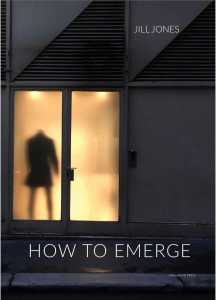
Jill Jones is a formidable poet, sometimes thrilling, often difficult, never cliché or dull.
Like many of her previous books, How to Emerge has won awards (including the Kenneth Slessor Prize for Poetry at the 2026 NSW Literary Awards) and been shortlisted for others (most recently the 2026 Prime Minister’s Literary Awards, winner to be announced on the 10th of September).
Some quotes from judges’ comments may give you a sense of the poetry, and also of the difficulty of describing it.
From the PM’s Literary Awards (for the full comments, click on the book’s cover at this link):
Advancing by non-propositional proposition, chances and crossings, How To Emerge is an absorbing, elegant collection of poetic numbers operating at the threshold of the personal and the impersonal. In its richly suggestive representation of worldly entanglement, it solicits readers willing to enter into a pact of mutual attention and unpredictable exchange.
From the NSW Literary Awards (the full comments are at this link):
These poems discover humanity, perhaps even meaning in the accumulating weight of the world; we are star dust, but we are also the brat summer. Part of the appeal of these poems is the rare faith they show in the reader, a belief that readers will find their own meaning and carry from the collection something of the warmth, humour and care that radiates from the poems.
I won’t add any generalisations of my own, except to say that I like the idea that readers have to be ‘willing’ (PMLA judges) and ‘will find their own meaning’ (NSWLA judges).
I’ll just look at one poem, ‘Poem Mourning My Name’, on page 79*.
It has fifteen lines. According to an endnote, all the poems in the book ‘are composed of lines that are multiples of three’. I’m guessing this was a self-imposed restraint, important in creating the poems, but not so much in the reading of them, unless at a subliminal, numerological level.
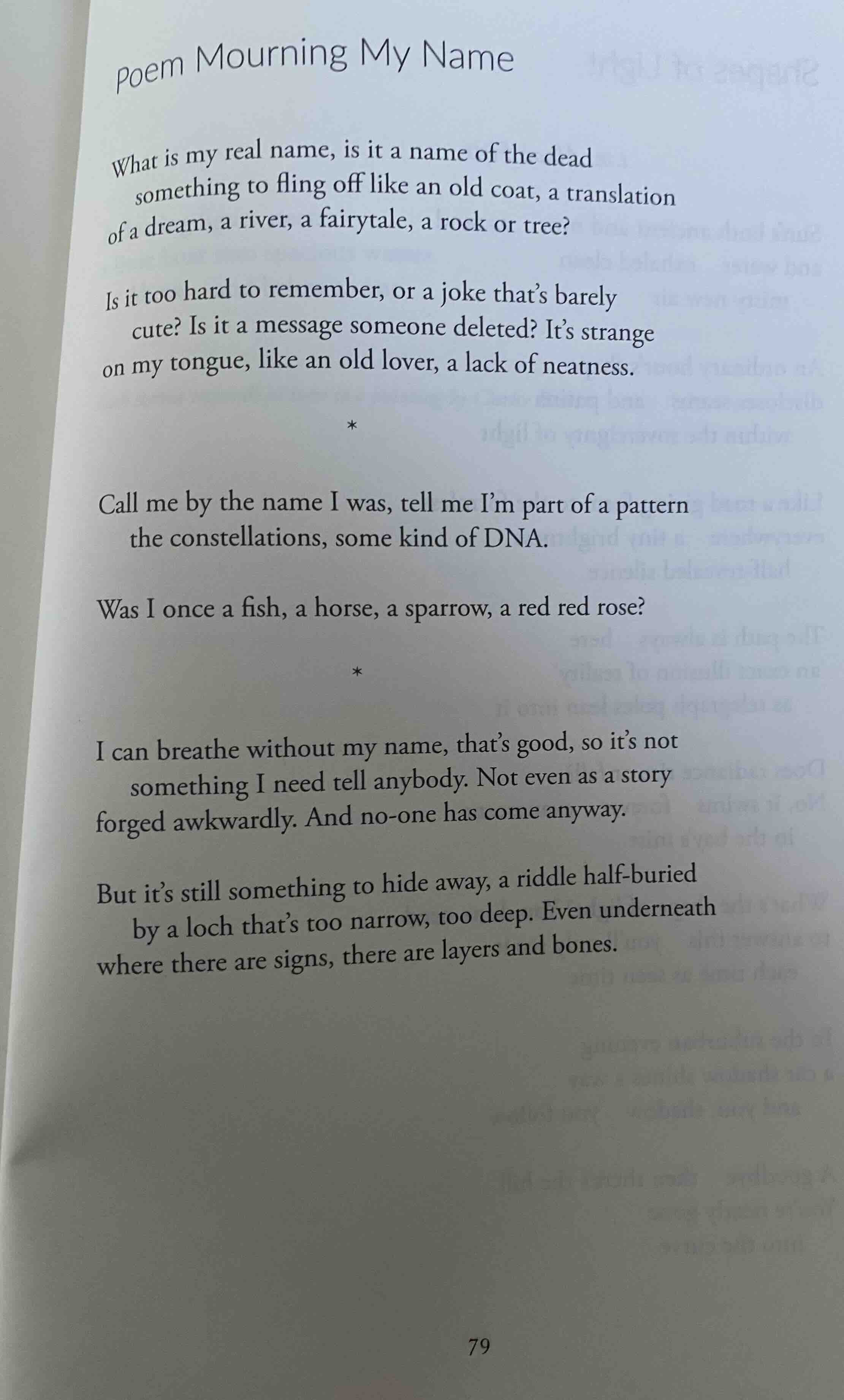
Before you read on, please stop and read the poem itself, preferably aloud. You’ll get a sense of its flow, its general effect, and if you’re like me, you’ll feel an itch to look more closely, poke around in it, figure out what precisely is happening. The rest of this blog post is an attempt to record some of that looking, poking and figuring.
When I was thinking about the poem, I happened to hear Florence Knapp discussing her novel The Names in a Sydney Writers’ Festival podcast (at this link). That novel tells three life stories, each of the same boy, but he is given a different name in each with massive consequences for how his life goes. And I realised that in various contexts my name has been Jonny, Jonno, Shaw, Shawrie, [offensive nickname deleted], John, Jon, Jacko (just for one weekend) and Jonathan. Names are important, and perhaps everyone can tell a story about theirs.
What if you’re called Jill Jones? I stopped counting when I reached the 200th person with that name on Facebook. This commonness could be what leads to the poem’s opening. Surely, you might think, if your name is a marker of your untransferable individuality, it must be more distinctive than that. In my reading of the poem, that’s the starting point – the fantasy that behind the everyday name there is another, ‘real’ name:
What is my real name, is it a name of the dead
___ something to fling off like an old coat, a translation
of a dream, a river, a fairytale, a rock or tree?

Is it too hard to remember, or a joke that's barely
___ cute? Is it a message someone deleted? It's strange
on my tongue, like an old lover, a lack of neatness.
As in many of Jill Jones’s poems, these lines are full of allusion. Some people are named after dead ancestors, or from a parent’s dream. Fairytales about names abound – I was just telling my grandson about Rumpelstiltskin this week. There’s a popular belief that in some cultures babies are named for the first thing the mother sees after giving birth – a rock or tree. And there’s a joke that’s ‘barely cute’ that relates to that belief – which I won’t tell here because I try to keep the blog family friendly.
While this play is going on, a different understanding of the opening question swims beneath the surface. Is a name something other than an arbitrary word used to identify the person? Is a real name an inversion of what the trans community calls a dead name? In the second triplet, that unease comes closer to the surface: the deleted message, the strangeness on the tongue, the awkwardness of an old lover, something that doesn’t fit though maybe it did once in a time that’s forgotten.
It is this imagined-forgotten name that is being mourned.
The next lines, coming after after a visual break, are a kind of prayer.
Call me by the name I was, tell me I'm part of a pattern
___the constellations, some kind of DNA.

Was I once a fish, a horse, a sparrow, a red red rose?
The ‘real name’ has become ‘the name I was’: it’s more than a label, it’s a metaphor for lost identity, a way of understanding the speaker’s place in the universe, but one that’s in the past. We name stars by their place in constellations. DNA is a deep identifier. But the last line here does a kind of twist. After a glancing, fanciful reference to reincarnation, it pulls back from that rabbit-hole and allows a rose to enter the poem. In European poetry, a rose can’t be mentioned without invoking a long tradition: here the phrase is taken from Robert Burns (‘My love is like a red red rose’) but it’s impossible not to think of Shakespeare (‘A rose by any other name would smell as sweet’) and Gertrude Stein (‘A rose is a rose is a rose’), both of which, with their understanding that names are arbitrary, oppose the main argument.
After another visual break, the poem makes a new start, perhaps responding to that skepticism:
I can breathe without my name, that's good, so it's not
___ something I need tell anybody. Not even as a story
forged awkwardly. And no-one has come anyway.

But it's still something to hide away, a riddle half-buried
___ by a loch that's too narrow, too deep. Even underneath
where there are signs, there are layers and bones.
A paraphrase: Assuming that there was a real name in the past, I don’t need it to go on with life; I don’t even need to tell anybody, and that’s just as well as no one would want to hear me anyhow. But …
Is this what the PMLA judges meant by a ‘non-propositional proposition’? Maybe it’s nonsense to think I had a ‘real’ name, now lost, and that knowing it would reveal something essential about myself. But somehow the idea won’t go away: it lingers in some half-buried part of consciousness.
There’s a fresh twist in the last sentence. The poem to this point has been a lament for a lost name, a lost sign. But even when there are signs, it says,there are layers of meaning in them. (Which brings me back to the stories I could tell (perhaps awkwardly) about the variations on my own unforgotten and unmourned name.
Through all of this strangely abstract rumination, there are things: a coat, a river, a rock, a tree, a fish, a horse, a sparrow, a rose, and in the end bones.
We keep being told that there’s a crisis in our culture to do with shrinking attention spans. A remedy that’s often suggested is to read long-form writing like novels. A poem as short as 15 lines can also invite – and reward – sustained, active attention.
I am an Australian man of settler heritage. I’ve written this blog post on the currently cold, wet land of Gadigal and Wangal of the Darug Nation. I acknowledge Elders past and present of those clans, and welcome any First Nations readers and commenters.
* My blogging practice is to focus on the page that coincides with my age, currently 79.


Love your reflection of this poem Jonathan. And I liked the NSW judges’ comments more than the PMLA’s as I could get what they were saying. Like you I like the idea that readers (need to) bring something to what they are reading.
I had sensed some of the things you teased out from this poem, but I am usually really anxious that I will say something stupid (that will upset the poet if they are alive) because I have been known to get the wrong end of the stick!
LikeLiked by 1 person
Thanks,Sue. Yes, after reading the PMLA judges’ comments I was hugely relieved to read the more or less plain English of the New South Welsh
LikeLiked by 1 person
Phew, glad I’m not that far out on a limb!
LikeLiked by 1 person