
Helen Garner, How to End a Story: Collected Diaries 1978–1998 (Text Publishing 2025)
– pages 1 to 193.
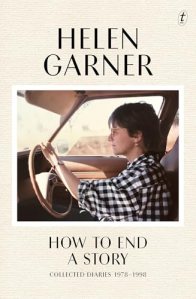
Someone at the recent Sydney Writers’ Festival said that we ought to stretch our attention spans by reading for twenty minutes at a time – or it may have been by reading twenty pages at one sitting. That’s probably good advice, but I’ve now been reading just five pages of Helen Garner’s diaries every morning for a little over a month, and I’m convinced this is the best way to read them.
I expected the experience to be similar to reading Seamus Heaney’s letters in the same way (first of several blog posts here). But a diary entry is a different beast from a letter, even one written to an intimate friend. Garner is not concerned to present an acceptable face or to spare people’s feelings. I expect she has done some sparing in the editing – by anonymising most people, and probably by cutting some entries – but this is not a public face on display.
The diaries were, however, meant to be well written, to wrangle her observations and reflections into precise words. Nearly two-thirds of the way in the first volume, Yellow Notebook, narrative threads have emerged. Her second marriage, to a man identified only as ‘F’, has come to an end after a long period of bitter rows, and she is coming to terms with her new unpartnered life. Her first novel, Monkey Grip, won a prize on the first page, in 1978. Now, in 1986, she seems to go to a lot of writers’ festivals where people are all too happy to give their opinions about The Children’s Bach (1984) and sometimes mistake her for a staff member. A film she wrote the script for goes to Cannes – she doesn’t name the film (it was Two Friends, directed by Gillian Armstrong) or say any more about it. There’s a thread to do with religion: she senses the approach of what she calls ‘The Mighty Force’, and the thread has peaked in a brief entry (on page 185): ‘ I dread having to become a Christian.’ Perhaps related to that is her deep friendship with ‘J’, transparently Tim Winton (they laugh at gossips who assume they’re sleeping together).
I won’t be surprised if some time in the next decade or so an annotated edition of the diaries appears with notes identifying people and places, and elaborating on contexts. Without that apparatus, it’s like reading the ghost of an autobiography – tantalising, but still oddy satisfying.
There are dreams, conversations, snippets from her reading and film-going, lovely moments with her daughter and sister, irritating moments with various men, deft little pen portraits both physical and psychological, and entries that amount to prose poems.
There’s is a recurring fascination with murder, especially child murder. Several gruesome news items make their way into the diary, and then in 1985 she attends her first trial. Here she is talking to the father of a murdered girl:
I asked him if I could come to the trial.
‘Why do you want to?’
‘First because I thought you might like people to be with you. And second because I’m curious.’
The real truth would be in reverse order. In fact the real truth is part 2. The first is cosmetic, though it is true also, in another way.
How could she have known that this interest would lead to her brilliant non-fiction books Joe Cinque’s Consolation (2004) and This House of Grief (2014), both published well after the end date of these collected diaries.
In today’s reading there’s a long, gruesome account of a visit to the dentist, a number of notes on possible books and stories to write, comments on movies (Visconti’s Bellissima) and books (she reads surreptitiously from a novel about a sadomasochistic affair at Readings book shop), snippets from conversations, descriptions of nature, quotes from a reader and a critic. Here’s a sample just from these five pages:
A micro-fiction:
At the school concert a girl’s proud father says, ‘I love you!’ and squeezes her in his arms. She shrieks, ‘Ewww,YUCK!’ and fights to break free. He grips tighter with a demonic grin
A delicious name-drop (‘the law student’ is her lodger):
Raymond Carver called collect when I wasn’t home, and the law student, confused, caused him to hang up.
A neighbourly conversation:
Out near the rubbish bins I ask my neighbour if she knows anything about Melanie Klein. ‘I absolutely detest psychoanalysis,’ she snaps. I bet you do. Look at your life.
A gruesome moment observed:
Outside the post office the dog shat out a tapeworm. It trailed behind her and I had to put my foot on it to snap it off.
A tiny addition to the underlying narrative:
Spring comes. People fall in love – or they will, when the sunny breezes blow and exams are soon and cafe tables are put out on the pavements. Will I? I can’t imagine who with?
I’m so glad she decided to publish these diaries. I’m pretty sure I’m also glad I’m not ‘the neighbour’, ‘the law student’ or even the ‘proud father’.
I am a man of settler heritage who has been alive for almost a third of the time since Arthur Phillip raised his flag on the shores of Warrane. I wrote this blog post on the land of Gadigal and Wangal of the Eora Nation. I acknowledge their Elders past and present and welcome any First Nations readers.


Haha Jonathan, I enjoyed this. You’ve captured her, the diaries, and our interest perfectly. Love your closing paragraph.
LikeLiked by 1 person
Thanks Sue. I was amazed to find so many quotable snippets in one day’s reading. And there are great longer bits too.
LikeLike
She is so delicious to read … I’m not surprised!
LikeLiked by 1 person