
Sou Vai Keng, art of ignorance(Flying Island Books 2023)
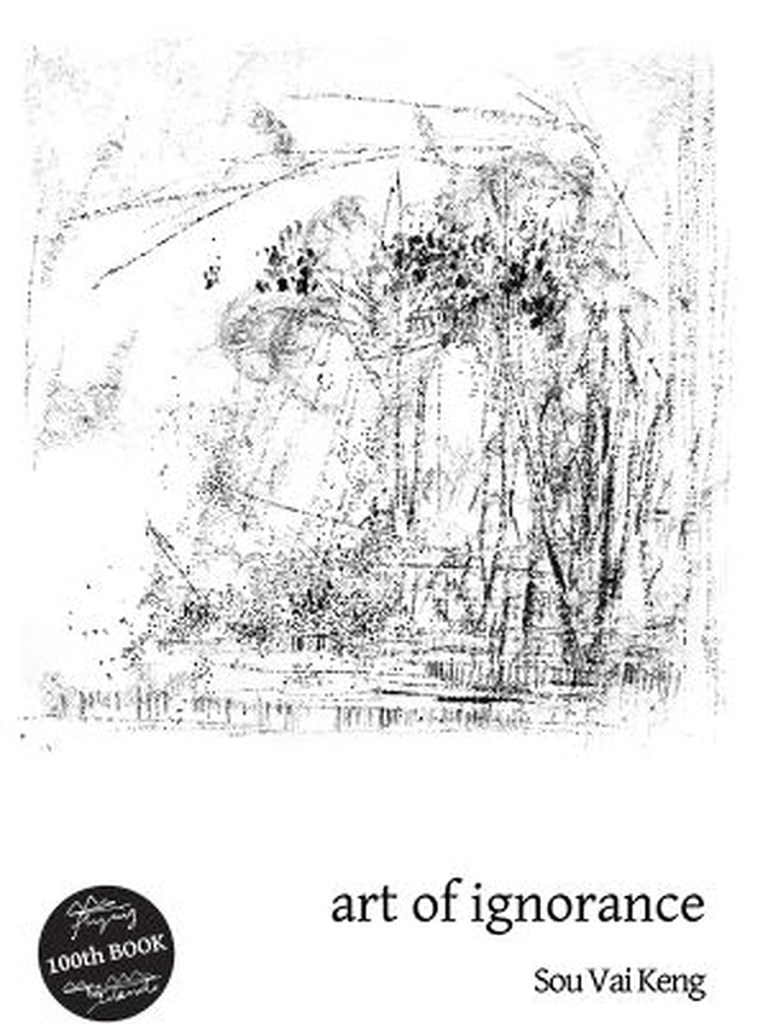
art of ignorance is the last of the small but substantial books I took with me on my recent fortnight in North Queensland. Like the others, it’s part of the Flying Island Pocket Poets series.
It’s a bilingual book – that is, each poem appears first in English then in Chinese. As there is no mention of a translator, I assume Sou Vai Keng wrote both versions. She also created the generous number of elegant drawings that intensify the book’s relaxed, contemplative feel.
A note tells us that all the poems were written in mountain areas in Germany and Switzerland between 2014 and 2018. Reading the book felt like sharing the experience of immersion in those mountains with someone with sharp eyes and a seriously playful mind – there’s not a lot of explicit description, things are seen in close-up, sometimes with a touch of surrealism, there are tiny fables and fantasies.
The opening line of the title poem could stand as an eight-word statement of the book’s prevailing mood:
the butterfly does not know the French call it papillon
Page 77* is a good example of how the book works: English on the left, Chinese on the right, with a delicate drawing in the middle (I’m sorry my tech skills aren’t up to showing the drawing without it being sliced in half by the gutter):

The poem starts with sweet whimsy:
she believes she is a tree
The rest of the first stanza elaborates: to be a tree is to ‘live on blessings from heaven’ in the form of rain and dew, and not to need anything else. A different poem might have mentioned roots and connection with other trees by way of the complex underground tangle of fungi. It might have mentioned birds’ nests, or arboreal animals, or fruits and flowers. But not this one. Here the character, like certain ascetics in the early Christian tradition, and in Chinese tradition as well I think, is opting out of active social life, choosing solitude and passivity in relation to a world she assumes to be benign.
But society intervenes. If she was ‘mean and nasty’, she could vanish, but her version of opting out is ‘a lovely idea’. It’s an idea that, by implication, the passers-by find attractive but not permitted. It’s ‘lunacy’. The poem is a parable of sorts, in which a character indulges for a moment a yearning to be stable and self-sufficient like a tree, only to be drawn back gently to the reality of human connectedness and instability:
out of sympathy and solidarity
people drag her away from where
trees stand firm and strong
and from now on she has to
roam and rove around
together with other
rootless nuts
The final word, far from offering a neat resolution of the poem’s conflict, raises more questions. What does it mean to equate humans with nuts? Nuts as opposed to sane, stable beings; nuts as fruits, insubstantial compared to the tree; nuts as bearing the possibility if one day taking root and developing into something more like trees? She is dragged away from her wistful belief, but at the very last moment the poem opens up to the possibility of her fantasy somehow becoming real.
It’s a fine example of the way Sou Vai Veng’s poem’s twist and turn beneath apparent simplicity. I enjoyed the book a lot.
I wrote this blog post in Gadigal Wangal country, as the days are warming up, the worms are fat and busy in the earth, the adolescent magpies are developing their adult colours. I acknowledge Elders past, present and emerging for their continuing custodianship of this land.
* My blogging practice, especially with books of poetry, is to focus on the page that coincides with my age, currently 77.


 Me fail? I fly!