
It’s been a while since I’ve blogged about my grandchildren’s reading. Both do quite a lot.
I’ll write about the four-year-old another time. For now, I’ll just say that he loves Tabby McTat by Julia Donaldson and Axel Scheffler, which I blogged about four years ago, when his big sister was also enamoured of it.
Our newly-turned-seven-year-old has become a comics reader. Unlike the Donald Ducks and Phantoms of my childhood, her comics are little books, and seem to be mainly adapted from series of non-graphic novels. Partly as dutiful grandfather and partly (mostly?) as committed reader of comics, I’ve read two books from her current obsessions. (I did dip into a Babysitters’ Club title, but couldn’t make myself read the whole thing.)
Dav Pilkey, Dog Man: For Whom the Ball Rolls (Graphix 2019)
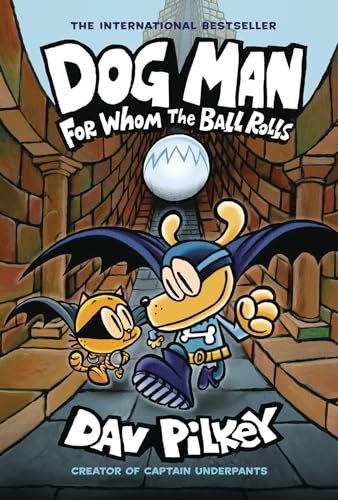
I’d heard of Dav Pilkey’s Captain Underpants, but had no idea until I looked him up on Wikipedia that he had received the prestigious Caldecott Honor Award (in 1997, for The Paperboy) or that he had been named Comics Industry Person of the Year in 2019. His first name, I also learned there, doesn’t come from a non-Anglo heritage but from a misspelled name tag at a fast food outlet.
This is the seventh of the Dog Man books. It’s good fun.
The first pages explain that the hero has had a head transplant. His new head came from a dog, and now as he continues with his work as a police officer, his doggy abilities and instincts often come in handy. Sadly, and hilariously, they also cause problems.
In this book, whenever Dog Man comes close to making an arrest, the bad guy throws a ball and he is compelled to chase after it.
Having written that much, I realise that I didn’t actually finish reading the book. In an increasinglty rare treat for both of us, I read it to my granddaughter until life made other demands. I enjoyed what I did read, and will try to sneak a further look if I can find it among the chaos of books in their bedroom.
Tui T. Sutherland, Barry Deutsch, Mike Holmes & Maarta Laiho, Wings of Fire: The Dragonet Prophecy, the graphic novel (Graphix, an imprint of Scholastic, 2018)
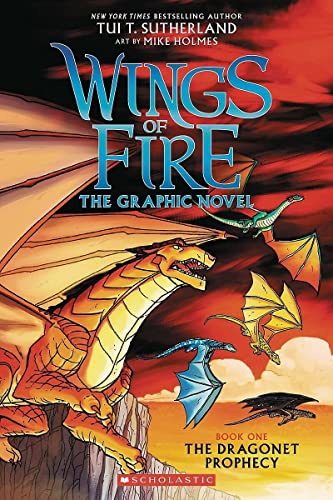
Tui T. Sutherland’s Wings of Fire series is a major phenomenon in YA fantasy. The first (non-graphic) novel, The Dragonet Prophecy, was published in 2012, and has been followed by fourteen more, plus two stand-alones, a number of novellas (‘Winglets’), and other spin-offs. The series is currently being adapted into ‘graphic novels’ (I prefer to call them comics) by Barry Deutsch, with art by Mike Holmes and colour by Maarta Laiho. Evidently the sequential art version makes the stories accessible to a younger readership, as my granddaughter has devoured the first six volumes. I have just read the first.
In the world of this novel, intelligent dragons are the dominant species. There are at last six dragon nations / subspecies, each with its own powers. A war has been raging for twenty years – a war of succession, sparked by the death of a queen at the hands of a Scavenger (a creature we recognise as human). There is a prophecy that five dragons ‘who hatch at brightest night’ will end the war and bring about peace.
The story begins with the hatching of those five baby dragons (‘dragonets’). They spend their early years imprisoned in a cave, protected from the outside violence and trained for their future task by formidable adult dragons, the Talons of Peace, who don’t much like them. They bicker like siblings, study the history of the war, and test their diverse powers. Like many institutionalised children, they form powerful bonds of affection and are fiercely loyal to each other. As you’d expect, they escape from the cave and adventures ensue.
Rather than give more detailed summary, I’ll stick to my practice of looking at page 77:
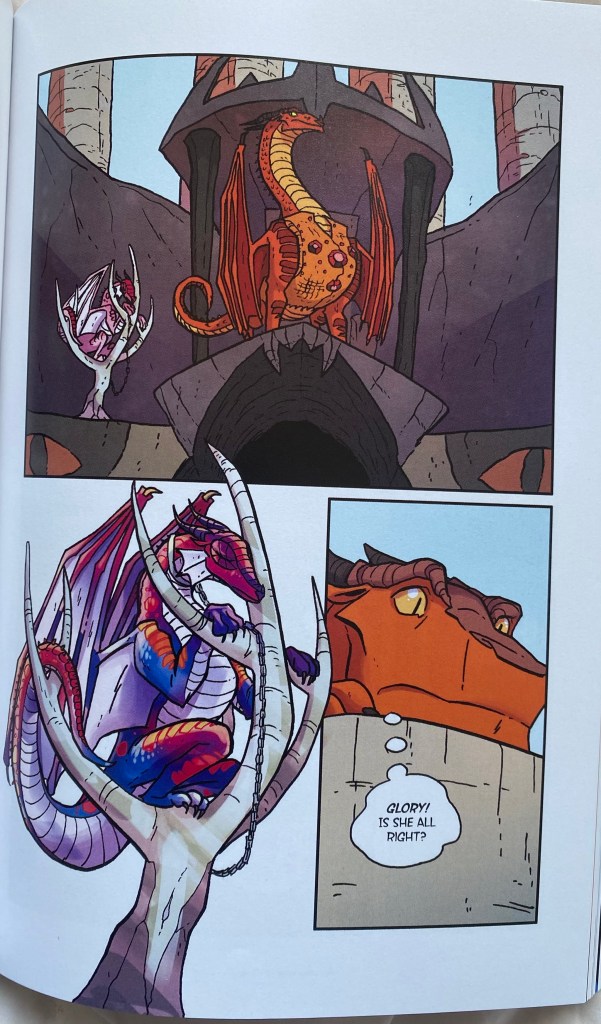
It would be interesting to compare this with the equivalent section of the original novel. Certainly it would take a lot of words (three thousand for these three pictures?) to convey as much information about character and to move the plot along so far. (The next page does include aquite a bit more explanatory dialogue.)
The large dragon at the top is Scarlet, one of the powerful queens who not only wages war but is committed to keeping it going for its own sake. She knows of the prophecy and, having captured the dragonets, is out to humiliate and destroy them. She stands on a platform that overlooks an arena where, for her own entertainment, she stages fights to the death between dragons who have been taken prisoner.
The small, brightly coloured dragon in the intricate cage is Glory, one of the five dragonets. She is a rain dragon, despised by everyone except her companions as beautiful but lazy and generally useless. Scarlet has not condemned her to gladiatorial combat, but has arranged her as an artwork. In keeping with her reputation, she is apparently sleeping (no spoiler to tell you that she is actually wide awake, biding her time).
The square-snouted character at bottom right is Clay, a mud dragon, another dragonet and this book’s central character. He is currently chained to the top of a pillar overlooking the arena with his wings constrained, destined to fight and, Scarlet expects, die violently. So much of his character is revealed in this one frame: though he has just discovered his own precarious situation, his attention goes completely to Glory – alarmed at her vulnerability but also with sibling irritation at her passivity.
To tell the truth, part of my reason for reading this book was what an unsympathetic observer might call moral panic: I had heard my granddaughter exclaim from the seat of the car, ‘Why is there so much blood in this book?’ This is a girl who recoils from even the mention of blood in real life. Having read the book, I’m guessing that this young reader is in there for the story and at worst puts up with the so far extremely stylised violence and gore, at best uses it to work through some of her own fears and anxieties.
I don’t know if I’ll read on, but I’m tempted.


 Me fail? I fly!
Uh… this makes me wonder about which books are being read to her at school.
#ClimbsUpOnSoapbox
It is well-known that boys will read/tolerate books about boys but not about girls. (Especially if it’s the Babysitters Club that’s on offer). Girls will enjoy/tolerate books about either.
Some teachers pander to the it-doesn’t-matter-what-they-are-reading-as-long-as-they-are-reading theory, and so they try to entice reading by reading books to the class by authors and booksellers who pander to this with predictable boy-as-hero stories, toilet humour and some level of fighting and violence.
As grandparent, you can’t interfere. But you could adopt my theory which is that when an adult reads a story to a child, it’s an opportunity to introduce much more enduring stories than these forgettable books which are designed to lead to an endless wishlist for the next one being churned out in the series. As my students used to say, there are stories which are fun while you read them, and then there are stories that you remember all your life and that’s literature.
Seven? A beautiful edition of fairy stories #NotDisney. Hans Christian Anderson. The Velveteen Rabbit. The Tashi series by Anna Fienberg, The Muddle-Headed Wombat by Ruth Park. Sassy Girl Heroes: Lily Quench and the Dragon of Ashby series by Natalie Jane Prior, a favourite of my students. Audrey of the Outback by Christine Harris, the Alice-Miranda series, The Violet Mackerel series by Anna Branford. Pippi Longstocking. I think some of the Emily Rodda series are suitable for younger readers, ask your children’s librarian which ones, and for other more recent suggestions since my time in the library. If she suggests Paul Jennings or Treehouses go somewhere else.
#Tip: you can get your own way by offering to read a set number of pages of her book, and double that number of yours because yours doesn’t have so many pictures (or any other reason you can get away with.)
LikeLiked by 1 person
Thanks for that glorious soapbox moment, Liza. Much appreciated. R’s situation isn’t quite as I’ve described it, though I think there’s something of ‘an endless wishlist for the next one being churned out in the series’.
I’ve recently read Hans Andersen’s ‘The Snow Queen’ to her, in the version my mother read to me. She was interested in it as the story behind Frozen and engaged intelligently. Currently we (mostly the Emerging Artist) are reading Amanda Graham’s The Hats of Marvello to her, a couple of chapters at a time. From the bits I’ve heard/read it’s a satisfyingly complex mix of magic and realism – and we’re all enjoying it. Wings of Fire itself has a lot of complexity – I didn’t mention in my blog post, but I asked her what the series was about before borrowing one book, and she gave me what turned out to be an excellent summary of the general situation.
I’m not worried about her current enthusiasm for comics. I loved comics myself and – as all the worst people say – I turned out all right.
Thanks for your list. It may be a good time to revisit Tashi – I think we introduced her to him when she was too young and was repelled by the violence (!). Lily Quench and the Dragon of Ashby certainly sounds like a goer, and so does Audrey of the Outback, if only because one of her main friends is named Audrey. I cold swallow my irritation with Pippi Longstocking and give her a go. The world is spread before us where to choose.
LikeLike
Oh! Gasp! I loved Pippi Longstocking!
Of course, in my girlhood, sassy girls were few and far between. People actually thought that Jo from Little Women was an exception to the slushy role models we mostly had. Fortunately there were some twins who travelled the world in a series, and there was Cherry Ames an indefatigable nurse, but I think I was bit older than seven when I read them.
I read comics too. (I had an aunt who sent us subscriptions to children’s magazines.)
I read Blyton too, though these days I can see the flaws. But I was an English child and those children were English like me and for a long time I belonged more in their world than I did anywhere else. I have never understood why Australian parents give these to their Australian children when there are so many wonderful Australian children’s novels that are about the place they belong in.
LikeLiked by 1 person
it probably makes a difference that I read Pippi Lonstocking when well into my 40s! Yes, I read Blyton too – the Finder Outers were my favourites. And here was Just William, which was fabulously exotic to me: it was brioad daylight at nine o’clock at night, and mysrr=erious jokes about brown rice being healthier than white (my mother explained that it was true but the people who said it actually brought the brown rice because it was cheaper). One of my aunts gave me the CBC’s book of the year for my birthday each year, so I got to read Nan Chauncey and Ivan Southall. But I have no idea how old I was when I read what!
LikeLike
Oh yes, I loved Just William! He was exotic to me too because I went to all girl schools and there just weren’t any boys in my life.
LikeLiked by 1 person
I will look at these graphic novels, Jonathan for our nearly 7-year-old (well, 7 in June). I hate to say it but he loves violence. For a few years now we’ve had this running joke between us about my not liking imagining (in our LEGO games) or reading, guns, bombs, fighting, etc. his father had been reading Ronald Dahl to him, hmmm, and I don’t remember the current book.
Meanwhile our nearly three year old is still on picture books mostly.
LikeLiked by 1 person