
Evelyn Araluen and Jonathan Dunk (editors), Overland Nº 254 (Summer 2023)
(Only the editorial is online at the time of writing – so I haven’t included links, sorry!)
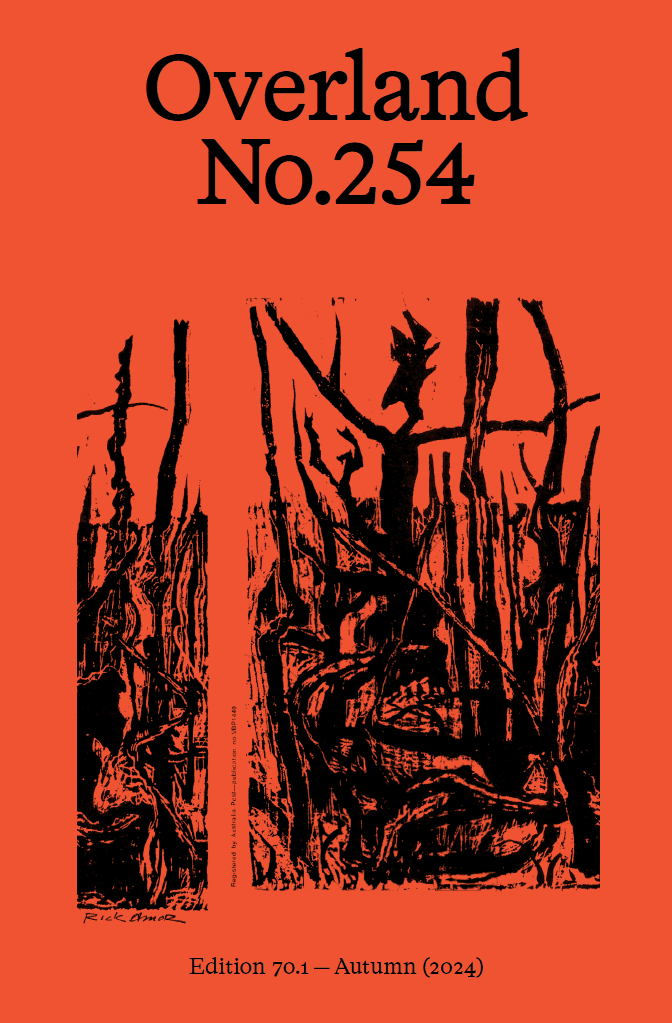
The first thing you notice about this issue of Overland is its design – an austere black and red cover and monochrome throughout, a smaller format, and surely the paper stock is cheaper than we’ve become used to. Could this be a sign of a funding crisis?
Of course there may be a funding crisis – this is an Australian literary journal after all. But there’s a definite retro aesthetic to the new look. Editors Evelyn Araluen and Jonathan Dunk call it an ‘archivally informed design’, and explain that it’s the first of four issues to mark Overland‘s seventieth year of publication. The internal illustrations are all from the archives, and include stunning ink drawings by Noel Counihan from the 1970s and Rick Amor from the late 80s and early 90s. Fabulously, page 128 features a Bruce Petty cartoon from 1976.
The nostalgia stops with the look. The words are all 2024.
I recommend the whole issue, but want to single out two articles that make me sorry so little of this content has made it to Overland‘s website. They are ‘“A State of Waste”: Myall Creek, the Sydney Herald and the Foundations of Australian Capitalism’ by Jeff Sparrow, and the anonymous essay, ‘Writing after … October 7’.
I’ve recently read how the 16th century Papal ‘Doctrine of Discovery’ (Wikipedia entry here) was explicitly invoked to justify dispossession and genocide of Indigenous people in the Americas and elsewhere well into the 19th century. Jeff Sparrow’s magisterial essay offers a very different account of how similar acts were justified in Australia. It’s a clear and cogent history of how the closing of the commons in 18th century Britain led to a new understanding of ‘ownership’ of land, which was applied ruthlessly by the settlers in Australia. The content may not be startlingly new, but Sparrow’s copious quotation from the Sydney Herald in the first part of the 19th century is, for me at least, revelatory. It’s not that the way First Nations people related to the land was strange to the settlers. It was all too familiar:
Like the British commoners, Indigenous people clearly did ‘make use’ of the land. They lived in a use-value society, tending their country to encourage the animals and plants they required. The Herald, however, understood ‘productivity’ in capitalist terms, with use values significant only insofar as they generated profit. (Page 67)
The essay spells out the way this thinking leads shockingly, but logically to the minds of the Sydney Herald editors, to justification of massacres.
What can I say? If you get a chance, read this essay.
The author of the other stand-out essay is a person of Arab background, writing in the context of conversations with Arab and Palestinian friends who work in academic or cultural contexts. They describe how they have always held in their mind the history of Palestine as ‘a bustling site of plurality and coexistence’. The establishment of the state of Israel in the nakba put an end to that condition but it has remained as a vision of possibility.
Jews worldwide were shaken by the visceral hatred shown for them in the Hamas attacks on 7 October last year. Palestinians and Arabs have been no less shaken by the hatred and disregard for them that subsequent events have demonstrated. The multi-religious and plural world of pre-1948 is now unthinkable. ‘We had not realised until this carnage started,’ the author writes, ‘how dehumanised Palestinians and Arabs are in the eyes of most Israelis.
There’s more. Back here, well-intended and well-informed colleagues have been carefully ‘balanced’ when discussing the situation of Palestinians in Israel, in large part because of not wanting to be seen as antisemitic. The author and friends have believed that if a point came when Israel unleashed its full fury on Palestinians their colleagues would take a stand. But it has happened, and many have not changed their stance:
It is not hyperbole to say we are grieving as we watch our kin annihilated on an hourly basis … We feel neglected, betrayed and discarded. We have always stood in solidarity with the causes these colleagues are most passionate about because those causes are ours too. Why isn’t Palestine their cause? (Page 49)
There’s another fine Palestine-related essay – providing devastating perspective on the brouhaha over three actors wearing a keffiyah at a preview of The Seagull in Sydney last year. But it’s the anonymous writer’s cry from the heart that strikes home.
There’s poetry – including the winners of the 2023 Judith Wright Poetry Prize and an excerpt from Nam Le’s 36 Ways of Writing a Vietnamese Poem.
There are short stories, of which my favourite is ‘Who Rattles the Night’ by Annie Zhang, a comic ghost story that won the Neilma Sidney Fiction Prize.
I finished writing this blog post in the land of the Bidjigal and Gadigal clans of the Eora nation, overlooking the ocean and surrounded by birdsong. I gratefully acknowledge the Elders past and present who have cared for this beautiful country for millennia.


 Me fail? I fly!
That Sparrow essay sounds fascinating and chilling Jonathan, and the anonymous one sounds enlightening too. I might try to get this at the NLA bookshop when I get back to Canberra.
LikeLiked by 1 person
I’d be intersted to hear your take on both, Sue
LikeLike