
Michael Crane, Urban & Landscape / Ordinary Lives (Flying Island Books 2024)
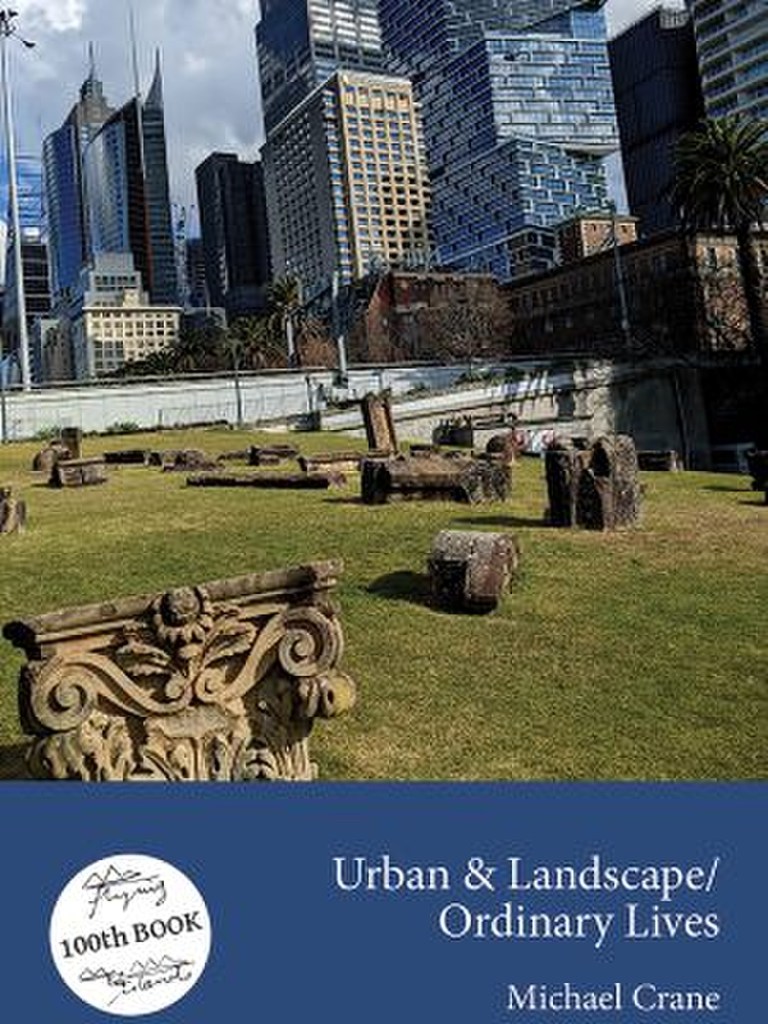
Michael Crane organised Australia’s first poetry slam in 1991, and has been a significant figure in Melbourne’s spoken word scene ever since – or at least until his Wikipedia entry was updated, which may have been more than a decade ago until I added this book.
So this is a book of poems by a spoken word practitioner. That is, they are mainly poems for the stage rather than the page.
There are three sections: ‘Urban’, ‘Landscape’ and ‘Ordinary People’.
The first is mostly snapshots of life in inner-city Melbourne, with a couple of Brisbane scenes thrown in. The ones I like best are list poems. Take ‘The Emerald Hill Library Story Time’, for example, which lists many aspects of Clarendon Street that make it a tough place to live, and ends with the tenderness of storytime for children at the library; or ‘Hi Rise’, made up of fifteen couplets, each describingsomeone we take to be a resident of the building:
Marlene ran a tight ship
as her cat, Teddy, rubbed its tail between her legs.

Many visitors arrive unannounced,
cheating the security system.

Harry lives with his father
who he must treat like his child to manage him.
‘Landscape’ mostly moves out to the country, though in its final poem, ‘Life in the Big Smoke’, a poet from the country (a version of Michael Crane in his post-Wikipedia days?) visits the city, has a number of (non-)encounters and goes back ‘to where he came from’. This poem is enriched by being read in this context: its string of encounters echo similar ones on the first section, but the emotional impact is the opposite. In particular, it pairs nicely with ‘White noise of an urban landscape’, which begins, ‘The country life was not for him.’
The third section, ‘Ordinary Lives’ begins with ‘Introduction’, which lays out the section’s rationale, including this:
I find most people more interesting than me, but my job
is to document their success and failures, the moment of glory or
the times when they are alone without love.
The poems in this, as in all three sections, are mostly direct, straightforward, unassuming. They tend to name things without analysis or commentary. On the page they tend to be flat, but my sense is that they would come alive with the gesture, tone of voice and facial expression of spoken-word performance. They’re also mostly on the depressive side – fewer moments of glory, more times alone without love.
My arbitrary blogging practice, especially with books of poetry, is to focus on the page that corresponds to my age, which is currently 77. Page 77 of this book features one of the ‘Ordinary People’ poems, ‘On a plane to Cuba’:

This seems straightforward on a quick read, but there’s something unsettlingly off kilter about it – which may be another way of saying it couldn’t have been written by AI.
After I wrote that last sentence, I decided to test my assertion, and asked Chat GPT to write a poem about a woman who is about to leave her sleeping husband and go to Cuba. I’ve given the result at the bottom of this post, so as not to confuse it with real poetry*.
ChatGPT was worryingly proficient. But what it produced demonstrates that a mechanical aggregator just can’t do what a human poet can. The AI product has sharp images of the room, gives reasons for the woman’s choice of Cuba, and even has a last line that works, but none of it is surprising.
Michael Crane’s poem, on the other hand, pretends to be offering us clichés, but undermines them all the way. In the first ten lines, even as the poem evokes the woman’s yearning for elsewhere, it subtly, almost invisibly, distances itself from her. Does anyone in touch with reality think of Paris, City of Lights, as dimly lit? And though I’ve been in London when it snowed, surely ‘snow-covered footpaths’ is an idiosyncratic way of evoking that city. Her version of Cuba is similarly idiosyncratic. The ‘almost naked dancing women’ are a cliche from Rio rather than Havana. She seems to be vague about Cuban history. What is the ‘long war’? Maybe she’s thinking of Fidel wearing military fatigues? And, in the most telling split between the woman’s perspective and the poem’s, why does she find memories of war attractive?
In lines 13 to 15, the woman’s situation becomes clear:
She is going to catch a flight to Cuba
as soon as she leaves the snoring man
who kidnapped her youth, ransomed her beauty.
Perhaps the woman’s idea of a ‘long war’ has come from the implied long time that she has been unhappily married. The definitive final line is hinted at here.
The poem continues to tread a fine balance between sympathy and – what is it? – scepticism. She takes no responsibility for whatever has one wrong with the relationship: there’s no indication that the man has been abusive – just that she took up with him when young and beautiful, and now feels the loss of those qualities (and we understand that she means he held her beauty to ransom rather than, what the words literally mean, that he paid a price to set it free). The feeling of loss is real, but we (or is it just me?) can’t help suspecting that she lacks insight.
Crucially, it’s her dreams that she packs along with supremely impractical clothing, and the last line strikes a superbly ambivalent note: all through the poem she has been dreaming of Cuba, and she heads off to ‘the songs of endless summer nights’, but really it might as well be dim Paris or snowy London, because what matters is
days filled with the absence of him.
It’s not ‘She’s Leaving Home‘, with it’s brilliant empathy for both sides of the departure, but then what is?
I finished writing this blog post on land of Gadigal and Wangal of the Eora Nation, as the sun was breaking through clouds after a day of heavy rain. I acknowledge the Elders past and present who have cared for this land for millennia.
*ChatGPT’s poem:
She watches him sleep, his chest rising and falling,
the steady rhythm of a man who never saw her breaking.
The sheets tangled around him,
a quiet fortress she once called home.
But now it feels like a cage.

Her bags are packed, a quiet rebellion in the corner.
Cuba waits—its colors, its heat,
its freedom, a place where she can feel her pulse again.
She runs her fingers over the window sill,
tracing the outlines of a life she no longer wants.

She should wake him, say goodbye,
but the words are too heavy,
the goodbyes too worn.
Instead, she steps lightly,
a ghost slipping past the threshold.

She breathes in the cool air of the morning,
the world opening wide in front of her.
And with every step,
she leaves behind the woman she used to be.


 Me fail? I fly!