
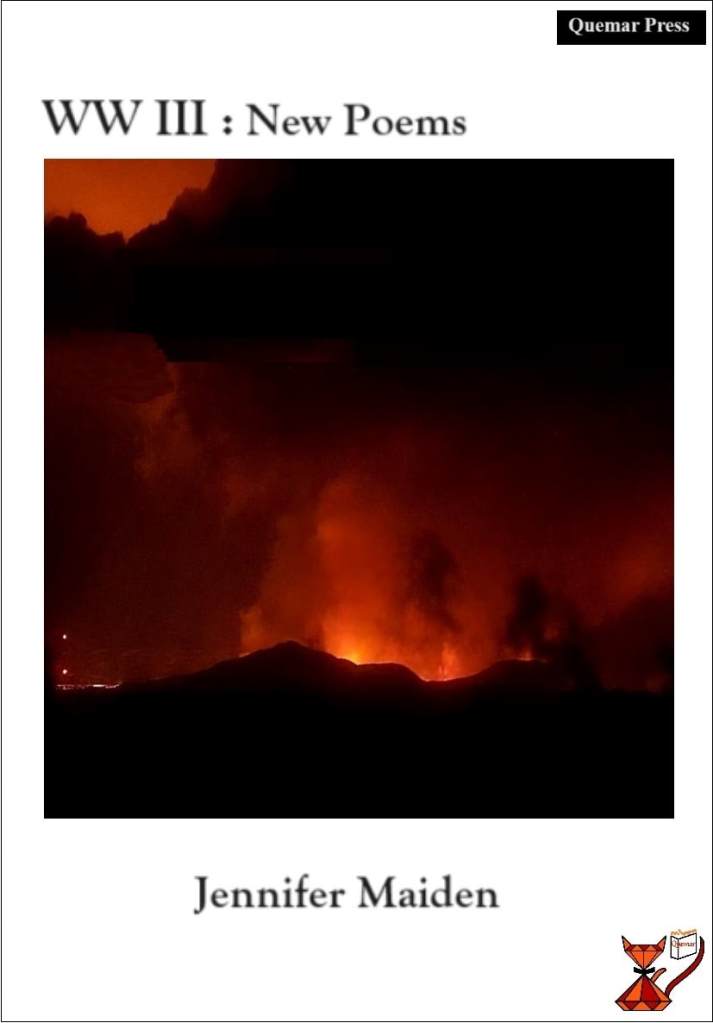
Jennifer Maiden, WW III: New Poems (Quemar Press 2025)
You don’t go to Jennifer Maiden’s poetry for a comfort read. For almost a decade now she has announced the title and theme of a forthcoming book early each year, and uploaded sample poems as they were written over the following months, generally relating to violence, political hypocrisy, and villainy from the headlines. The book has appeared, as promised, early the next January. It’s as if a fragmentary epic poem of our times is unfolding in real time.
WW III: New Poems is the latest instalment. As the title suggests, violent conflict, especially in the Ukraine and Gaza, features prominently, behind it the looming threat of global war. For a proper review, I recommend Geoff Page in the ABR at this link. This blog post isn’t so much a review as a disjointed reflection on just page 47*.
Before going there, a personal note. My blog post about Maiden’s previous book – The China Shelf: New Poems (Quemar Press 2024) – focused on the poem, ‘It’s an odd thing, pity’, and included this:
Not everyone will grasp how US imperialism can be seen as ‘falling’. If anything, some would say it’s on the verge of exploding and bringing the rest of us down with it, terrifying rather than poignant.
The title poem of WW III includes this:
Reviewing The China Shelf, a kind critic worried
that my reference to the falling Empire could
lessen the idea that it wasn't just falling
but exploding, and possibly dragging
its allies hellward with it, but he was only
considering one poem and of course the book
and others before it always took
often a stance of sharper warning
I may have got it wrong, but at least I’m kind, and as a humble blogger I’m flattered to be called a critic.
Page 47 of WW III is the first 19 lines of ‘Dietrich Bonhoeffer woke up in the Australian Ambassador’s residence in Washington’.
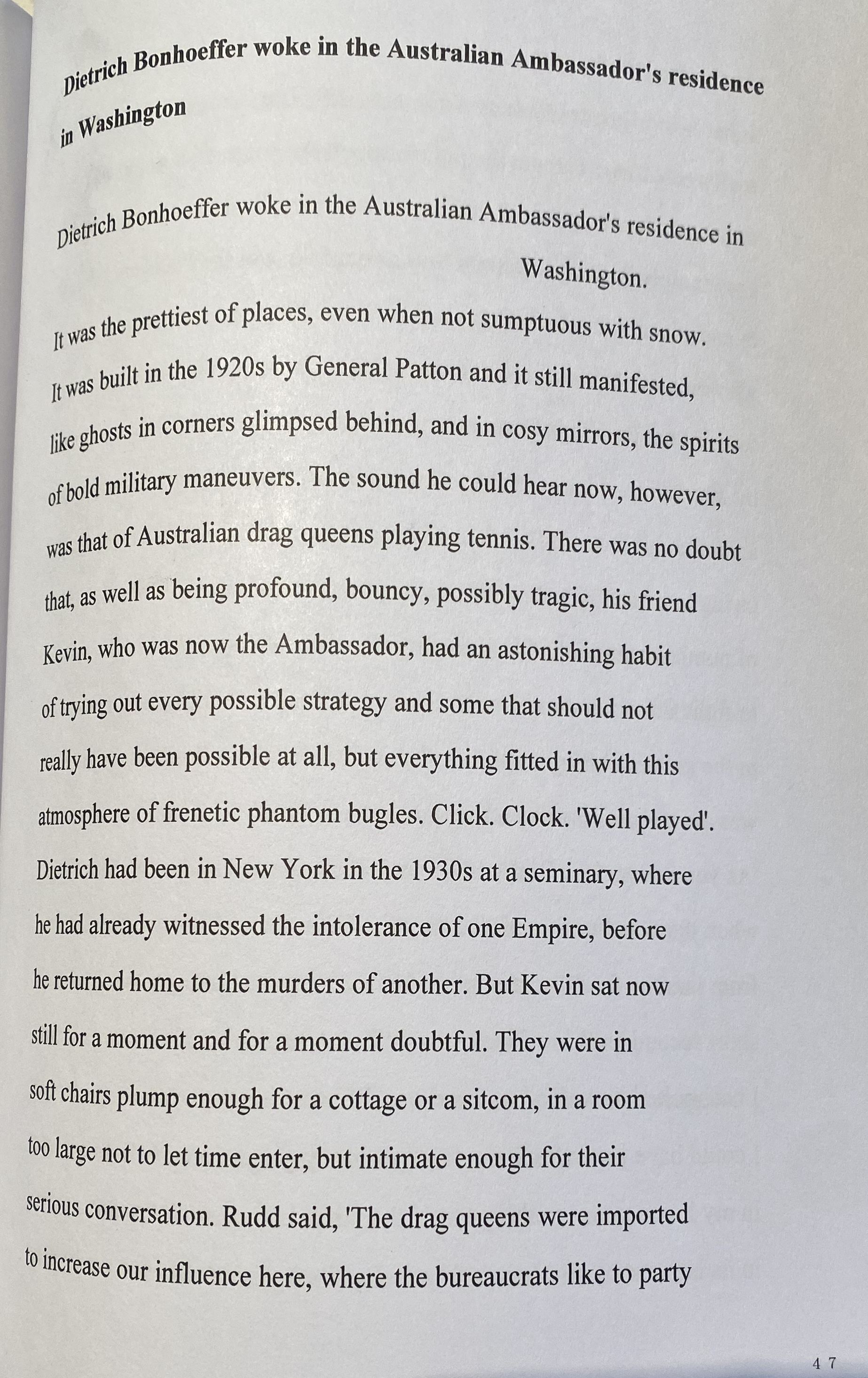
This page sets the scene for a much longer poem. The ‘serious conversation’, foreshadowed in the second-last line, could be summarised as, ‘Dietrich Bonhoeffer tells Kevin Rudd that it’s not wise to set Australia up to be the US’s proxy in a future war with China.’ The poem could be summarised abstractly: ‘With Dietrich Bonhoeffer as mouthpiece, Jennifer Maiden repeats her warning that the USA is not to be trusted as an ally to Australia.’ Luckily, as with any poem worth its salt, that summary tells you almost nothing and is pretty misleading. You can buy the book to read the whole poem, or you can hear Jennifer Maiden performing it at this link.
The poem belongs to Maiden’s personal tradition of poems where a famous person, historical or fictional, ‘wakes up’ to interact with a living person. In 2009 her fictional character George Jeffreys woke up in a number of global hotspots to see George W Bush on television. Kevin Rudd is one of a number of Australian politicians who have figured since then in delicious conversations: Tony Abbott with Queen Victoria, Julia Gillard with Aneurin Bevan, Malcolm Turnbull with Jessica Fletcher from Murder She Wrote, Tanya Plibersek with Jane Austen. (Beyond these shores, pairings have included Mother Teresa and Diana Spencer, Gore Vidal and Julian Assange, Eleanor Roosevelt and Hillary Clinton.) Usually the pairings are based on something the politician has said or written. In Kevin Rudd’s 2006 essay, ‘Faith in Politics’, published in The Monthly (link here, if you want to refresh your memory), he named Bonhoeffer as an inspiration. The pair made their maiden Maiden appearance in Drones and Phantoms (2014).
It’s interesting to notice just how much information is either given or assumed in these lines. It wouldn’t be a crime to read without googling. As Magdalena Ball said in her review of The China Shelf (link here), ‘You don’t have to have the kind of encyclopaedic knowledge of Australian history and command of current affairs that Jennifer Maiden does to read her books.’ But it helps, and there’s always the invitation to learn more.
First, Dietrich Bonhoeffer. I’ve vaguely heard of him as a pastor who spoke out against the Nazis and was murdered by them. So I know he brings a kind of moral integrity to the conversation. The poem give me a little more:
Dietrich had been in New York in the 1930s at a seminary, where
he had already witnessed the intolerance of one Empire, before
he returned home to the murders of another.
I might not have gone googling if I wasn’t blogging about the poem, but I did, and found that while studying theology in New York in 1930, Bonhoeffer engaged with African-American churches, and became strongly anti-racist. I don’t know that he used the term ‘empire’ about either the USA or Nazi Germany, but it wouldn’t be a poem without that kind of editorialising.
Second, Kevin Rudd. You’d probably know that he was the Australian Ambassador to the USA, but for those who know him there’s a deft evocation of his persona: ‘profound, bouncy, possibly tragic’. (Further on in the conversation, Kevin asks a question ‘and answered himself, as was his custom’.)

Third, the setting. Here’s a pic from the building’s facebook page – ‘the prettiest of places’. Who knew it was associated with the notoriously belligerent US general George Patton? (For readers of my generation no explanation needed: George C Scott in the movie Patton leaps to mind.) According to my googling, Patton rented the house rather than built it, but the association is still there.

Fourth, the headlines. Kevin Rudd did host a party featuring drag queens at the ambassador’s residence in June 2023. As far as I can tell, the tennis party was a different occasion, but who’s to say there wasn’t tennis at the Pride party as well? The fabulous image of drag queens playing tennis is an example of a news items seized on for poetic purposes, in this case with what looks like glee.
Given recent events in the USA, the mention of drag queens suggests that the poem will be about culture wars. But it’s actually a piece of misdirection. Over the page, the poem’s real subject is revealed, when Kevin asks:
____________________________________ But I suppose
really you are here about the police force?
And the poem’s key news item is identified: a hot-mic moment in August 2024 in which a US official, talking to Prime Minister Anthony Albanese,
_________________________ named Rudd as the schemer
who dissuaded America from proposing their own police
force in the Pacific in favour of one organised and paid for
by Australia.
All this information, of course, doesn’t lie inert on the page, but is woven into engaging poetry. For instance, one of Maiden’s themes is the way the US, behind its benign façade, is a ruthless military power. The residence, with its link to Patton, could have been built to her specifications. The prettiness and cosiness of the residence is haunted by bold military maneuvers (note the US spelling), yet the sensuous reality is also there:
still for a moment and for a moment doubtful. They were in
soft chairs plump enough for a cottage or a sitcom, in a room
too large not to let time enter, but intimate enough for their
serious conversation.
We are given enough of Kevin and Dietrich’s histories and personal quirks for them to be more than simply avatars for positions or points of view (like, say, the characters in Plato’s dialogues). On the other hand, neither on the page nor when performing the poem, does Maiden make any attempt to give them different voices. (Maiden-Trump has none of real-life-Trump’s incoherence.) They are not fully-rounded dramatic characters (it’s not a sitcom) but they have enough independent reality that you feel the poet herself is curious to hear what they have to say in their ‘serious conversation’. I think that’s why this long run of imaginary conversations doesn’t feel tired or repetitive – they are still part of a process of discovery. (There’s an underlying question that this poem goes on to address: What are we to make of Kevin Rudd’s current incarnation as Ambassador? What’s happened to his irritability, his love of China, his social awkwardness, any bitterness about being ousted by Julia Gillard? It doesn’t address Trump’s hostility to him … that would be a different poem.)
It’s easy to be caught up in Maiden’s subject matter. Her poems can be contentious – over the page, Kevin says, as if it’s plain fact, ‘the Americans replaced me with Gillard’, and even on this page there may be an implied equivalence between Nazi Germany and 1930s USA. (If ever there was a poet who didn’t expect her readers to agree with her sentiments a hundred percent, it is Jennifer Maiden.) But this is poetry, and what is said isn’t necessarily more important than the way it is said.
Weaving isn’t a bad metaphor for how these lines progress. The reader’s attention moves back and forth like the shuttle on a loom: the residence with and without snow, General Patton then and now, corners and mirrors, military manoeuvres and drag queens, Kevin’s contrasting qualities, a room large but intimate, the shift from drag queens to the Pacific police force. Maybe it’s not so much a shuttle as a tennis ball. ‘Click. Clock.’
The way the poem sounds is interesting. Some of Maiden’s poems have sustained rhymes that you barely notice on first reading. That’s not so in this one, but especially in the opening lines there’s a lot of alliteration, especially of sibilants (‘prettiest of places’, ‘still manifested, / like ghosts in corners’, ‘every possible strategy and some that should not’). The long lines often break in mid sentence, even mid phrase (‘his friend / Kevin’, ‘should not / really have been’, ‘where / he had already witnessed’, ‘before / he returned’, ‘they were in / soft chairs’, ‘their / serious conversation’). To my ear, these result in a kind of clutter, a feature rather than a bug, that adds an odd urgency to the voice, an urgency that’s all too fitting in poems that predict war.
Since WW III: New Poems was published, Dietrich and Kevin have had a further conversation in the Residence. Click on this link to the Quemar Press website and search for “Rare Earths”.
I wrote this blog post on land of Gadigal and Wangal of the Eora Nation. I acknowledge the Elders past and present of this country, never ceded.
* My blogging practice is focus arbitrarily on the page of a book that coincides with my age, currently page 78. As WW III: New Poems only has 76 pages, I’m reverting to the year of my birth, ’47.


 Me fail? I fly!