

By the end of the festival I was suffering from information overload. I plan to blog about every session, but it may take a little longer than I’d like. I’m writing this on Tuesday – about last Friday.
2 pm: Alan Hollinghurst: Our Evenings
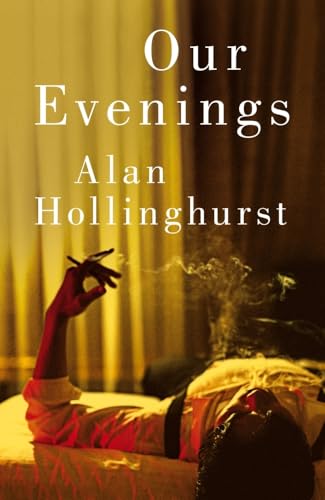
Hollinghurst appeared on stage, the very picture of an urbane British novelist, in discussion with British journalist Georgina Godwin. (Georgina’s brother Peter is also a guest at the Festival – I didn’t book for any of his sessions but was enthralled by his conversation with Sarah Kanowski on ABC Radio, which – serendipitously – I listened to while walking home from the festival.)
The conversation focused on Hollinghurst’s novel Our Evenings, which I’ve read and blogged about (at this link). The conversation flowed and Hollinghurst had a lot of interesting things to say. I’ll just mention a couple of them.
GG’s opening question was about first-person narration. After talking about its advantages and limitations as he had found them in his first novels, Hollinghurst said that though he will never write a memoir, he realised that he wanted this book to read like one. He won’t write an actual memoir because he doesn’t really know who he is – and when the audience laughed at that he thanked us for our kindness but said it was true. (I just reread my blog post about Our Evenings and see that our book group felt that one of the main things about its protagonist David Win is that he doesn’t really know who he is. It looks as if we were onto something.)
Hollinghurst wanted a character who was like him but with at least one undisguisable difference. His main character / narrator, David Win, is mixed race Burmese and British. Hollinghurst wouldn’t have dreamt of giving David, say, Caribbean parents, which would have entailed a massive feat of the imagination. As it is, David (or Dave, as I’m pretty sure Hollinghurst called him throughout the conversation) never knew his Burmese father – he is brought up in a completely white environment with just mementoes – a photograph, some items of clothing. He never visits Burma/Myanmar, and knows no more about it than a white English novelist who does some online research. But the difference is real, and perhaps just as much as class and sexuality it’s a driver of the plot.
The other thing I want to mention came up in response to a question. There were no questions from the floor, but Georgina Godwin harvested them from an online platform. Someone asked what it was like to have progressed from being a queer novelist to being a British novelist. Hollinghurst said that probably happened with the Booker Prize for The Line of Beauty. It’s not that he stopped writing on queer themes – there’s plenty of same-sex desire and deed in Our Evenings – but he never wanted to write for a niche audience. He wanted to be part of the general conversation. This interested my partly because of how it chimed with what First Nations poet Jazz Money had said in an earlier session: that as an Indigenous queer woman it was only after her first book was well received that she realised she had the gift of responsibility – in effect, the responsibility to be part of a general conversation.
Oh, he read to us, and it was great to be reminded of how beautifully he puts words and sentences together.
7 pm: Raja Shehadeh: Chronicling Palestine
While we were waiting for this session to begin, with Australian Abbas El-Zein (whose Leave to Remain I blogged about a while back, at this link) sat in darkness on the stage. Curious about the two athletic looking young men sitting next to me, I asked what had attracted them to the session. ‘That’s our dad up there,’ one of them said. ‘And we love Raja Shehadeh,’ the other added, and recommended especially his book, We Could Have Been Friends, My Father and I.
Then the giant screen came alive and Raja Shehadeh was beamed in from his home in Ramallah in the West Bank. He is a lawyer and the founder of the Palestinian human rights organisation Al-Haq. He’s also a prolific writer. In this conversation, Abbas el-Zein asked him about three recent books:
- We Could Have Been Friends, My Father and I (2023). After his lawyer activist father was murdered, his mother wanted him to deal with the boxes of papers he left behind; when he eventually looked in the boxes he learned a lot. He said, ‘I did what I never did in his lifetime. I came to terms with his suffering.’
- What Does Israel Fear from Palestine? (2024) This began as a lecture on the Naqba delivered in Japan
- Forgotten: Searching for Palestine’s Hidden Places and Lost Memorials, due for publication later this year, written with his wife Penny Johnson. Its seed was when they came across a plaque in the west Bank commemorating the death of a group of Egyptian soldiers in the 1967 war. Who knew Egyptian soldiers had been there? he wondered. What other forgotten pieces of the Israel-Palestine story were told in such neglected monuments?
His writing, he said, has been an effort to show what really happened in the past as opposed to the romantic versions accepted by younger generations. Yet, as the settlements are eating up land on the West Bank, there is urgency in the present that he also must address.
The central question in his work is, How can these two nations live together after this? What he means by ‘this’ has grown ever more momentous. But there is no other way. What is happening now is destroying the state of Israel just as surely as it is destroying the lives of so many Palestinians in Gaza.
As at many moments during this Festival, I thought about Kathy Shand , who retired as Chairman of the Festival board just before this year’s program was announced, probably because of concerns over the way Israel-Palestine issues were being platformed. If she got to hear this session, she might have regretted her departure.
8 pm: Big Beginnings (I’ll add a link to the podcast if/when it is released.)
This was a fun session. A dour irishman, an urbane mixed-race Englishwoman and a flamboyant Melbourne man who lives in Athens, each dealing with and perhaps reeling a little from the success of a first novel.
Madeleine Gray (whose own first novel, Green Dot, made a splash last year) chaired the panel with cheerful authority, leading them down a clear path of well-constructed questions: What were the circumstances in which you wrote the novel? What was your path to publication? Where did the idea start? What role does humour play? Who were your big influences, including those you only realised after the book was finished? What’s your research process? What’s the weirdest thing that’s happened since publication?
We learned:
Dominic Amerena (I Want Everything) was earning money while he wrote the book by doing medical trials – the book is partly a revenge for those precarious times. It was a struggle to write but once he submitted it, it was a dream run. The book is an inside-publishing mystery-scandal, and began with Dominic being fascinated by the number of Australian literary hoaxes – he rattled off a list of five from Ern Malley to The Hand that Signed the Paper. What is so Australian about them, he wondered. The Whitlam era features in the novel, and in his research he discovered stories about ‘men’s rights terrorism’ of the time – which he found a way of squeezing in.
Kaliane Bradley (The Ministry of Time) had lost a job in publishing because of Covid and though she got a new one she was working from home, knew no one in the new office and felt very precarious. She submitted the manuscript under a pseudonym because she is known by agents and editors. Once it was accepted, she had to do six rewrites over a year. The seed of the book was a photograph of ‘a sexy dead guy’ – a member of a lost polar expedition of 1845. She wanted to bring him back to life, to amuse herself and her friends. In the rewrites she had to think about literary genre tropes – elements of romcom, sci-fi, spy thriller. The word mash-up came to mind. She won me when she proclaimed her love of Terry Pratchett, and quoted him: ‘The opposite of funny isn’t serious. The opposite of funny is … not funny.’
Ferdia Lennon’s (Glorious Exploits) was teaching at a university near Disneyland in London when Covid gave him time to write the book. He’d long been obsessed with Ancient Greece, and had read a line in an ancient historian saying that Athenian prisoners-of-war kept in appalling conditions in Syracuse would be given extra food if they could produce a quote from Euripides. (I’ve just read the novel, and can tell you that’s pretty much how it starts.) In his research, he tried to suss out what it would have felt like to be there: he visited the quarries where prisoners were held.
We were well entertained for an hour.
The Sydney Writers’ Festival is happening on Gadigal land. I have written this blog post on Gadigal and Wangal land, 45 minutes walk away, where the memory of ancient wetlands is currently very strong and the dark is coming earlier every night. I acknowledge their Elders past present and emerging, and welcome any First Nations readers of this blog.


 Me fail? I fly!
Delighted that Abbas’ boys now attend literary festivals, they both played football with my youngest stepson for a number of years. I’m sure they have matured into lovely young men. Their mother is also the current director of the SWF. All of which reminds me that I must get onto his award winning Bullet Paper Rock sooner rather than later.
LikeLike
They did give off football vibes, while being completely, as you say, lovely. I didn’t know the Ann Mossop connection – learning such titbits is another perk of blogging. Yes, I’m looking forward to Bullet Paper Rock too.
LikeLiked by 1 person
I’m always amazed by the small world syndrome, though both us of being (or used to be) Inner Westies, we are bound to ‘know’ many of the same people.
LikeLiked by 1 person