

Saturday 24 May, the weather relented a little. The Emerging Artist and I usually do the Sydney Morning Herald quiz in bed in the morning. Today we went to Carriageworks to do it as a communal affair.
10 am: The Good Weekend quiz
Quizmaster Brian Yatman was interviewed by Benjamin Law about how he goes about creating a quiz. The only tidbit I remember is that any question involving Dolly Parton comes from Yatman’s wife. Then we got down to it, a special literary quiz written especially for this audience, with prizes.
The EA and I resisted instructions to form a team with up to three others, and scored 18 out of 25, a decent score. But the two top scoring teams were at 23 or so – we left during the tie-breaker because we didn’t want to add to a ragged start of our next session. If it had been a more intimate affair I might have queried our score. In response to a question about what four books had in common – the only one I remember is Jane Austen’s Persuasion – we said that each of them was the last one written by its author. The ‘correct’ answer was that they were all published posthumously. The EA insists that our answer was also correct, and I’d be prepared to argue that case. So maybe we scored 19.
But without pause to draw breath:
11 am: Yael van der Wouden: The Safekeep
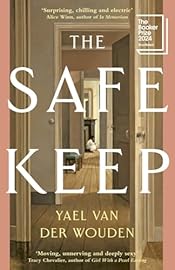
This is another book I’ve read and blogged about (link here). Yael van der Wouden was in conversation with Claire Nichols, presenter of The Book Show on the ABC.
The first thing I have to report is that, if Claire Nichols is to be relied on, the pronunciation of the author’s family name is very close to Fun de Vow-dun. The second thing is that van der Wouden is as much a debut novelist as last night’s panellists. She’s experiencing the first of everything: she’s never been this far from home, she doesn’t know anyone here, she hasn’t talked about herself to rooms full of people before. She’s relieved that she didn’t win the Booker because that would have meant far too much time away from her loved ones.
Apart from that the conversation, or at least my scribbled notes from it, covered four main topics.
First, language. It’s an obvious subject to raise in relation to a book written in English by a Dutch writer. It turns out that English is van der Wouden’s first language. Her mother spoke Hebrew, her father spoke Dutch, and they used English to communicate with each other. She was born in Israel and moved to the Netherlands when she was ten years old. As a result she is ‘proficient in a chaos of three languages’. English is for writing, Dutch is for doing tax returns, etc.
Second, the narrative about World War Two in the Netherlands. In the mainstream version, the Resistance looms large. Only resistance fighters were celebrated on Remembrance Day – it wasn’t until the 1960s that Jews, Roma and other groups were included. The narrative has been changing thanks to the work of many scholars. It’s now generally recognised that the resistance to the Nazis wasn’t as significant as in, say, France, and that seventy-five percent of the Netherlands’ Jews were ‘despatched’, very few returned after the war, and of those many didn’t stay. The novel sits squarely among attempts to retrieve the real story.
Third, sex. In my blog post about the book, I said, ‘At times I felt like averting my eyes, as if I was intruding on intensely intimate moments.’ van der Wouden would have been pleased to read that, as she said that in writing the now famous sex scenes, mainly in Chapter 10, she wanted to make the reader aware that they were a voyeur. When Claire Nichols asked how she did that, she said some interesting things. First, erotic writing only works as a continuation of what has gone before it: in this case the long build up of repressed desire in her main character, Isabelle, at first experienced by her as disgust. The emotional content matters. In writing the sex scenes, she swings between the haptic (things to do with touch), something more abstract, something emotional, then back to the haptic.
Asked about the difference between good and bad sex scenes, she said it’s all about intention. Putting on her hat as creative writing lecturer, she told us that unless the aim is to be funny, the writer needs to commit fully, not lean into comedy or grossness. Surprisingly, she went on to say that it doesn’t work to borrow from your own sexual experience. I think her point was that if you do that you skip the work that needs to happen to take the reader with you. As I don’t have any immediate plans to write erotic scenes, I may not have paid close enough attention to these instructions.
The conversation ended with some reflections about being shortlisted for the Booker Prize, incuding a lovely anecdote about meeting one of her literary heroes at the Booker ceremony and not recognising her. The conversation went like this: ‘Good luck.’ ‘Thank you.’ ‘I’m Sarah.’ ‘Nice to meet you.’ ‘Waters.’ Yael cries.
I went to two more sessions on Saturday. I’ll write about them in my next post.
The Sydney Writers’ Festival is happening on Gadigal land. I have written this blog post on Gadigal and Wangal land, 45 minutes walk away, where the memory of ancient wetlands is currently very strong and the dark is coming earlier every night. I acknowledge their Elders past present and emerging, and welcome any First Nations readers of this blog.


 Me fail? I fly!
I’m a bit behind as we are in FNQ – since Monday – and holiday life is busy. We are heading today up to Cape York and Thursday Island, not returning to Cairns until 8 June. Reception may be poor so I’ve scheduled some posts just to show I’m still here (though of course if a croc gets me who’ll know. I’ll be posting on…)
Anyhow, enjoyed your post. Mr G and I do the Saturday Paper quiz on Saturdays but usually in a cafe over a cuppa.
Enjoyed your post on the discussion with van der Woudon. Do you think she was just heading people off at the pass when she said she didn’t write erotic scenes from personal experience?!
I have a friend here whose parents were in the Dutch resistance. She was saying recently that when they came to Australia, they didn’t mix much with Dutch people because they just didn’t know who had been on what side. I found that really sad – but as a result found your report of her comments interesting.
LikeLiked by 1 person
That is interesting about your Dutch friends. I don’t think she was being coy about the sex thing – but that’s an intriguing possibility
LikeLike
I suspect she wasn’t from what you said but you never know!
LikeLiked by 1 person
Maybe she’s just very skilled at misdirection
LikeLike