Monthly Archives: Jul 2025

Jean-Michel Guenassia, the Incorrigible Optimists’ Club and (not) the book group

Jean-Michel Guenassia, The Incorrigible Optimists’ Club (2011, translation Euan Cameron 2014)
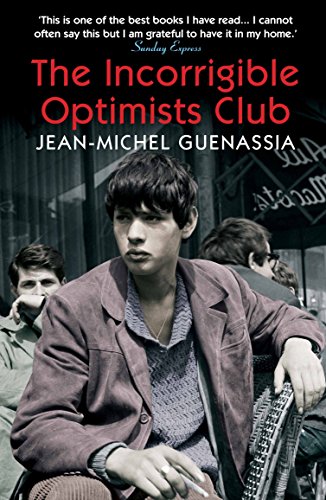
Before the meeting: The Book Group’s designated chooser defied recent practice and chose a long book – 624 pages in my edition. I doggedly put in the time, and had read the book well before the meeting, only to realise that I was away from home on the night and couldn’t be there.

The club of the title is a group of exiles in 1950s Paris who meet in the back room of a bistro, mostly to play chess but also to share news of their homelands, and to argue fiercely about love, politics and life in general. One of the two main strands of the book is made up of their stories. Mostly they are without ID, even stateless refugees or defectors from the Soviet Union. One has actually been a friend of Stalin’s, who defected for love but remains faithful to the Soviet cause. The rest are dissidents or men (they are all men) who were in the wrong place at the wrong time. Jean-Paul Sartre is a member and kind of patron, though after a riveting scene in which he registers news of Camus’ death, he pretty much fades from the narrative.

We see the club and its members through the eyes of Michel Marini, a schoolboy who first visits the cafe to play desktop football (whose French name, ‘baby-foot’, trand). His coming of age story, against the backdrop of the Algerian War of Independence, is the other main narrative strand. Michel befriends Cécile, the girlfriend of his older brother, Frank. Frank bunks off to fight in Algeria, then disappears, only to reappear as a fugitive. Cécile calls Michel ‘little bro’, and neither she nor he realise that he is completely in love with her. Meanwhile, Michel’s parents’ marriage goes through tumultuous times.

It’s never dull, richly political and just as rich in its focus on the storms of adolescence. Yet the blurb describes it as a debut novel. Could this possibly be the work of a young person? I went looking and found that it’s not. According to Wikipedia, Jean-Michel Guenassia is almost as old as me, and was 59 when the book was published. He had in fact previously published one novel, and three TV screenplays and some plays had been produced. The Incorrigible Optimists Club is another example of an overnight sensation that was years in the making.

Euan Cameron’s English version is smooth, lively and engrossing.

Page 78* highlights elements of the book that didn’t feature in that quick overview. But they’re qualities that are important to the way the book draws the reader into the warm embrace of its imagined time and place.

We’re still getting to know Michel before he becomes involved with the Incorrigible Optimists, before the realities of the Algerian War intrude into his life, before his parents’ relationship becomes fully hostile. His father, a small businessman, has just bought a flash car – a DS 19 – and takes it for a spin with Michel in the passenger seat:
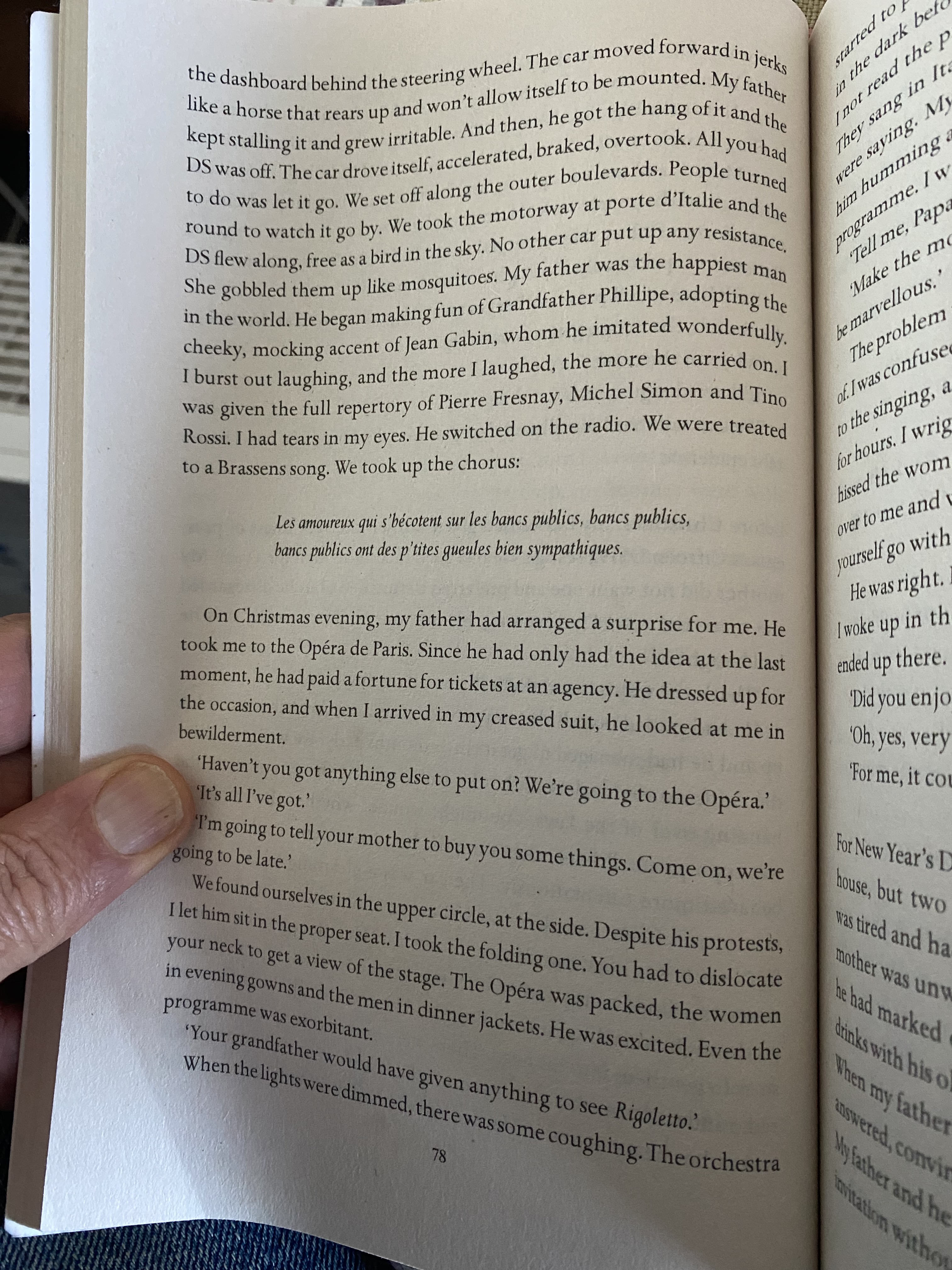
After a rough start, the car behaves like a midlife-crisis dream come true. We’ve been told that Michel’s father loves to impersonate the cool screen actors of the day, and that he is more or less despised by his wife’s upper-class parents, including Grandfather Philippe mentioned here. This paragraph reminds us of that tension, shows him having fun with his son, and at the same time fleshes out the soundtrack of the era. This kind of detail is what brings the narrative alive, even for readers (like me) who have vague to nonexistent knowledge of he singers and actors mentioned:

My father was the happiest man in the world. He began making fun of Grandfather Philippe, adopting the cheeky, mocking accent of Jean Gabin, whom he imitated wonderfully. I burst out laughing, and the more I laughed, the more he carried on. I was given the full repertory of Pierre Fresnay, Michel Simon and Tino Rossi. I had tears in my eyes. He switched on the radio. We were treated to a Brassens song. We took up the chorus:
_ Les amoureux qui s’bécotent sur les bancs publics, bancs publics,
_ bancs publics ont des p’tites gueules bien sympathiques.

Jean Gabin played Maigret in 1958. Pierre Fresnay was the suave Frenchman in La Grande Illusion. Michel Simon was described by Charlie Chaplin as the greatest actor in the world. Tino Rossi, like the others that Michel’s father impersonates, was feted as a film actor who supported the Resistance. Even without all the googling, you can tell that this is a moment when father and son are enjoying each other and loving life, singing together, and celebrating an anti-Fascist strand of French culture.

Here’s a YouTube of George Brassens singing ‘Les amoureux des bancs publiques’. The words don’t really matter, but they translate as ‘The lovers who kiss on public benches, public benches, public benches, have very friendly little mouths.’

Then there’s this:

On Christmas evening, my father had arranged a surprise for me. He took me to the Opéra de Paris. Since he had only had the idea at the las moment, he had paid a fortune for tickets at an agency. He dressed up for the occasion, and when I arrived in my creased suit, he looked at me in bewilderment.
‘Haven’t you got anything else to put on? We’re going to the Opéra.’
“It’s all I’ve got.’
‘I’m going to tell your mother to buy you some things. Come on, we’re going to be late.’
We found ourselves in the upper circle, at the side. Despite his protests, I let him sit in the proper seat. I took the folding one. You had to dislocate your neck to get a view of the stage. The Opéra was packed, the women in evening gowns and the men in dinner jackets. He was excited. Even the programme was exorbitant.
‘Your grandfather would have given anything to see Rigoletto.’

This time Michel doesn’t share his father’s enthusiasm. The tiny incident, especially coming on the heels of the singing together with Georges Brassens, shows us the mutual affecrtion between father and son, as well as the distance that is growing between the generations, both of which become hugely important when the father disapproves of things done by Michel’s brother Frank but makes enormous sacrifices for him.

After the meeting: Sadly, I wasn’t there.


I wrote this blog post on Wulgurukaba land, the luxuriant island of Yunbenun, where cockatoos screech during the day and curlews serenade the night. I acknowledge the Elders past and present, and welcome any First Nations readers.


My blogging practice is to focus on the page that coincides with my age, currently 78.
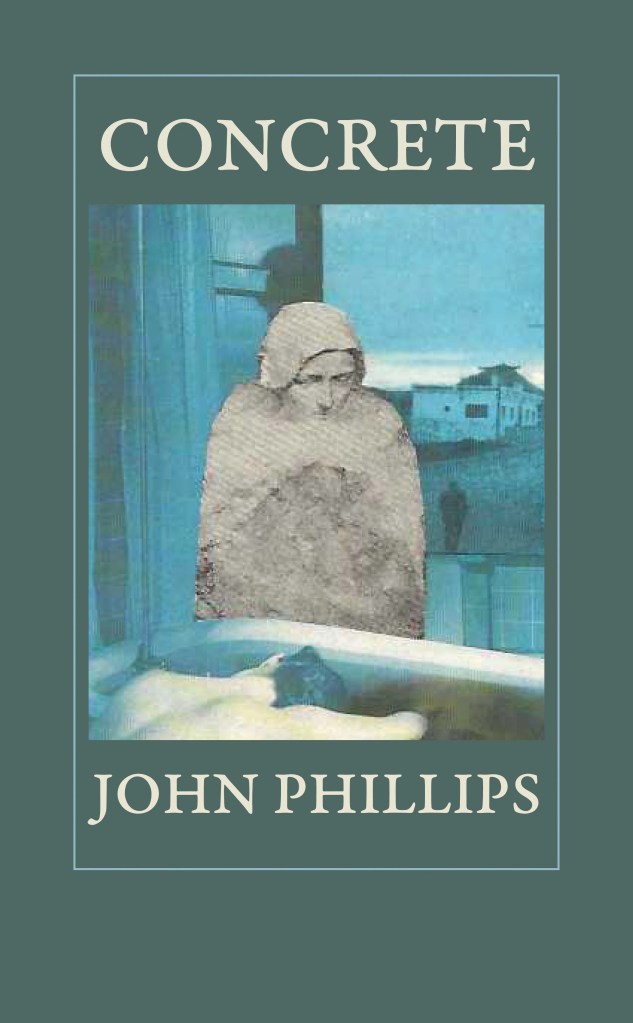
John Phillips’s Concrete

John Phillips, Concrete (Bodily Press 2025)

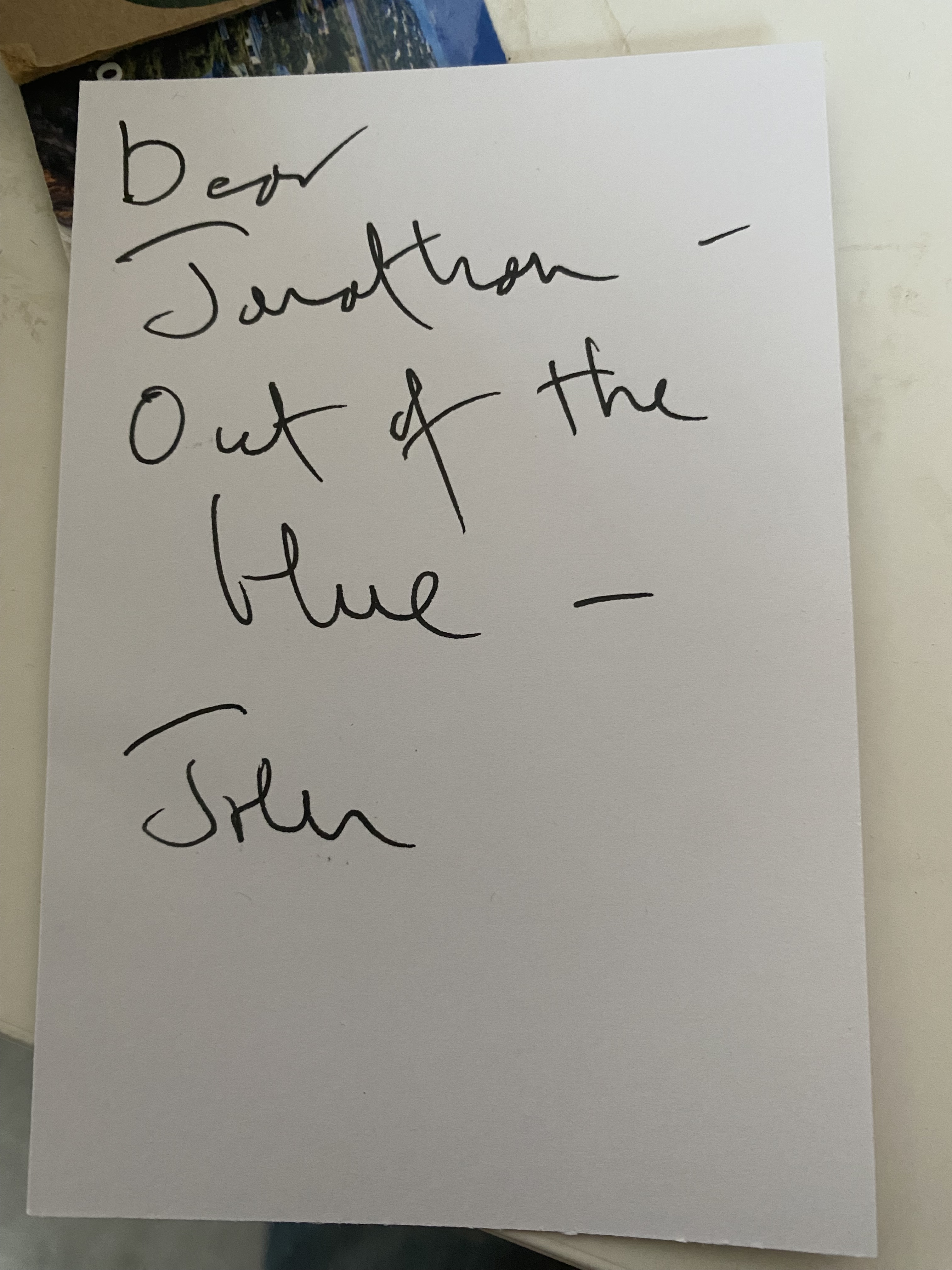
A couple of mornings ago, I opened my letterbox to find an envelope stamped with a profile of King Charles and evidence that someone had paid £4.30 postage to send it to me. It felt like a book, but I hadn’t ordered anything from the UK, and I couldn’t think of anyone over there who might be sending me one. When I opened the envelope and pulled out this slim volume, I was no less bemused. Then, tucked inside the front cover, I found a plain white card:

The man who wrote that, I thought, is a real poet.

Published by The Bodily Press, a small publisher in Amherst, Massachusetts, Concrete is a collection of 26 short, even tiny poems. John Phillips, according to his bio, hails originally from Cornwall and now lives in Slovenia. I can only imagine that he has come across my blog and just wanted me to read his poetry. Somehow the gesture, being ‘out of the blue’ didn’t feel like a request for a review but a friendly offer of connection.

What I want to say about the book is that I enjoyed it! The poems are so short that mostly to quote from one would be to quote all of it. Each of them is like a small huddle of words in the middle of white space, and the meaning of the poem is in the space as much as in the words.

It’s worth noting a feature of the book’s design. Many of the poems have individual dedications, most of them to people I assume are the poet’s friends but some to familiar names like Zbigniev Herbert or Giuseppe Ungaretti. But rather appearing with the poems, these dedications are relegated to a list at the back of the book, leaving the poems themselves to sit on the page clean and uncluttered.

The form perfectly embodies the sense, as most of the poems are about the limits of language, and / or the importance of silence.

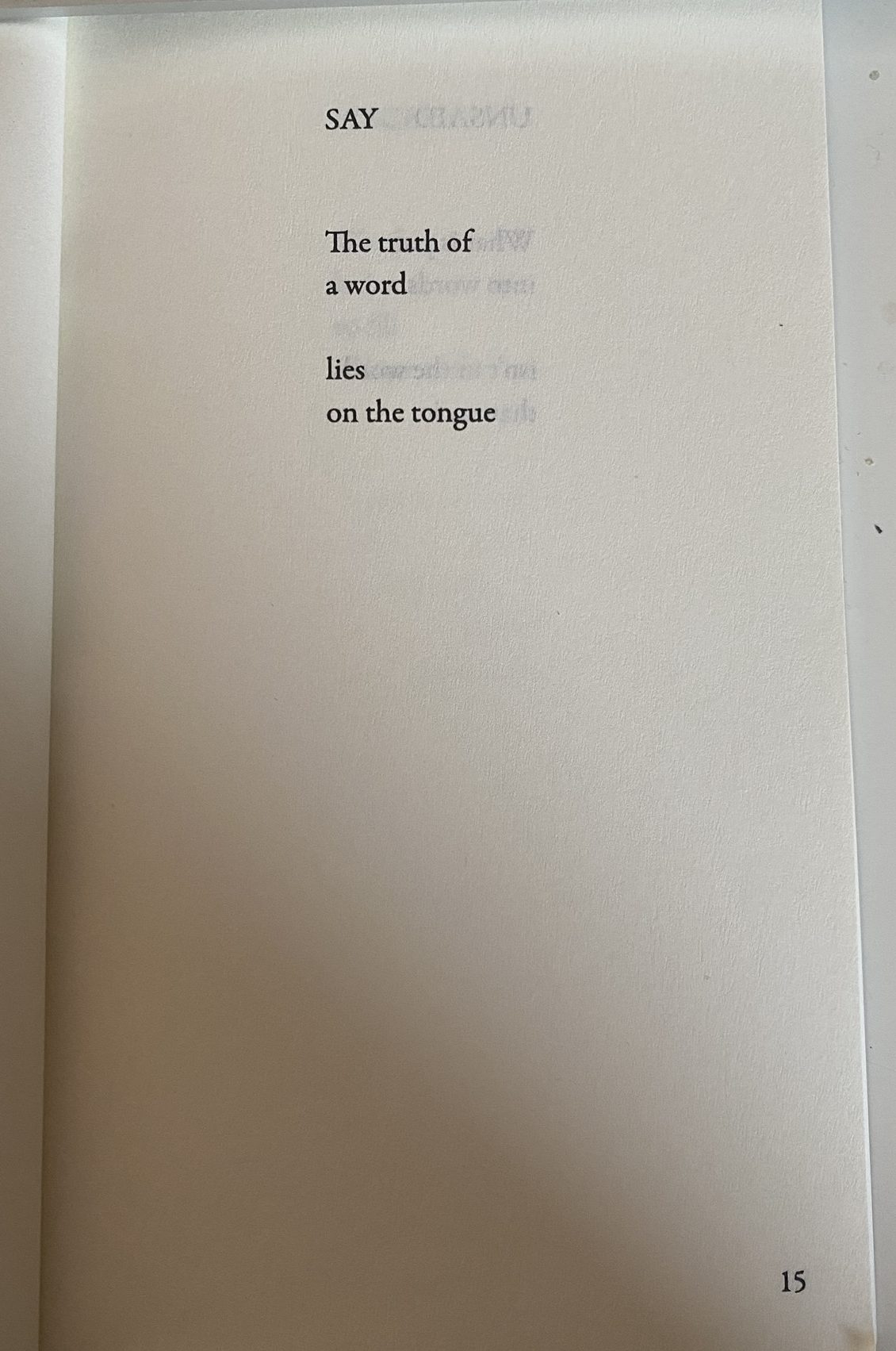
The poem on page 15, ‘SAY’, is a good example:

It’s a poem that makes me want to read it aloud a number of times. Once just for the sound of it. Once, wondering if it’s complete nonsense. Once for the image of the word’s truth staying on the tongue while the word itself, vibrating airwaves, goes out into the world. Once for the pun in ‘lies’. Once to see if I can keep those last two readings in mind at the same time. Once paying attention to the line break after ‘lies’. Once more, taking the poem’s title as an instruction, listening to how my reading aloud relates to my silent reading.

And I end up with a mind full of questions about the connection between thought and speech, speech and silence, written and spoken words, reality and language. Ten simple words in four lines, and a rich moment of silence. What’s not to like?

[John, if you read this, please let me know your land address and I’ll send you a copy of my own chapbook, None of Us Alone. I only have one, compared to your own impressive list of publications.]


I wrote this blog post on the land of the Wangal and Gadigal clans of the Eora nation. I gratefully acknowledge the Elders past and present who have cared for this beautiful country for millennia in song and story.


My blogging practice is focus arbitrarily on the page of a book that coincides with my age, currently page 78. The last poem in this book is on page 34. I’ve stuck with arbitrariness and gone for page 8+7.

Journal Catch-up 31: Overland 256

Evelyn Araluen and Jonathan Dunk (editors), Overland Nº 256 (Spring 2024)
(Links are to the online versions unless otherwise indicated.)

This is the third of four promised editions of Overland dedicated to commemorating its 70th year. In some ways it marks the end of an era as Toby Fitch, who has been poetry editor for a decade, breaks his silence with ‘A farewell and a poem from poetry editor Toby Fitch, 2015–2025‘, and resigns from the ‘simple work, of carving down a cornucopia of submissions into a small set menu for each issue’.

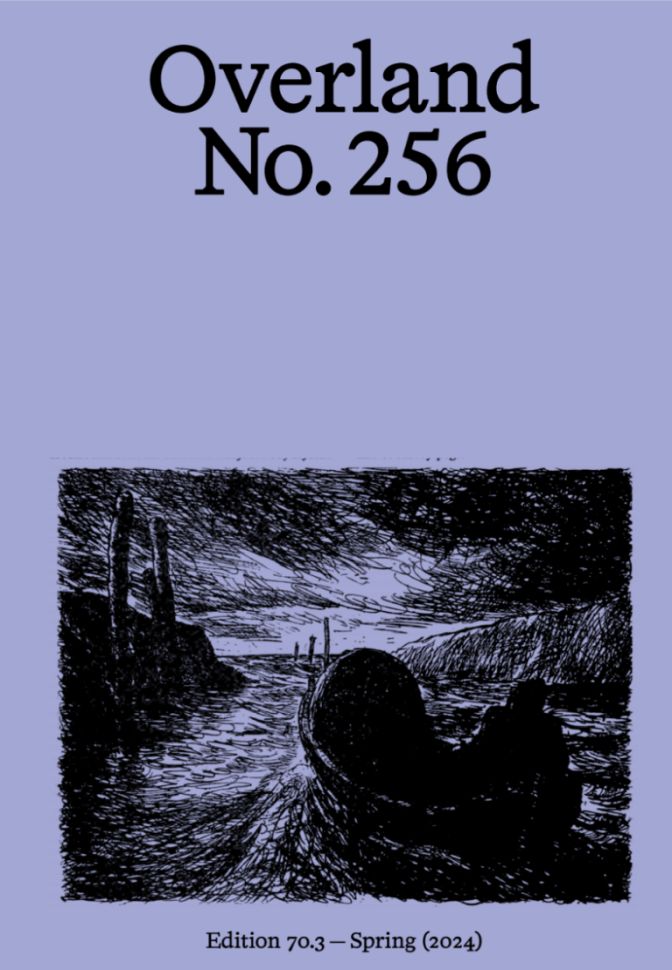
There is an element of nostalgia in the design and the illustrations reproduced from past issues – by artists including Fred Williams (from 1985), Ian Rankin (from 1987) and Richard Tipping (from 1993). The writing by contrast tends more to the urgent.

Plant hatred in our hearts‘ by Sarah Wehbe, ‘the child of refugees who are the children of refugees’, contextualises the current atrocities in Gaza by listing events reported from there in the first week of the writer’s life. The essay includes this, a reminder of Edward Said’s resonant statement that ‘Palestinians have been denied permission to narrate’:

The recent genocide in Gaza has planted hatred in the hearts of its survivors and onlookers, a painful wound so immense that it will continue to throb generations on. Plant hatred in our hearts and watch as hope and resilience grow in its place. Long after the rubble has settled and the refugees have dispersed across the world, we will share our stories. … We are here, we tell our stories, and as long as that is true, there is hope.

There’s a lot else besides. ‘Dust‘ by Lilli Hayes is a brief, harrowing first-hand account of the impact of asbestos-related mesothelioma on her family. In ‘Résonances‘, Daniel Browning – whose book of essays Close to the Subject won the 2024 Prime Minister’s Literary Award – writes about the work of Swiss–Haitian artist Sasha Huber, as seen through an Australian First Nations lens.

There is more poetry than usual (Toby is going out in a blaze of glory). There are some big names, but I’ll just mention ‘speed, a pastoral‘ by Ruby Connor, which has a subtitle ‘(After John Forbes)‘. It doesn’t feel very Forbes-ish to me, but it captures an episode in a young woman’s life in vivid, unpunctuated three-line stanzas.

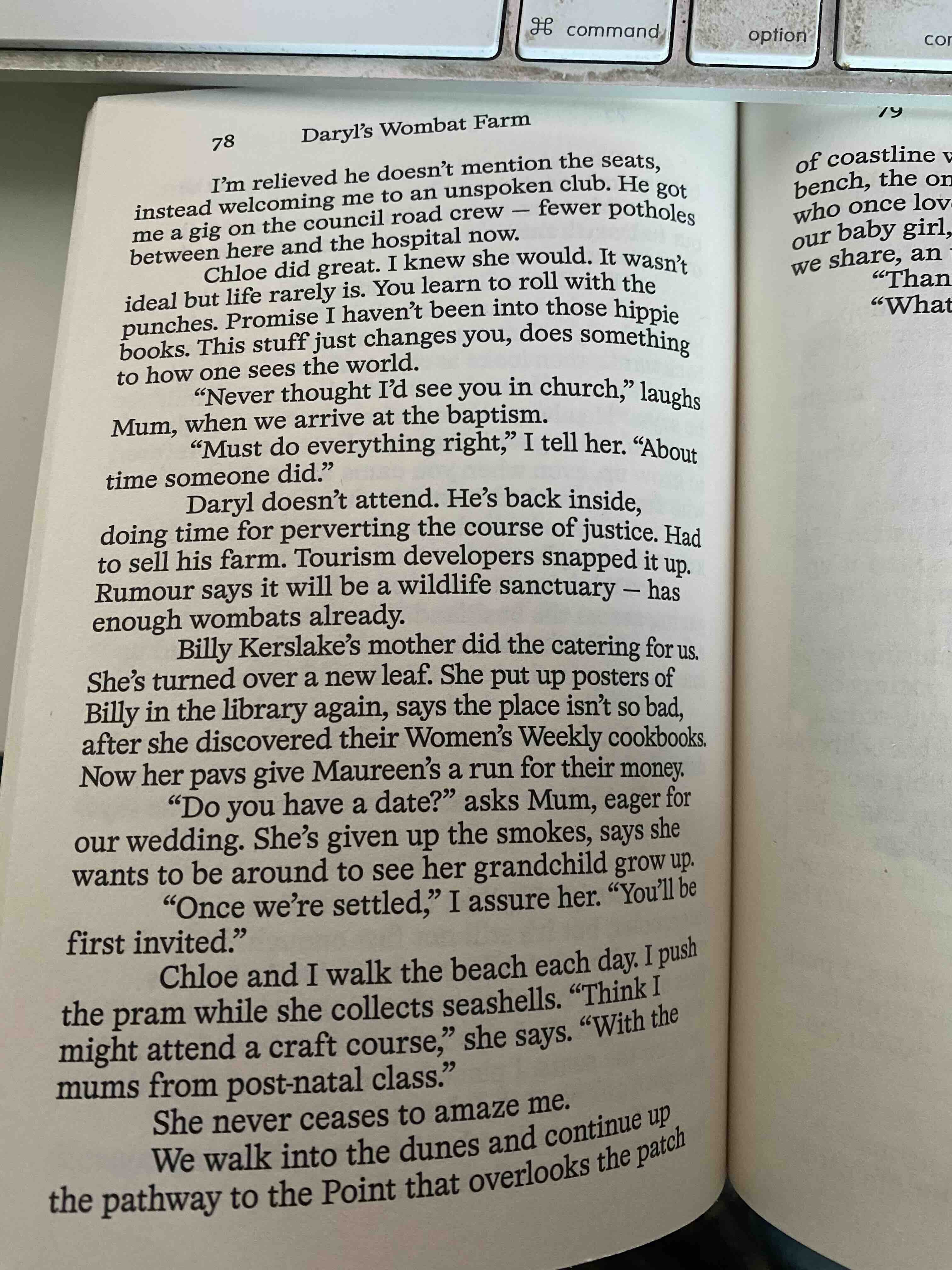
My page 78* practice serves me well with this Overland. It falls in the middle of one of the three pieces selected by fiction editor Claire Corbett, the masterly ‘Daryl’s wombat farm‘ by Rowan MacDonald.

The image gives you an idea of the retro design – the chunky type face and larger font size, and the plain white, matt paper stock. I don’t necessarily prefer this to the modern design, but the larger font is a relief to my ageing eyes, and the poorer paper stock creates a companionable vibe rather than an austerely professional one.

I know I said there’s not much nostalgia in the writing in this Overland. I’ll now contradict myself. This story reminds me solid, social realist, working-class fiction that was a staple of Australian short fiction decades ago. I hasten to add that it does it in a good way.

At the start the narrator, wearing his girlfriend Chloe’s pink gumboots, is shovelling cube-shaped wombat poo. What grows from there is a portrait of a small, marginalised rural community filled with histories of violence, untimely death, ‘unspoken stories’, and a cast of characters who are known only by their first names and vague reference to their status, exploits or fates. Within that portrait is the sweet, elliptically told story of fatherhood.

When I say elliptically-told, I mean it sometimes take a bit of pleasurable work to figure out what’s going on. The beginning of page 78 is an example. The narrator has just returned Curly’s borrowed Skyline (a make of car – my four-year-old grandson would be ashamed of me that I had to look it up) with mess on the seats. Curly, who hasn’t been mentioned previously, doesn’t make a fuss about the mess. Instead he says, ‘Congrats, brother. You’re one of us now.’ Only as the first sentences of page 78 unreel, the reader understands. Curly has played a good role in the narrator’s life in other ways than lending the car, and his ‘one of us’ refers to fatherhood. The narrator has borrowed the car when Chloe was in labour, but didn’t make it to the hospital in time:

I’m relieved he doesn’t mention the seats, instead welcoming me to an unspoken club. He got me a gig on the council road crew — fewer potholes between here and the hospital now.

On the rest of the page, the aftermath of the birth plays out and a number of economically sketched subplots are resolved. The narrator catches himself voicing some of Chloe’s hippie-book-derived philosophy. He has an oblique conversation with his mother about breaking the pattern of neglect and abuse set by his father. Daryl of the wombat farm gets a degree of justice for his role in the narrator’s father’s death. The mother of a missing boy overcomes her dislike of libraries and education enough to put posters back up. Maureen, mentioned once before in connection with pavs, gets another mention. A wedding is mooted. And there’s a tiny, beautifully pitched conversation about the future.

Chloe did great. I knew she would. It wasn’t ideal but life rarely is. You learn to roll with the punches. Promise I haven’t been into those hippie books. This stuff just changes you, does something to how one sees the world.
Never thought I’d see you in church,’ laughs Mum, when we arrive at the baptism.
‘Must do everything right,’ I tell her. ‘About time someone did.’
Daryl doesn’t attend. He’s back inside, doing time for perverting the course of justice. Had to sell his farm. Tourism developers snapped it up. Rumour says it will be a wildlife sanctuary – has enough wombats already.
Billy Kerslake’s mother did the catering for us. She’s turned over a new leaf. She put up posters of Billy in the library again, says the place isn’t so bad, after she discovered their Women’s Weekly cookbooks. Now her pavs give Maureen’s a run for their money.
‘Do you have a date?’ asks Mum, eager for our wedding. She’s given up the smokes, says she wants to be around to see her grandchild grow up.
‘Once we’re settled,’ I assure her. ‘You’ll be first invited.’
Chloe and I walk the beach each day. I push the pram while she collects seashells. ‘Think I might attend a craft course,’ she says. ‘With the mums from post-natal class.’
She never ceases to amaze me.

The story could end there, really, but it continues for another 75 words, and concludes on an explicitly optimistic note that sings:

We hold our baby girl, smile in awe at this creation, the love we share, an unwritten future ahead.
‘Thank you,’ I say to Chloe.
‘What for?’ she laughs.

It’s a story that repays the closer attention that my page 78 practice requires.


I wrote this blog post on the land of the Wangal and Gadigal clans of the Eora nation. I gratefully acknowledge the Elders past and present who have cared for this beautiful country for millennia, and lived through extraordinary changes in the land and climate over that time.


My blogging practice is focus arbitrarily on the page of a book that coincides with my age, currently page 78.

Steve MinOn’s First Name Second Name

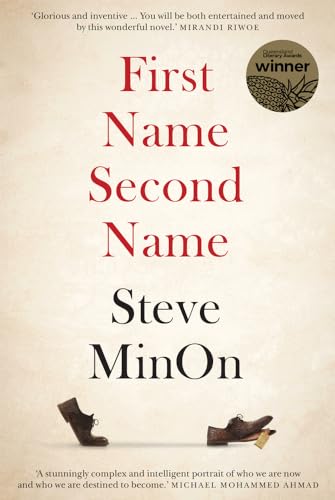
Steve MinOn, First Name Second Name (University of Queensland Press 2025)

A friend told me about this book: ‘A man dies in Brisbane leaving a note that he wants his body to be taken to Innisfail to be buried. When his relatives ignore the note, his dead body rises from the grave and walks there.’

As I may have mentioned once or twice on this blog, I come from Innisfail, Ma:Mu land. Point me in the direction of a book or work of art that features it – a note from a Chinese shopkeepera poem by David Malouf, a social realist novel by Jean Devanny, a memoir by Rebecca Huntley, a TV series by Anthony LaPaglia – and I’ll come running. So I borrowed First Name Second Name from the library.

My friend’s description of the book omitted a couple of key points. The man who dies, Stephen Bolin, is mixed race Chinese, and the note that he leaves asks not just that his body be taken to Innisfail, but that it be strapped to two bamboo poles and then carried there by his sisters, one at either end of the poles. The other key thing my friend didn’t mention is that interspersed with the story of the reanimated corpse’s journey is the history of his family, beginning with his great grandfather Tam Bo Lin on the North Queensland goldfields.

The book progresses in alternate chapters.

The family history chapters progress by leaps and bounds. Tam Bo Lin marries an Irish woman who decides that his personal name, ‘Bo Lin’, will become their family name, ‘Bolin’ (‘First name second name,’ she says, pointing to the marriage papers). After many years he is kicked out of the marital home when his wife discovers that he has been sending money to a wife back in China, married before he came to Australia. His descendants live through Federation, the World Wars, the Depression, the Bjelke-Petersen era and the coming of Pauline Hanson, mostly marry non-Chinese partners, and over the generations they become less and less comfortable in their Chinese heritage. Stephen, who is to become the walking corpse, is a Gay man who hates what he sees as the fetishing of Asian bodies – of his body seen as Asian.

The corpse’s chapters, each titled ‘Jiāngshī’, are told from the corpse’s point of view. He has an irresistible drive to continue walking north, even as his body is decaying, and bits fall off, or are nipped off by a dog or eaten away by worms and insects. Every now and then he is compelled to leap on a living person and suck their life force from them. A couple of chapters in, I googled “Jiāngshī”, and found an ancient Chinese tradition of ‘hopping vampires’ that has inspired a genre of modern books and movies in Hong Kong and elsewhere. I haven’t read or seen any of those works, but I doubt if any of them depict the Jiāngshī as unwilling, agonising characters like Stephen, who takes absolutely no joy from his condition and only dimly understands it.

As the family history approaches the present and Stephen’s corpse nears Innisfail, a question arises: what does it all mean?

Of course, as zombie filmmaker George Romero said, ‘Sometimes a zombie is just a zombie,’ or he may have said, ‘A zombie is always just a zombie.’ (If you can find the actual quote please tell me in the comments.) Sure, a jiāngshī is also just a jiāngshī. It’s hard enough being compelled to walk a thousand miles while dead without having to mean something. All the same, as I read on, a number of metaphorical possibilities hung over the narrative. As a Gay man who had cut ties with his family to live first in Sydney then in London, Stephen as a corpse is compelled to do what his living self needed to do at some deep, unacknowledged level, and reconcile himself with his family, in this case symbolised by the place of his birth. Maybe, stretching it, as a settler Australian he has been deeply influenced by First People’s sense of the importance of Country. Maybe, stretching it in another direction, anyone who comes from Innisfail in particular can’t resist its call, living or dead. Or – and this metaphor is spelled out in the final chapter – having wanted so much to pass as white, he now must return to the Innisfail joss house and be reclaimed by his Chineseness. (Incidentally, the joss house, lovingly described in the relevant chapter as the somewhat neglected building I remember from my 1950s childhood, has been restored in real life and has a notice out the front asking that we not call it a joss house but ‘the Innisfail Temple’. It has a website.)

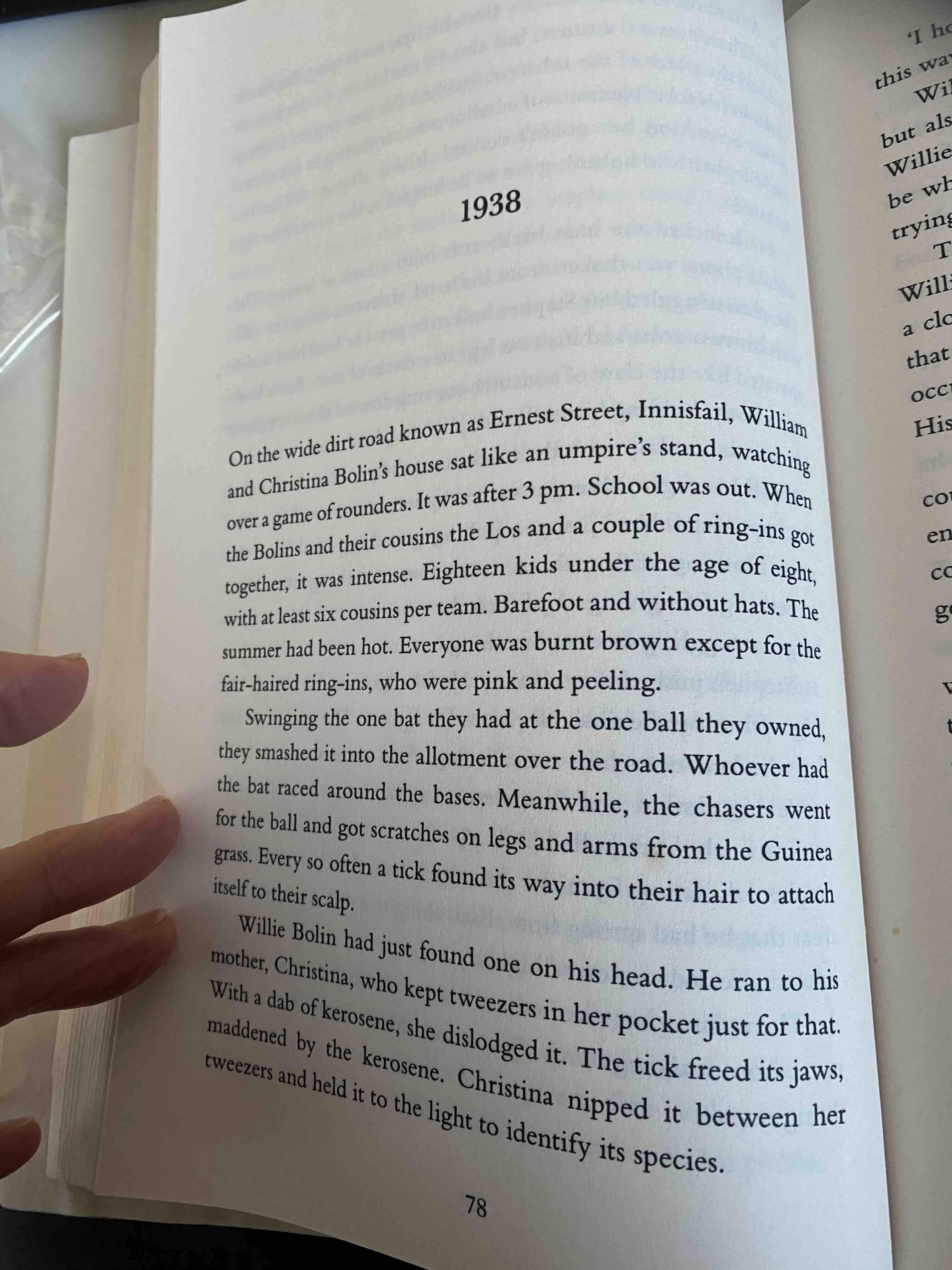
If you picked up a copy in a bookshop and turned to page 78*, you would have no idea you were looking at a zombie-adjacent genre novel. William in this extract is Tam Bo Lin’s son, Stephen’s grandfather. Christina, née Lo, is perhaps the only other Chinese heritage person a Bolin has married.

The chapter begins like all the family history chapters, with the year, and like all the chapters evokes the period and the place with a deft touch:

1938

On the wide dirt road known as Ernest Street, Innisfail, William and Christina Bolin’s house sat like an umpire’s stand, watching over a game of rounders. It was after 3 pm. School was out. When the Bolins and their cousins the Los and a couple of ring-ins got together, it was intense. Eighteen kids under the age of eight, with at least six cousins per team. Barefoot and without hats. The summer had been hot. Everyone was burnt brown except for the fair-haired ring-ins, who were pink and peeling.
Swinging the one bat they had at the one ball they owned, they smashed it into the allotment over the road. Whoever had the bat raced around the bases. Meanwhile, the chasers went for the ball and got scratches on legs and arms from the Guinea grass. Every so often a tick found its way into their hair to attach itself to their scalp.
Willie Bolin had just found one on his head. He ran to his mother, Christina, who kept tweezers in her pocket just for that.
With a dab of kerosene, she dislodged it. The tick freed its jaws, maddened by the kerosene. Christina nipped it between her tweezers and held it to the light to identify its species.

You don’t need to come from Innisfail to enjoy this, but it helps. Ernest Street is still a wide road now, part of the main north-south highway. Guinea grass is an invasive weed in North Queensland, which we used to call blady grass – I have stories about those scratches. Rounders, a poor relation of baseball, was played by the young at least as much as cricket. I would have thought ticks in the hair were less likely than on other parts of the body in those circumstances, but ticks were still an issue, if not on Ernest Street, in the 1950s.

Willy, seen here running to his mother, will fall in love with a white woman and marry her in spite of her abusive father’s racist opposition. He becomes manager of a department store in Proserpine further south, a domineering father deeply disappointed in his effeminate son Stephen.

The page gives you a sense of the quiet, assured story of the family. Add gruesome undead action and who could resist?


I was born and spent my first 13 years on beautiful Ma:Mu country. I wrote this blog post on land of Gadigal and Wangal of the Eora Nation,. I acknowledge the Elders past and present of both countries, never ceded.


My blogging practice is to focus on the page that coincides with my age, currently 78.
Ken Bolton’s Metropole

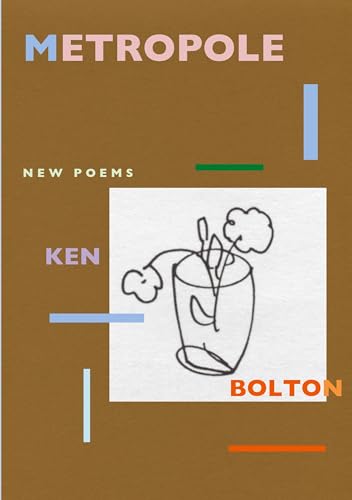
Ken Bolton, Metropole: New Poems (Puncher & Wattmann 2024 )

I’m more than a bit in love with Ken Bolton’s poetry, but I was at a loss what to write about Metropole without in effect repeating what I’d said about his three previous books that I’ve read (you can see those blog posts here, here and here).

Then I saw a headline on the Overland website: ‘The trouble Ken Bolton’s poems make for me, specifically, at the moment’ by Linda Marie Walker. Ah, I thought, someone who hates his poetry! Maybe they’ll point out ingrained misogyny or other cancellable qualities. Someone I can get into an argument with!

No such luck. The article is a very funny account of how Linda Marie Walker has enjoyed three of Bolton’s poems – where the word ‘enjoyed’ has complex meanings. All three poems she discusses appear in Metropole. Her ‘trouble’ with Bolton is partly summed up in this sentence:

These poems are, for me only, perhaps, enormous art museums with small and hopeful labels beside the works, just tempting enough to turn me into a rabbit sitting beside a trap at the mouth of the burrow/hole.

It’s not only you, Linda Marie.

So, rather than someone to fight with, I found someone who can describe the pleasures of these poems infinitely more satisfyingly than I can.

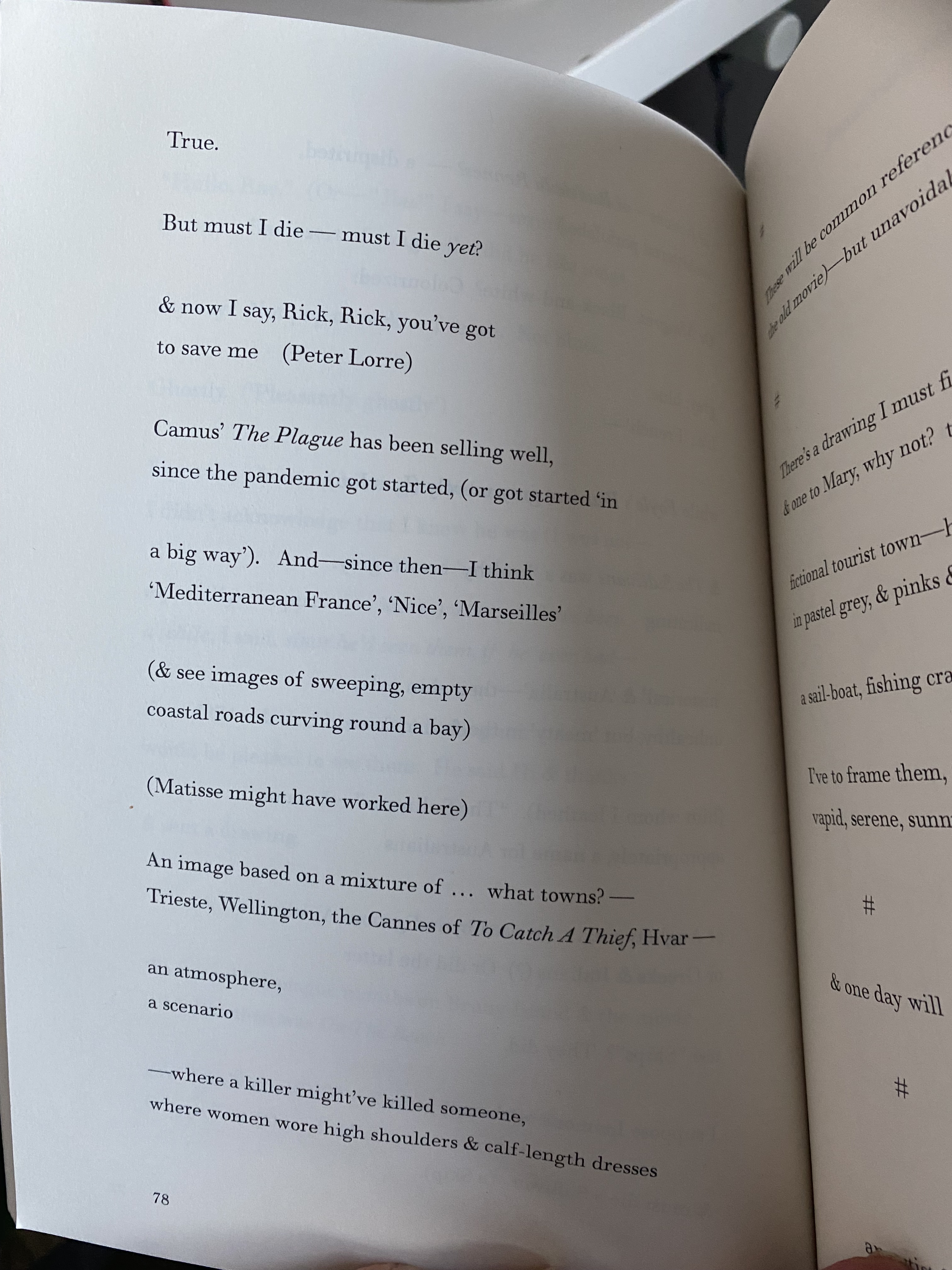
So I’ll stick with page 78*, which is the 12th of 14 pages of the poem ‘A Misty Day in Late July, 2020’, and has its own small and hopeful labels. It’s a Covid poem – specifically, according to one of Bolton’s delightful endnotes, Covid ‘as experienced by Adelaide: a “phoney war” situation as the city at the time remained relatively disease-free’.

The first lines of this page will seem melodramatic when presented without what has gone before:

True.

But must I die – must I die yet?

You could read the preceding pages as designed to blunt the force of that question. They have circled the subject of the Covid pandemic – describing family activities and a richly metaphorical fog on Bruny Island, quoting an ‘unflappable’ writer in the London Review of Books, remembering friends who have died long ago, and referring to movies and TV shows of tangential relevance. Somehow the poem arrives at the 1970s WWII TV series The Sullivans, and Bolton/the speaker remembers that ‘the Sullivans’

_____________________ _______________ became
appropriately, a name for Australians

or Anglo types ... as used by Indigenous Aussies ...
or Greeks & Italians

He supposes he is ‘one of them’ and says he ‘must die a Sullivan’. Almost by accident, it seems, he has explicitly acknowledged the prospect of his own death – and the stark threat from Covid is momentarily present.

True.

But must I die – must I die yet?

The rest of the page is a lovely example of the way Bolton’s poetry fizzes with allusion. (I’m reminded of a favourite line from Martin Johnston: ‘Even my compassion reeks of libraries.’) First, in recoiling from the thought that Covid might kill him, expresses the recoil by quoting from an old movie:

& now I say, Rick, Rick, you’ve got
to save me (Peter Lorre)

That’s from Casablanca, which has been mentioned earlier in the poem because of the fog. I went down that little rabbit hole to watch the scene on YouTube. The actual line is, ‘You must help me, Rick. (Then, as he is being dragged away) Rick! Rick!’ This is not an academic exercise where the quote needs to be exact – the line is quoted as it sits in the poet’s memory.

It turns out that the quote is a bridge back to safe ground. Mention one classic story, and the mind can go to another, and at the comfortable remove provided by sales figures. He also finds reassurance by putting ‘in a big way’ in minimising quote marks:

Camus' The Plague has been selling well, 
since the pandemic got started, (or got started 'in

a big way').

And then he’s away, play on associations with the foggy scene outside.

a big way'). And – since then – I think
'Mediterranean France', 'Nice', 'Marseilles'

(& see images of sweeping, empty
coastal roads curving round a bay)

(Matisse might have worked here)

An image based on a mixture of ... what towns? –
Trieste, Wellington, the Cannes of To Catch a Thief, Hvar –

Bolton is well-travelled. I haven’t been to Trieste, hadn’t heard of Hvar, and have to do a bit of mental calisthenics to see what Wellington and the Cannes of To Catch a Thief have in common – I guess it’s the coastal roads and steep hillsides. A reader could get hung up on not knowing the town referred to, or wondering about Matisse landscapes (and I did just google “Matisse landscapes”). The effect, though, is to find distraction / refuge / escape (?) – the poem’s speaker has travelled in his mind to faraway places, to works of art.

In the last lines on the page, he progresses in his escapist reverie from an image, to an atmosphere, to a scenario. In the final couplet, death again shoulders its way into the picture, to be turned away from in a whiplash switch to images from the old movies:

– where a killer might've killed someone, 
where women wore high shoulders & calf-length dresses

When I read the poem for the first time, I confess I just went with the flow, enjoying the back and forth of image and allusion, picturing Audrey Hepburn and Cary Grant in their convertible on the Corniche. Only reading it now with hands on the keyboard, I can go some way to articulating what’s happening. The final lines of this poem, two pages further on, make new sense to me:

The West has invented
some great glass-bead games

& I have been a sucker for all of them

Hermann Hesse’s The Glass Bead Game is another classic work I haven’t read. According to Wikipedia, the game ‘is essentially an abstract synthesis of all arts and sciences’ which ‘proceeds by players making deep connections between seemingly unrelated topics’. Not a bad description of what happens in Bolton’s poetry in general, and this one in particular. But Bolton doesn’t present himself as a polymath champion of the game. Polymath he may be, but that just makes him a sucker.

This is poetry that cries out for a collaborative reading. Or maybe it’s me that’s crying out – not ‘you’ve got / to save me’ but ‘come and enjoy this with me!’


I wrote this blog post in Gadigal Wangal country, as the days are starting to get longer, and the banksia are in flower. I acknowledge Elders past, present and emerging for their millennial long, and continuing custodianship of this land.


My blogging practice, especially with books of poetry, is to focus on the page that coincides with my age, currently 78.
Jess Hill’s Losing It

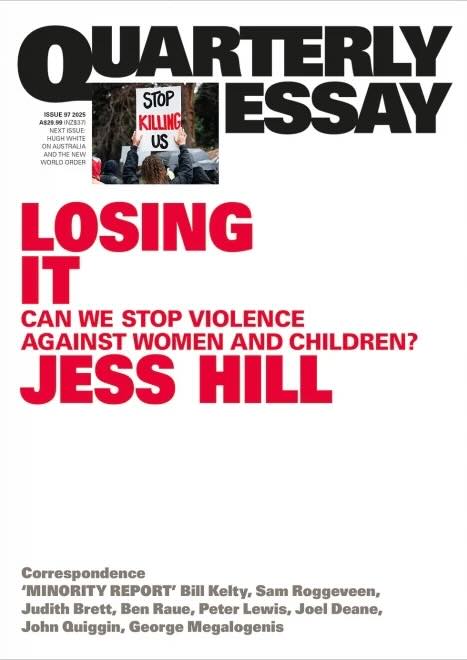
Jess Hill, Losing It: Can We Stop Violence Against Women and Children? (Quarterly Essay 97)
– plus correspondence from Quarterly Essay 98

I came to this Quarterly Essay with a heavy heart, but I’m very glad to have read it, to know that there are people who are tackling a huge evil with intelligence, courage and compassion.

In the final chapter of her groundbreaking 2019 book, See What You Made Me Do (link is to my blog post), Jess Hill wrote:

The mission to transform attitudes to gender inequality and violence is laudable, and will no doubt produce important cultural changes. But as a primary strategy for reducing domestic abuse, it is horribly inadequate. 

Losing It enlarges on that argument. Hill is all in favour of transforming attitudes to gender equality, but argues that an almost exclusive focus on giving that strategy leads to neglect of other significant factors and of strategies other than education and awareness-raising. In Nordic countries, where by most measures gender equality is more established than elsewhere in Europe, there is more violence against women. This is known as the Nordic paradox.

Hill gets into the nitty-gritty of Australian campaigns, and argues that they have stuck to an original plan in spite of evidence that it isn’t working. Although Australia is to be commended for leading the world in funding and developing primary prevention, we are not world leaders in actually preventing violence. The people responsible for developing strategies, she argues, are caught in rigid groupthink.

Advertising campaigns that intentionally or otherwise shame perpetrators can actually increase violence, because a lot of violence has shame somewhere at its root.

School education session on consent and gender equality are up against the enormous influence of internet personalities like Andrew Tate, and beyond them of ‘co-ordinated, strategic and incredibly well-funded’ organisations with anti-rights agendas around the world. Sexual violence is being reported by ever younger male perpetrators. On page 40, Jess Hill quotes Deanne Carson, an ‘external educator’ who teaches the Respectful Relationships program in Victorian schools:

Every single classroom I go into, I have children who have been raped. I have children who have sexualy abused other children.

Regulation of alcohol and gambling is needed; likewise more nuanced understanding of what is happening in the lives and minds of men who perpetrate violence. More attention is needed to the situation of child victim-survivors, especially when they are not accompanied by a victim-survivor mother. Something with the benign name of ‘alternative care accommodation’ can be a horror show.

There’s a ‘fifty-year-old turf war’ between the adherents to the ‘feminist’ model and the ‘psychopathological’ model. The quote marks are important: not all feminists and not all psychologists are in the trenches, but non-warriors tend to be sidelined in the policy debates. Hill argues for a ‘properly negotiated peace’ between the sides:

Australia’s prevention strategy should be alive to how gendered violence is driven by power imbalances – from gender inequality to homophobia, racism, economic inequality and ageism – as well as by suffocatingly narrow models for masculinity. But it must also strive to stop violence passing from one generation to the next, which requires a much stronger focus on preventing child mistreatment, helping children and victimised parents recover, placing more limits on harmful industries, helping men who are willing to do the work to heal, and keeping women and kids safe from the men who won’t. It’s only by integrating both viewpoints – feminism and psychopathology – that we can start to truly comprehend the phenomenon of men’s violence against women and children and find effective ways to stop it (pages 73-74).

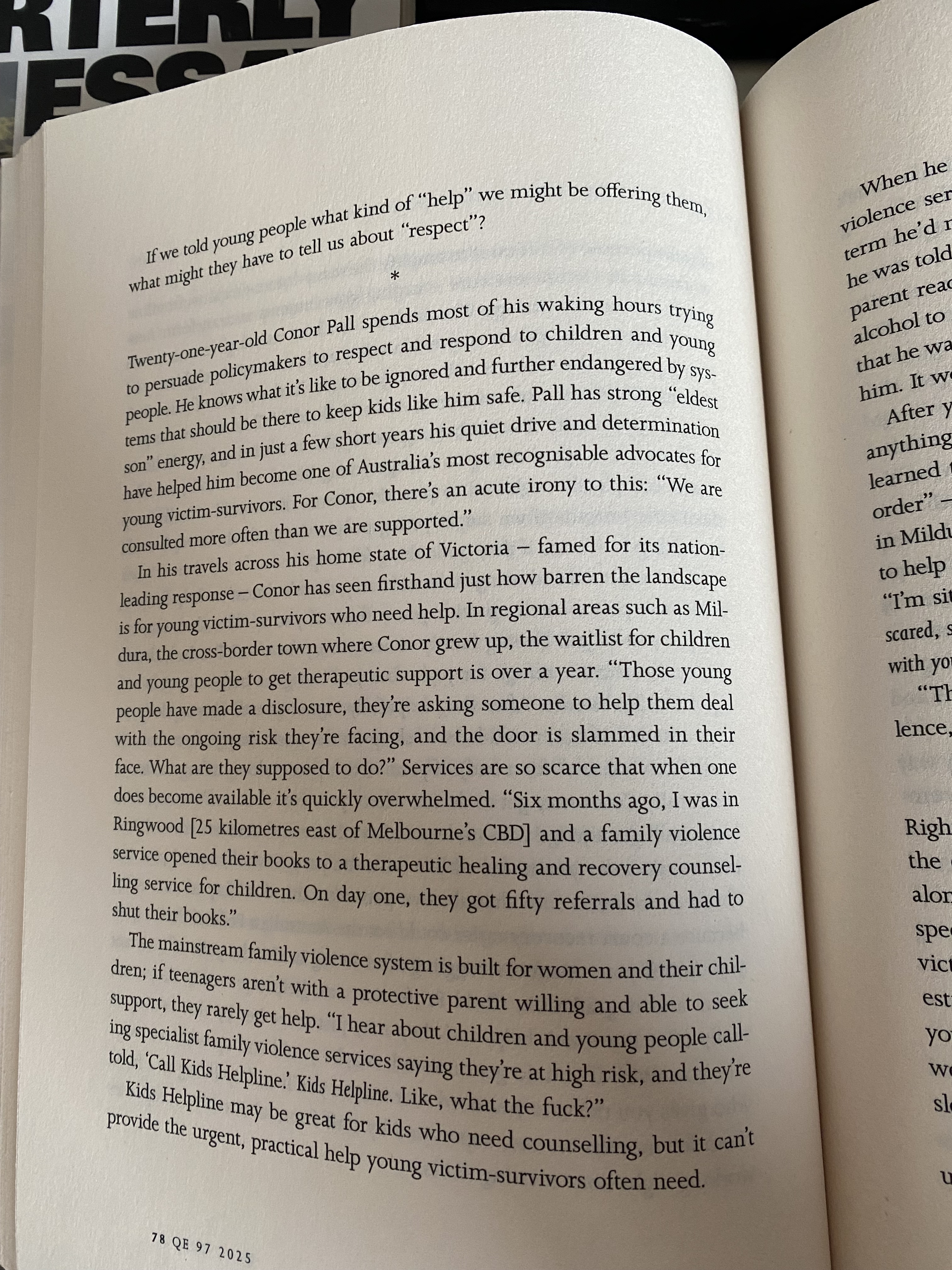
Page 78* is in the six-page section ‘State of Neglect’, which discusses our collective failure to provide systems that would keep children safe, including people who get into violent intimate relationships in their teens.

The previous page has given a list of appalling options. This page begins with a barb at ‘respect education’:

If we told young people what kind of ‘help’ we might be offering them, what might they have to tell us about ‘respect’?

The rest of the page is an excellent example of what Jess Hill has described, also on the previous page, as the purpose of the essay: ‘to amplify the many voices … urging governments to transform Australia’s prevention strategy.’

Twenty-one-year-old Conor Pall spends most of his waking hours trying to persuade policymakers to respect and respond to children and young people. He knows what it’s like to be ignored and further endangered by systems that should be there to keep kids like him safe. Pall has strong ‘eldest son’ energy, and in just a few short years his quiet drive and determination have helped him become one of Australia’s most recognisable advocates for young victim-survivors. For Conor, there’s an acute irony to this: ‘We are consulted more often than we are supported.’
….. The mainstream family violence system is built for women and their children; if teenagers aren’t with a protective parent willing and able to seek support, they rarely get help. ‘I hear about children and young people calling specialist family violence services saying they’re at high risk, and they’re told, “Call Kids Helpline.” Kids Helpline. Like, what the fuck?’
Kids Helpline may be great for kids who need counselling, but it can’t provide the urgent, practical help young victim-survivors often need.

Voice amplified, even before the brief description on the next page of Conor’s own experience ‘surviving after surviving’.


The correspondence in Quarterly Essay 98, Hard New World by Hugh White, is what you would expect, given the existence of a turf war. Some of the leading figures in the main government programs respond with understandable ire, saying the essay ‘lacks any nuanced discussion of the kinds of intersectional solutions needed’ and insisting that current strategies are based on sound research and wide consultation (Patty Kinnersly, CEO of the primary prevention organisation Our Watch); that it’s divisive, makes sweeping public critique of the workers in the field, is misleading and harmful (Helen Keleher, lead researcher and writer of the framework Hill criticises). I am absolutely in no position to judge the rightness and wrongness of the various arguments, but I do note that there’s a moment when Keleher accuses Hill of using ‘a recurring straw-man fallacy to position feminism as an obstacle to the prevention of violence against women’, which is itself a total straw man, as Hill doesn’t make that argument at all.

Of the other correspondents, the most horizon-broadening is a brief, revelatory essay on ‘how family violence is facilitated within Australia’s migrant and ethnically diverse communities’ by Manjula Datta O’Conor, a founding director of the AustralAsian Centre for Human Rights and Health and author of Daughters of Durga: Dowries, Gender Violence and Family in Australia. I’ll give her the last word here:

If we are to reduce the rates of family and domestic violence, we must look unflinchingly at all contributing factors. Mental health is one of them. That means rethinking how we design perpetrator intervention programs. It means integrating mental health support, not as an excuse but as a method of accountability.


I wrote this blog post on the still-beautiful land of Gadigal and Wangal of the Eora Nation. I acknowledge their Elders past and present.


My blogging practice is focus arbitrarily on the page of a book that coincides with my age, currently 78. It’s like a lucky-dip sampling of the book.
Richard Tipping’s Instant History

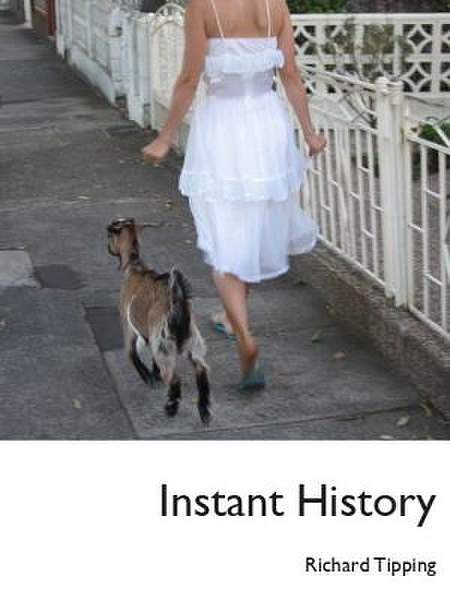
Richard Tipping, Instant History (Flying Island Poets, 2017)

As a subscriber to Flying Island Poets, I receive a bundle of ten books at the start of each year. The pocket-sized books belie their miniature appearance by being substantial poetry collections. Taken as a bundle they are wonderfully various – poets being published for the first time and poets with established reputations, embittered old poets and bright-eyed young ones, Chinese poets and poets from rural Australia (Flying Island’s co-publishers are Cerberus Press in Markwell via Bulahdealh and ASM in Macao).

I was delighted to find Instant History in my bundle this year. Richard Tipping is a multi-disciplinary creator whose work I have been encountering and enjoying for more than 50 years.

Probably my first encounter was the poem ‘Mangoes Are Not Cigarettes’ performed as a duet with Vicki Viidikas in the Great Hall at Sydney University in the early 1970s, then reprised immediately as ‘Oysters Are Not Cigarettes’. (That poem lives on – I just found the text, with photos, on Michael Griffith’s blog at this link.)

Tipping’s ‘signed signs’ appear regularly at Sydney’s Sculpture by the Sea. Photos of a couple of them have featured in recent issues of Overland: in issue 255 two chunky rocks near the shoreline bear gold leaf lettering, ‘SEA THREW’; in issue 256 a road sign reads, ‘FORM 1 PLANET‘.

Tipping’s Wikipedia page lists poetry, art, spoken word, documentary films, an art gallery, and more. Yet he doesn’t look at all exhausted in his cover photo.

Instant History bristles with quotable lines. Rather than focusing on just page 78*, here goes with a brief description of each of its four parts and a couple of lines from each.

‘The Postcard Life’ comprises 33 mostly short, impressionistic poems that are like, well, postcards from travel destinations from New York City to the Malacca Strait. My favourite in this section is ‘Snap’, a collection of short poems that are either haiku-like or snapshot-like, depending on your point of view, that capture a visit to Japan, individually and cumulatively wonderful. For example:

Bullet train to Kyoto
speeding by still river, reflecting rain
Chain-smoking chimneys
Greyroofed villages, rice fields, cement

‘Rush Hour in the Poetry Library’, for me the most memorable section, has 28 poems that are mainly about art and works of art. I particularly like ‘On Film (for Steve Collins, editor)’, which reads to me as a poem gleaned from conversations with its dedicatee. It begins with this resonant paradox:

Film is painting in light with time 
for the ears' extra pleasure
even if the pictures are better on radio

‘Earth Heart’ has just nine poems, and includes images of his typographic visual poem ‘Hear the Art (Earth Heart)’ – if you write either of those phrases out a couple of times without word spaces, you have the poem, a wordplay that absolutely sings. Its appearance in this book is one of many manifestations. For a land art version in the grounds of the Lake Macquarie City Art Gallery, you can go to Richard Tipping’s website.

‘Kind of Yeah’, the final section, feels mostly like a bit of fun with the vernacular, nowhere more so than in ‘Word of Mouth’ which includes this:

It was hair-raising, pulling your leg,
turning the other cheek; quick as a wink
you got me by the short and curlies
just as I'd finally got my arse into gear.

That’s just a taste. There’s politics, Buddhism, whimsy, and always a sense of performance, in the best senses of the word.


I wrote this blog post on land of Gadigal and Wangal of the Eora Nation, and finished it in a brief pause from heavy rain. I acknowledge the Elders past and present of this country, never ceded, and welcome any First Nations readers.


My blogging practice, honoured in the breach here, is to focus on the page of a book that coincides with my age, currently 78.