
John Phillips, Concrete (Bodily Press 2025)
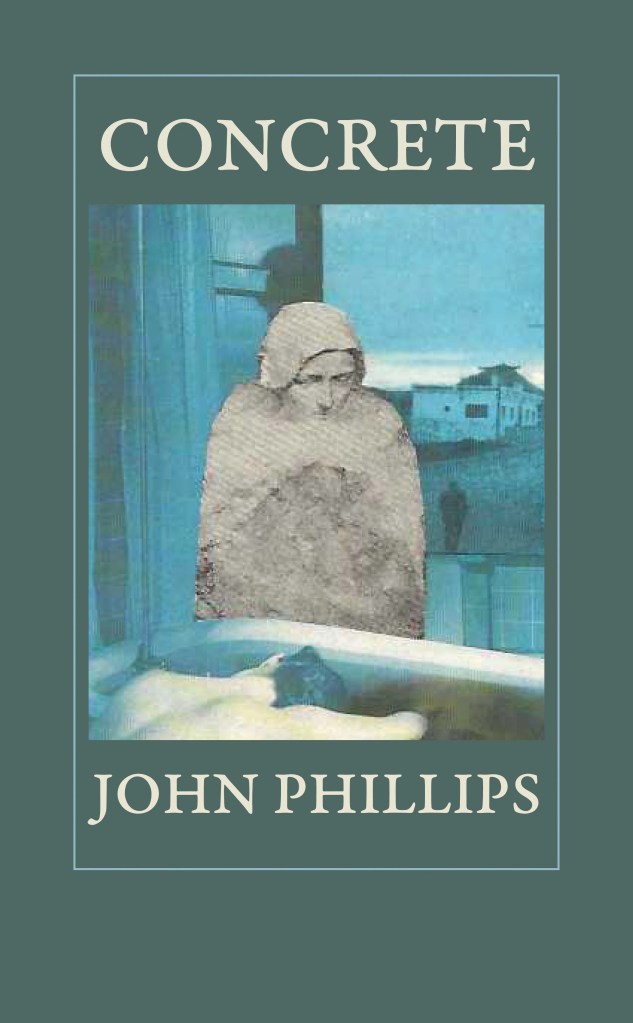
A couple of mornings ago, I opened my letterbox to find an envelope stamped with a profile of King Charles and evidence that someone had paid £4.30 postage to send it to me. It felt like a book, but I hadn’t ordered anything from the UK, and I couldn’t think of anyone over there who might be sending me one. When I opened the envelope and pulled out this slim volume, I was no less bemused. Then, tucked inside the front cover, I found a plain white card:
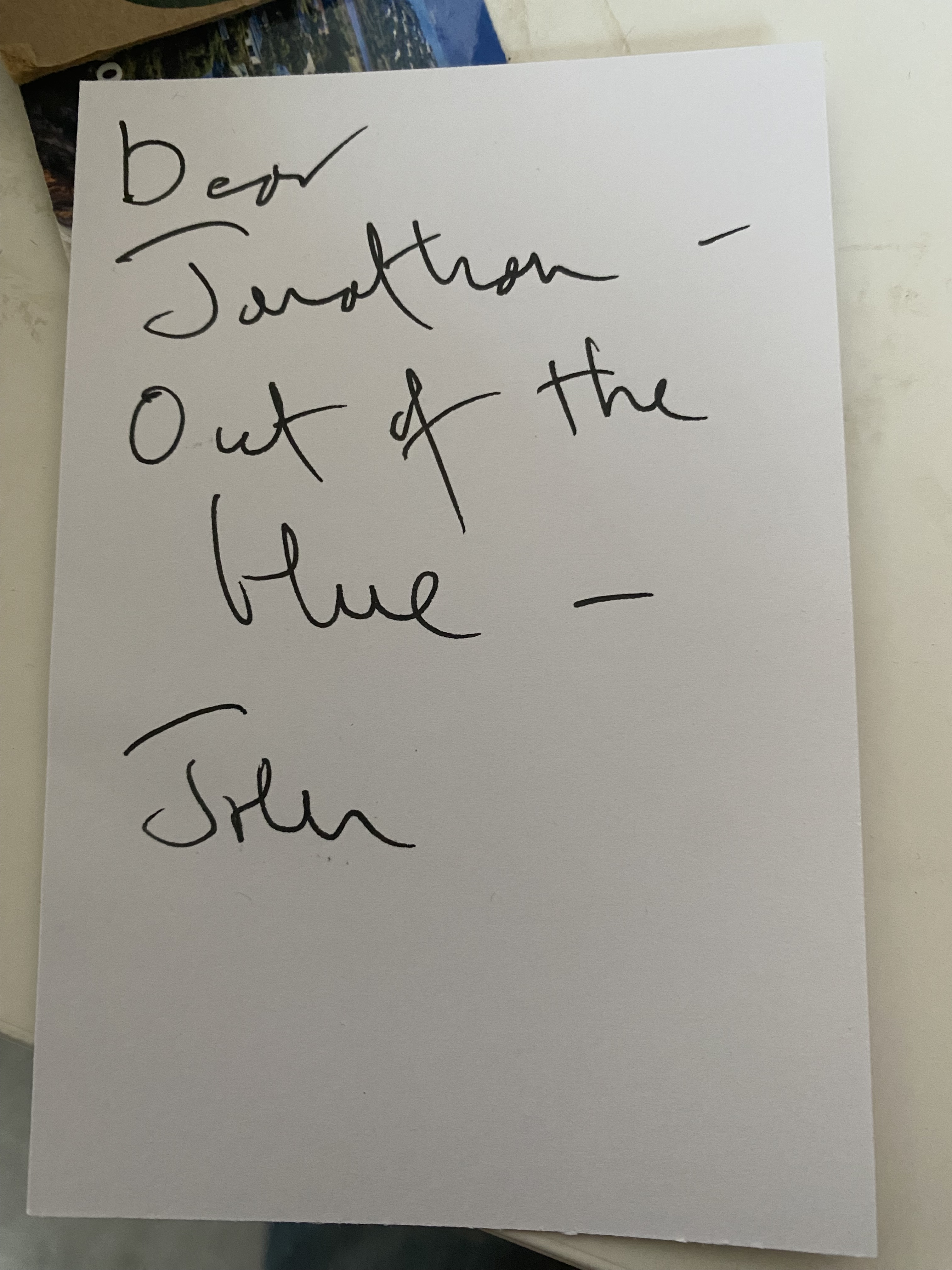
The man who wrote that, I thought, is a real poet.
Published by The Bodily Press, a small publisher in Amherst, Massachusetts, Concrete is a collection of 26 short, even tiny poems. John Phillips, according to his bio, hails originally from Cornwall and now lives in Slovenia. I can only imagine that he has come across my blog and just wanted me to read his poetry. Somehow the gesture, being ‘out of the blue’ didn’t feel like a request for a review but a friendly offer of connection.
What I want to say about the book is that I enjoyed it! The poems are so short that mostly to quote from one would be to quote all of it. Each of them is like a small huddle of words in the middle of white space, and the meaning of the poem is in the space as much as in the words.
It’s worth noting a feature of the book’s design. Many of the poems have individual dedications, most of them to people I assume are the poet’s friends but some to familiar names like Zbigniev Herbert or Giuseppe Ungaretti. But rather appearing with the poems, these dedications are relegated to a list at the back of the book, leaving the poems themselves to sit on the page clean and uncluttered.
The form perfectly embodies the sense, as most of the poems are about the limits of language, and / or the importance of silence.
The poem on page 15, ‘SAY’, is a good example:
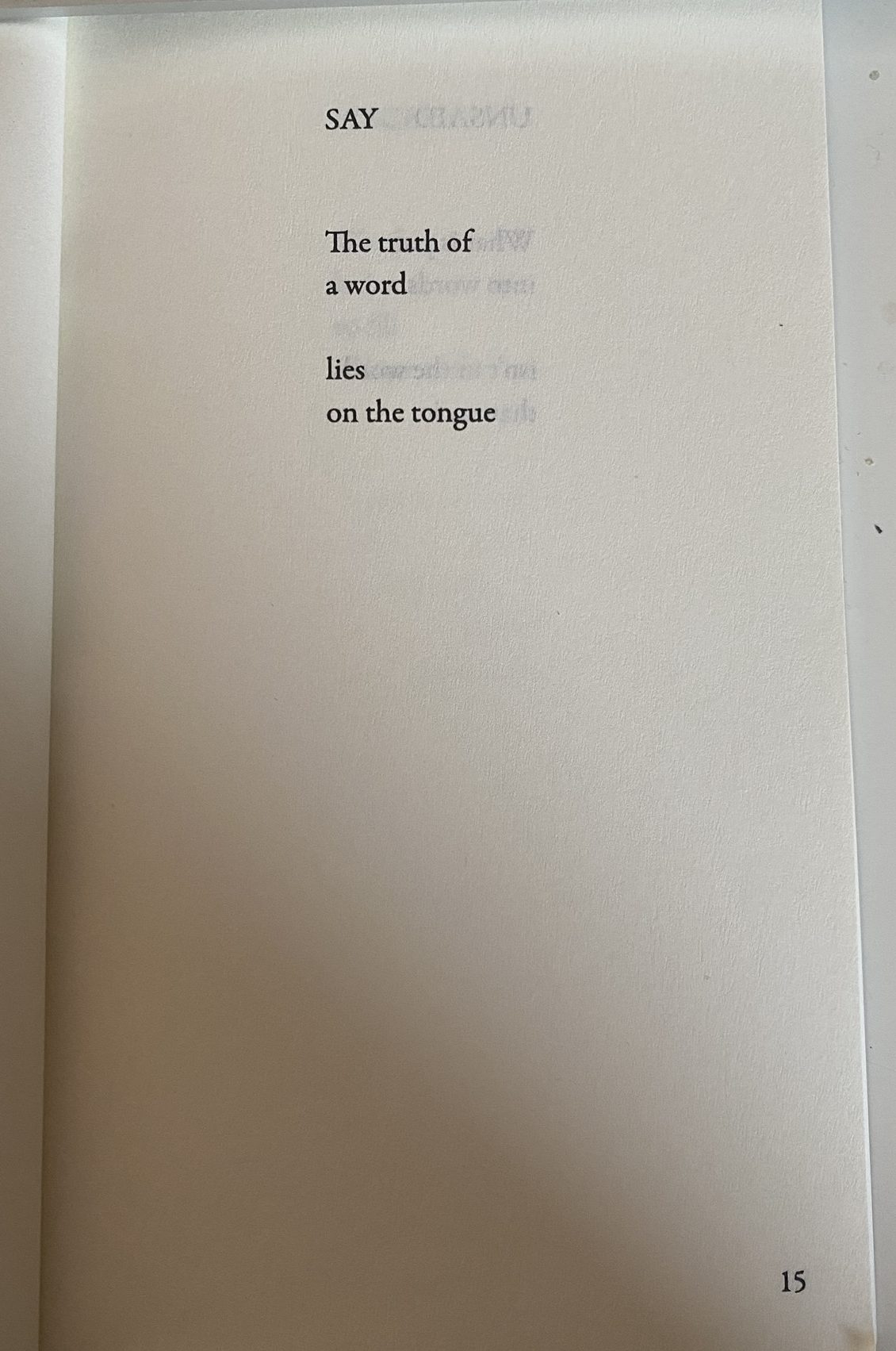
It’s a poem that makes me want to read it aloud a number of times. Once just for the sound of it. Once, wondering if it’s complete nonsense. Once for the image of the word’s truth staying on the tongue while the word itself, vibrating airwaves, goes out into the world. Once for the pun in ‘lies’. Once to see if I can keep those last two readings in mind at the same time. Once paying attention to the line break after ‘lies’. Once more, taking the poem’s title as an instruction, listening to how my reading aloud relates to my silent reading.
And I end up with a mind full of questions about the connection between thought and speech, speech and silence, written and spoken words, reality and language. Ten simple words in four lines, and a rich moment of silence. What’s not to like?
[John, if you read this, please let me know your land address and I’ll send you a copy of my own chapbook, None of Us Alone. I only have one, compared to your own impressive list of publications.]
I wrote this blog post on the land of the Wangal and Gadigal clans of the Eora nation. I gratefully acknowledge the Elders past and present who have cared for this beautiful country for millennia in song and story.
* My blogging practice is focus arbitrarily on the page of a book that coincides with my age, currently page 78. The last poem in this book is on page 34. I’ve stuck with arbitrariness and gone for page 8+7.


 Me fail? I fly!
Thanks Jonathan! I read the poem that you included and thought – ok – but then I read your discussion of it and my mind expanded, seeing its cleverness and beauty.
LikeLiked by 1 person
Thanks, Kathy. A lot of the poems in this book are like that: ok, you think, but they leave a kind of itch. And when you scratch it the poem expands
LikeLiked by 1 person
A wonderful review! Thank you! I especially love this sentence about the poems:
“Each of them is like a small huddle of words in the middle of white space, and the meaning of the poem is in the space as much as in the words.”
Here is another of the poems from the book:
THIS
What you do with
your silence
is up to you
What I do with mine
is this
—- The cover of the book is a collage by John Phillips. The book itself is beautifully designed and printed. As you say, “What’s not to like?”
John Levy
LikeLike
Thanks, John. I nearly quoted that one in my blog post. I don’t know if you or John Phillips are aware of MoodPo the online course on Modern and Contemporary American Poetry (I think that’s its correct name). Al Filreis, the presiding genius of the course, often plays with the word ‘this’ to make a point about Emily Dickinson’s poetry – I think he wold approve of this metapoetic use of the word.
LikeLike
P.S. In the poem I quote, “THIS,” there is a stanza break between the third and fourth line. I had thought I typed it with the spacing to indicate the stanza break, but it came out looking like the poem is a single stanza, which it is not. Even the stanza breaks, in these poems, are full of meanings.
John Levy
LikeLike
I’ve fixed it, John. I agree, the breaks are full of meanings – and I like your plural there.
LikeLike
There are so many things to like about this story.
LikeLiked by 1 person