
Debra Oswald, One Hundred Years of Betty (Allen & Unwin 2025)
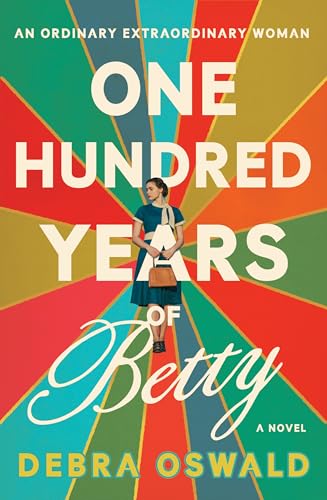
Long before the meeting: If not for the Book Club, I would have put this book aside at page 14. Betty is the seventh child in a desperately poor family in South London. Her Catholic mother dies soon after giving birth to a tenth live child. As Betty and her Protestant father emerge from church they pass the two priests who have said the funeral Mass, one ‘in a creamy chasuble with scarlet embellishments, the other sporting a gold-embroidered number’. Betty’s father delivers a tirade:
Tell my daughter Betty the truth on this day we’re burying her poor Catholic mother. Tell her that it’s all a lie and that you two – with your fancy clothes and your Latin gibberish and your snouts in the trough – you know it’s a lie. Your religion is a pack of fairy stories to bamboozle poor people and keep us in line. Tell her.
I don’t mind a bit of anti-Catholic vitriol. In my devout childhood I was intrigued by mockery of the saints in a Walter Scott novel, and as a 17-year old trainee religious I was thrilled by Dostoevsky’s Grand Inquisitor. BUT this just gets too much wrong. Two priests saying Mass for a poor person’s funeral? Not likely! Even one priest standing at the door of the church still wearing his vestments? Also not likely! And even a quick google would have told the author (or certainly her editors) that priests wore black chasubles at funerals – never cream or (gasp!) scarlet.
But what the Book Club wants …
Before the meeting: I did persevere. It’s not a terrible book, and there were no other moments that felt so wrong.
Betty works in a factory, emigrates to Australia, falls in love and makes two lasting friendships on the ship, marries a rich man who becomes abusive then kills himself leaving her destitute. She has two children each of whom is problematic, protests against the Vietnam War, joins Women’s Liberation, spends some time living in Mexico where she loves swimming in cenotes, comes back to Australia for her daughter’s wedding, works in television where she eventually becomes a writer, has her heart broken a number of times, helps out in an AIDS ward, has a severe depressive episode, develops breast cancer, finds happiness when reunited with her first love, sees friends die. Oh, and there’s a daughter she gave out for adoption before leaving England. As she moves through the phases of her life her name changes: Betty, Beth, Elizabeth, Lizzie, Liz, and finally back to Betty. Sometimes I cared and was engaged, sometimes not so much. I did laugh a number of times.
I never got a feel for the narrative voice – the voice of 100-year-old Betty. There are self-conscious moments when Betty warns us (mostly disingenuously) that things won’t turn out as they do in novels, or expects us to be surprised at her earthiness, but these don’t create the sense of an actual person telling the story.
The penny dropped for me in Chapter 16, when a friend urges 63-year-old Betty to pitch a long-held idea for a show to a TV channel. Betty realises she no longer has ‘the stamina to deal with the machinery of TV drama, the muscle spasms of hope and dejection, the delicate calculations of conciliation and obstinacy required of you’. That night in bed, her husband suggests that she could put the idea into novel form, and Betty’s career as a novelist is launched.
Ah! I thought. One Hundred Years of Betty is really the treatment for a TV show. When it makes it to the screen, which is very likely, I’ll be happy to watch it.
I’m sorry to be so negative. I may have come to the book with inappropriate expectations. Maybe I was wanting the story of an individual life told in the context of world events in the manner of Annie Ernaux’s The Years, Alan Hollinghead’s Our Evenings, or Ian McEwan’s The Lesson. Maybe I expected a fictionalised treatment of Debra Oswald’s mother’s generation, something probing and compassionate. This isn’t one of those books, and nor does it need to be.
After the meeting: Unusually, we met in a pub. As always with the Book Club, we had two books on our agenda. The other one, Susan Hampton’s Anything Can Happen, took up most of the discussion.
One of the other Catholics said she registered the problems with the post-funeral scene that so irritated me, but it hadn’t disturbed her. One of the non-Catholics said the scene felt very Anglican to her rather than Catholic.
A couple of people felt there was a box-ticking element: the songs, devices, events more or listed as a way of marking the different eras. Others felt that was a feature rather than a bug. Betty’s life touches on major events of her times, is sometimes significantly changed by them, without their ever becoming her central passionate concerns.
Someone described the book as an excellent summer beach read, engaging enough to keep you entertained without making big demands. She said it a lot better than that, and I think we all agreed.
The Book Club met, and I wrote this blog post, on land of Gadigal and Wangal of the Eora nation. I acknowledge their Elders past present and emerging, and gratefully acknowledge their care for this land for millennia. I welcome any First Nations readers of this blog.


 Me fail? I fly!