
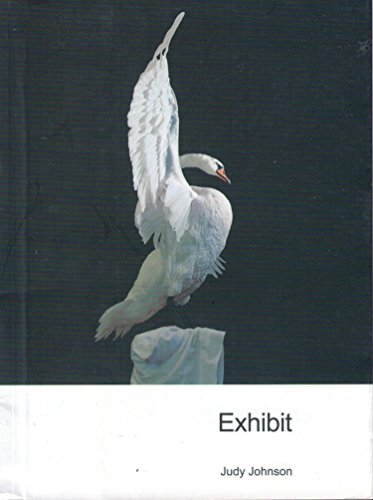
Judy Johnson, Exhibit, translated into Chinese by Iris Fan Xing (Flying Island Books & ASM 2013)
This is my fourth post for National Poetry Month.
Like Geoff Page’s Codicil, Exhibit is a bilingual book, aiming to bring an Australian poet to a Chinese readership.
According to the book’s dust-flap, Judy Johnson has been writing and publishing poetry for 20 years, and has won a number of prizes. She was editor of Picaro Press’s Wagtails series of chapbooks for some years. In 2021 she appeared with David Ades on his Poet’s Corner video show (link here), where among other things she spoke interestingly about her African-American convict ancestors and her book Dark Convicts, which I now have on order from Gleebooks.
Iris Fan Xing, the translator, was a PhD student at the University of Western Australia when the book was published in 2013. An interview with Robert Wood in Liminal Review of Books in 2021 (at this link) makes lovely reading for anyone who’s interested in translators, wonder-workers who are usually pretty much invisible. Sadly, my only response to her work in this book is to enjoy its visual beauty.
The book’s verso pages – that is to say, the English text – are terrific. To attempt the impossible and generalise: the poems tend to focus on small things (‘Three Tools’ fulfils the promise of its title), specific places (‘Walking Nobby’s Breakwall’ is almost a poetic manifesto for focusing on the small and partial), small interactions (‘Words, after an Absence’), without ever being trivial. Again and again in this book I was struck by a brilliant metaphor.
A poem that could provide a fun exercise for students, one of several set in Ireland, is ‘Saint Kevin and the Blackbird’ (which you can read as first published in Westerly in 2012 at this link – it’s a PDF, and you need to scroll quite a lot). The late great Seamus Heaney wrote a poem of the same name (which you can read at this link). Both poems tell the legend of a bird building a nest in the saint’s hand outstretched in prayer. One imagines what is happening in the saint’s mind and body; the other makes acerbic feminist comment on his broader life. Judy Johnson isn’t afraid to take on the big names.
If you were browsing in a bookshop and flipped to page 78* of Exhibit, you’d be looking at the first of two pages of the poem ‘Thirty-Four Years On’. Here it is, with the Chinese translation opposite:
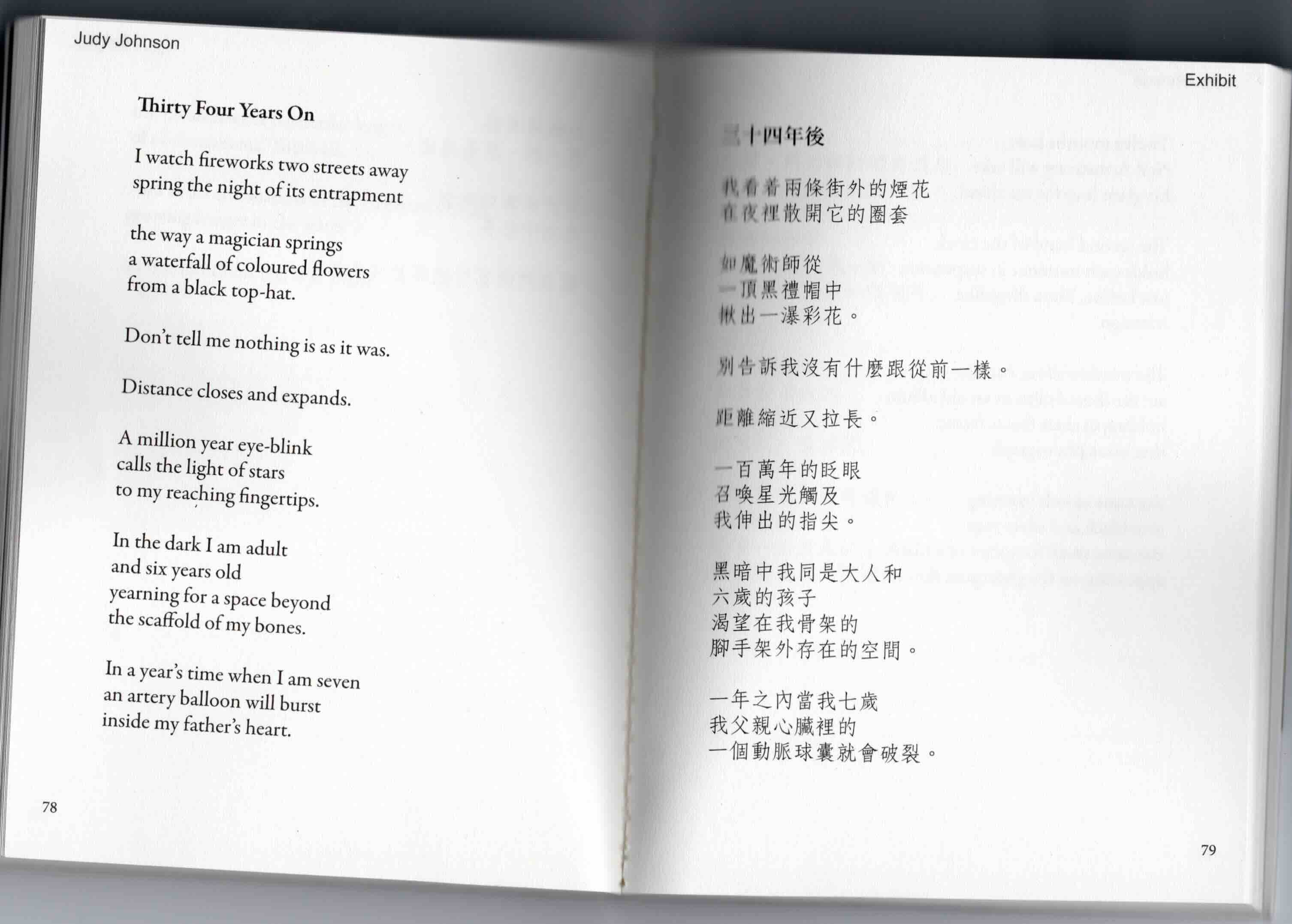
The title is a bit of a tease: thirty-four years on from what? My guess, based on the numbers given in the poem, is that its present moment is the year 2001, and the immediate prompt of the poem is a fireworks display, probably as part of Australia’s centennial celebrations. The fireworks remind the poem’s speaker of a similar display from her childhood, which she calculates to have been 34 years earlier. (It’s not that 34 is a significant anniversary, as in the episode of the Seth Hogan show Platonic when a character celebrates her ‘big two-six’.)
Thirty Four Years On
I watch fireworks two streets away
spring the night of its entrapment
I’m used to thinking of fireworks as embodying ephemerality: now they’re here, and beautiful, now they’re gone leaving nothing but the smell of cordite. In this poem they have a different effect. The night is normally trapped in just one time, but the fireworks explosion frees the speaker’s mind to be in more than one time at once, like magic:
the way a magician springs
a waterfall of coloured flowers
from a black top-hat.
This is the kind of thing I mean about Judy Johnson’s use of metaphor. The firework’s time-freeing effect is magic, and the fireworks share other elements with a magician’s act – the cascading colours produced from a hat, which further bolsters the metaphor by being black like the night.
The next three stanzas play with time and space in more or less abstract ways. How this relates to the opening image won’t become clear until the following stanza.
Don't tell me nothing is as it was.
A possible paraphrase of this is, ‘I don’t want you to remind me of the obvious fact that that things are always changing.’ The poem’s speaker is experiencing the present moment as identical to some other moment.
Distance closes and expands.
She is also experiencing physical space as relative. In her mind, she is living in two times and places at once.
A million year eye-blink
calls the light of stars
to my reaching fingertips.
Isn’t that beautifully put? We know how long it takes light to reach us from the stars, but that’s not how we experience it. It’s both a million years and an eye-blink. At the same time, the stars remind us that the poem started with a fireworks display two streets away – and also 34 years ago.
The next stanza brings us back to the present moment:
In the dark I am adult
and six years old
yearning for a space beyond
the scaffold of my bones.
At a literal level, then, the fireworks remind the speaker of a similar display when she was six years old. The ‘scaffold of my bones’ echoes the ‘entrapment’ of the night. She remembers as a child longing for transcendence.
Because I’m looking at the poem closely, I’ve done my sums. Judy Johnson was born in 1961. She was six in 1967, and 34 years after that, she is 40 and Australia is celebrating its Centenary. The poem is prompted by a fireworks display in 2001.
Having been taken back to that moment, she then moves forward in time:
In a year's time when I am seven
an artery balloon will burst
inside my father's heart.
If the poem ended here, it would be a bit of a downer: ‘Ah, these magical fireworks remind me of a similar display when I was six. Oh, then my father died.’ But that’s not the tone. The next stanza, over the page, also a three-liner, moves forward to the next year, 1969, with an abrupt change of register from intensely personal to public. 1969 is the year when ‘Neil Armstrong will take / his giant leap for mankind’.
This progression changes the way her father’s sudden death is presented: not so much a personal trauma as simply the next major event after the fireworks, with the moon landing the one after that. It’s not that the pain of her father’s death is minimised – it’s just not indulged, and it’s not mentioned again in the four remaining stanzas of the poem. In my reading, that silence is the heart of the poem.
I want to quote one more stanza:
The second hand of the clock
holds each moment in suspension
just before, like a slingshot
it lets go.
The observable way a second hand moves jerkily becomes a metaphor for the way we remember moments, almost like still photographs, but that time moves on inexorably.
The final paragraphs return to the fireworks, seen through a window, whose ‘four corners / are cardboard clips in an old album / holding in their freeze frame / that same photograph’. Time moves on, things change constantly, but this moment make those past moments present: the fireworks, the clouds of smoke (‘black an silver rags’), and
the same small footprint of a man
appearing on the ghostgum moon.
I’ve heard Evelyn Araluen speak derisively about how settler Australians love to write about ghost gums. At the risk of incurring her mockery, I think ‘ghostgum moon’ is perfect here – as an Australian reference that contains the word ‘ghost’ it does a lot of subliminal work. The poem focuses closely on that ‘same small footprint of a man’, leaving the bursting artery balloon in the realm of the unspoken, almost unspeakable, but with just the wisp of a reference to it in those final two words of the poem.
(For reasons that are probably peculiar to me, I find myself remembering Biblical quotes and theological concepts from my youth: ‘The seven years seemed to him to be just seven days, so great was his love’; the sacrifice of the Mass doesn’t just commemorate Jesus’ sacrifice on the cross, it is that sacrifice, happening in the present moment, not repeated but the same.)
Not that I saw all that on first reading, but I felt some of it, which is what poetry can make happen.
I first read Exhibit while flying over countries between Djabugay land and Gadigal Wangal land. I wrote the blog post on the land of Gadigal and Wangal of the Eora Nation. I acknowledge Elders past and present of all those Nations, and welcome any First Nations readers.
* My blogging practice is to focus on the page that coincides with my age, currently 78.


 Me fail? I fly!