
Brian Purcell, Filmworks (Flying Islands 2025)
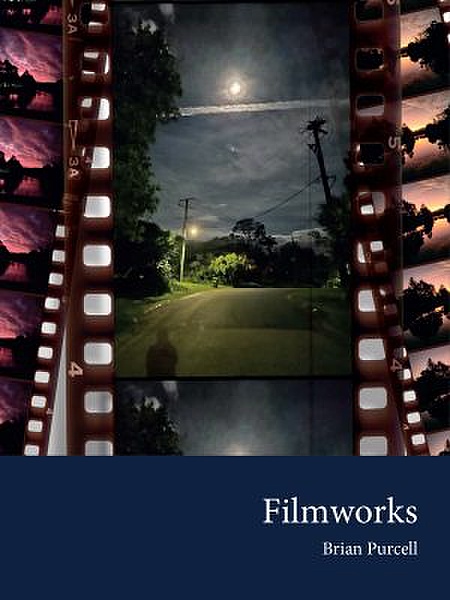
Brian Purcell is a painter as well as a poet. He was lyricist and singer with the rock band Distant Locust, which gets a consistent rating of four stars (out of five) on rateyourmusic.com. He’s been involved in community literature for decades – in 2010 he founded the Bellingen Readers and Writers Festival, which celebrated ’15 years of storytelling magic’ in June this year.
Filmworks is a collection of 41 poems, all but one of them named with film titles. The exception, ‘Reason’, has the subtitle ‘Man Ray’s films of the 1920s’, so it’s barely an exception at all.
Here’s a random selection of opening lines to give you an idea of the range of movies that make the cut and the range of poetic responses to them.
An autobiographic note in the first poem in the book, ‘2001’:
A small boy beneath a big screen
that begins to split, somersault, explode
at the beginning of an infinite journey.
Notice the lower case ‘depression’ in ‘Top Hat’, so that it can signify both the context of the movie’s creation and a mental state that it may help with:
A parallel universe
where depression does not exist
High level showbiz gossip in ‘The Misfits’:
Her husband wrote the part for her
as a farewell gift.
Details of the movie are evoked vividly in ‘Blue Velvet’, though this is not how I remember the film beginning, probably another example of my unreliable memory:
The crushed blue velvet gently moving
at the beginning of the film
hangs down like an enchanted sea
or a field where fabulous creatures roam.
In ‘The Imitation Game’ – dedicated, of course, to Alan Turing – the film is a springboard for a poem on our attention economy:
Secrets
we all have them
and they kill us.
I love this book. It feels like an extended conversation with another film lover, a conversation that can go anywhere, and does. And not a Marvel Universe blockbuster in sight. It makes me want to do a similar collection of poems about my own favourite movies.
I have written this blog post on the land of Gadigal and Wangal of the Eora nation . I acknowledge Elders past and present of all those clans, and welcome any First Nations readers.


 Me fail? I fly!