Category Archives: Page 7x/47/7

Megan Davis’s Voice of Reason

Megan Davis, Voice of Reason: On Recognition and Renewal (Quarterly Essay 90, 2023)
– plus correspondence in Quarterly Essay 91
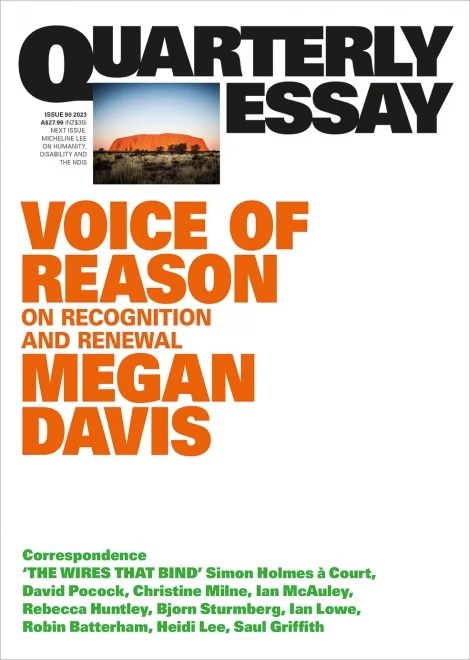
As we approach voting day on the Indigenous Voice to Parliament, bad-faith arguments multiply and I don’t intend to add to the clamour. But I can recommend this Quarterly Essay by Megan Davis, one of the architects of the consultation process that led to the Uluṟu Statement from the Heart.

It’s short – just 66 pages. It’s personal – Ms Davis gives enough of her story that we know who she is. It’s instructive – she tells how the proposal for the Voice evolved through several official processes under several Prime Ministers. It’s respectful – it understands why some First Nations people might vote against the proposal, and argues the case with them. It has heroes and villains – John w Howard and Tony Abbott feature as wreckers; Yunupingu as a leader. It’s not into blame and rage. It has hope. And it’s utterly convincing.

If the referendum fails, as current polls suggest, this essay will bear re-reading for decades to come, though it will have to be read through tears.

You don’t have to buy a copy. At least for now you can read it on the Quarterly Essay website, beginning at this link.

My blog practice is to look a little closely at a single page. Usually it’s page 76 (my age). As there is no page 76 in this essay, here’s a little about page 47 (I was born in 1947).

In 2015, there was apparently bipartisan parliamentary support for constitutional change acknowledging that Australia was first occupied by Aboriginal and Torres Strait Islander peoples, recognising their continuing relationship to the lands and waters, and expressing respect for their ‘cultures, language and heritage’. That is to say, it looked like all systems go for symbolic recognition: nothing about non-discrimination, and no structural change. A group of 40 First Nations leaders met with Prime Minister Tony Abbott and Opposition leader Bill Shorten, and explained that such a change ‘would not be acceptable to Aboriginal and Torres Strait Islander peoples’ (the quote is from the Kirribilli statement). This meeting led to the consultation process that produced the Uluṟu Statement from the Heart and the proposal for an Indigenous Voice to Parliament. (It also proposed a Makaratta / Treaty and a truth telling process, but those aren’t on the table just yet.)

On page 47, Megan Davis hits the pause button in her recount of the history:

The thing I could not shake from my head was watching the prime minister and Opposition leader sit at the head of the table while forty people from forty communities spoke about the structural problems their communities faced. What is it like to be the leader of a nation and encounter a polity that is profoundly unhappy?
At this time, as one of the main Indigenous lawyers working on constitutional reform, I found it difficult to understand why politicians failed to hear what First Nations leaders and community members were saying. I had a textbook idea about how political and law reform work, but none of it applied to our people.
There were two challenges I saw. One is that politicians meet with Aboriginal leaders on a myriad of issues, but often First Nations do not feel heard and politicians and advisers do not listen.
The second is the impact of telling your story over and over again and not being heard – what effect does this have on health and wellbeing?

Which comes close to being the heart of the argument for a constitutionally enshrined Indigenous Voice: it’s not that First Nations people haven’t been speaking, it’s that the necessary people haven’t been listening – because, as Megan Davis argues elsewhere in the essay, they don’t have to.

That’s just a tiny part of the essay. The whole thing is worth reading.


The correspondence in QE 91 includes some big names, in particular historians Mark McKenna and Henry Reynolds, and some brilliant fleshing out of the issues by First Nations and other writers. Megan Davis acknowledges them all as ‘worthy and inclusive commentary on the essay and on this historic moment that we are barrelling towards’. She singles out the joint contribution from Sana Naka and Daniel Bray, a Torres Strait Islander woman and a man of European heritage who write about the way their family is constantly negotiating intercultural complexity. She gives them the last word in her response. Following her lead, I’ll end the blog post with the same quote from them:

Structural injustice exists because that is how our political system is structured. We are getting exactly what the system was designed to deliver. A Voice to Parliament alone cannot specifically redress every injustice, but it will connect people to power in a way that currently does not happen. Democracy demands nothing less.

Yumna Cassab’s Australiana

Yumna Cassab, Australiana: A Novel (Ultimo Press 2022)

I came to this book with inappropriate expectations. I had just read Dean Ashenden’s Telling Tennant’s Story and Julianne Schultz’s The Idea of Australia, and the title Australiana seemed to suggest a similar attempt to speak to the state of Australian culture – possibly, given the author’s name, from a non-Anglo perspective. If those other books hadn’t been in my mind I might have expected an ironic treatment of clichés of national identity, like kangaroos, slouch hats, or Big Things.

But neither of those expectations was met. As far as I can tell there is no attempt at a grand unifying statement about Australia, and there’s no cute wildlife or cultural kitsch. Nor is the book a novel, as proclaimed in small print on the cover (but not on the title page, which makes one suspect that it was the cover designer who added the descriptor). It’s a number of short fictions.

There are five stories, all more or less presenting grim sketches of life in rural New South Wales, up Tamworth way. The first and longest, ‘The Town’, is the most interesting. It consists of roughly 30 short pieces – ranging from half a dozen lines to seven pages in length. Most pieces pick up a detail of the previous one – a character, an action, a piece of furniture – and place it in a different story, as if the writer’s attention is caught by a detail in one story and lets it lead her (and us) where it will. What emerges is not so much a mosaic of country town life as a meander through parts of it: there’s flood, fire, and drought, so maybe a hint of a grand national panorama in the background.

In the first piece, an unnamed character has his house broken into a number of times, and on the fourth time he has a weirdly amicable chat with the intruders. Subsequent pieces introduce us to the intruders, and then to other people in their lives. The pattern repeats: asomething happens, then we see it from another perspective, and what had seemed arbitrary, weird or perhaps insane, becomes comprehensible – or vice versa. The writing is spare, and trusts the reader to make the connections – even sometimes to make them up.

If you picked the book up in a bricks-and-mortar bookshop and turned to page 76 to check it out, you would be in the midst of the section ‘The Knife and the Axe’, featuring a man consumed with anxiety when his nine-year-old daughter invites a friend home from school. The friend, we know from the previous story, has set fire to his father’s fields in reaction to something his father did that enraged him:

Would you believe it? No, he did not believe it. His own daughter was nine years old and he tried to imagine her burning their home or even the fence and he couldn’t. She would never do it. She had pigtails and ribbons and went around in a dress and polished shoes. His little Mia would never do that.

He truly believed that until she brought Jayden around after school. She told her dad that Jayden was in her class and he was afraid to go home, could he stay a while, please.

That’s all we hear about the aftermath of the boy’s arson in his own home. This story stays resolutely with the point of view of the girl’s father, and becomes a tale of parental paranoia:

He hid the matches and the lighter before they entered the house and he worried about the fireplace giving Jayden ideas. So he seated then at the dining table with their backs to where the fire could have been.

Not to spoil the episode for you, but his anxiety cranks up when the children go to Mia’s bedroom and Mia asks for a candle. ‘The Knife and the Axe’ ends with a classic horror-movie cliffhanger (I should mention that the fragments in this and the other stories move in and out of a range of genres, including fairy tale and prose poem and micro fiction), as the children, armed with a knife and an axe, come towards him demanding that he give them candles:

He turned and ran for the door but he didn’t make it that far. As he fell to the ground he thought: I never imagined my life would end like this.

(Page 79)

And the next section, ‘Lost’, picks up the story from his wife’s point of view. I won’t disclose why he failed to reach the door beyond saying that the story isn’t lacking in sardonic humour.

As befits such a set of linked episodes, the final one returns to an object that was stolen in the first.

Each of the other four stories is similarly made up of short, sometimes very short sections. Three of them are grim contemporary tales, and the fourth, ‘Captain Thunderbolt’, is a mix of narrative, verse, and reflective essays inspired by the lingering presence of the titular bushranger in the New Englandregion.

I still don’t understand the book’s title. I suppose ‘Tamworthiana’ or ‘New Englandiana’ don’t have much of a ring to them.

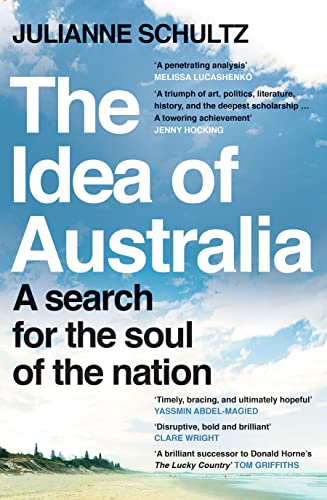
Julianne Schultz’s Idea of Australia

Julianne Schultz, The Idea of Australia: A search for the soul of the nation (Allen & Unwin 2022)

Julianne Schultz is best known as the founding editor of Griffith Review, where she made a substantial contribution to Australian literary culture over 15 years, publishing and engaging with the work of a vast array of writers (including more than one piece by my niece Edwina Shaw), facilitating a rich and complex conversation about things that matter.

The Idea of Australia was originally imagined, according to Schultz’s Acknowledgements, as a meditation, a short volume about Australia, ‘one that floated lightly over the past to make sense of the present to distil a rich, multilayered identity’. That’s not how it turned out. It’s a shaggy, baggy monster of a book, part history, part memoir, part polemic, part reportage, part Covid opus. It’s as if the process of writing that short, light mediation was disrupted by the hundreds, even thousands of voices from the Griffith Review days, each of them with a compelling case for inclusion. Add the sound journalistic and academic practices of quoting sources meticulously, and the project got right out of hand.

There are wonderful things. The twenty-page chapter on the Australian Constitution, ‘Small Brown Bird’ (as opposed to the American eagle) is a brilliant account of how the Constitution was created, and why it is so little read and so hard to change. The impact of John Howard’s time in office on the national consciousness is rendered with heartbreaking vividness in the chapter ‘Soul Destroying’. If you’re looking for a concise and engaging account of Rupert Murdoch (for whom Schultz worked for a time as a journalist) you’d have trouble finding better than the chapter ‘Power Players’. Schultz has interesting things to say about Yassmin Abdel-Magied, Kath Walker, Henry Reynolds, Bernard Smith, Alexis Wright, Mary Gilmore, Galarrwuy Yunupingu and more.

The book turns a critical eye on the idea of Australia as the land of the fair go, including well known stories of exclusion (the White Australia Policy, the dictation test, the ‘offshore solution’ and so on), and doesn’t turn away from the monstrous history of genocidal white supremacy. It is full of riches.

But too often digressions pile upon digressions; there are alarming time switches – from the early days of the Sydney colony to the late 20th century in a single sentence; the elements of memoir and family history aren’t well integrated. It looks as if the book began with the idea of Covid producing an X-ray that shows up the fault lines of our society, but that idea pretty much disappears after a couple of pages to resurface occasionally like the ghost of a discarded structure. And – this may be just me – there are some strange tics in the language: Australia is assigned the pronouns ‘she/her’; and eighty-three years, say, is regularly phrased as ‘four score years and three’. Either the copy editor was overwhelmed or her/his suggestions were overruled. The effect is weirdly alienating.

I’d be lying if I said this book is a must-read. If you know nothing about the history of Australia it is more likely to bewilder than illuminate. If you are already well-informed, depending on who you are, it will either infuriate because of its left-liberal point of view or frustrate because of the its out-of-control elements – or both.

Winter reads 9: Richard James Allen’s Text Messages from the Universe

This is my ninth and last post on books I took with me on my escape from Sydney’s winter, focusing as usual on page 76. I’ve been home for a while, but it takes a while for the blog to catch up with life.

Richard James Allen, Text Messages from the Universe (Flying Island Books 2023)

Like the other titles in Flying Island’s ‘minor works / Pocket Poets’ series, Text Messages from the Universe is a physically tiny book – just 152 x 102 mm. But it’s part of a broader multi-media project.

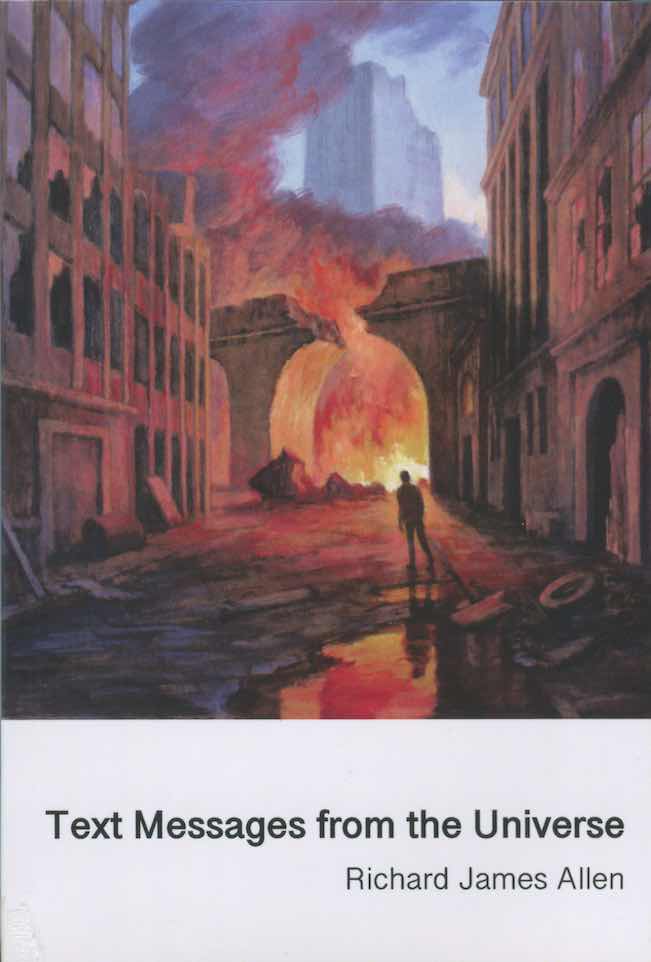
There’s a movie of the same name directed by Richard James Allen, which is the source of the lavish images of dancing figures that accompany the text (or perhaps, depending on how you see things, that are accompanied by the text). The front cover is from a painting created for the book by 2023 Archibald finalist Michelle Hiscock. The text itself, a single prose poem, is the final work in the multi-volume The Way Out At Last Cycle, which has been three decades in the making (Hale & Ironmonger published The Way Out At Last and other poems in 1985).

The poem is inspired by the Tibetan Book of the Dead. The first, shorter section is addressed to a person who dies in a car accident. In the second section, made up of 49 short parts, the person is lost in a state between death and rebirth, the bardo, in a cycle of dreaming and waking, bewildered, disoriented and panicking. The poetry takes on a weirdly insubstantial quality that is beautifully enhanced by the billowing drapery of the dancers on every page. I haven’t read the Tibetan Book of the Dead – that part of 1960s enthusiasm passed me by – so I don’t know if the poem follows it with any precision, but there’s a wonderful sense of being carried along on a current leading to detached oblivion and then, perhaps, to a new beginning.

No spoiler intended, but the text messages of the title are revealed towards the end of the poem, in part 46: ‘This is your last moment,’ closely followed by, ‘This is your first moment.’ Part 47 adds this gloss:

As for the rest, Your text messages from the universe 
seem to be happy to take any form and any language 
they please.

Some of them aren't even text messages, just 
whispers inside your head.

Speaking as someone who is currently reading Saint Augustine’s Confessions, I’d add they may also come in the form of a child chanting on the other side of a wall.

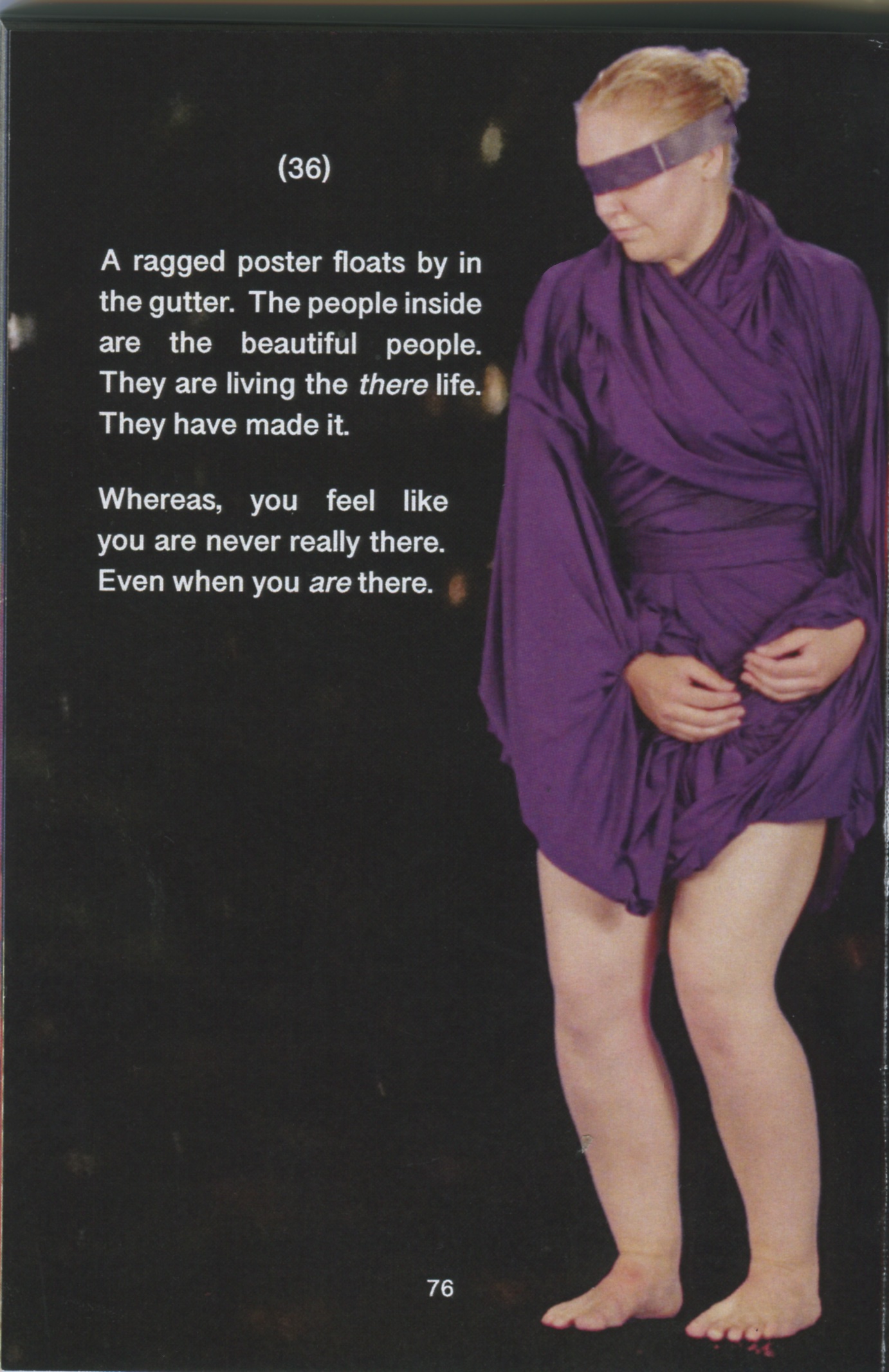
Even while I’m enjoying the poem’s journey in an invented universe (apologies to any of my readers for whom the bardo is as real as purgatory is to some Catholics), my tendency as a reader is to cast around for the kind of actual experience that the invention draws on and possibly illuminates. The short poem on page 76, section 36, rewards this tendency:

(36)
A ragged poster floats by in 
the gutter. The people inside 
are the beautiful people.
They are living the there life.
They have made it.

Whereas, you feel like 
you are never really there.
Even when you are there.

Incidentally, this is the only image in the book where the dancer is less than elegant, where the fabric is not floating in an ethereal breeze. It signals that, as so often happens, page 76 is a kind of turning point, in this case a low point.

The text offers one of the poem’s many noir-ish images – one of many alleys, gutters and empty lots. The poster is a piece of detritus from the life left behind. In the dream world of the poem, it asserts the substantiality of that life, its thereness. These lines reward my penchant for literalness by drawing on a moment of a kind I imagine we’ve all had: you see a poster for some event and reflect fleetingly that the life represented in the poster is unreal – either that, or it’s part of a reality that you have no part of. This is the moment in the bardo when the newly-dead person is closest to nothingness: it’s the rubbish poster that’s real.

In the years that this poem was fermenting, the bardo attracted the attention of a number of other creators. I’m aware of George Saunders’s multivocal novel Lincoln in the Bardo (2017), which I haven’t read, and Laurie Anderson’s movie Heart of a Dog (2015), for which I just couldn’t stay awake. I had no trouble staying awake on the journey with Text Messages from the Universe.


I’m grateful to Flying Islands Books for my copy of Text Messages from the Universe.

Tove Ditlevsen’s Childhood, Youth, Dependency and the Book Group

Tove Ditlevsen, Childhood, Youth, Dependency: The Copenhagen Trilogy, 1968–1971 (Penguin 2020)
First two books translated by Tiina Nunnally 1985; the third by Michael Favala Goldman 2009

Before the meeting: In January this year as part of a series of belated obituaries, The New York Times published an article on Tove Ditlevsen, 47 years after her death. You can read the whole thing at this link (you might have to sign up for a free account to get access).

The short version: Tove Ditlevsen (1917–1976) was one of Denmark’s most popular authors. Her published works included 11 books of poetry, seven novels and four story collections, as well as the three short memoirs, Childhood (Barndom in Danish), Youth (Ungdom) and Dependency (Gift) that have been collected here as The Copenhagen Trilogy. She didn’t enjoy critical success during her lifetime and was virtually unknown outside Denmark. None of her books of poetry were translated into English. Then in 2016 translator Michael Favala Goldman picked up a copy of Gift in an airport, considered it to be a masterpiece, and set the snowball in motion for a critical discovery in the English-speaking world and elsewhere.

I was prompted to go looking for that background by something about the book itself. Perhaps because I’ve recently read two brilliant memoirs by Annie Ernaux (blog posts here and here), not to mention Proust’s vast À la recherche du temps perdu, I felt that the first book (Barndom/Childhood) and much of the second (Ungdom/Youth) were too neat, too confident in their detail to be trusted as memoir.

The first book begins with Ditlevsen as a small child trying unsuccessfully to avoid triggering her mother’s anger, and observing the life of their apartment block. ‘Childhood is long and narrow like a coffin, and you can’t get out of it on your own.’ She goes to school, and has an ambivalent relationship with the cool girls who gather at ‘the trash-can corner’. She thinks of herself as unattractive and no one contradicts her. She is hospitalised with diphtheria. She reads a lot and writes poetry that she keeps in a secret album.

In Youth, still living at home, she has a series of terrible jobs, is befriended by the worldly Nina, and enters the world of boys and kissing goodnight at the door. She continues to write and, encouraged by her older brother and Nina, dares to show her poems to a literary gent who offers qualified encouragement of her writing and allows her to borrow from his well stocked bookshelves, then disappears without explanation. Another older man becomes a mentor and publishes one of her poems in his literary journal. She fantasises becoming his wife. At the end of this volume, she has had a book of poems published.

Rather than memoirs, these books read as novelisations of the writer’s early life, and as novels they have an almost generic quality. I was so lulled into thinking of them as fiction that I was taken aback when, in Dependency, Piet Hein turns up as a character. Piet Hein, as you probably know, was a Danish polymath (1905–1996) who wrote little poems he called grooks, of which probably the most famous is

The road to wisdom? Well, it's plain
And simple to express:
Err
and err
and err again,
but less
and less
and less.

He was a real person, who would have been known to the book’s first readers at least as well as Ditlevsen herself, and he was very much alive when the book was published. He is portrayed mockingly as a charming but callous serial monogamist. Maybe, I thought, all the other people named – and to varying degrees shamed – were real as well. I did a little duck-duck-going, and sure enough the people given full names mostly did exist. So I’m guessing that part of the books’ original appeal may have been their gossip value – a popular writer was spilling the beans.

In the third book, things get much worse for Tove, and as a result (I’m sorry to confess this of myself as a reader) the book is much more interesting. Its Danish title, Gift, means ‘poison’ but it’s also some form of the word for ‘marriage’. Michael Favala Goldman’s title, Dependency, suggests both Ditlevsen’s approach to marriage and relationships, and her harrowing experience of drug addiction. In this book, Ditlevsen marries, divorces, and has a child with a new lover (not Piet Hein). When she falls pregnant a second time she has an illegal and traumatic abortion, which leads to her first experience of the opioid painkiller Demerol. The book comes fully alive and gripping in the detailed account of the abortion and her subsequent addiction to Demerol. The harrowing process of drying out, relapsing, drying out again, is described with tremendous force.

I’m not sure I needed the first two books, but I was shaken and stirred by the third.

There’s not a lot of lightness – her relationships with men are terrible and mainly explicitly transactional, though (spoiler alert) that changes at the very end. One snippet of literary gossip is an exception that’s worth mentioning as a moment that makes her (and us) realise how grim her life has become in the grip of addiction and of the controlling lover who administers her ‘shots’. It also casts a somewhat benign light on her ambivalence about her children. She accepts a rare invitation to dinner:

During the dinner I sat next to Evelyn Waugh, a small, vibrant, youthful man with a pale face and curious eyes. … Kjeld Abell asked Evelyn Waugh if they had such young and beautiful female authors in England. He said no, and when I asked what brought him to Denmark, he answered that he always took trips around the world when his children were home on vacation from boarding school, because he couldn’t stand them.

(Page 334)

After the meeting: It was a long time between meetings – I wrote the previous paragraphs a couple of months ago – and my memories of the book had faded when at last we met. In the days leading up to the meeting there were ominous rumblings on our WhatsApp group giving advance notice that many group members either disliked the book intensely or couldn’t finish it for reasons other than lack of time. A lone voice said it was brilliant. It was promising to be an interesting evening.

But then, one chap was attacked by an unruly plate-glass door on his way here and had to be taken to a hospital emergency, which would have been bad enough, but the man who drove him to hospital was the book’s main advocate and – I learned later – he himself had just finished the book and thought it was a masterpiece.

Because of the accident itself and the absence of advocacy, discussion was fairly muted. One chap who had also just finished reading the book gave a spirited account of why he loved it (making it three out of 11 definite thumbs up; maybe three definite thumbs-down). He read it quickly. He couldn’t put it down, he said, and then at time he had to put it down. My sense was that a number of people got to the moments when you have to put the book down and just didn’t want to pick it up again – some would say they were lily-livered.

Someone pointed out that a good deal of the action takes place in Denmark occupied by the Germans, and it’s a revelation that for Ditlevsen and her literary pals the occupation was little more than a dark shadow on the edges of their lives.

But it wasn’t long before conversation moved to other pressing matters: the Women’s Football World Cup – the Matilda’s had beaten France, but not yet been defeated by England, and many of us were in love; the Voice referendum, Peter Dutton’s dastardliness and Anthony Albanese’s alleged lack of statesmanship; the mushroom dinner; parental dementia; and far too much food.

No one was interested in my recitation of the above grook.

Winter reads 8: Sophia Wilson’s Sea Skins

This is my eight post on books I took with me on my brief escape from Sydney’s winter, focusing as usual on page 76. (I’ve actually been home for a while, but the blog is still catching up.)

Sophia Wilson, Sea Skins (Flying Island Books 2023)

Sophia Wilson was joint winner of the inaugural Flying Islands Manuscript Prize for Emerging Poets in 2022. Originally from Australia, she now lives in Aotearoa New Zealand.

The poems in this collection reflect her attachment to both countries: there are poems based in her Australian childhood, and a number about the fraught history of colonisation in Aotearoa, as well as evocations of its land. There are also poems that bear witness to her experience as health professional (one poem mentions ‘the unbearable silence of asystole’), translator (most notably in ‘En Cas d’Urgence’, which switches among English, German, French, Spanish, Greek and Chinese), and manager of a wildlife refuge. That is to say they deal with an astonishing range of subjects.

If I had to generalise, I’d say the book’s central concern is the assertion of the human as part of nature as opposed to abstraction and mechanisation. But as soon as I’d written that sentence I read four short poems that only fit this description with quite a bit of mental contortion.

As with a lot of contemporary poetry, a key feature is a compression of meaning, which means that precise meaning is often elusive.

The poem on page 74 comes with a dedication: ‘for Valeria’. It’s an elegy for a friend who has died:

Nello Specchio d'Acqua
You were a glass blower, un soffiatore di vetro 
hands of silica and carmine
You lifted a globe, il tuo capolavoro
Within it two dancers cast crumbs to pigeons
A window opened to the sea

You were the blind man crossing a piazza
I was your white-tipped cane
On the bridge, at the centre, above the grey 
you were the singer, the song

I was the street sweeper, gathering dust
You were a magician, un pagliaccio intossicato 
dancing across the square

I was the guide in a maddened crowd
You were a tramp passing by - 
a mirage in a watery mirror
adrift on swelling tides

You were wasted, skeletal -
maligno il cancro, il tuo fiore in gola
You were sinking foundations, eroded façade
a stone lion slipped beneath tidelines

The sea swallowed our steps - 
you were swallowed in steps
invaded through doors, the walls of your neck 
your mouth's floor – la tua lingua

They gave you a tube for a windpipe

I measure the loss of you in tides
You were scattered at the rate of tsunami

There was a glass blower, un sofiatore di vetro 
who lifted a globe, il suo capolavoro 
I was a street sweeper, treading water

You came dancing across the square

(for Valeria)

This is a lovely evocation of a lost friend, with references to their experiences together that are cryptic, but not so cryptic as to be frustrating. The friend was clearly Italian, a glass blower, who died of cancer of the throat. The scattering of Italian phrases is a way of honouring the friend’s cultural heritage. (A number of poems in the collection do this with Mãori words, wth a similar effect of honouring difference.)

A specchio d’acqua is usually translated as a calm expanse of water. As specchio means ‘mirror’, the emphasis is on the surface reflection rather than other watery qualities – so the phrase could also be translated as ‘watery mirror’ (as in stanza four). Most of the other Italian phrases are pretty much explained in the text: capolavoro is ‘masterpiece’; un pagliaccio intossicato is ‘a drunken clown’.

The first stanza introduces the friend as an artist, and focuses on a glass globe created by her, a glass globe containing two dancing figures.

The next three stanzas riff on that image, describing the poet’s relationship to the artist in terms of two figures in a setting that suggests Venice: the big square, a group of tourists, a bridge, water. The poet was mundane, ‘gathering dust’; the friend magical, a drunken clown, a mirage, a singer, an exotic beggar. It’s not all one-way – the ‘I’ is a white-tipped cane for the friend as blind man, perhaps implying that she brought some groundedness.

Then the poem turns abruptly to the friend’s final days, wasted and skeletal. Interestingly the key information is left untranslated: maligno il cancro, il tuo fiore in gola, ‘malignant the cancer, your flower in the throat’. It’s as if the poet can’t bear to say the words in her own language. In what follows, the images of Venice are no longer of romantic waterways, bridges and tourist-filled squares, but ‘sinking foundations, eroded façade’ and the threat of rising sea levels. The cancer invades the friend’s body like floodwaters, in steps at first – and then, in the third-last stanza, leaving all thought of Venice behind, with the overwhelming force of a tsunami.

The single-line stanza, ‘They gave you a tube for a windpipe,’ interrupts the metaphorical elaboration with a moment of brutal literalness. There’s no need to name death itself: this tube says it all.

The last two stanzas turn again. The first of them reprises the poem’s opening movement, condensing it into three lines, but now the friend is no longer addressed directly. She can only be spoke of in the third person – ‘There was a glass blower’. The poet now recalls herself, not as gathering bust but as treading water ,an alrernative way of saying the same thing, that paves the way beautifully for the final line.

And the final twist: the friend can be spoken to again – and the vital image of her as she first appeared reasserts itself: ‘You came dancing across the square.’

I so get this! A friend of mine died recently. There was a wonderful farewell gathering where her many achievements were celebrated, and her qualities as a friend eloquently evoked. I can’t think of her without a terrible sense of loss, but at the same time my mind keeps returning to an occasion when, a fifty-something woman exultant at having won a game of canasta, she leapt onto the card table to do a wild, stomping victory dance.


I’m grateful to Flying Islands Books for my copy of Sea Skins.

Winter reads 5: Nicholson Baker’s Anthologist, page 76

This is my fifth post on books I’ve brought with me on my escape from Sydney’s winter, focusing as usual on page 76. Most of the books have been physically tiny books of poetry. This is the second novel.

Nicholson Baker, The Anthologist (Simon & Schuster 2009)

One of the men from my Book Group handed a copy of The Anthologist to me with a knowing look. ‘You’ll love this,’ he said.

He was right.

Paul Chowder is a minor US poet. He has had poems in The New Yorker and is on nodding terms with eminent literary figures. When the book opens he’s running spectacularly late with his introduction to an anthology he has edited, of rhyming poetry. His girlfriend, Roz, has found his procrastination unbearable and moved out. Over the next couple of weeks and almost 250 pages, he ruminates on what he wants to say in the introduction, does a half-hearted clean-up of his house and workspace, makes feeble attempts to win Roz back, and reflects on his own failings as a poet and a human being.

That’s it. It’s not exactly nail-biting stuff. I loved it.

The guts of the book is Chowder’s mind playing over the things he wants to say in the introduction. He has theories about metre that fly in the face of standard accounts, but are far from ridiculous. He spells them out in detail, with many examples. He considers the last century or so of ‘free verse’ to have been a mistake, though he admits some excellent poems have been written without rhyme. He detests enjambment. He dishes the goss about great poets of the past, and has plenty to say about key poets – especially Swinburne (too much of a good thing), Marinetti (bad), Elizabeth Bishop (good), Ezra Pound (very bad). He takes several pages to rip into Pound – the man himself and those who protect his legacy. His opening salvo gives you the general gist:

Pound … was by nature a blustering bigot – a humourless jokester – a talentless pasticheur – a confidence man.

(Page 92)

This may make it sound like a series of lit-crit essays strung together on a flimsy narrative. But that’s not so at all. It really feels that we are spending time inside the hand of a man almost totally preoccupied with matters poetical. If we learn something, that’s a side benefit. If we disagree with him, all the better. You may have to be interested in poetry to be interested in Paul Chowder: there’s no exuberant sex as in Alejandro’s Zambra’s The Chilean Poet, another excellent novel about poetry. The stakes are pretty low – will he get back with Roz, will he ever write his introduction, will he ever write a poem he thinks is any good? But I for one enjoyed it from cover to cover.

Spending a little time on page 76, I realise that we learn a lot more about Paul than I have indicated so far. The page begins with memories of his father, who used to recite two poems ‘with his fists clenched’ – ‘John Masefield’s “Cargoes” and E. E. Cummings’s poem about the watersmooth silver stallion. I had to look the latter poem up (it’s here if you’re interested): Paul Chowder’s father was more sophisticated than my parents, who sang ‘The Rose of Tralee’ and recited part of ‘The Hound of Heaven’ respectively; my older brother used to recite E. E. Cummings’s poem with ‘mudluscious’ in it.

He says in passing that he misses his parents every day – a note that is struck a number of times without further elaboration. Then his mind moves on, first to Tennyson:

Tennyson’s father was a beast. He was a violent alcoholic and an epileptic, and he was horrible to his sons. From the age of twelve on, Alfred Tennyson was home-schooled by his fierce, crazy father. When Tennyson Senior was drunk, he threatened to stab people in the jugular vein with a knife. And to shoot them. And he retreated to his room with a gun. A bad man. And eventually he died. Tennyson was liberated, and he began writing stupendous poems.

Characteristically, having made a huge value judgement, he pulls back from it:

Were they stupendous? Or were they only good? Or were they in fact not good at all? I’m not sure.

None of this may make it into the Introduction, but a constant process of drafting and redrafting is under way.

But his mind won’t stay there for long:

Last night I watched two episodes of Dirty Jobs and then went upstairs to bed after thinking that my poetry was not for shit, frankly. If I may be pardoned the expression. I got in bed, and I realised that what I wanted was to have some Mary Oliver next to me. If I had some Mary Oliver I would be saved

Now, the second most visited post on my blog is about a book by Mary Oliver, so whether by calculation or otherwise, Paul’s wanting her book next to him will strike a chord with many readers (it does with me). She was alive when the book was written, and I hope she would have been chuffed that he turned to her for salvation, even though she doesn’t use rhyme or strict metre.

If you picked up The Anthologist in a bookshop and flipped to page 76, you’d get a fair idea of what the book is: a kind of stream of consciousness of a man who is steeped in poetry and feels himself to be part of a great community of poets living and dead – a poet himself, a passionate reader, a teacher of sorts, a mind that’s alive.

I hear that Nicholson Baker has written a second book about Paul Chowder. I can’t imagine it.

Winter reads 4: Jill McKeowen’s Sunday morning, here

This is my fourth post on books I’ve brought with me on my escape from Sydney’s winter, focusing as usual on page 76.

Jill McKeowen, Sunday Morning, Here (Flying Island Books 2023)

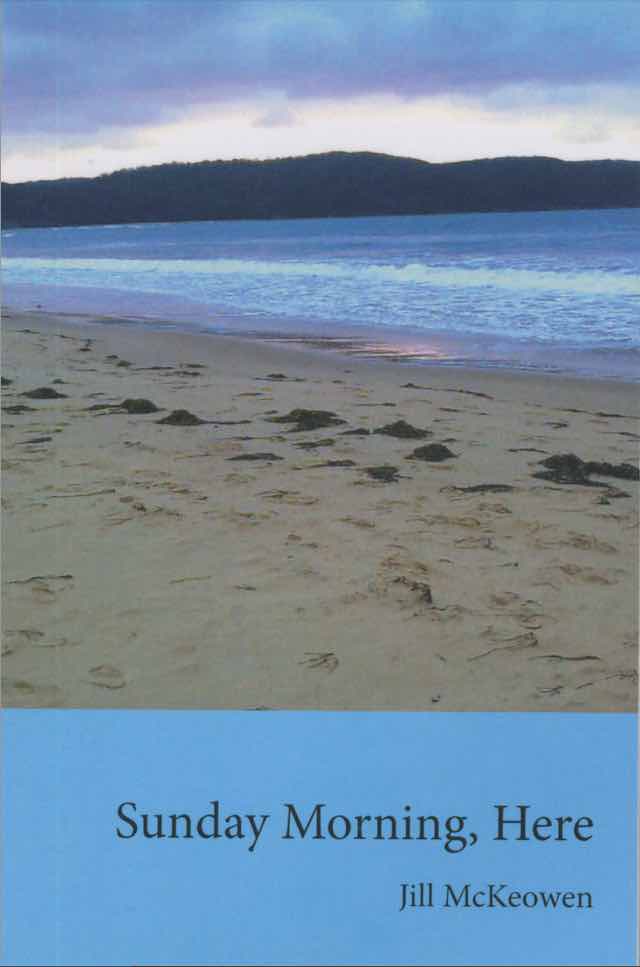
Sunday Morning, Here is another book in Flying Island’s hand-sized poetry series. Jill McKeowen’s bio tells us that, among many other things, she has been a regular reader at Newcastle Poetry in the Pub, and that this slim volume is her first book of poetry. I hope there will be many more.

It’s the kind of book that opens a window into the poet’s life: daily observations of life around her home on NSW’s mid-north coast, and on her travels up the coast and across the continent; some splendid poems about cockatoos; a whole section dealing with her father’s death and its aftermath; a section on her childhood family, then and now. Some poems suggest a disciplined practice of writing for an hour each morning. The poems are warm and genial, sometimes playing with form (there’s a nifty and heartfelt homage to Elisabeth Bishop’s The Art of Losing).

The title poem, ‘Sunday Morning, Here’, is partly a response to a Wallace Stevens poem, ‘Sunday Morning’, signalling that McKeowen expects to be read in conversation with other poets. Its first line, ‘Here there’s no complacency, but ease’, echoes the first word of the Stevens poem (‘Complacencies’), at the same time highlighting a recurring theme: the poet’s life is in the main comfortable and pleasant, but it includes an awareness of privilege: ease, but not complacency.

Serendipitously, the poem on page 76, ‘It’s still dark’, embodies many of these general characteristics.

It's Still Dark
I nudge the doona back, unwrap 
my sleep to the cold, and drift 
consoled in fleecy gown, pocket 
feet into slippers, feel
my way on hushed carpet, spark 
the gas heater to flame, flick 
the bathroom into light, give 
thanks for this convenience;

I fill the kettle from the tap, 
strike a match to more gas, 
slice ginger into boiled water, 
put my night-dried dishes away, 
sip the tea by fire glow, 
watch the rising-falling breath 
of curled cat, and write 
a reckless page of adjectives.

A woman wakes by the road 
close to a border town, her body 
warmth still wrapped around 
her sleeping child,
unseen
by armed militia.
She must look for water
while the dawn is pinned with stars.

Serendipitously, as I’m typing this I have on the table beside me a glass of ginger tea made from slices of ginger. I don’t wear slippers, my holiday rental has tiled floors, there is no cat, but the sense of simple luxury conveyed in the first two stanzas communicates beautifully. The four beat lines move smoothy, and the relaxed suggestions of rhyme (pocket/drift, spark/flick) and alliteration (water/away) hold the lines together, contributing to the sense of ease.

But not complacency.

The flow is disrupted in the second-last line of the second stanza, after the ultimate image of laziness – the ‘curled cat’ – comes a midline break in the sense, the first in the poem, and the line ends on just three beats, so that ‘write’ takes on a different, less indolent feel. Things are still easy but there’s a sense of purpose. Then ‘reckless’ confirms the change in mood. What is this reckless undertaking? It’s a writing exercise, perhaps a warm-up for something more challenging. Elsewhere in the book there’s a suggestion that McKeowen has a regular practice of writing in this way.

The third stanza takes the poem somewhere else altogether. It’s as if the act of putting words on paper ‘recklessly’ her mind is dragged from its early-morning drowsiness to awareness that her ease and comfort are an extraordinary privilege. The image of the woman who does not share her privilege bursts into the poem in lines of uneven length, with line breaks that do violence to natural phrasing (body / warmth, unseen / by armed militia). The other woman too has to find water, but in radically different, more precarious circumstances. We don’t need specifics of what country she is from: there are plenty to choose from.

I’m sure someone has said that good literature doesn’t provide solutions to problems, but helps to understand them. That’s certainly true of this poem. It gives us an unsettled and unsettling juxtaposition of two early-morning awakenings. A lesser poet might have gone on to spell out how the juxtaposition affected her – inspiring feelings of helpless guilt, say, or a decision to increase her regular donation to UNICEF. But that would have let the reader off the hook.

What we are left with is the final image of the dawn ‘pinned with stars’. As in those classical Chinese poems where the moon can be seen by the exiled poet and also by those who are far away, both women in this poem can see the stars. It’s a reminder of their shared humanity, and of ours.


I’m grateful to Flying Islands Books for my copy of Sunday Morning, Here.

Winter reads 6: Kevin Smith’s Another Day

This is my sixth post on books I took with me on my escape from Sydney’s winter, focusing as usual on page 76.

Kevin Smith, Another Day (Flying Islands Books 2023)

It was exquisitely bad timing that I read Another Day concurrently with Nicholson Baker’s novel The Anthologist. Baker’s protagonist Paul Chowder detests enjambment, even in such hallowed places as the opening lines of Keats’s ‘Ode to a Nightingale’, and Kevin Smith’s poems fairly bristle with enjambments.

But the poetry got me over that hump fairly easily.

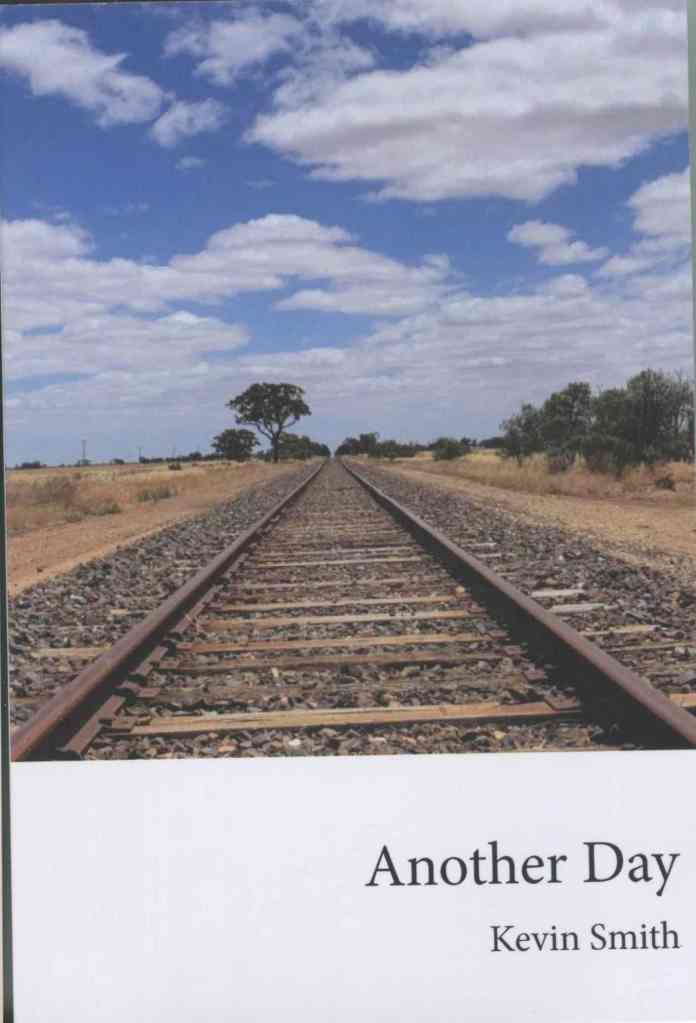
It’s a collection of 38 poems, many of which have been long- or short-listed for literary prizes in Australia and elsewhere. There are enjoyable travel poems and people-watching moments; sex, birth, fatherhood and grandfatherhood. If I had to pick one poem that put unexpected words to experience similar to my own it would be ‘At Once Father and Son’, in which the poet speaks to his son who has just become a father himself. These lines also, incidentally, illustrate the poet’s attachment to enjambment:

And when I watch you look
___into his face – your own face –
full of wonder that you

and he were meant to be –
___so it was I used to think
that this would never end.

But time – travelling on 
___a one-way ticket –
won't return. And so we've drifted.

You've grown into a man 
___as I had done – as surely
as your son will do. And my hands,

empty of you all these years,
___tell my time has passed,
my station done.

One striking thing about the collection as a whole is the powerful poems about the cancer treatment and eventual death of a loved one. These are scattered through the book, with the disconcerting effect that these terrible things are somehow just part of life – just another day, perhaps – until they come to a grim conclusion in the final pages

Page 76 is parts 3 and 4 of the book’s only prose poem, ‘More Soft Than Water’. It’s a narrative – a short short story. In the first two parts the narrator recalls how as a young man he accompanied his sisters on their volunteer nights at an unidentified institution. A baby girl is placed in his arms, with skin ‘more soft than water’.

3.
Each week, I came back to her and walked the 
corridors again. Through a window, she caught
the light at play among the eucalyptus leaves 
brought to life by a breeze; her eyes fixed on 
them as I cradled her in my arms. Then some-
one told me she was dying. Her mother had to 
let her go, they said, or her husband would have 
left her too. So she became a ward of state. Some 
weeks later, I stood outside the facility door and, 
despite the cold, I could not make myself go in.
On the way home my sisters fixed their eyes on 
the road.

So much in so few words! According to the ‘About the author’ at the back of the book, Kevin Smith ‘has worked primarily in drama and theatre, as actor and writer’. I think a reader might have deduced that from these lines. The narrative beats are so clear: his slow bonding with the baby in the first two sentences. The seven-word bombshell. A quick backflash in the next two sentences, then the main action of the poem: the young narrator’s failure. And his sisters’ implied condemnation of his cowardice.

All the narrator’s emotion is conveyed by action and objects. We see the baby’s face as she watches the leaves. The bald statement of her expected death is left without commentary. There’s no judgement on mother’s past decision. We’re left to make our own interpretation of the narrator’s inability to enter the facility and of his sisters’ fixed gaze. This is letting the actions tell the story; it also creates a sense that the emotion of the moment is still too painful, possibly too shameful, to name.

4
For a long time I wondered if you'd died, and 
when. Sometimes I imagine I'm still standing at 
the door – the wind like a knife in my back – as 
I remember how comfortably you fitted into my 
arms. Once, you looked at me, and galaxies of 
stars kindled in the darker regions of my heart.

In the end, the poem isn’t concerned with a possible moral reading of the incident, but with an opportunity missed. There are probably hundreds of poems about what happens when you look into the eyes of a small baby. I think of Francis Webb’s sublime ‘Five Days Old’, though the echo here of these lines doesn’t mean Kevin Smith was necessarily thinking of them:

The tiny, not the immense
Will teach our groping eyes
So the absorbed skies
Bleed stars of innocence

The poem is full of regret, but also gratitude. If that young man had moved away from the wind’s knife, perhaps the baby’s look would have kindled more than stars.

You can find out more about Kevin Smith at his website, https://www.kevinsmithpoetry.com/.


I’m grateful to Flying Islands Books for my copy of Another Day.

Winter reads 3: Tony Birch’s The White Girl

This is my third post on books I’ve brought with me on my escape from Sydney’s winter, focusing as usual on page 76.

Tony Birch, The White Girl (UQP 2020)

Tony Birch has turned up in my blog fairly frequently as a contributor to Overland, winner of awards and speaker at writers’ festivals (link here). The White Girl the first novel of his that I’ve read, and it has been burning a hole on my bookshelf for years.

A friend told me she gave up on it after about 20 pages because it was full of stereotypes and it signalled crudely what was going to happen – she’d rather read non-fictional accounts of the terrible things done to First Nations families by white justice and so-called welfare, rather than something filtered through a more or less didactic imagination.

She was wrong. Many expectations are set up in the first part of the book, many disasters foreshadowed. But the expectations are more often than not overturned.

It’s the early 1950s. Odette Brown lives in the now near-deserted part of an Australian country town that once was home to a sizeable Aboriginal community. Now there’s just her, her fair-skinned, blonde-haired, twelve-year-old granddaughter Sissy, and at some distance her oldest friend Millie. Both Odette and Sissy have run-ins with a loutish young man who carries a gun and drives a dangerous truck. The local police offer no protection, and – worse – there’s a new officer in charge who takes his role as ‘Guardian’ of all Aboriginal children seriously. He is biding his time to take Sissy into ‘care’. Add to that, Odette has increasingly frequent spasms of pain in her side and a doctor has told her she absolutely must have surgery – surgery which she can’t afford, even if she was willing to leave Sissy unprotected while she was in hospital.

So the set-up ticks a lot of boxes: apart from the above, there’s a retired Afghan cameleer, a Polish teenager on the run from immigration officials, a Holocaust survivor with a tattooed number on his arm, a brain-damaged white man who runs a junkyard, a posh white woman who buys art from Odette and sells it with a bogus tribal attribution.

But, probably at about the place where my friend gave up, the story takes off. The focus is on Odette’s courage and ingenuity. Allies turn up in unexpected places. Sissy’s white appearance becomes an asset as well as a vulnerability. Other Aboriginal people tell their stories to Odette. Partly one feels that these stories serve a didactic purpose, making sure we know that terrible things were happening to First Nations people in the real world. But they also remind us how high the stakes are, right up to a climactic scene where the evil policeman (yes, he is pretty two-dimensional) makes his final play.

Page 76 is one of two moments when a First Nations character enters a rundown settler dwelling. In the other moment, Odette finds the decrepit old man, father of the young man with the gun and the truck. In this one, Sissy is testing the limits of her freedom on a day when Odette won’t be home until late. She wanders into an abandoned white farmhouse, knowing she could be in trouble, and the scene takes on an Mrs-Haversham eeriness:

Sissy opened the door of an ornately carved wardrobe. It was full of women’s dresses, scarves and coats. She reached out and touched the sleeve of a red velvet dress pitted with moth holes. The material fell apart in her hands. In the mirror in the centre of the wardrobe, Sissy could see the fireplace and mantle behind her. A large gilded portrait sat above the mantle. She walked across the room and stood in front of the frame. It was a photograph of a white family, standing in front of the house. The men in the photograph wore suits, the women dresses and straw hats. Children sat in front of the adults. The girls had beautiful long hair and wore white dresses. Sissy put a finger to the glass and imagined herself wearing such a fine dress. On the edge of the group, at a slight distance from the family, stood two Aboriginal women. The older woman had her arms crossed over her breasts and looked sternly into the camera. The younger woman refused the lens completely, looking off to one side.

What can I say? My friend gave up too soon.