Now I’m signing up for another year, at the Franklin level, which means I aim to read and review 10 books by Australian women in 2019. Given that I expect to read at least a couple of small children’s books as part of the challenge, I’ll probably read more than 10 books, but that’s all I’ll commit to. Add to that, I plan to read at least two by Aboriginal and/or Torres Strait Islander women, of whom I read none this year.
On a related topic, I’ve done a quick gender check on books I read this year altogether. Not counting illustrators of children’s books or comics, I read:
34 by women
29 by men
I read four books in translation (two each from German and Polish), and two books by Aboriginal authors. I’d like to have more diversity in my reading.
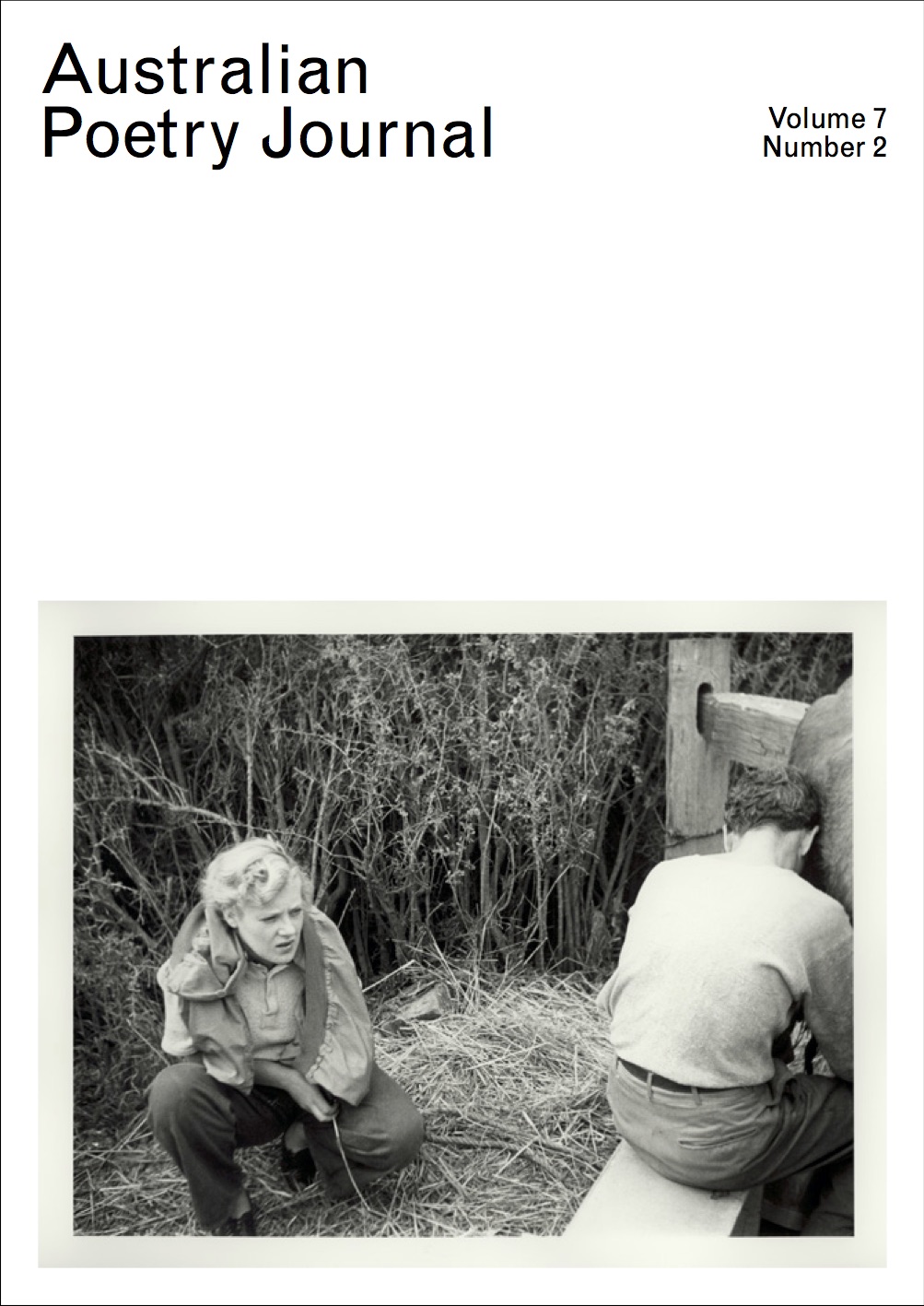
I mainly read this issue of The Australian Poetry Journal on my computer screen. It sat on my desktop to be dipped every now and then, a bit like Twitter only more than 280 characters, more nuanced, less infested with outrage and snark, and more nourishing. Here are some of the bits I enjoyed a comment on the front cover and then some snippets from poems that struck me (though not the only ones that did).
The cover illustration, a photo taken by artist Albert Tucker of artist Joy Hester watching art patron John Reed milking a cow at the artist’s colony Heide in 1942, is rich with metaphorical implications in reference to the journal’s theme of work. It reminds me of Jerome K Jerome’s famous quip about liking work: ‘It fascinates me. I could sit and look at it for hours.’
From Jill Jones, ‘This Could Take a While’:
How do you get through days

that have already curved too far?
From Andy Kissane, ‘The Study Before the Major Work’:
I finish one sketch and start another, in love
 with the repetition that is the texture of my life,
waking each morning to currawong calls,
raising the blinds to the shifting architecture
 of light, dressing in loose clothes, keen to dwell
 in the lilting halls of wonder.
From Geoff Page, ‘In medias res’:
I should perhaps have warned you all
my death will be in medias res:
 a carload of musicians

driving up from Sydney
 and being switched to voicemail
From Judith Beveridge, ‘The Pest Inspector’:
He gave good advice: ‘Always listen at night,
and if you hear a sound as though you’ve left
a record on after all the songs have played,
the ticking of a needle as it tracks in a groove;
 if you hear what you take to be the scratching
of a mouse, the contractions of a cooling
tin roof, or click beetles snapping their thoraxes
 and abdomens to flip themselves right way up –
 take note, they could turn out to be the mandible-crafted
ticks of termites eating along the grain
 of your floorboards.’
The whole of Cameron Lowe’s ‘Botanic / Beginning with four words from a poem by Joseph Massey’, which maybe I love because there was a giant fig behind my childhood home in North Queensland:
There’s little
 to say. The fig –

giant – leans
across the

bridge, reaches
up into

itself, names
fading

from the love
heart

scored in its
trunk.
Cameron Lowe’s poem is part of ‘New Shoots: Garden of Poems’, a special feature that takes up nearly half of the journal’s pages. In 2017, under the auspices of Red Room Poetry, Australian Poetry Inc and the Melbourne Writers Festival, Tamryn Bennett commissioned ten poets to create a new suite of poems each, inspired by plants and histories they encountered in the Royal Botanic Gardens in Melbourne. The poems they produced have had other outings – at the Festival, as a poetry trail at the Gardens, and in an online recording accompanied by interviews (here). They make a brilliant feature here: first the poems, then nine pages of ‘Reflections’ by the poets, which mostly allow for a much deeper reading experience. Just for one example, Bruce Pascoe’s powerful poem, ‘Kuller Kullup’, about the 19th century Wurundjeri elder of that name, becomes even richer when read in the light of his reflection, which begins:
It is very hard for Aboriginal people to get through a day without being reminded of loss, sometimes accompanied by a profound sadness, sometimes by mere elevated irony. When I was walking around the gardens with the other poets dread was dragging at my heels, feeling for my throat. The talk of last and natural and heritage was clutching at me with scrabbling fingers.
There’s much more, in the ‘New Shoots’ section and in the journal as a whole. Copies are available for sale from Australian Poetry Inc.
Eileen Chong, Rainforest (Pitt Street Poetry 2018)
Rainforest is Eileen Chong’s fifth book of poems in five years. I’ve blogged about three others here, here, and here and I’m still a complete fan.
The book’s title is explained in a note: the Chinese character on the cover, which is the third character of Eileen’s Chinese name (the Lin of Zhang Yi Lin) ‘refers to a constant, nourishing rain’, but the radicals that comprise it are yu, meaning ‘rain’, and mù, the radical for ‘wood’. So though the word doesn’t translate as ‘rainforest’, the note explains, ‘the rainforest is embedded within the word itself’. The poem plays on the contrasting connotations of this and those of her western name, Eileen/Helen:
My namesake, so greatly desired
men set fire to a thousand ships –
the light they must have given off,
each sail a blackened flame sooting

the sky. I prefer the rain, a cloud
cradling drops that fall at an angle
over a forest waiting to receive.
It goes on to offer a kind of poetic manifesto in the form of a playful take on nominative determinism – the idea that unconscious processes mould our lives to fit our names: we can choose, it says, how to read our names. What an advantage it is if your name can be represented in pictograms!
So ‘Rainforest’ invites us to expect something like a self-titled album. And the book is intensely personal, though generous to the reader, inviting us in to play, to commiserate, to share joy and occasionally, as in the title poem, to learn.
There are four roughly equal sections, ‘East’, ‘South’, ‘West’ and ‘North’. It’s not that there’s a narrative, but the book has a dramatic shape, and it works so well that I had to stop reading on the first two pages of ‘North’ to weep tears of relief.
‘East’ comprises poems of Chong’s Singaporean Chinese heritage, childhood family, and identity: poems feature food, history, places, connections with other Chinese expatriates. ‘South’ is a collection of Australian poems: places again, artworks, relationship to First Peoples, and especially the five-part ‘Country’, a response to Dorothea Mackellar’s ‘My Country’, where Chong stretches beyond her generally joyful tone to include some ugly manifestations of racism, though I don’t think we’re meant to take the bleakness of the final lines, whose context is a ‘coastal walk’, as her last word on her adopted home:
_______________You hear about walkers
who stray and die of thirst or exposure.

Always bring water. Leave enough time
for the return journey. Watch the sun's path.
You're on your own. This country cares for no one.
However ironic, these lines certainly lay the ground for the third section, ‘West’. Geographically, they are mostly if not entirely set in Europe. Thematically they deal with trauma, painful memories, and darkness.
It takes a while to realise what’s happening, because the images and language lose none of Chong’s clarity and grace. From the first poem in the section, ‘Measure’:
Words: fallen soldiers on a page.
They come and they go. Memory

as surprising as a laden donkey
picking its way towards the church

at the top of a hill. On this island
even the cats sleep with one eye open.
Or this, from ‘Tide’:
That morning in spring I'd thought
I was at peace. To think of you and walk
past without pain. This evening the moon
rose above the treeline. I stepped into
the garden – sharp, clean air. Autumn.

The same moon, but changed.
As the section progresses, the poems become more graphic: violence in an intimate relationship, miscarriage and childlessness are evoked in unsparingly explicit language. Really, don’t read ‘Sandpaper’ if you’re feeling fragile.
The geographical reference of the final section, ‘North’, is Scotland. Thematically, it opens with a deft piece of misdirection, ‘Warhol: Notebooks’, a wonderfully sensuous account of a Warhol pencil drawing of a ‘man undressed, lying on his back’, the soles of whose feet form
________________________a wrinkled cave
of skin, akin to a woman's soft receiving
It turns out that unthreatening erotic allure of this announces the theme of beautifully. After the ordeals of ‘West’, the poet finds happiness and intimacy with a man rom Scotland. The poems are full of the joy of that relationship. While it would be a mistake to take every poem in the book as strictly autobiographical, one can’t help but be very glad for Eileen Chong, particularly in the half-dozen love poems that start with the section’s title poem, whose final lines are where I started crying:
True north: I sought you
in the darkest of nights.
Drop anchor. Deep harbour.
There’s a lot more to this book than I’ve been able to say. Kim Cheng Boey has a beautiful and enlightening review in the Sydney Review of Books. He may not be as keen on the third and fourth sections as I am, but if if I haven’t persuaded you to have a look at Rainforest, perhaps he will.
Erich Kästner and Walter Trier (illustrator), Emil and the Detectives (1929; translation by Eileen Hall 1959; Puffin 1984)
My virtual To-Be-Read pile includes innumerable children’s literature classics. Emil and the Detectives is one of them. I have somehow come to own a copy of it, and it seemed like the perfect read after the rigours of Edward Said’s On Late Style. I knew almost nothing about it. And of course, not being a children’s literature scholar, I still don’t know what its historical claim to fame is, but I did enjoy it, and had a complex enough response that I felt compelled to do a little background reading
First published in Germany in 1929, it evidently broke new ground by telling a tale set in recognisable current reality, mainly in Berlin, with a mainly realistic story. Emil, who lives with his mother in the tiny village of Neustadt, sets out by train to visit his grandmother and aunt and family in Berlin. His mother gives him the enormous sum of seven pounds (in Eileen Hall’s 1959 translation the money is British), one pound for spending money, the rest to help Grandma out. The money is stolen, and Emil has to catch the thief and retrieve the money. He is helped by an ever expanding gang of Berlin boys, and one girl. It’s not really a spoiler to tell you that they are successful.
The book was a delight to this 71 year old, and the note on my yellowing copy’s opening page is almost certainly accurate:
It is a book everyone reads with pleasure. Forward readers of eight could tackle it, while those in their early teens still enjoy it without wanting to disguise the fact.
The squabbling among the boys, their awe in the presence of the only girl, the presence of a kindly journalist named Mr Kästner, the acknowledgement to the smallest boy whose undramatic contribution to the project was nonetheless heroic, the attention paid throughout to tiny practical details, the evocation of the city of Berlin – nostalgic now but no doubt fresh and new then: so much to love.
The thing that sent me to Wikipedia was this: I became uneasy in the climactic scenes leading up to the villain’s capture. Some of this is described from his point of view:
Mr Grundeis found himself completely surrounded. He looked about in amazement, Boys swarmed round him, all laughing and talking among themselves, jostling each other, yet somehow always keeping up with him, Some of them stared at him so hard that he hardly knew where to look.
Then – whizz – a ball flew past his head. He did not like that, and tried to move more quickly; so did the boys, and he remained surrounded. Then he tried to take them by surprise by turning abruptly to go down a side street, but he could not get through the mass of children which seemed to stream across his path whichever way he turned.
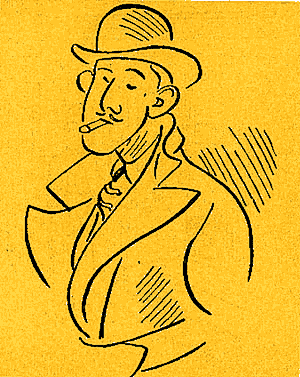
And it goes on. Mr Grundeis threatens to call the police, but the boys call his bluff. And so on, until there’s a violent confrontation in a bank, and the boys convince the tellers and police (who do eventually turn up) that the man is indeed a thief. I can’t be the only one to be made uneasy by this scene of a cheerful mob of adolescent boys harassing a solitary man, especially in late 1920s Berlin. It’s possible that Mr Grundeis has some of the cultural markers for ‘Jew’. He is certainly described in more detail than any other character. He wears a bowler hat, and has ‘a long face, with a small black moustache and a lot of wrinkles around his mouth’. In addition, ‘His ears were thin and stuck out from his head.’
So I was uneasy. I did go to Wikipedia, where I learned that this is the only pre-1945 book by Kästner that wasn’t censored by the Nazis, so I’m reasonably assured that this isn’t deliberate anti-semitism. But I’m putting it out there as a question to people who know more about the history of this book than I do. Does this lovely book about youthful solidarity and power contain a coded version of the antisemitism that Hitler and the Nazis built on? Is it possible for the same story to make one think of the recent school students’ demonstrations for the environment, and in the same moment to remember that boy in Cabaret singing so sweetly, ‘The future belongs to me’? Or am I being hyper-vigilant in this age of assertive identity politics.
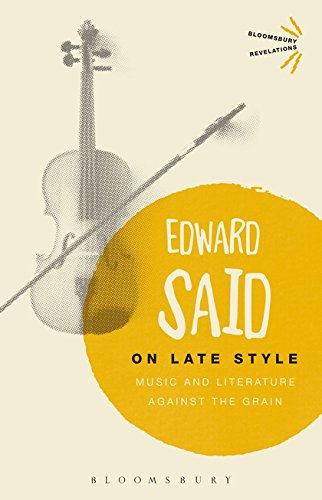
Edward Said, On Late Style (Bloomsbury Revelations 2006)
Before the meeting: The Book Group recently changed its system for choosing books: instead of a chaotic argy-bargy at the end of each meeting, we now take turns to be the Autocratic Book Selector. I’m pretty sure On Late Style, like earlier floats of In Search of Lost Time and something by Heidegger, wouldn’t have made it through the argy-bargy system. But here we are. It’s a short book, but disproportionately demanding.
On 25 September 2003, Edward Said, best known for his books Orientalism and Culture and Imperialism, and for his advocacy of the Palestinian people, announced over breakfast that the next major project he would concentrate on was Late Style, and that it would be finished in December. He died that morning, and what we have is compiled from what his widow Miriam Said describes in her Foreword as ‘a tremendous amount of material’ he had already written – essays, articles, lecture notes. It’s almost certainly not the book Said himself would have submitted to the publisher, but Edward Wood, who did the main work of ‘putting it all together without losing Edward’s voice’, to quote Miriam Said again, assures us in his Introduction that the ‘words are all Said’s own’.
If you’ve read any of Said’s work you won’t be surprised to hear that his notion of ‘late style’ is complex. Deriving in some way from Theodor Adorno‘s writings about Beethoven’s late works, it doesn’t mean simply a style someone has in their work when they are old and/or near death. It includes that, but there is also a lack of resolution, of coherence. Adorno’s term is ‘catastrophic’. Shakespeare didn’t have a late style in this sense: in his late plays major conflicts and dilemmas are resolved or magically transcended. But I’d say Leonard Cohen did in his final album, You want It Darker, and Bob Dylan too, in choosing to perform Sinatra classics.
Said doesn’t discuss Leonard Cohen and Bob Dylan. His examples are the late Beethoven, Richard Strauss’s Der Rosenkavelier, Mozart’s Cosí Fan Tutte, Lampedusa’s novel and Visconti’s movie The Leopard, Thomas Mann’s novella and Benjamin Britten’s opera Death in Venice, a clutch of 20th century operas that use 18th century settings and conventions, Jean Genet, and pianist Glen Gould, with brief discussions of Cavafy and Euripides. I’ve been to maybe three operas in my life, Cosí not among them; I have a CD of Glen Gould but I don’t know if I’ve ever listened to it. That is, musically I’m close to illiterate. I have read the Mann novella and some of Cavafy’s poems; and I’ve seen Visconti’s The Leopard, and also his Death in Venice (which doesn’t rate a mention here). But none of that helped much.
For me, reading the book was like listening in on a conversation among very clever people about something I know almost nothing about. The main conversationalists are Edward Said himself and Adorno. Said wrestles to interpret Adorno’s dense and opaque prose, and then argues with him. A score of other critics turn up as well, always treated with courtesy, sometimes as authorities, but more often to be politely rebutted. For example, after quoting film critic Pauline Kael on Burt Lancaster’s performance in The Leopard, Said writes:
I think we can feel her enthusiasm for Lancaster’s quite noble performance without really accepting any of this at all.
I did read the whole book, and found a lot to enjoy. His discussion of Così Fan Tutte is fascinating, his comparisons of the different versions of The Leopard and Death in Venice likewise. His personal anecdotes about Genet are wonderful, and his reflections on Genet’s non-Orientalist love for the Palestinians are very rich. There are sentences worth lingering over to let their implications settle in, like these:
Identity is what we impose on ourselves through our lives as social, political, and even spiritual beings. The logic of culture and of families doubles the strength of identity, which to someone like Genet – who was a victim of the identity forced on him by his delinquency, his isolation, and his transgressive talents and delights – is something to be resolutely opposed.
In the end, though, I can’t say I followed Said’s argument. The closest I could find to a summary is this, and it’s worth quoting at some length, both for what it says about the artists and for what it implies about possibilities for ageing in general:
Each of the figures I have discussed here makes of lateness or untimeliness, and a vulnerable maturity, a platform for alternative and unregimented modes of subjectivity, at the same time that each … has a lifetime of technical effort and preparation. Adorno, Strauss, Lampedusa and Visconti – like Glenn Gould and Jean Genet – play off the great totalising codes of twentieth-century culture and cultural diffusion: the music business, publishing, film, journalism. The one thing that is difficult to find in their work is embarrassment, even though they are egregiously self-confident and supreme technicians. It is as if having achieved age, they want none of its supposed serenity or maturity, or any of its amiability or official ingratiation. Yet in none of them is mortality denied or evaded, but keeps coming back as the theme of death which undermines and strangely elevates their uses of language and the aesthetic.
The meeting: A couple of days before the meeting, interspersed among arrangements for food, were some comments on the book:
First Chap: I’m an apology on Wednesday night. The company I will miss, discussion of the book I won’t. I found it very difficult to be reminded of how much I don’t know (again).
Second Chap: I am not very far into the book as yet (hoping for time tonight) but understand your sentiments … I thought I was very knowledgable about Beethoven … but apparently not.
Third Chap: I’ll bring a late style potato bake
Fourth Chap: I am intrigued to see that. Is it the sort of dish you make for people when you don’t give a f#@k anymore?
We met over a barbecue and exchanged gift-wrapped books. We spent quite a lot of time on On Late Style, even though it faced stiff competition as a topic of conversation: big news about a guilty verdict that the media couldn’t tell us about, but one of us knew someone who knew someone who had been in the courtroom; one member was absent because his daughter was being honoured for a remarkable achievement; another had very recently become a grandfather; and of course there was food, and Christmas.
Only a couple of us made it all the way through the book. At least one of the non-finishers was actually angry with it – it’s as if it promised to shed light and provoke thought on the stage of life and career that many of us in the group are entering, that is, the late stage, but then failed to deliver anything coherent. None of us know enough about music, in particular opera, to engage with Said’s arguments. He would like someone else, say Alain de Bouton, to write a version the book Said might have written using this material if he had lived to do it.
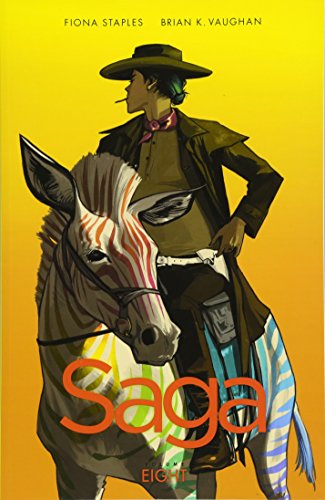
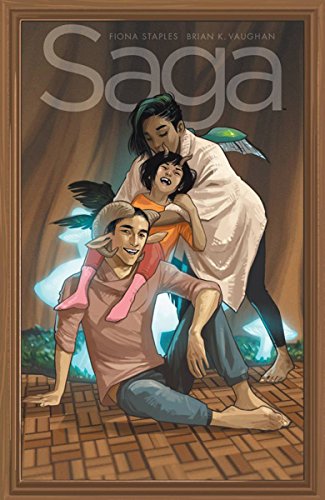
Fiona Staples and Brian K. Vaughan, SagaVolume 8 & Volume 9 (Image 2017, 2018)
It’s common for people who create books for children as well as adults to give fair warning on the first page of a book for adults that the book is not suitable for a young readers. An obscenity on the first line, as in Neil Gaiman’s American Gods, will do it. Given that an early volume of Saga hit a firestorm because an image (one that I didn’t even notice on first reading) was deemed corrupting of minors, it’s not surprising that both these much later volumes have startlingly not-for-children opening pages.
There’s a pretty striped horse on the cover of Volume 8, and the first page of the story itself features a cute bird with pink, three-toed boots and a sheriff’s badge saying, ‘Howdy strangers!’, but above the bird’s head is an unmissable banner that reads, ‘Welcome to Abortion Town!’ Oh, not for children! The cover of Volume 9 shows a warm family portrait with fantasy elements, but the story opens onto a piece of full frontal male nudity. Not for children either!
In Volume 8, as it turns out, our heroes – Alana who has wings, Marko who has horns, their daughter Hazel who has both and so represents the possibility of peace between their warring species, plus their remaining companions – aren’t looking for an abortion, but there’s a lot about reproduction. Alana became pregnant in Volume 7, and I don’t think it’s giving too much away to say that it doesn’t turn out well. Hazel, now maybe seven, asks a lot of awkward questions, and there are moments of sublime joy and sorrow for her as she deals with the issue of having, or not having, a sibling.
As always there’s plenty of sex and violence, and the the plot developments involving the little family’s allies and enemies are full of surprise twists, and some stand-alone tales.
The naked man at the start of Volume 9 is likewise not just a warning to doting parents and grandparents. He is a significant enemy of our little family, now fallen on hard times. In the course of this volume, his fortunes change dramatically, of course violently, and in a way that brings about a major plot development. As always among the violence, intrigue and treachery, there is blissful family life (including blissful sex between Alana and Marko, oh and between another unlikely couple), and cute cartoon animals.
Saga has now been running as a monthly serial for six years. it’s definitely episodic in nature, and there’s a danger-escape-danger rhythm to it, but there’s also a clear forward movement and a clear memory of what has gone before. I have no idea where it’s heading, but I trust its creators. It’s brilliant story telling page after page, month after month, and now year after year.
Brian K Vaughan has recently been put on the payroll of a television production company. I can’t imagine how a TV series could be made of Saga, but that’s no reason not to hope.
When I ran into the lovely Pamela Freeman in an Annandale cafe the other day, just down the road from where I used to live, she insisted on interrupting her lunch to dash off, and returned to present me with a copy of Amazing Australian Women, which she inscribed to my almost-one-year-old granddaughter.
The granddaughter won’t be ready for this book for another couple of years, but I couldn’t just leave it to wait for her. Besides, I’ve been a fan of Pamela’s writing for young readers (and old) for years.
The book is what it says on the lid: twelve spreads, each featuring an amazing Australian woman. It’s a terrific list, presented with a keen eye for the memorable detail, and decorated by Sophie Beer with wit and charm.
I’m willing to bet that none of my readers, asked to draw up a list of twelve Australian women who have changed history, would come up with exactly the twelve women in this book. I’ll bet the lists wouldn’t be identical even if I tightened the brief and asked you to include women who represent ‘warriors, artists, business owners, scientists, singers, politicians, actors, athletes, adventurers activists and innovators’ (to quote the back cover), and then tightened it again to say your list must include at least one Aboriginal or Torres Strait Islander woman, at least one other person from a non-European background, and at least one person with a disability.
The two absences that surprised me were Cathy Freeman and Mary McKillop. At least four of the inclusions are new names to me. Of the ones I knew about, none felt Wikipediated. Did you know for instance that Mary Reibey, when she was thirteen, dressed in boy’s clothes to ride the horse she was then accused of stealing? And did you know who discovered the cause of the Northern and Southern Lights?
If you want to know who made it onto Pamela’s list, whether for your own enlightenment and entertainment, or to quarrel with her decisions, you probably don’t have to wait for the author to give you a copy. Once you’ve checked it out, you might well consider buying it as a gift for a young girl (or boy, because what boy doesn’t want to know about amazing women?)
Ursula Dubosarsky & Gaye Chapman, Leaf Stone Beetle(Dirt Lane Press 2018)
Just under a year ago I became a grandfather. My granddaughter isn’t up to Sendak or Roald Dahl yet, of course. She’s barely up to Eric Hill’s Where’s Spot, Ted Prior’s Grug or Eric Carle’s The Very Hungry Caterpillar, though she listens attentively to readings from them, as well as Judy Horacek and Mem Fox’s Where Is the Green Sheep? and any number of excellent board books supplied by her excellent parents.
My own interest in children’s literature has been undergoing a revival independent of the granddaughter’s needs or interests. When I saw Leaf Stone Beetle on the shelf at Gleebooks, I couldn’t resist: Ursula Dubosarsky has written a number of brilliant novels for children, and Gaye Chapman is a formidable, adventurous illustrator. The book will probably belong to a grandniece in less than three weeks, but I have enjoyed it first.
It’s a beautifully produced little book, just 36 pages, that tells a little story about three things – vegetable, mineral, animal, leaf, stone, beetle – each of which/whom is affected by a storm, which brings them together for a moment. That’s it. That’s the whole story. Small illustrations of the leaf, stone and beetle are scattered through the pages, and there are three spreads showing the storm, one for each of the ‘characters’.
My grandniece will no doubt have a different take, but I responded to it as a lyrical embrace of a world where anything can happen, where life is precarious and finite, where there is profound comfort to be found in the sense that one’s small existence is part of the great processes of nature. The text is exquisite, and the drawings burst with energy.
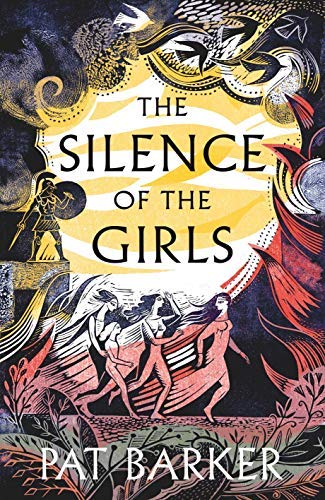
Pat Barker is one of the great war novelists. Mostly she has written about the wars of the 20th century, most notably in her Regeneration trilogy. The Silence of the Girls goes back to the first war story in western literature, and tackles the Trojan War. She’s not the first to do so: in recent years, David Malouf’s novel Ransom focuses on the episode where King Priam begs Achilles to hand over the corpse of his son, Hector, and Alice Oswald’s stunning book of poetry Memorial excavates the Iliad, consisting mainly of translations of the death scenes. The Silence of the Girls tells Achilles’ part of the story, mostly from the point of view of his trophy slave Briseis.
Some readers have complained that though the book sets out to tell the story of the women, whose voices are unheard in the original text, the men’s stories are still central and much more interesting than the women’s. I don’t see it that way. I think the book sets out to tell the story of Achilles, bringing to bear Briseis’ perspective as a non-combatant who is generally regarded as a prize rather than as fully human. I don’t think Pat Barker sets out to subvert the tale of Achilles’ heroics and passions so much as to contextualise them and enrich our understanding of them.
There are a couple of pages in The Silence of the Girls describing the deaths of individuals at Achilles’ hands that I would have assumed were Pat Barker’s invention if I hadn’t read Alice Oswald’s filleted translation (yes, I haven’t actually read the Iliad): the original makes the brutality of warfare viscerally explicit. What Barker does add is Briseis’ imaginings of how the slain men’s mothers must have seen them as children. The book asks, and sets out to answer, not so much the plaintive question, ‘What about the women?’ as the much more interesting ones, ‘Where were the women and what did they think about it all?’
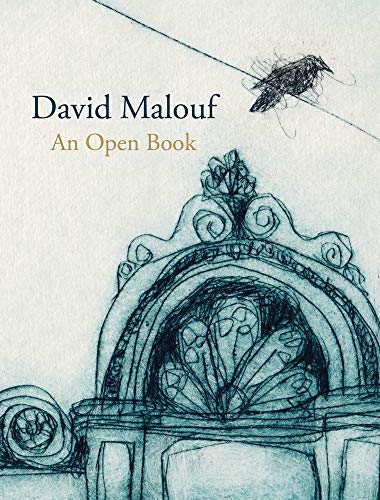
Speaking a couple of years ago at a seminar on Poetry and the Sacred at the Catholic University, David Malouf offered a definition of prayer as paying close attention. If one accepts that definition, then An Open Book is full of prayer: attention to the environment, to relationships, to small children playing, to tiny moments, to his own fleeting thoughts and feelings. There’s also close attention to language, in particular the kind of attention that translation demands.
This means that for the reader the book offers many things that make you go hmmm, or ah, and sometimes oof!
The title, An Open Book, could look like a publisher’s little joke: that is, it’s a kind of label – ‘This is a book.’ But there’s more to it: it makes you think the sentence, ‘My life is an open book,’ and the book does follow the trajectory of a life’. It pretty much begins with a series entitled ‘Kinderszenen’, German for ‘Scenes from childhood’, and ends with a number of poems about old age and the anticipation of death. It follows in the poet’s footsteps from the Brisbane of his childhood, to London, the village of Campagnatico in Tuscany, Myrtle Street in Chippendale, and back to Brisbane.
One of the childhood poems, ‘The Open Book’, suggests pretty strongly that while the book may be in some way autobiographical, it’s not offering us a writer stripped bare:
My mother could read me, or so she claimed,
like a book.  Fair warning! But I
too was a reader and knew that books

like houses have their secrets. Under the words
even of plain speakers,
echo and pre-echo.
There’s plenty of echo and pre-echo under the mostly plain words of these poems.
I mostly want to talk about translation, but first, just because I love them, I have to quote these lines from one of the ‘death’ poems, ‘Before or After’:
At something more
than fourscore, till the big

surprise kicks in and leaves me
breathless, most
surprises, though not unwelcome,

are small. It is the small,
the muted inconsequential,
at this point that comes closest
to real.
About translation. Malouf’s first collection, Bicycle and other poems (UQP 1970) included a number of translations. I can’t quote from memory, but I remember the pleasure I found in the freshness of his versions of Horace: one of them mentions the early light glinting off milk churns put out beside a country road, and to me it felt that rural Queensland was being linked to classical Rome; and his translation of ‘carpe diem’ is a small miracle:
Today's a rose.
Let it blaze in your lapel.
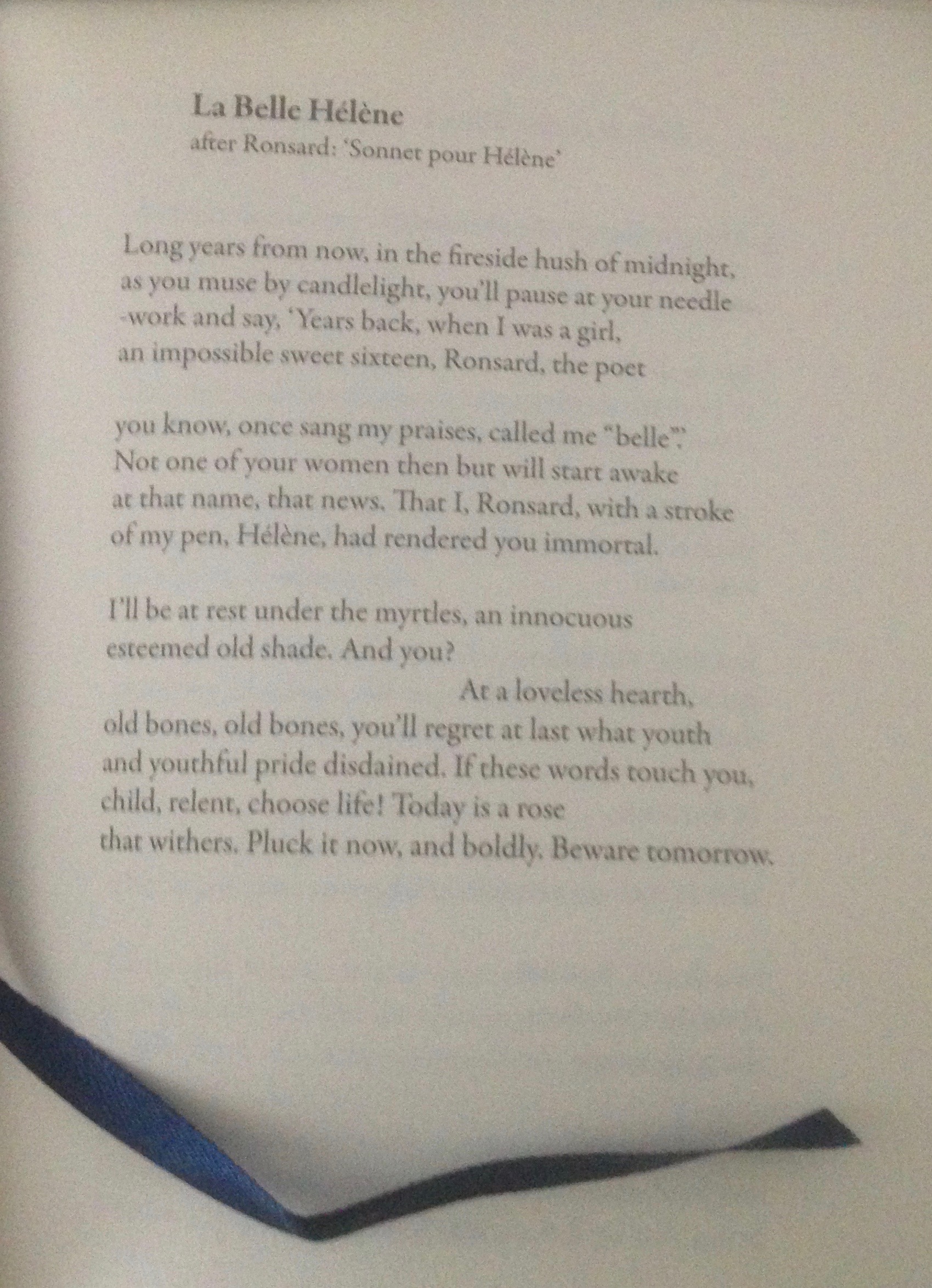
There’s a Horace translation in this book, and a Dante, and the one I want to talk about, ‘La Belle Hélène’, after ‘Sonnet pour Hélène’ by the 16th century French poet Pierre de Ronsard. This is not exactly an obscure poem: I found a website that gives the original French and at least ten translations (here, if you’re interested).
A basic question about any translation is: why? Why this poem? Why include it in a collection of your own poems? Is it a technical exercise? is the translated poem one you love and simply want your readers to know about? Or does it provide a medium for you to express something of your own?
The first thing to say is that ‘La Belle Hélène’ is actually a translation – in contrast to W B Yeats’s also-lovely ‘When You Are Old‘, which takes the original poem as a starting point for a slightly different argument addressed to his own love.
Look at the first lines.
The original:
Quand vous serez bien vieille, au soir, à la chandelle,
Assise auprès du feu, dévidant et filant,
Direz, chantant mes vers, en vous émerveillant :
Ronsard me célébrait du temps que j'étais belle.
Very close literal translation):
When you will be well old, in the evening, by the candle,
Sitting near the fire, dividing and spinning
You will say, singing my verses, being filled with wonder:
Ronsard celebrated me in the time when I was beautiful
David Malouf:
Long years from now, in the fireside hush of midnight,
as you muse by candlelight, you'll pause at your needle
-work and say, 'Years back, when I was a girl,
an impossible sweet sixteen, Ronsard, the poet

you know, once sang my praises, called me 'belle'.
Malouf doesn’t stay close to the words of the original, or use full rhymes, but nor does he hijack the poem for his own purposes. There is evidence everywhere that he has paid close, loving, deeply respectful attention to the original. All the elements are there: the projection well into the future, the fire, the candle, the work, the rhyme scheme (though modernised away from full rhymes). Instead of singing the poet’s verses, the future person drops his name, a rough equivalent in these days when no one sits around a fire singing poetry. Malouf moves the hour of the imagined future scene from the evening to midnight, and introduces the idea of a hush, but the effect is to intensify what’s in the original rather than change it. Interestingly, he does specify the girl’s age, ‘sweet sixteen’, which has a decidedly 20th century feel, and can be seen as part of the project of rescuing the poem from a museum existence.
But she’s not just ‘sweet sixteen’, she’s ‘an impossible sweet sixteen’. And that sounds a note not in the original: one feels that Ronsard is about the same age as the woman he addresses, but this ‘impossible’ comes from a much older person. It seems to be asking how anyone could ever be that young?
And it turns out that the poet as an older person has been subtly woven into the texture of the poem. Where Ronsard’s speaker refers to his future self abstractly as a boneless ghost (fantôme sans os), Malouf’s is more specifically imagined – ‘innocuous’ and ‘esteemed’. It’s slight, but enough to be the difference between a young person and an old one imagining themselves as no longer alive. So the ground has been prepared for when he calls her ‘child’ in the second last line. And that word does a lot of work.
Ronsard’s original is unambiguously a poem of seduction. Malouf’s is something else. Ronsard says the older woman will be ‘regrettant mon amour et votre fier dédain‘ (‘regretting my love and your proud disdain’). There is no reference to Malouf’s speaker’s love:
You'll regret at last what youth
and youthful pride disdained.
Ronsard’s final injunction – ‘n’attendez à demain; /Cueillez dès aujourd’hui les roses de la vie‘ (‘don’t wait until tomorrow; / Gather today the roses of life’) – is a lover pressing his case. In Malouf’s version, having diverged incrementally from the original, it becomes something else, a warning from age to youth:
child, relent, choose life! Today is a rose
that withers. Pluck it now, and boldly. Beware tomorrow.
Only the single word, ‘relent’, carries a hint that seduction might be on the agenda. Which would be just a bit creepy. But having now read the poem a number of times, I find that element recedes into the shadows, and the poem becomes an impassioned, generous, considered cry to the young not to waste their youth.








 Me fail? I fly!