Category Archives: Books

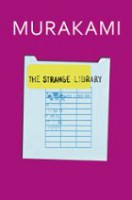
Haruki Murakami’s Strange Library

Haruki Murakami, The Strange Library (2008, translation by Ted Goossen, Harvill Secker 2014)

1846559219I received this as a Christmas gift, and I’m pretty sure that’s what the publishers had in mind.

Tucked away on the imprint page is a credit to Suzanne Dean as designer with a copyright symbol next to her name, and that is just as it should be. The library record pocket glued to the front cover is just the beginning. As one reads the book, almost every page offers a little (or big) design surprise: gorgeous illustrations (many of tangential relevance to the text), to the illusion of different paper stocks, simulated water damage, clumsily stamped page numbers. You can never forget that you are dealing with a book as physical object. I haven’t been been as entranced by a book design since Marshall McLuhan and Quentin Fiore’s The Medium Is the Massage.

The creep, scary, dream-logical story of a boy who is imprisoned in a labyrinth beneath a library until he can memorise four thick books about taxation in the Ottoman Empire reads like Murakami’s version of a children’s story. If it had crossed my desk when editing The School Magazine, I probably would have voted to include it in our list of recommended books ‘for advanced readers’, though I would have understood if I’d been voted down because of some deliciously scary threats that the boy faces.

As it is, it’s a brief, pleasant diversion for adults as well as whoever else might find it.

Luke Carman’s An Elegant Young Man

Luke Carman, An Elegant Young Man (Giramondo 2014)

/home/wpcom/public_html/wp-content/blogs.dir/889/7316403/files/2015/01/img_1161.jpg Published at the same time as Michael Mohammed Ahmad’s The Tribe, in a similar format (they are both Giramondo Shorts), and with a similar voice-from-Western-Sydney cover blurb, this book cries out to be read alongside that one. Both books comprise interlinked stories with a single narrator. Carman has shared the stage with Ahmad at a number of readings in Bankstown and elsewhere over the years, and his name has cropped up on this blog a fair bit, often alongside Ahmad’s. Both of them write fiction that feels as if it’s at one small remove from autobiography. They are, however, very different writers.

First, a trigger warning: if you’re sensitive to what the record companies call explicit language, you’d better give this book a miss. If you’re fine with the C word, but don’t want to have a vile image of sexual debasement served up to your inner eye, definitely skip pages 10 and 11, in which the narrator tells of an early encounter with pornography.

Quite apart from that, much of this book isn’t for the faint-hearted. The dominant theme is multiculturalism as it’s lived by working-class teenagers in western Sydney: plenty of violence, racist and sexist verbal abuse, drugs and desperation. In his performances of these stories, Carman has an oddly dissociated, almost robotic manner, with no attempt to mimic the natural rhythms of speech, or indeed of language. It’s as if we’re hearing a meticulously observed report from the point of view of a visitor from another plane – or even another planet: no judgement, no analysis, no emotive suggestions. I don’t think the stories work quite the same way on the page, but there are elements of it: after the description of porn I mentioned earlier, the narrator comments inscrutably, ‘In some ways, life was better before the Internet,’ and moves on with the story. When the narrator (named Luke, and with a number of verifiable things in common with the author) gets onto a fight with a Cronulla punk named Pivot, it goes like this:

…my head started erupting over and over with blows to my face before I realised I was in a fight. By the time I’d understood, I’d thrown a punch of my own. It hit nothing. I watched it miss and so did Pivot, delighted. The two security guards came out from the McDonald’s to cheer us on. One turned to the other and said, ‘It’s like Rocky V!’ The other guard laughed and my second punch connected so hard that I panicked. The first I knew about throwing it was the sound Pivot’s head made cracking against my fist. He toppled and clonked crown first against the concrete. I bent to my knees and put my knuckles against his forehead. Not punching. Just grinding them into him, saying things that didn’t make sense. Somebody grabbed me by the shoulders and yanked me away, saying ‘Oi! Don’t do that mate, it’s over!’ The crowd dispersed in an instant. The security headed back into Maccas and the sound of the clubs and bars came back to me. Tall bronzed meat-heads carrying cans of Woodstock in their hands helped Pivot to his feet and one in a Bundaberg jersey said ‘Better luck next time, Pivo, you weapon!’

About halfway through the book, the narrator leaves the western suburbs and moves to the inner west, where he listens to young men talk ‘in their lilting tones as if no shadow in the coming night would trip them up’. He and another ‘Westie come good’ (I did warn you about offensive language) go to the Sydney Writers’ Festival and ask offensive questions. They get Christopher Hitchens to inscribe a copy of God Is Not Great, ‘You’re the man now dog.’ In one of the book’s many funny scenes, a lightly fictionalised Penguin Plays Rough event in Sydney Park is disrupted by an Aboriginal homeless man:

‘Be gone! The lot of you! This is my home!’ And no one knew what to do, not just because he had a big stick and was wild and homeless and drunk but because he was Aboriginal and we were all white and so if somebody wanted to say, ‘This is public space, we have a right to be here!’ he could very easily say, ‘No you don’t!’

Be reassured, the situation is resolved peacefully.

Perhaps the most striking moment comes at the end of one of the shortest stories, ‘I Heart Henry Rollins’. The narrator sees the planes fly into the World Trade Center on TV. He wakes his mother and tells her America is being attacked. ‘That’s no good,’ she says, and goes back to sleep. [That’s the closest thing I’ve read to what happened in our house that night.] Then he arrives at school the next morning to find scenes of great rejoicing. The principal makes a perfunctory attempt to stop it, and the narrator is uncomprehending. His maths teacher is standing close by:

I asked him, ‘Why is everyone with the terror?’
He scowled, then he grunted an ugly laugh. He was missing a tooth.
He said, ‘When people die in other countries are you so concerned?’
I did not know what to say. I still don’t. Johnny the Serb had overheard us, and he said, ‘Exactly sir, exactly!’ and I wanted to go home … I sensed a great phantom of history was awake and visible for the first time, shadowing my town, looming over the Western Suburbs like an oncoming colossus …
The clouded sun looked like a blood clot. No one was really afraid.

That’s the end of the story. I don’t know about the colossus, which sounds like hindsight, but the schadenfreudeof those semi-alienated young people and their teachers, which has nothing to do with being ‘with the terror’, rings true. To describe it so bluntly comes close to breaking a taboo. The same can be said for the rawness of much of the book. It comes as a breath of fresh air, not as in sweet-smelling, but as in from a new place.

A final note: Like its back cover blurb, I’ve emphasised the book’s report-from-Western-Sydney qualities. I should mention that the narrator is also bookish. He reads Whitman. A poem by Viennese flâneur Peter Altenberg (1859–1919) is a key element of ‘West Suburbia Boys’. Patrick White, Frank Moorhouse, Peter Skrzynecki and other Australian writers ate brief mentions, not necessarily honourable. In ‘Rare Birds’ he sets out to undo the harm he did by enthusing a woman friend about Kerouac and ruining her life.

Michael Mohammed Ahmad’s Tribe

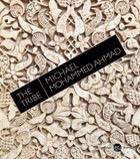
Michael Mohammed Ahmad, The Tribe (Giramondo 2014)

The Tribe cover Though I’ve been mentioning Michael Mohammed Ahmad, writer, performer, actor, organiser and editor, in this blog and its predecessor for some years, The Tribe is his first book. It’s one of Giramondo’s Shorts series – ‘short form, short print run books, designed to take account of the new technologies of digital printing’.

The Tribe narrates three episodes in the life of a Lebanese family living in Sydney – first in the inner west and then further out, in Bankstown – told by Bani, a son of the family who is aged seven, then nine, then eleven. The back cover blurb reminds us that ‘the representation of Arab-Australian Muslims has been coloured by media reports of sexual assault, drug-dealing, drive-by shootings and terrorist conspiracy’, and offers this book as a corrective. But The Tribe isn’t a defence or apologia: it’s a lively, intelligent, funny, weep-making portrait of an extended family. It’s clearly fiction, but if it’s not drawn from life than Ahmad is a true magician.

Every member of a huge cast of characters constantly calls on the reader’s attention, and though there’s occasional confusion about who is related to whom, it’s a marvellous achievement that we mostly know exactly who is speaking and their place in the complex network. There is great warmth, mostly emanating from Tayta, the family matriarch. There is a wedding and a death, both of which are like every family wedding or death that I have been involved with, but dialled up to eleven and a half. By the last page, we feel as if we know these people.

The book isn’t a communal hagiography – one of Bani’s uncles beats his wife; another is addicted to ice; an aunt has been more or less excommunicated because she and her husband were greedy for her legacy; grudges are treasured. During the wedding celebrations Bani’s father stares unsmiling at the door of the venue, armed with a hidden knife and ready for who knows what – the suspense is beautifully executed and the pay-off is unexpected, credible and deeply satisfying.

There’s a lovely moment at the wedding when an adult says hello to  nine-year-old Bani. Astonished, he looks to see who would pay any attention to him in this very adult-centred context. Seeing that it is the man from the couple whose corner shop the family frequent,  the only two Christians invited to the event, he realises that although they have the same physical appearance, wear the same clothes, speak the same language, they are outsiders: it is Muslim identity that is key to belonging to this tribe. (In fact, it’s more specific than that: the tribe are Shi-ites, and the fact that Tayta came from a Sunni family and converted when she married is something that just isn’t spoken of.)

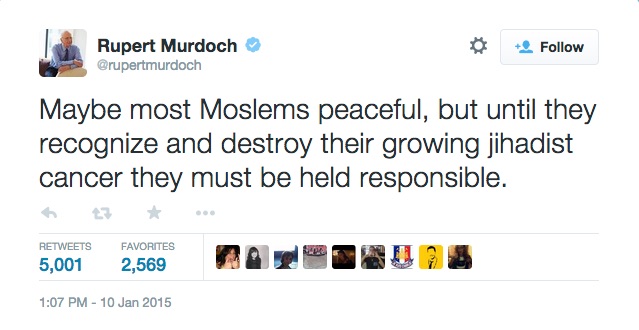
As I was writing this blog post, Rupert Murdoch published this sad tweet in response to the Charlie Hebdo terrorist murders:

RMtweet

I wonder which of the characters in this book he would hold responsible. Tayta, the grandmother racked with arthritic pain who is a source of great comfort and strength to her grandchildren? Bani, a sharp observer of the world of his family? Bani’s mother, whom we last see demented with grief? Uncle Ibrahim, addicted to ice and barely managing to be a decent family member? The refused suitors, the protective husbands, the fathers who rage and then beg forgiveness? Mr Murdoch, if you chance to read this, I recommend – assuming that you won’t get out a bit and meet some non-elite Muslims – that you read The Tribe before the next time you tell ‘most Moslems’ what they must be held to.

John Cornwell’s Dark Box

John Cornwell, The Dark Box (Profile Books 2014)

1781251088 In Ken Loach’s movie Jimmy’s Hall, the Communist hero visits his arch-enemy the parish priest in the darkness of the confessional and asks for advice on how to deal with the Pharisees who encourage oppression of the Irish poor. The priest, outraged, exclaims: ‘This is sacrilege!’ Jimmy shoots back, ‘I’ll tell you what’s sacrilege. You hate more than you love.’

At the beginning of John Michael McDonagh’s Calvary we see a priest in extreme close up as a voice from the other side of the confessional grille announces the intention to kill him in revenge for sexual abuse committed by another priest.

It’s unlikely that the writers of those scenes, Donal O’Kelly and Paul Laverty for the first and John Michael McDonagh for the second, had read The Dark Box or even knew much of the history it recounts. An Irish Catholic childhood would provide more than enough acquaintance with the confessional box as symbol of pervasive clerical power. But this book could have been written as an explication of these and similar scenes.

It actually was written as an explication of the experiences of generations of Latin Rite Catholic children in the first six decades of last century. (I believe it was different for the Maronite and other rites.)

The practice of frequent sacramental confession was introduced at the Catholic Reformation, in the mid 16th century. Under pain of excommunication and hell all Catholics who had reached the ‘age of discretion’ had to confess at least once a year. In large part this was to strengthen priests’ hold over their parishioners’ inner lives, with the aim of detecting and deterring heretical tendencies. At about the same time the confession box was invented, reputedly by St Charles Borromeo, as a way of preventing priestly abuse of the intimacy of Confession – you could tell your sins without the priest recognising you in the dark or being able to touch you through the separating wall. John Cornwell argues persuasively that it also fostered an approach to morality that was individualistic, introspective and divorced from the narratives of people’s lives – which is pretty much the approach that was taught in the schools of my childhood.

In the 16th century, the age of discretion was generally taken to be somewhere in the late teens. It was Pope (now Saint) Pius X in the early 20th century who decreed that Catholics must make their first Confession at the age of seven. To put it crudely, 17 was too late if you were going to get a solid grip on people’s minds, and steel them against the amorphous threat of ‘Modernism’ – which seems to have been a word for openness to current philosophical and other thinking.

Cornwell spends a lot of time on the link between child sexual abuse and Confession as it existed from the time of Pius X to the Second Vatican Council in the 1960s. First, the ultra private nature of the confessional provided opportunity – though paradoxically it was when priests began hearing confessions in places other than the box that opportunity increased, as his personal recollections attest. More interestingly, though, Cornwell argues that the training that had grown along with the practice of confession created a skewed understanding of human sexuality among priests. He quotes extensively from the text books used in British seminaries for the first half of the 20th century: homosexuality was seen as mortally sinful but rated a very brief mention; rape was a mortal sin but not much discussed; child sexual abuse wasn’t mentioned; masturbation was also a mortal sin, possibly worse than rape for reasons I can’t bear to repeat, and discussed at length.

Through it all, priests were to see themselves as the authorities. As children they had recited laundry lists of sins; now they had more elaborate laundry lists and a host of arguments they could rationalise with. Nowhere was there room for thinking about life as it is lived.

Catholics of my generation sometimes swap stories about childhood confession. The word for ‘sex’ was ‘impurity’, for example, and what was a seven year old boy to make of the information that if he touched his ‘private parts’ except for bathing or peeing purposes he risked burning in hell for eternity? I remember curling up with embarrassment when I went to confession with the Archbishop of Brisbane in the early 60s, when I was perhaps 14. The Archbishop had a deep, loud voice, and when I confessed to impure acts (a term that covered everything from pack rape to a cheerful roll in the hay, but in my case meant touching my own erect penis – and I do mean just touching), he rumbled for the whole cathedral outside the box to hear, ‘Alone or with others? And how frequently did you do it?’

It’s a dark kind of joy, but a joy all the same, to have history’s unforgiving light shone on this part of my childhood. I recommend the book to anyone who has a close relationship with a Pre–Vatican Two Latin-rite Catholic.

Minchin’s Storm, Vaughan’s Saga

Tim Minchin, DC Turner & Tracy KingStorm (Orion 2014)
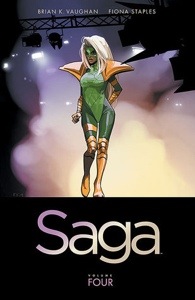
Brian K Vaughan & Fiona Staples, Saga, Volume Four (2014)

The slender rationale for including these books in a shared blog post is that they’re both comics, and I read them both in a single beach-side holiday afternoon.

Storm cover Storm had its first incarnation as a beat poem Tim Minchin performed in one of his musico-comic solo shows. DC Turner and Tracy King, animators, loved it and saw its potential for an animated film. When they happened to meet the man himself a little later they asked his permission, and voilà, after just a couple of years’ work by many people, their video was scoring millions of hits on YouTube. This is the comic book of the film of the poem.

The poem tells of a dinner conversation where one of the guests (‘Tim’, known mainly as ‘I’) throws civility to the wind and delivers a blistering rant in defense of evidence based medicine and the scientific method against another guest, the eponymous Storm, who persistently advocates hip irrationality. It’s funny, both in its remorseless point scoring and in its mockery of the protagonist’s probably futile passion. It’s also completely serious, and includes a sweetly lyrical evocation of the wonders of the actual world.

The book in effect performs the poem on the page, illustrations and typography doing the work of voice and music. When ‘Tim’, in full snarky flight, asks, ‘Do we actually think that Horton heard a Who?’, a pale blue Dr-Seuss elephant trunk pokes in from a corner of the frame. And there’s an extra comic dimension in images of the other diners’ reactions – I particularly like his wife’s scowl when he mentions the tattoos on Storm’s breasts.

And then there are the equivalent of DVD extras: a foreword by Neil Gaiman (such a nice touch to have one of the living masters of fantasy write approvingly of a book that could easily be misread as antagonistic to fantasy); accounts of the book’s genesis by the writer and the artists (they are called illustrators, but they are much more than that); and a selection of alternative covers by other comics artists.

Saga vol 4 This volume of Saga continues to be as funny, suspenseful and artfully told as the first three volumes. I just reread my blog post on those, and don’t have anything to add. Except possibly that it begins with a full page close up of the television-head of one of the aliens emerging from the birth canal, Hazel’s parents separate, Hazel herself is kidnapped by a television-headed insurgent, who has also kidnapped the one we saw being born. Sadly the next volume won’t be here for an awfully long time.

Geoff Dyer’s Ongoing Moment

Geoff Dyer, The Ongoing Moment: A Book about Photographs (©2005, Canongate 2012)

0857864017This was a gift from a photographer friend who says she rarely reads a book all the way through. She dips here and there until she has had enough. The Ongoing Moment could have been written with her in mind. When I wrote the top line of this blog post, I first wrote the book’s subtitle as ‘A Book About Photography’. That may not be a completely inaccurate description of the book, but its actual subtitle comes closer to the mark. There are 105 photographs reproduced in its pages, most of them muddy and far too small in the edition I read. Dyer’s discussion of them – and of perhaps as many again –  is organised around themes that he says emerged as he immersed himself in what appears to have been a sea of photographs.

He writes about photographs of blind people, of men in overcoats and men in hats, of hands, backs, steps, doors, roads, service stations, barber shops and, perhaps most movingly, park benches. These subjects allow him to explore the distinctive styles of different photographers – and those wonderful moments when a work by one photographer looks exactly like something by another. He finds or invents narratives that link images created decades apart, and at times I don’t think he knows which he’s doing. He has a considerable gift for describing an image in an illuminating way.

He discusses works by more than 40 photographers – most of them of the United States, though he says in his introduction that he didn’t set out with that intention. One of the key questions about a photograph, he says, is whether it is of something or by someone.

There are delightful skerricks of gossip, wonderfully apposite quotation from Whitman, Wordsworth and other poets, a constant, confident play of mind. There’s a moment of snark in the acknowledgements that should win some kind of award.

I’m not well versed in photography. In the first days of my relationship with the Art Student, we bonded over a Diane Arbus exhibition (neither of us had previously heard of her, and we both realised at about the same moment that she wasn’t mocking her subjects). We recently visited a huge Paul Strand exhibition in Los Angeles. I’ve peered over her shoulder as she did assignments on Dorothea Lange and Walker Evans. This much knowledge, plus my passing familiarity with some Australian greats (who of course are beyond Dyer’s southern horizon), enriched my experience of reading the book. I expect it could be enjoyed by people who know an awful lot about photography, who would find it an interesting personal take on aspects of this huge field. Equally, for people who know next to nothing, it serves as an unsystematic introduction to 20th century US photography – or not so much un- as eccentrically systematic. It’s like spending a couple of hours with a well informed and witty friend who chats enthusiastically as he shares his shoebox full of photographs.

Southerly 74/2

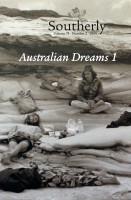
David Brooks and Elizabeth McMahon (editors), Southerly Vol 74 No 2 2014: Australian Dreams 1

southerly-74-2

When Dorothea Mackellar was living in England a little over a century ago, she dreamed – and versified – about a sunburnt country, rugged mountain ranges and sweeping plains. Times have changed. When David Brooks sent out an invitation for an issue of Southerly on Australian dreams, he wrote of ‘a mounting dismay and shame at seeing the cruel place we’ve become’, and though in his editorial he protests that he doesn’t want to deliver a jeremiad, that editorial will do the job quite effectively until an actual jeremiad comes along.

So there’s not a lot of singing about the wide brown land here.

Rowena Lennox’s ‘Timor Dreaming’, about a friend who was killed in the East Timor massacre of 1976, pokes at the open wound of the Australian government’s silence then and its bullying more recently. JH Crone’s three-part ‘Elegy to Giants’ mourns Australians killed in the Bali bombing while ambivalently celebrating their ‘binge Bintang, root, vomit’ lifestyle (and in the third part, a jarringly unrhymed parody of CJ Dennis identifies them as descendants of Dennis’s Ginger Mick).

Jim Everett, a plangermairreener man of the First Nations of north-east Tasmania, refuses to identify as an Australian citizen in a fiercely polemical article, ‘Savage Nation: First Nations’ Philosophy and Sovereignty’. Mudrooroo Nyoongah, citizen of the world, faces old age, illness and the prospect of death in two powerful lyrics, ‘Wisps of Delightful Desire’ and ‘Old Fella Poem’.

Joshua Mostafa’s ‘Against Progress: Dreams, Nightmares, and the Meaning of Abbott’ probes the state of the Australian political culture (don’t be put off by its citing of a contemporary French philosopher, which often foreshadows pages of heavily academic prose, but not here): crudely summarised, he argues that public debate is too often limited to a contest between those who play on people’s fears and those who play on the fear of having one’s fears played on.

A number of the poems could have been written in direct response to David Brooks’ Claytons-jeremiad, touching on asylum seekers’ deaths at sea, environmental degradation and the parlous state of currently existing democracy. The poems that resonated with me most strongly, though, didn’t have an obvious connection to the theme: travellers’ tales from Laurie Duggan – ‘A short history of France’ and ‘New York Notes’ (not the only travellers’ tales by any means); a snowy expatriate winter from Kevin Hart – ‘February’; and a long piece by Sian Ellett, ‘Chopin & Friedric’, in which the top part of each page has a slam poem by a teenager with multiple sclerosis while at the bottom his mother gives her point of view.

The closest thing to a good old-fashioned bush yarn is Frank Moorhouse’s ‘I, initiation’, which starts out, ‘At the age of eight as a cub scout, with a never before experienced delight, I cooked and ate my first lamb chop barbecued on a green forked stick at my first camp fire in the bush,’ and goes on to talk about his regular eight-day solitary sojourns in the bush. But we are taken way out of our – and his – comfort zone with the story of an accident involving his scrotum and the years of psychoanalysis that followed.

The closest thing to a good old Aussie family story, and the piece if fiction that most wrung my withers, is Cecelia Harris’s ‘All That is Left Behind’, a father–daughter story that is full of snow rather than sunburn.

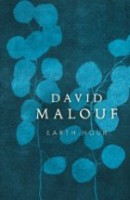
Michelle Borzi’s ‘David Malouf, Earth Hour‘ provides what I’m always hoping for when I read literary criticism. She quotes generously, and helps us see the poetry with fresh eyes.

There are signs that some items were written – and edited – in haste. It’s hard to take seriously an article about Gough Whitlam that misspells Malcolm Fraser’s surname and the name of the Labor Party (especially given that Southerly follows US spelling conventions elsewhere). A reference in one article led to a critical response to the piece it was supposed to refer me to. One story ends so abruptly that one wonders if a couple of pages have dropped off or, more likely, it’s an undeclared excerpt from a longer work. And, fascinating though it is, I do wonder if Frank Moorhouse mightn’t have put his memoir through another draft to take some of the awkwardness out of his discussion of Aboriginal initiation ceremonies and the TMI discussion of his therapy.

Evidently a further Australian Dreams issue is in the pipeline. Good!

Guy Rundle’s Clivosaurus

Guy Rundle, Clivosaurus (Quarterly Essay 55)

1863957014Since I first met Guy Rundle’s writing in the late 1980s I’ve thought of him as two writers in one. He wrote brilliant scripts for Max Gillies’ stage and TV satires, and at the same time wrote formidably, even impenetrably, abstract prose for the Marxist periodical Arena. In Clivosaurus those two Rundles are working well together: the essay is bitingly funny where it needs to be, and provides much-needed serious analysis of its subject. Its prose, happily, is far from impenetrable.

The essay begins with an episode from the familiar Clive Palmer narrative, the epic weekend at Palmer’s Coolum resort just before the first Senate sitting of 2014.

‘I donnn’t wannnnn’t to see any more dinosaurs,’ said a small girl. ‘We’re going to see the dinosaurs,’ said her dad, pulling her along. The weekend was rich in analogy.
Over at the Coolum rooms, other big beasts were gathering. The PUP’s Queensland senator, Glenn Lazarus, the ‘brick with eyes’, rolled in with a posse of good ol’ boys, enormous men in male bling, tapping on BlackBerries as they walked. Palmer’s other media guy, Andrew Crook – improbably but inevitably trading as Crook Media – buzzed around, harassed and bothered. Then a golf cart pulled up, and Crook imposed himself in front of the two camera crews as His Cliveness struggled  out.

In general, the press has focused on the comedy of Clive Palmer, treating his entry into federal politics as if it was akin to his animatronic dinosaurs or his plan to launch a new Titanic, needing no further explanation than naked economic self-interest and his vendetta against the conservative parties of Queensland. This essay relishes the comedy, going so far as to include some of Palmer’s eminently mockable poetry. It also goes into the swashbuckling history of the Gold Coast and Queensland conservative politics, in which Palmer has been a player. But it goes on to argue that behind the twerks and twaddle is a consistent political outlook rooted in Palmer’s Catholic centre right background:

Palmer has been completely consistent in doing what he said he’d do – vote to abolish the carbon and mining taxes – and completely in accord with his stated beliefs in developing a set of policies in response to the surprise budget. For six months he has said he and his party would not agree to the Medicare co-payment, the harsh new arrangements for unemployed youth, an increase in university fees or ‘assets recycling’, and he hasn’t. Much of what he was willing to compromise on with the government involved issues and policies peripheral to his philosophy. His rapid deal-making, a legacy of his real-estate and mining-lease years, and his ability to package and repackage sets of options at a rapid pace seemed to bamboozle people, to convince them that anything was up for grabs. Yet this was nothing more than the horse-trading that is a necessary part of politics everywhere else, but that has been lessened by the lock-step nature of the Australian party system.

Perhaps the essay’s final movement is its most interesting. ‘It is not Clive Palmer per se,’ Rundle writes, ‘ that is the source of this merry dance we have been on in the past six months.’ He goes on to discuss what he calls ‘the now sclerotic apparatus of Australian government’, by which candidates who receive a tiny fraction of the primary vote can gain seats on the Senate, and the way the major parties and the media have vested interests in not challenging that system. People may be upset at the disruptive effect of Clive Palmer and the PUPs wielding such power, but just imagine if it had been Gina Reinhart or someone similarly lacking in Palmer’s social concerns (such as they are) had bought their way into parliament the way he did! What’s more, we have

a Treasurer whose family fortune is constituted by his wife’s skills as a banker, and whose family’s future fortune will be considerably affected by the general decisions the Treasurer and his party make on taxes, interest rates, deductibility and the like. The party system masks the latter set of interests – Palmer’s, at least, are right out there where we can see them. … [In] the longer term we will only have come out of this period successfully if we are pointed towards an era when big beasts no longer, with such impunity, stalk the land.

So this started out looking like one of the Quarterly Essays that probe the personality of a public figure, or explore the way they appeal to some generalised Australian national psyche, but it turns out to be a call to action on a serious problem with our ‘democracy’.

Best of 2014 in 3 lists

List 1. Movies (with links to the movies’ IMDb pages):

The Art Student and I gave each of the 50+ movies we saw in 2014 a score out of 5. There was a respectable number of 4s and 4.5s. Here are the seven with a combined score of 9.5 or more, in no particular order:

17_d

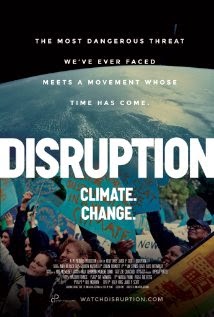
Disruption (Kelly Nyks & Jared P. Scott): we broke our tacit rule about not including movies we saw on the small screen for this one. It’s a brilliant presentation of the situation we face, made in preparation for the Climate Mobilisation in August, but still powerful and useful.

17_bh

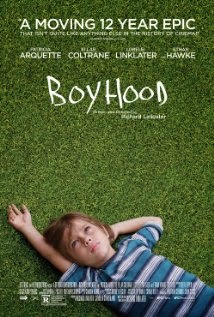
Boyhood (Richard Linklater). This does miraculous things with filming in real time. The actors actually age as the characters do. Towards the end, someone says, ‘I thought there’d be more,’ and we feel her pain.

17_L

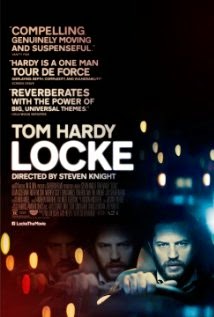
Locke (Steven Knight). Another film that does wonders with real time. One man drives in a car through the night, and is spellbinding. The spell is greatly helped by the beauty of Tom Hardy’s voice.

14_CC

Charlie’s Country, Rolf De Heer’s brilliant collaboration with David Gulpilil is just superb. That it to some extent reflects Gulpilil’s own story gives it a depth of feeling.

12y

12 Years a Slave (Steve McQueen). Nothing much needs to be said, except that this is a wonderful movie.

17_c4

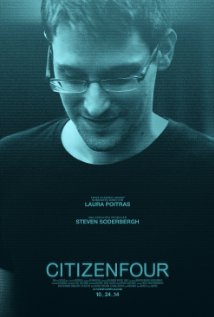
We saw Citizen Four (Laura Poitras) as part of the DOC NYC film festival. It’s a stunning documentary that plays out like a thriller, complete with grim comic relief, about Edward Snowden’s revelations of government surveillance.

tgs

Nick Broomfield’s Tales of the Grim Sleeper, which we also saw as part of DOC NYC, makes a mockery of most fiction movies about serial killers, and peels back the cover from race relations in the US.

Our worst movie
This prize has to go to the only film we walked out of: Woody Allen’s shouty, silly, predictable and unfunny Magic in the Moonlight. (To be quite honest, the Art Student predicted the reveal; I just didn’t care.)

List 2. Books

The Art Student’s best five (with comments taken from my notes of a chat about them):

144477963X

Siri Hustvedt, The Blazing World: The Art Student particularly loved how convincingly this novel describes the artworks created by its protagonist. [We heard Siri Hustvedt read from The Blazing World to about 30 people in Brooklyn last month. She read beautifully and answered questions generously. Memorably, she told us she had found Kierkegaard to be great fun since she first read him as a teenager.]

1400066026

Alan Furst, The Spies of Warsaw: a novel of espionage in eastern Europe in the 1930s. Strong on atmosphere and suspense, it manages to tell its story without contriving a catastrophe.

Helen Garner, This House of Grief: The Story of a Murder Trial (Text 2014)

Helen Garner, This House of Grief: Everyone who likes this book seems to give different reasons. The Art Student liked its tight, almost domestic focus on its characters.

1594486344

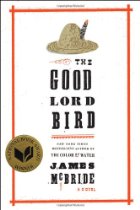
James McBride, The Good Lord Bird: a novel about John Brown, the anti-slavery activist, from an African-American point of view.

0316322407

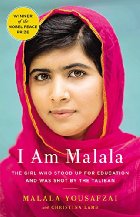
Malala Yousafzai, I am Malala: a fabulous, fabulous book that combines a History 101 of the Peshawar Valley with an account of two extraordinary people, Malala and her father.

I’m not going to list a best five books, but here are six that delighted, challenged and enlightened me, or did that thing of putting into words things I dimly felt or perceived. The images link to my blog entries.

A note on gender and diversity: The Art Student announced proudly that she had read more books by women than by men (as she usually does). I read 25 by women and 32 by men. Up against recent Viva statistics on literary journals on reviews by women or about women writers, I’m doing pretty well. I’ve read 6 books in translation, from Chinese, Japanese, Bengali and Hebrew.

List 3. Best ‘Me Fail I Fly!’–related headline:

5ip

Onward to 2015!

Responses to Noel Pearson

As I’m sure I’ve said before, one of the best things about Black Inc’s Quarterly Essay is that substantial responses to each issue are published in the next one. I’ll write about Guy Rundle’s essay on Clive Palmer in QE 56 some time soon. For now I just want to draw your attention to the Correspondence section.

There’s a plan for a referendum in 2017 on changing the Australian Constitution to recognise Aboriginal and Torres Strait Islanders. This referendum has been postponed a number of times, at least partly because the subject doesn’t seem to be hitting any kind of nerve with most Australians, and partly because there’s no agreement on what proposal should be put to us.

You might think you know enough now to know how you’ll vote. Well, maybe you’re wrong about that. You really should read Noel Pearson’s Quarterly Essay 55, A Rightful Place and then you should read the responses in No 56. (If you’re pressed for time you could skip John Hirst, who has said elsewhere that Aboriginal matters are out of his comfort zone and demonstrates the truth of that here by creating and then dismissing as unpersuasive a breathtakingly simplistic summary of Pearson’s argument. You might also skip Paul Kelly – definitely not the songwriter – who seems intent on offering advice to Tony Abbott rather than talking to you and me.)

Here are some snippets.

From Megan Davis, professor of law at University of NSW:

Even before the Quarterly Essay went on sale, Pearson’s potentially complementary proposal was dismissed as ‘grandstanding’ and ‘unhelpful’. Having served on the prime minister’s expert panel on constitutional recognition alongside Pearson, I found this an exasperating reminder that although black leaders regularly chant ‘leaders are readers’ to our young mob, Australia’s political leaders are in fact, on the whole, not readers.

From Rachel Perkins, filmmaker and activist:

Noel’s notion of tethering cultural survival to constitutional reform is intriguing. When I grasped the potential of his idea, I realised it may be our best hope – in the short term – of attracting national interest on this issue. It lit a spark for me and gave me hope, for we have only to look back on our history to understand the trajectory we are on. The question is: will our people be able to put their differences aside and unite, as they did in 1967, towards this possibility?

From Celeste Liddle, Arrente woman and trade union organiser:

As a trade unionist, I support a hearty process of negotiation between parties wishing to work together to achieve outcomes. There has never been a negotiated agreement between First Peoples and the government in this country and I feel that it is integral to achieve this before we look at amending the constitution to include Aboriginal and Torres Strait Islander people.

From Henry Reynolds, historian:

Noel Pearson’s powerful advocacy notwithstanding, Australia has regressed on indigenous matters– a generation ago the question of a treaty was seriously discussed, as was the status of traditional law. And this leaves us far behind comparable societies such as New Zealand, Canada, the United States and the Scandinavian countries. Noel argues that we cannot expect any more because, unlike the Maoris, indigenous Australians are only a very small minority. But this carefully avoids comparison with the much higher status of the Native Americans in North America and the Sami in Scandinavia.

From Robert Manne:

During the 1990s, under Paul Keating and Patrick Dodson, there existed an atmosphere of intense hopefulness about the role reconciliation might play in the creation of a better nation. In May 2000, at its climax, hundreds of thousands of Australians walked across the bridges of Australia in support of a reconciliation ceremony at the centenary of federation, an idea which, unforgivably, the Howard government quickly killed. The mood of hope was still not altogether extinguished, as the passions stirred by Kevin Rudd’s February 2008 apology to the stolen generations demonstrated. However, in recent years that atmosphere has faded. Somehow, if the referendum is to succeed it will now have to be rediscovered. Pearson it probably right to believe that unless the movement for indigenous constitutional recognition is led by a rock-solid conservative it is unlikely to succeed. The problem is that a rock-solid conservative is the least likely kind of political leader capable of reigniting the social-justice passions of Australians.

From Fred Chaney:

It is helpful to read this essay alongside a viewing of Noel’s address at Garma this year, published on YouTube. There you get the force of presentation as well as intellect. Following reference to the destruction of Tasmanian Aboriginal people, he posed the question ‘we are still grappling with today’: ‘will European settlement of Australia enable a different people with a different heritage to have space in it?’ He poses it as a question still unresolved. He says that in the 1820s in Tasmania we answered the question by our actions. Then in stark terms he suggests, ‘If we don’t come to a just answer to that question today, that same answer will come about for benign reasons.’ If he is correct in this, and I think he is, it is a matter of great seriousness for all of us.

Really, I recommend you to read the whole thing.