Category Archives: Diary

Sydney Writers’ Festival: My Day 1

By one count, the Sydney Writers’ Festival has been going since the weekend. The opening address, by all accounts brilliant, was on Tuesday night. My festival started yesterday.

My first event – a poetry reading in the English Department’s Common Room at the University of Sydney – wasn’t strictly part of the Festival, but two of the poets were in Sydney for the Festival, so I’m counting it. I had to leave early to catch a bus to the Opera House so I only got to hear one and a half poets, all of Fiona Hile and half of Kate Lilley. Sadly, I missed out on Louis Armand from Prague, and Pam Brown.

The room was full of poets. Overheard pre-reading conversations (there were nibbles and drinks) included happy reports of ‘having something accepted ‘ in a coming anthology. John Tranter recorded proceedings for the Penn Sound Archive. Vagabond Press was selling in a back corner.

I enjoyed Fiona Hile’s reading but I wouldn’t say I understood much of the poetry. Partly this was because she read fast, the room was a bit echoey, and I’m a bit deaf. Mainly, though, I expect it was because she’s what the Spoken Word people call a page poet, and even more an experimental poet, which tends to mean that meaning isn’t easy to grasp. There were lots of striking lines. I managed to jot down:

The lilliputian threads of the old ways make me want to lose a limb

and in a context to do with sheep:

That wolf you’re wearing goes with everything.

In introducing Kate Lilley, Fiona Hile conjured up a fabulous image. She said she used to think it was uncool to have heroes, but when she began writing her own poetry, she had four horsewomen: Kate Lilley, Pam Brown, Gig Ryan and Jennifer Maiden. I’d love to see the movie that has those four poets charging into battle.

Kate Lilley read from Ladylike, and was about to read from Realia when I reluctantly tore myself away to catch a bus to the Quay, have dinner and then climb the stairs to the Joan Sutherland Hall of the Opera House for:

7.30 pm: The Life and Times of Alice Walker, in which Alice Walker was interviewed by Caroline Baum and joined by Archie Roach. The SWF blog already has a report.

As is customary at the Sydney Writers’ Festival, the session bore little relation to its title. Alice Walker was in no mood to tell her life story, or to discuss her ‘times’ with any specificity. The tone was set right at the start when Caroline Baum asked, ‘Are you nervous at the start of events like this?’ and Alice Walker replied, ‘No,’ and waited serenely for the next question. CB bounced back by asking her to read us a poem, and she obliged with ‘You Should Grow Old Like the Carters’, which she read beautifully, giving each word its full weight, conveying the music , treating herself and the poem as worthy of our full, serious attention. That mix of awkwardness, resilience on Caroline Baum’s part, and weight on Alice Walker’s kept up for the whole session.

Part of the awkwardness came from the level of unaware racism in the room, or at least a reasonable expectation of it on Alice Walker’s part. She didn’t give her interlocutor the benefit of any doubt. For example (from memory, so probably missing a lot of nuance):

CB: So you grew up in a house without books and were part of an oral, story-telling culture.
AW: Oh, no, we had books. My parents got hold of old books that people had thrown out. But yes, there were lots of stories that everyone told, wonderful stories. [End of reply.]
….
CB: You read a lot when you were young. I believe your favourite books were … and Jane Eyre. What was it like the first time you read a book with black characters you could identify with?
AW: Oh, I identified completely with Jane. White people seem to think they can’t identify with black characters, but when we read it’s not about these divisions. It’s the spirit we identify with.’ [Applause]

Fortunately, Caroline Baum has a wonderful capacity for putting herself out there, and then bouncing back when she has her knuckles ever so serenely rapped.

Another reason the session seemed such hard work is possibly a problem of definition. Is Alice Walker at the festival as a writer, an activist, or a vague kind of celebrity?

Well, obviously, she’s a writer. But The Color Purple was published roughly 30 years ago, and I wonder how many people in that huge hall had read Possessing the Secret of Joy, or made it all the way through The Temple of My Familiar. As a poet she would draw a crowd, but not this big a one. Many of her essays are absolutely brilliant: ‘In Search of Our Mothers’ Gardens’, ‘Only Justice Can Remove a Curse’, her essays on Zora Neale Hurston and Bessie Smith, on olive oil, the scar in her eye … I can rattle those off without googling. And a new collection of essays – Cushion in the Road: Meditation and Wandering as the Whole World Awakens to Being in Harm’s Way – has just been published. But how many essayists can fill the Opera House?

As an activist, she has an impressive record. She campaigned very visibly against female circumcision a while back, and was part of the flotilla that was intercepted so dramatically on its way to Gaza. But as far as I know she’s not part of any activist organisation and her activist philosophy boils down to stressing the importance of having friends (a ‘circle’) you can be completely honest with, and meditation seems to fit there.

Celebrity seems to be the key. So although the conversation touched on many things, and Caroline Baum kept pulling the conversation back to the recently published book, my overwhelming impression was that we were in the presence of celebrity, who was dispensing her wisdom for our benefit. The most telling celebrity moment was when she was asked about her daughter’s very public statements that her activism had made her a neglectful mother. Her reply included no whiff of self doubt, no hint that her daughter might have had a legitimate point (as the children of many activists surely would). The problem was that her daughter suffered from ‘mental instability’, from which she had now mercifully recovered. This dismissiveness was cloaked in serious and valid reflections on the legacy of slavery on her family, but it was dismissive all the same. We were to make no mistake who was the important person in this conversation.

I’m sorry if that’s jaundiced. I’m still a fan. I will buy the new book of essays, and probably her new book of poetry as well. I’m seeing another session with her on my second day, and hoping I’ll have a change of perspective.

Ngurrumbang update and some very old news

It can now be revealed that Melburnians will have a chance to see Ngurrumbang on their home turf in May. No need this time to travel to Sydney, Brisbane, Adelaide or central Spain, just head off to the Australian Shorts session of the Human Rights Arts and Film Festival at the Australian Centre for the Moving Image 7.30 pm on 9 May.  The whole program looks fabulous. (Sadly, that set of films won’t be part of the Festival as it travels around the country in the next three months.)

And other news: I was interviewed yesterday for a project about resistance to conscription at the time of the Vietnam War. Gulliver Media’s Hell No! We Won’t Go, which may one day become a film, is shaping up at present as a collection of interviews with draft resisters and conscientious objectors. I was a conscientious objector and happy to delve into memory as part of this project to preserve part of our history that is threatened with occlusion.

I also delved into a diary that I kept at the time (my CO hearing was either late 1970 or early 1971), which prompts me to offer the following unsolicited advice to anyone in their early 20s who is keeping a diary: no one, including yourself, is going to be interested in your half-baked witticisms and introspective anxieties in 40 years time; what they’ll want is NAMES, and DATES, and PLACES.

While finding very little to help my recollections of the court case, and shrivelling with embarrassment at the angst and pomposity of 23-year-old me (which makes me look even more kindly on Lena Dunham’s Girls),  I did find one or two entertaining snippets. On Les Murray:

I met Les Murray at Dianne’s party last Saturday night, a man who is not shy about quoting from his own someday-to-be-written ‘Table Talk’. Among other things he said wh I found interesting: ‘There is no Tao for stumbling in the dark. If you had the Tao, you’d walk.’

On David Malouf, perhaps from conversation in the English Department common rooms, which I’d forgotten I ever shared with him:

Dave Malouf  ‘don’t think Polanski’s any good’, but when pressed likes all except Rosemary’s baby, on the grounds that it moves away from the class vision wh MUST be part of his Communist framed sensibility – and WILL NOT see Fearless V Ks.

Having recently read the script of Rosemary’s Baby, I think he was right about that. But I hope he relented and saw The Fearless Vampire Killers, which I hope is as funny as I remember.

The media and March in March

I wrote this to the Sydney Morning Herald yesterday morning:

Dear Sir
So Prime Minister Tony Abbott was correct after all when he said, as shown on the ABC News last night, that the only big march happening in Sydney was the St Patrick’s Day march. He must have been correct because that’s the only march reported in today’s SMH, and the SMH is a journal of record, or at least it was once.
The March in March demonstration by people wanting their voices to be heard in opposition to the many ways in which the Abbott government is attacking the common good evidently didn’t happen. Their numbers, ranging from 8 to 40 thousand depending on whose estimate you take, were an illusion that took up the whole of Broadway from Railway Square to Victoria Park. The illusion evidently was sufficiently realistic for you to publish two accounts online, the first a derisory and derisive AAP report [sorry, I couldn’t find it on the Fairfax site] saying there were hundreds of people and mentioning a couple of ‘wacky’ placards, the second mentioning a more realistic  figure of 8–10 thousand and giving a somewhat more accurate account of the demonstrators.
A couple of the speakers at this non-event spoke of the terrible effect of cynicism on our public life. Your total silence about this event, and other marches all over the country – not even a by-the-way in your account of the St Patrick’s Day march – is certainly doing its bit to foster cynicism.
Yours
Jonathan Shaw

Today’s paper did publish a letter from Antony Mann of Lawson (scroll down at the link) making the same general point much more succinctly. I wonder how many they received?

Paradoxically, I found the Herald‘s near silence oddly encouraging. If they can minimise or ignore what was probably more than 50,000 people in the streets all over Australia, then what else are they not telling us about? How many small acts are being performed in the community every day, invisible to the newspapers, that contribute to a swelling movement to bring some kind of sense to Australia’s responses to climate change, the international refugee crisis, predator capitalism and so on? Maybe the future is brighter than the Fairfax press makes it look. (Pardon me if I don’t mention Murdoch.)

And then there’s this, which I’ll write in spite of Godwin’s Law:

At Belmore Park on Sunday, I met an old friend who had come out in the pouring rain to be part of the march. She was going home before the speeches were finished, because, as she said, she was pooped. She’s 89 next week and the effort had taken its toll, but she said she was greatly heartened by the big turn-out. She was a girl in Austria at the Anschluss, the daughter of secular Jews. It matters to her to see people making their voices heard against injustice, even when the injustice is perpetrated by a democratically elected government.

A young woman with rainbow hair asked to take our photo. As we smiled for the camera, my friend surmised that she wanted us for our white hair. The young woman said she was sending the photo to her parents to show that there were respectable people at the demo – something, it turns out, they wouldn’t have learned from the Sydney Morning Herald.

(Also, thank heaven for the publicly funded SBS and ABC television.)

Blogging from New Caledonia 3

The heavy rain we were staring out last time I wrote was part of something that could have turned into a cyclone. The whole of southern New Caledonia was on orange alert on Tuesday and Wednesday, which meant we were advised to stay under shelter and batten down any available hatches, even though in the still of the night we could see stars. Cyclone Edna didn’t materialise, so we got up early this morning and cleaned our borrowed residence thoroughly, hoping that the proposed trip to the Rivière Bleue park would be on. But the park was closed anyhow, so no trip.

We went to town, bought some little gifts, visited the bookshop to buy some more, made an attempt to go to the Maritime Museum but decided we were happy just strolling by the water. We caught the bus home, then a shuttle out here to spend the night at the Tontoutel Hotel, just across the road from the Tontouta airport, ready for an early departure tomorrow. For the record, the hotel is quite pleasant, a little down at heel perhaps, like an old country hotel in New South Wales, but nowhere near as dire as some indignant TripAdviser reviews would make out. The swimming pool is dry, but the air is full of birdsong, the outdoor chairs are comfortable, the reggae from the bar is unobtrusive, passing children call out ‘Bonjour!’ What do people want?

Despite our plans and attempts to get out of Nouméa having generally come to nothing, we’ve had a good holiday here, spending time in a place where English isn’t the dominant language, where a very large minority of the people are not white, where the trees play a game of ‘Am I what you think I am?’ We’ve had time to read and chat and (me) blog and (the Art Student) paint and draw. We’ve met some lovely people and had our sense of the world expanded.

There have been small moments of drama. On our first night, at the tourist beach of Anse Vata, as we were passing the taxi-hire hut, we heard a dog yelping and a man shouting in French, then some thuds. On the other side of a bamboo fence, we saw a white man kick a dog repeatedly, hard, then pick it up by the scruff of the neck. At this stage we saw the dog – a black Labrador, yelping in great distress. That all took just a few seconds, and the man and the dog were both gone, leaving us and two Melanesian men as the stunned witnesses. We had been planning to hire a water taxi the next day to see the open-air sculpture exhibition on the nearby Ile aux Canards, but there was no way we would give our custom to that establishment, whatever crime the dog had committed. (Alas, the exhibition was over by the time we realised there was another water-taxi hire place a little to the north.) That was our only glimpse of the dark thread of violence that I suppose is inevitable in colonial/postcolonial societies. Other dogs, I should note, seemed happy and pampered, and even an alarmingly diseased looking creature we met on the road out here in la brousse seemed curious rather than frightened or aggressive.

The other small drama was much more benign. At the Baie des Citrons yesterday afternoon, some women were exclaiming and laughing loudly as we strolled past. A beautiful striped sea snake was in the grass near them, and a big, competent-looking man was making moves to deal with it. These snakes are shy, but their venom is very poisonous, so there was good reason to pay attention, though no one was really freaking out. It was a young woman who saved the day by finding a branch long enough to pick the snake up and hold it at a safe, non-striking distance. This is just what she did, before handing the branch to the man, who then flung the snake the 10 metres or so into the lagoon. We all watched in silence for a few moments until the snake, which had been limp until then, began to swim languidly away from the beach.

One final note: apart from being out of the country when Jennifer Maiden won the Victorian Premier’s Literature Prize, we’ve also been away when a Preatures video directed by our firstborn son won Rolling Stone’s 2013 music video of the year. The report on the awards is here. There are only two photos at that URL, and he who is known as the Film Director on this blog is in the lower one: he’s the chap on the end looking very happy and every inch not a rock star. We’re the absolute cliché of proud parents. You can watch the video on YouTube.

Blogging from New Caledonia 2

Today we were meant to be going on a tour of the Parc Provinciale de la Rivière Bleue, which was declared a World Heritage Site just two days ago. As most of our attempts to organise ourselves onto tours have been thwarted, we were both looking forward to the day, despite or perhaps partly because of advice to wear dark clothes because the day involved contact with a lot of dirt.

But it was not to be. The rain came bucketing down in the night and was still bucketing when we were due to be setting off. The Man at Caledonia Tours (MCT, who incidentally speaks excellent English and has a sense of humour that communicates across the language divide) didn’t hold out a lot of hope, but the tour may yet happen before we leave for home on Friday.

In a lull in the downpour this morning, I went for a stroll around the neighbourhood, enjoying the vegetation that is so reminiscent of Queensland, stickybeaking at the houses, trying to remember which way to look when crossing the streets, and getting a stupid amount of enjoyment from the street names: Verlaine ran into Rimbaud; Baudelaire isn’t far from Jules Verne; Mallarmé, where we’re staying, crosses du Bellay and Heredia; and so on. My enjoyment was all the greater because when I had phoned to organise the tour that hasn’t happened, MCT asked where we were so he could pick us up, but said street names were no use because no one in New Caledonia knows them. As it was useless to invoke Symbolist and Renaissance poets, I had to give him the Majestic corner shop and the statue of the petite vierge (Our Lady of the Pacific) to steer by.

Luckily, Sunday was a spectacularly beautiful day. Just as well, because we’d paid a spectacularly large sum to go on a day cruise to the Ilôt Amédée ‘Where the weather is always nicer’, and where the first iron lighthouse to be constructed in France now stands. The weather was indeed very nice, the lighthouse was remarkable (though we didn’t climb it), the all-you-can-eat lunch was delicious. We cringed just a little at the traditional Polynesian dance performance. We saw turtles, a striped snake, large number of charming sea-birds about half the size of seagulls (so much more interesting than the unhappy caged birds at the Parc Forestier). We swam, lay about, people-watched, read our books. The Art Student drew and did watercolours. We met some people who were even nicer than the weather, and who invited us to dinner chez eux last night.

Although our hosts were European – a young Frenchwoman who has been here for two or three years and her Belgian mother and aunt over for a six-month visit – they had explored the local cuisine and treated us to nuts from the Solomon Islands, poingo bananas, and other delicacies, and were able to satisfy our curiosity about much of what we’d seen and heard, and about the political landscape as a vote on independence approaches over the next couple of years. It was fun navigating the language divide, though bilingual skills were much stronger on their side. They confirmed my impression that people here generally tutoient each other – that is, they use the tu form of address that was reserved for children, social inferiors and people you want to insult in the French I learned at school. ‘They’re not being insulting,’ our host said. ‘It’s kind of nice. But I don’t do it.’ They gave us some plump mangoes and drove us the significant distance home. It was such a pleasure to receive such warm hospitality – it’s not as if we’d been finding New Caledonia unwelcoming up to that point, but we now feel that we have been very cordially welcomed.

Now we’re cooped up, staring out at the rain, wondering if it will be possible to go out to dinner, and hoping that tomorrow we’ll visit the Blue River and perhaps see New Caledonia’s distinctive native bird, the kagu, in the wild.

Blogging from New Caledonia 1a

This is really just footnotes to yesterday’s sonnet. If you’re looking for excellent writing about Nouméa from the perspective of a USer who lives here and engages intelligently with the place and people, I recommend Julie Harris’s blog, New Caledonia Today. If you just want just one post, try this one, which shines an interesting and uncomfortable light on relations between Kanaks and European New Caledonians.

But back to my footnoting, largely by way of pics.

The corner of our street – where Mallarmé’s languid faun is about as appropriate as the Lindsay satyr in Sydney’s Botanic Gardens:

Mallarmé

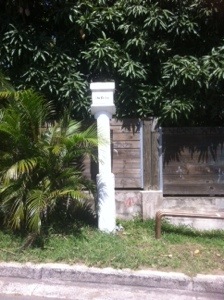
Our nearest bus stop, named with similar incongruity for renaissance man Joachim du Bellay:

du Bellay

The tricouleur, not as ubiquitous as the Stars and Stripes in the US, but enough to let you know you’re in France. And some people find it galling to have the Union Jack in the corner of their flag!

tricouleur

It’s not quite true that the tricouleur is the only flag here. Nouméa has its own city flag, of course, but there is also the Kanak national flag. The link above to the New Caledonia Today blog gives an idea of just how contentious this flag is. Here’s the only one we saw, planted on a rock in the bush across the road from a rather grand statue of Notre Dame du Pacifique. There’s supposed to be a referendum on independence some time this year. Interesting times ahead.

kanak flag

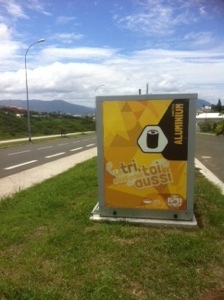
The writing on this bin says, ‘Le tri, c’est pour toi aussi’ – ‘Tri is for you too.’ It’s tri meaning sorting as in triage rather than three as in tricouleur, but the coincidence was too good to pass up.

tri

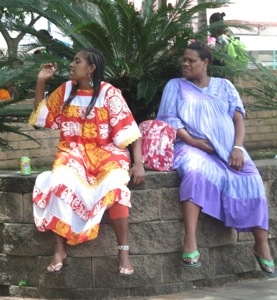
The women of colour, in both senses, are everywhere:

20140131-184410.jpgPhoto by Penny Ryan

20140131-184736.jpgPhoto by Penny Ryan

You can read about the separatist hostage-taking and subsequent deaths in the late 1980s here.

Blogging from New Caledonia

I’m writing this in a house in Portes de Fer, a suburb of Nouméa whose name translates as ‘iron gates’. We’re here for 10 days, on a holiday that was handed to us rather than planned for. A couple of months ago we received an email via homeexchange.com asking if we’d like to swap homes with a New Caledonian family. The dates fitted both our schedules, the cost of travel wasn’t prohibitive, and we knew almost nothin about New Caledonia. So we wrote back accepting, and here we are.

That’s my excuse for not being among the first to report that Jennifer Maiden’s Liquid Nitrogen won the Victorian Premier’s Literary Award, which the press release evidently described as the richest literary prize in Australia. JM commented that in the absence of superannuation it was a very welcome contribution to her finances. Just in case there’s anyone out there relying on my fannish notes to find out such news, I’m telling you now, a couple of days late. John Kinsella has a nice piece on the award in Crikey. Other Australian news, including Tony Abbott’s continuing war with the real world, does reach us, but I’m confident no one depends on this blog for that.

Inspired by the streets around here, which like those in Byron Bay are named after poets, I’m indulging my sonnet fixation:

First Impressions of Noumea, January 2014
With no rough strife at Portes de Fer
we’re lazing in rue Mallarmé,
a stroll uphill from Baudelaire
or down to bus stop du Bellay.
In town we hear no hostile gun
on Austerlitz, la Marne, Verdun.
These tricouleurs the only flags
though tri means sorting garbage bags
and colours won’t be kept to three:
dark skin, bright clothes and humble stance,
the Kanaks say, ‘We’re not in France!’
Some took up arms for Kanaky,
and died, but now if art’s a word
these words of colour will be heard.

Spring joy

It’s about two and a half years since we moved home. About a year ago, the grass tree (Xanthorrhoea) that had stood outside our kitchen window in the old house was ailing in its new location – most of its fronds were brown or browning. I took a photo of it to our local nursery and the man there said the plant was almost certainly dying: they don’t take to transplanting,  and it will sometimes take as long as 2 years for them to die, and ours was well on the way. We could trim off all the dead and dying fronds, even sit a cardboard box on top of the plant and burn it, so that all the green growth was burnt back, but it was a slim chance, and the burning was the product of wishful thinking rather than a proven remedy.

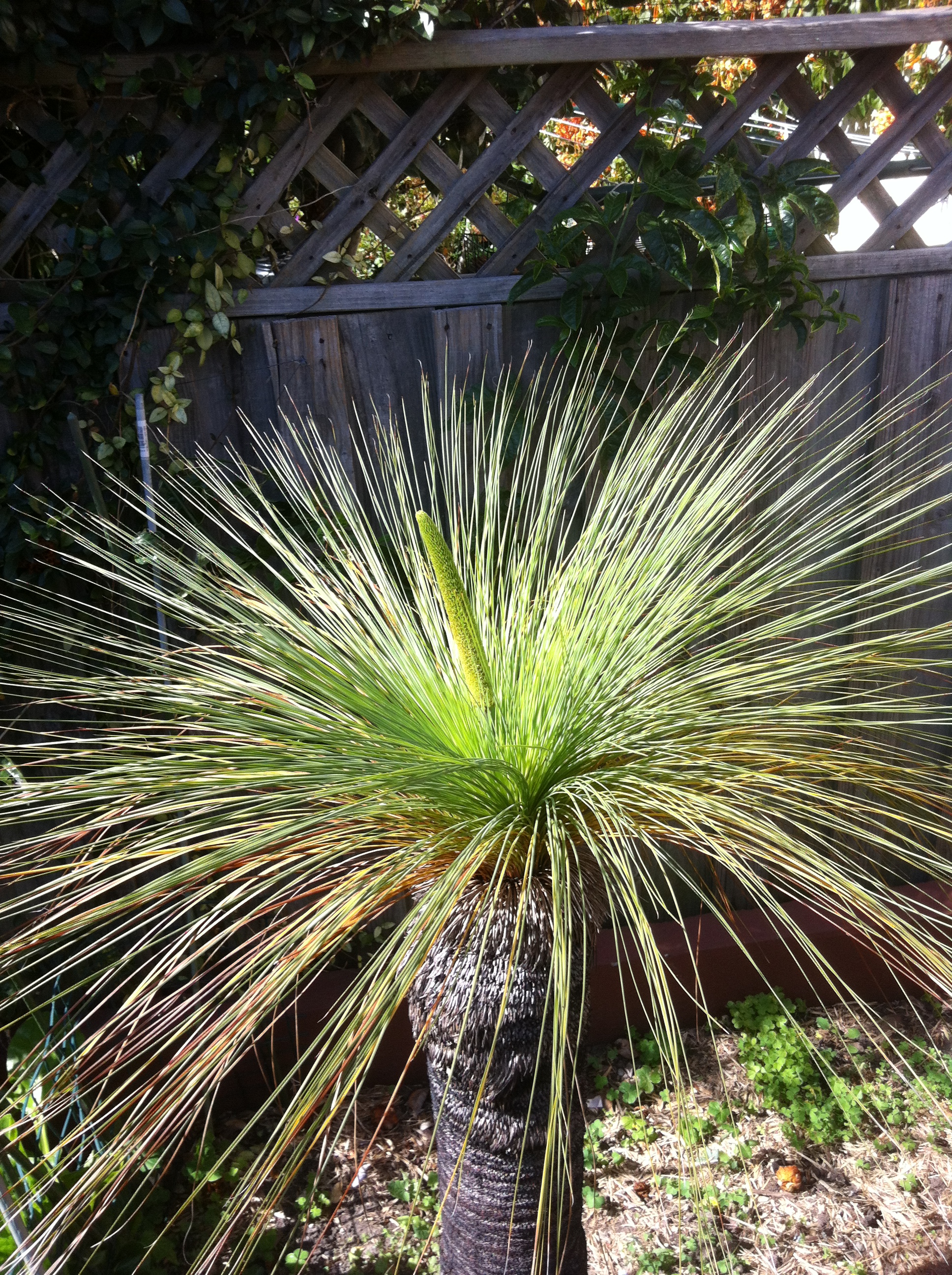
I didn’t do the burning, but I took to the leaves with a pair of secateurs and for months our once thriving grass tree was like a dead lump with a few green sprouts sticking out of its top. We made sure it wasn’t over-watered, and gradually it came back to good health. And on the weekend, we noticed it had produced a spike.

grass tree

In no time at all, as measured by grass trees, that spike will be more than a metre high and produce seeds and, if we harvest the seeds and plant them properly, in 20 years time we may even have a new generation of grass trees.

We don’t need another Abbott

Yesterday afternoon we went to our first demo responding to Kevin Rudd’s PNG solution to the asylum seeker problem. It was the third such demo organised by Sydney’s Refugee Action Coalition, and the plan evidently is to keep them up on a weekly basis until the policy is dead.

It was a smallish demo, but spirits were high, and speakers assured us that there were millions of people all over the country who shared our opposition to the policy. A young Hazara woman stood out, reading an eloquent account of the sufferings of her people in Afghanistan, Pakistan, Iran and, heartbreakingly, Australia; with a postscript on the contribution her refugee family is making to Australian society.

We marched around the block, carrying placards and chanting. The Socialist Alliance and Greens were strongly represented in the placards, but there were also Labor for Asylum Seekers and iamaboatperson.com, and a beautiful patchwork banner for a student women’s collective, as well as any number of individually crafted signs. Some art students handed out crayon and people were chalking slogans on the street and footpath (‘Refugees are welcome’, ‘It’s not illegal to seek asylum’ ‘We’ve boundless plains to share’ etc). The main chant was

Say it loud! Say it clear!
Refugees are welcome here!

Although I think it’s generally a mistake to personalise these things, I liked:

Kevin Rudd’s a racist coward!
We don’t need another Howard!

and propose a variant:

Kevin Rudd’s a racist rabbit!
We don’t need another Abbott!

Given that both major parties are looking for quick political fixes rather than a solution to the problem of desperate people risking their lives in unsafe boats to seek asylum here, and given that both major parties seem to think it’s political suicide to have anything remotely like Australia’s response to the ‘boat people’ who came here from Vietnam in the 1970s, I was thinking it was probably futile to take to the streets about this policy. But something happened to make me think that it may actually be important.

About three quarters of the way around the block, we noticed a deeply unhappy looking man in a grey suit filming the march. As we were about to turn back into George Street, I saw him stop behind a traffic control box and put on an identifying badge. He was fairly obviously a policeman of some sort. A little later I saw him talking in a threatening manner to two young women with chalk in their hands, then approaching another young woman who was writing on the road. He took this young woman aside and was asking her questions, close to a uniformed policeman, filing her answers and filming the ID he evidently asked to see. I approached and asked what was going on. He siad it was a private conversation. I didn’t have the presence of mind to ask him why he was filming a private conversation and if he had the young woman’s permission to do that. She told me later that he had said writing on the road constituted malicious damage to public property and that she would be hearing from the police department within three or four days.

From this I deduce that the NSW Police consider these demonstrations to be potentially a serious problem.

I do wonder if a policeman asking someone for their ID while filming them and threatening them with legal action in the middle of a street can by any stretch be called a private conversation. I also wonder if writing on asphalt with crayon can by any stretch be called malicious damage. I have photos of this unpleasant, deeply unhappy looking individual if anyone is reading this and needs a record of his behaviour.

And meanwhile, the protests will continue, every weekend at Sydney Town Hall and I expect all over the country. The Refugee Action Coalition have an excellent web page.

Half an acquisition

One by-product of living with an Art Student is that works of art proliferate around the house. Some are produced by the AS herself, some given to her, and some we buy. Our latest acquisition, which we bought jointly with another Art Student couple, is this photograph:

Janet-Tavener-Figs

It’s Figs, by Janet Tavener, from her recent exhibition at the Brenda May Gallery. The Art Student wanted to hang it over our bed, but it’s the middle of winter and the bed is generally cold enough to get into without having a huge photograph of melting ice sculptures hanging over it. So it has pride of place in the dining room, and the Art Student’s bright portrayal of the poppy’s life cycle keeps its place in the bedroom.

Incidentally, when we dropped in to pick up the photo today, we spent a good time enjoying Brenda May’s current exhibition, Mighty Small.